Skip to content


You can feel it before the dashboard makes it obvious. The site used to grow every time the team published another batch of pages, refreshed a few titles, and fixed a handful of internal links. Then the gains slowed, the queue got longer, and a “perfect” page started sitting somewhere in the index with almost no visibility.
That’s the point where teams start asking for more content, more writers, or more campaigns. The better question is whether the SEO system itself is broken. At scale, search success depends less on page count and more on whether the operating model can keep technical rules, content production, and governance working together.
The Moment Your SEO Playbook Stops Working
A lot of teams hit the same wall in slightly different ways. A catalog site adds thousands of URLs through filters and locations, but search traffic barely moves. A SaaS company keeps publishing new articles, yet the homepage and core product pages are still doing all the heavy lifting. A multi-location brand opens more markets and then discovers that half the pages are duplicates, thin variants, or hard to crawl.
The pattern isn’t a lack of effort. It’s a mismatch between the size of the site and the way SEO is being run. SEO at scale becomes an operating-system problem, because every new page, rule, and market adds another dependency that has to be governed, not just written.
“Practical rule: if the team can’t explain how a URL gets discovered, canonicalized, linked, and measured, the program isn’t scalable yet.
The shift is from campaigns to systems. Search is huge and concentrated, with Google processing about 8.5 billion searches per day and holding about 89% to 91% global market share in 2026, while organic search accounts for roughly 53% of all website traffic and the top organic result captures about 27.6% of clicks on average AIOSEO’s SEO statistics roundup. That’s why small breakdowns in discovery or indexing can create outsized losses.
At this stage, the old playbook usually fails in four places. Technical fixes are manual and inconsistent. Content briefs live in documents, but production lives in another system. Internal links decay as pages multiply. Governance slows every change because nobody owns the rules end to end.
A scalable program treats SEO like infrastructure. The goal isn’t more pages. It’s fewer bottlenecks, cleaner rules, and a repeatable way to ship, audit, prune, and improve pages without rebuilding the whole process every time.
What SEO at Scale Means
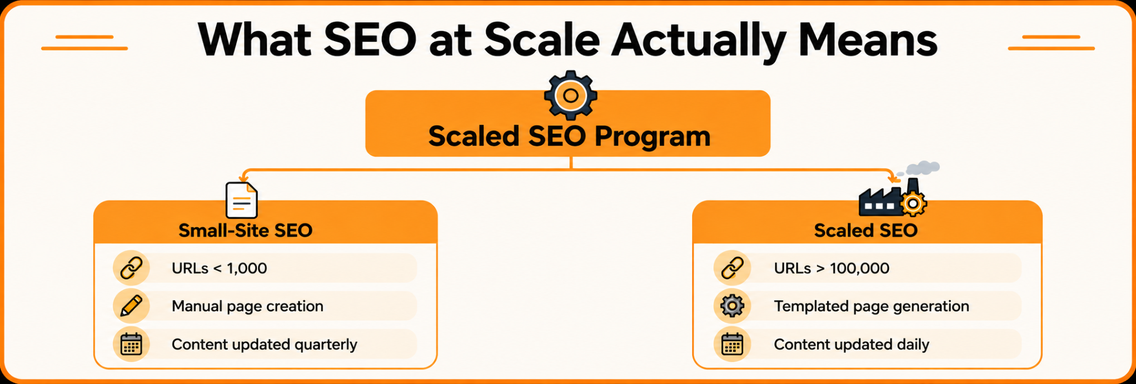
The word “scale” gets used too loosely. A site with 300 pages and a clean editorial calendar is not operating in the same environment as a marketplace, franchise network, or ecommerce catalog with templated URLs, multiple markets, and constant content updates. The difference is not just page count. It is how much of the work depends on repeatable systems rather than human memory.
The markers that tell you the site has crossed the line
A small-site SEO program can survive with manual page edits, ad hoc internal linking, and a shared spreadsheet. A scaled program usually looks different. URL volume starts creating crawl pressure. Templates carry most of the on-page SEO burden. Ownership becomes cross-functional, because engineering, content, and analytics all touch the same surface area.
The clearest threshold signal is crawl-budget pressure. Once search engines spend too much time on duplicates, parameters, or low-value pages, discovery of important pages slows down. Another is internal-link entropy, where link equity gets scattered across many similar pages and no one can easily explain which pages matter most. The third is governance bottlenecks, where every change needs a person to manually approve the same rules again and again.
If your team is still debating individual page tweaks one by one, the site probably is not in true scaled mode yet. Once templating, workflow automation, and release governance become the constraints, the program has crossed over. That is also when a search visibility strategy starts to matter as a broader growth system, not just a ranking task, which is why teams often pair SEO work with a wider visibility plan like the one described in this search visibility strategy overview.
“A scaled site does not need more opinions about pages. It needs fewer exceptions.
The practical self-check is simple. If most of the value comes from repeatable templates, if changing one rule affects thousands of URLs, and if approvals regularly slow the program down, you are already in SEO at scale territory. Before adding more pages, the better move is often to prune weak ones, consolidate overlapping sections, and remove URLs that keep sending crawlers and users to the wrong place. The tactics in the rest of this guide are built for that reality, not for a small site where every page can be hand-tuned.
Technical Foundations That Hold Everything Else Up
A scaled SEO program usually breaks first at the crawl and index layer. As URL volume grows, small inconsistencies in canonical tags, parameter handling, or sitemap hygiene spread quickly, then show up as index bloat, duplicate coverage, and important pages that never get the crawl attention they need.
Rules need to be machine-enforced, not remembered
Large-site programs work best when robots.txt is editable, XML sitemaps are generated dynamically, and redirects, non-canonical URLs, and non-indexable pages stay out of those sitemaps automatically. Clear canonical governance has to sit inside the system, not in a note someone remembers to update. Gray Dot Company’s scaling framework makes that control set explicit because it keeps crawl budget pointed at URLs that can rank Gray Dot Company’s scaling framework.
Canonical rules cannot live in a Slack thread, a spreadsheet, and a CMS field at the same time. Facet pages that are thin or duplicative should carry noindex logic at the template level, so the rule follows every page version. Large inventories also benefit from sharded or delta-friendly sitemaps, since the sitemap needs to reflect the site’s current state instead of turning into a static file no one trusts.
The same logic applies to template governance. A site foundation that holds up under growth is the same kind of work described in how the right website foundation supports long-term marketing success, because technical decisions made at the template layer decide how far SEO work can scale before it starts breaking.
Performance issues scale across every template
Speed is a template problem at scale. Enterprise guidance points to reusable SEO-friendly templates, centralized metadata and schema rules, CDN and browser caching, code minification, image compression, and monitoring of server logs plus Search Console data to catch crawl traps and render failures early advanced technical SEO checklist for scaling websites. If a JavaScript rendering issue appears on one template, it does not stay on one page. It repeats across thousands of URLs.
That is why release workflows need automated validation. If every deployment can break Core Web Vitals, create soft 404 behavior, or slow crawl throughput, the site needs guardrails before the problem spreads. The team should not wait for traffic to drop before discovering that a template changed in a way Google cannot use.
A practical audit can be done quickly. Check whether canonicals are editable in one place. Review whether sitemaps exclude dead ends automatically. Confirm that parameter rules, pagination, and redirects are governed centrally. If those controls are weak, content work will keep underperforming no matter how strong the pages look in a doc.
Turning Keyword Research Into a Production System
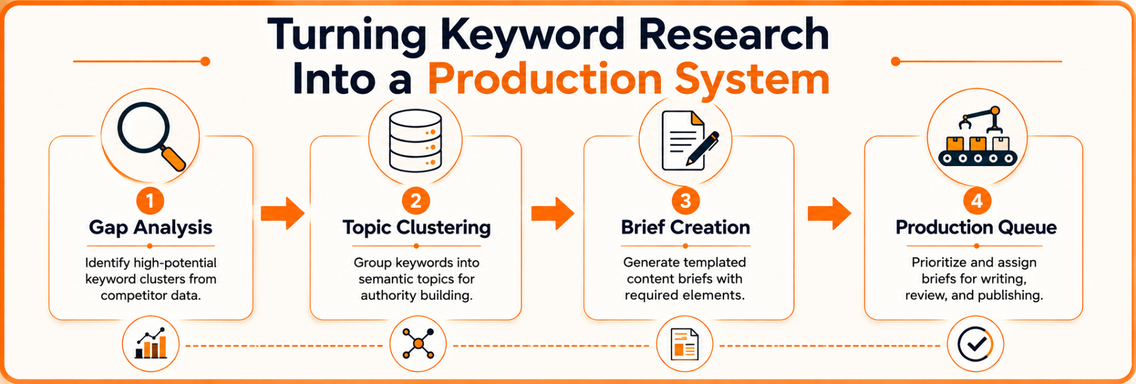
Keyword research often dies in a document. The keyword list is good, the opportunity is real, and then the work gets stuck in an editorial queue that never seems to shrink. At scale, the better model is to treat research as an input to a production line, not as a brainstorm archive.
Decide what’s worth building, not just what’s missing
The most useful question isn’t “what topics are missing?” It’s “which gaps are worth building given the editorial and engineering capacity we have?” That question matters because content gap analysis can quickly produce more work than the team can ship. RankUp’s guidance on unique content for SEO points out that the operational challenge is turning gaps into a repeatable workflow with prioritization, ownership, and QA, not just finding more terms to target RankUp’s content gap analysis guidance.
One useful way to handle this is to route every opportunity through the same gates. Is the page strategically valuable, or just interesting? Can it be templated? Does it need engineering support? Does it create internal-link value for other pages? Those answers determine whether the idea moves into production or gets parked.
Briefs, rules, and routing do the compounding work
The teams that ship consistently don’t rely on heroic writers. They use templated briefs, a fixed set of metadata rules, and clear routing so every page has an owner before production starts. Internal linking rules should be part of the brief, not a cleanup step after publication. Schema requirements should be tied to the template or CMS field structure, not recreated by hand.
That’s also where content operations connect to tooling. A workflow can push a gap from research to assigned brief to QA to publish without requiring every step to happen in the same person’s inbox. One option in this space is Excellorix, which offers SEO services that include keyword research, technical fixes, and content creation, along with structured data work and AI search strategies for visibility programs.
The point isn’t to produce more content blindly. It’s to make sure the content pipeline can keep moving when the site has hundreds or thousands of pages sharing the same template logic. When the workflow is stable, small improvements ship faster and with fewer mistakes.
When the Best Move Is to Delete Pages
The hardest lesson in scaled SEO is that growth often comes from subtraction. Teams usually want to publish their way out of underperformance, but large-site problems are often created by too many overlapping URLs, not too few. When that happens, consolidation beats expansion.
Duplication is usually the real problem
Search Engine Land’s multi-location guidance leans into this reality by recommending URL inventory, grouping pages by intent, merging overlapping content, and redirecting retired pages multi-location SEO structure guidance. That advice sounds conservative until you work on a site where every location, product variant, or service variation has its own near-duplicate page. Then it becomes obvious that the site is spending crawl equity on repetition.
The better move is often to keep one strong page, then push the value of the retired pages into it. That means updating internal links, cleaning up canonicals, and making sure sitemaps reflect the revised structure. If the old URL was weak, leaving it live just adds maintenance burden and muddies the site’s intent signals.
Use intent, not volume, to decide what stays
A page should survive if it serves a distinct search intent, supports revenue, or gives the site a cleaner topical structure. If two URLs answer the same query in nearly the same way, they’re usually competing with each other instead of helping the business. At scale, cannibalization isn’t a minor nuisance. It’s a structural tax.
“If a page can’t justify its existence with unique intent, revenue value, or link equity, it’s probably a consolidation candidate.
The practical workflow starts with an inventory, then groups URLs by purpose. Product pages may stay separate because the commercial intent differs. Location pages may need consolidation if the service and content are identical across branches. Informational pages can often be merged when one resource can cover the full query cluster more cleanly than three thin ones.
What not to do is keep publishing around the problem. Every extra duplicate makes the internal-link graph harder to manage and the crawl path less efficient. Pruning isn’t a sign that the program has stalled, it’s often the step that frees the program to grow again.
International SEO Without the Translation Trap
International expansion multiplies the entire SEO stack. One language becomes several. One set of templates becomes regional variants. One content decision can create indexation issues in more than one market. The teams that handle this well treat localization as a market-entry problem, not a translation job.
Translation is not localization
Auto-translating an English page into dozens of low-value locales is one of the easiest ways to create thin international inventory. Real localization changes the message, the currency cues, the legal context, and sometimes the information architecture itself. Hreflang can help search engines understand language and region targeting, but it can’t rescue content that doesn’t deserve to exist in the first place.
Country-specific content hubs usually work better when there’s a real market reason for them. That may mean different product availability, legal requirements, pricing, or service coverage. When those signals don’t exist, adding a country layer can create unnecessary duplication.
Structure choice depends on governance, not fashion
| Criterion | Country-code domain | Subdirectory | Subdomain |
|---|---|---|---|
| Market separation | Strong | Moderate | Moderate |
| Shared authority | Lower across domains | Stronger under one domain | Mixed |
| Operational complexity | Higher | Lower | Higher than subdirectory |
| Best fit | Distinct local businesses | Centralized global programs | Specialized teams or systems |
The right structure depends on how the business runs. Country-code domains can make sense when local teams own their own market, but they demand more governance. Subdirectories often suit centralized teams because authority stays consolidated and operational overhead stays lower. Subdomains can work, but they introduce another layer of management that many teams don’t need.
The decision point is simple. If the market needs separate rules, separate content, and separate commercial logic, structure for that. If it doesn’t, keep the setup as simple as possible and spend the effort on localization quality instead of platform sprawl.
Org Design and Tooling That Survive Growth
Tools don’t fail because they’re bad. They fail because the org design around them can’t keep up. A stack that works for 500 pages can buckle when the site moves into tens of thousands of URLs, because the work stops being a set of tasks and becomes a coordination problem.
The roles that keep the system coherent
At scale, someone has to own SEO engineering, because templates, crawl controls, and release guardrails don’t manage themselves. Someone else has to own editorial ops, because content briefs, QA, and publishing workflows need a consistent routing model. Analytics governance also needs a clear owner, because data definitions drift quickly when multiple teams pull from the same dashboards.
Those roles don’t need to be large, but they do need to be explicit. A small team can cover a lot of ground if it agrees on who handles technical changes, who owns content quality, and who decides when a page gets cut, merged, or promoted.
The tools that earn their place
The most useful stack usually includes log-file analysis, internal-link auditors, workflow tooling, and programmatic testing around templates and releases. Search Console and server logs matter because they show how bots behave, not how the team hopes they behave. Internal-link auditing matters because large sites lose obvious pathways over time. Workflow tools matter because research has to reach publication without being re-keyed by hand.
For organizations trying to connect automation to organic growth, the key is to map the work to the org, not the other way around. A practical view of that setup is captured in this automation and organic growth guide, especially for teams trying to decide which processes can be systemized without losing control.
The dashboards should make performance legible to leadership. They need to show whether index coverage is healthy, whether crawl patterns are sane, whether template changes caused regressions, and whether the pages that matter are contributing value. If leadership can’t see the state of the system, SEO becomes harder to defend when trade-offs show up.
A Phased Rollout You Can Start This Quarter
A scaled SEO program gets built in layers, not in one big launch. Start with a 90-day foundation focused on technical governance, tracking, and template health. Move into a 6-month scale phase where templated content production, pruning, and routing rules are live. By 12 months, the goal should be compounding, with reporting automation, stronger internal-link health, and more disciplined reinvestment in winning topics.
The anti-patterns are predictable. Chasing volume without governance creates more cleanup than growth. Treating international expansion as translation creates duplication. Ignoring pruning keeps crawl budget trapped on pages nobody needs. The guardrails that matter most are index coverage, crawl stats, internal-link health, and revenue-per-page trends.
Excellorix builds SEO programs with the technical, content, and measurement systems that large sites need to keep growing without losing control. If your team is dealing with crawl waste, duplicate pages, or a content pipeline that can’t keep up, visit Excellorix to see how a revenue-driven growth system can fit your site.