Skip to content




Your website gets steady traffic, your product catalog is technically accurate, and your marketing dashboard shows a healthy stream of organic sessions. Yet sales still asks the same question every month: “Where are the RFQs?”
That problem usually isn’t a traffic problem. It’s a buying-journey problem. Engineers may find a technical article but never reach the right product page. Procurement may compare suppliers without seeing clear compliance information. Plant managers may arrive on a solution page and find no direct path to request a quote. An industrial SEO agency should solve those gaps, not just deliver keyword rankings and monthly blog posts.
Why Hiring the Right Industrial SEO Agency Matters Now
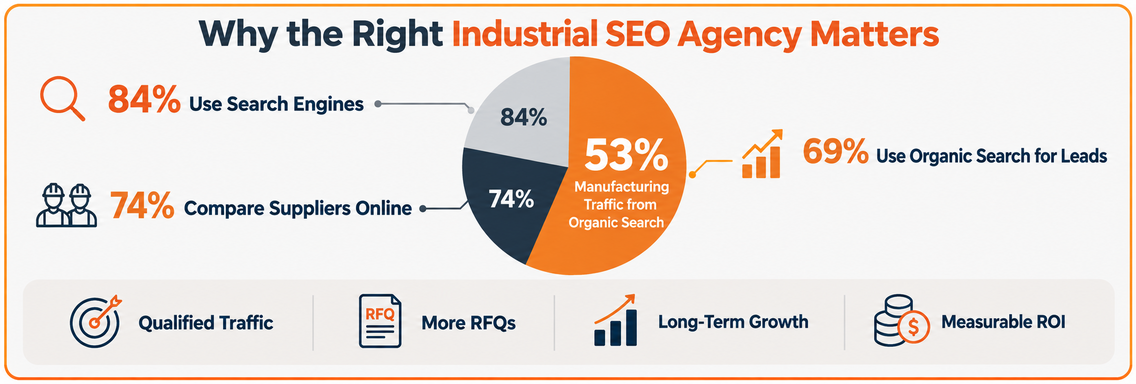
Organic search already plays a central role in manufacturing acquisition. Manufacturing SEO benchmark data reports that organic search drives 53% of manufacturing website traffic, while 69% of manufacturers use organic search for lead generation. The same benchmark compares SEO conversion at 2.6% for B2B manufacturers, ahead of PPC at 1.5%, paid social at 0.9%, and trade shows at 0.7%.
Those figures don’t mean every manufacturer should abandon paid media or field sales. They do show why industrial SEO deserves revenue-level attention. Search is often where a buyer begins investigating a component, production method, certification, replacement part, or specialist supplier. If your company appears only for broad terms, or if your strongest product pages can’t be crawled and indexed, competitors can capture demand before your sales team knows it exists.
Industrial buyers don’t search like consumers
Manufacturing buyers rarely make a decision from one visit. Industry search behavior data reports that 84% of manufacturing professionals use search engines to find equipment, components, and services. It also reports that 74% compare suppliers online, and 70% of those comparisons rely on search engines. B2B researchers average about 12 searches before engaging with a brand’s site, according to the same source.
That pattern creates a demanding job for your agency. The site must support different people asking different questions:
- Engineers need specifications, operating conditions, drawings, certifications, tolerances, and compatibility details.
- Procurement teams need supplier reliability, lead-time information, commercial clarity, documentation, and a straightforward RFQ process.
- Plant managers need evidence that the solution works in their environment and won’t create avoidable implementation risk.
- Executives need confidence in capacity, service coverage, strategic fit, and total business impact.
A generalist agency may understand title tags and blog publishing. That isn’t enough when a product family has variants, technical synonyms, distributor relationships, and a long path from search to revenue.
” Practical rule: Hire the agency that can explain how a search visit becomes a qualified RFQ, not the agency with the longest list of SEO deliverables.
What a capable partner should accomplish
The first 6 to 12 months should produce a clearer commercial foundation. That means fixing indexation and performance barriers, mapping priority queries to product and solution pages, creating useful technical content with subject-matter input, strengthening internal links, and connecting organic conversions to your CRM.
You should also expect better visibility into which pages attract qualified prospects and which actions produce RFQs, specification downloads, calls, or sales opportunities. If you’re evaluating the wider marketing requirements of a manufacturing business, digital marketing for manufacturing companies provides useful context, but your agency brief still needs to begin with your own products, buyers, and sales process.
Define Your Goals and Scope Before You Contact Agencies
Don’t ask agencies to “improve SEO” and then compare their proposals. That phrase is too vague to produce a useful scope, and it gives weak providers room to sell activity rather than outcomes.
Start with the commercial surface area. List the product lines, applications, industries, geographies, and customer segments that matter most to sales. Mark each item as a current growth priority, a maintenance priority, or out of scope. An agency can’t prioritize effectively if every product is treated as equally valuable.
Build a revenue-oriented SEO brief
Your brief should answer five practical questions:
- Which products deserve demand capture? Identify the categories, individual products, replacement parts, and engineered solutions that sales wants to grow.
- Which markets matter? Separate countries, regions, plant locations, distributor territories, and language requirements.
- What counts as a conversion? Define an RFQ, quote request, technical consultation, sample request, specification download, phone call, and contact form submission.
- Who influences the purchase? Document the questions asked by engineers, procurement, plant managers, maintenance teams, and executives.
- What must the agency measure? Require reporting on qualified organic visits, conversion actions, assisted opportunities, and sourced pipeline, not traffic alone.
Keep the definitions precise. “Lead” might mean a newsletter signup at one manufacturer and a completed request for a custom assembly at another. Your agency needs to know the difference before it recommends keywords or content.
Audit your current site before the sales calls
Review the architecture, catalog structure, conversion paths, analytics setup, and CRM handoff. Look for products that exist in the catalog but lack dedicated indexable pages. Check whether product variants create duplicate URLs, whether PDFs contain essential information that search engines and users can’t easily connect to, and whether high-value pages are buried several clicks deep.
Pay special attention to commercial-intent pages. A guide about material selection can support discovery, but a well-built product category, application page, or RFQ page is closer to revenue. Your brief should tell agencies which pages need immediate attention and which content opportunities can wait.
” A useful test: For every priority product, ask whether a qualified visitor can understand the offer, verify technical fit, find supporting documentation, and request a quote without depending on a sales representative to rescue the experience.
Set targets that leadership can inspect
Avoid targets based only on rankings. Rankings can rise without producing qualified demand, especially for broad informational queries. Instead, establish a baseline for organic traffic to priority pages, RFQ submissions, specification downloads, contact quality, sales acceptance, opportunity creation, and pipeline attribution.
You don’t need perfect attribution before starting. You do need a documented method. Agree on source definitions, conversion events, CRM stages, reporting ownership, and how assisted organic interactions will be reviewed. That baseline makes agency proposals comparable and prevents the relationship from becoming a debate over whose analytics platform is correct.
What to Look For in Industrial SEO Expertise and Deliverables
The difference between a true industrial specialist and a generalist with manufacturing vocabulary appears in the details. A capable partner asks how products are configured, which terms engineers use, how distributors affect search demand, which documents influence procurement, and where the RFQ process breaks.
Technical competence is essential for large catalogs. A crawl and indexation audit methodology recommends defining business pages, running a reliable crawl, reviewing Search Console exclusions, connecting landing pages to conversions, investigating crawl budget and duplicates, and prioritizing work by impact, effort, and risk. It also identifies a greater than 20% gap between crawled and indexed URLs as a strong signal for investigating duplicate parameters, low-value faceted URLs, and redirect chains.
Score capabilities, not presentation quality
Use the matrix below during proposal reviews. Score each agency consistently, then discuss the gaps with your internal stakeholders.
| Capability | What Good Looks Like | Red Flag |
|---|---|---|
| Industrial sector understanding | The team can discuss technical buyers, product variants, applications, certifications, distributors, and long sales cycles in practical terms. | The proposal replaces manufacturing language with generic phrases such as “target audience” and “high-value content.” |
| Catalog technical SEO | The agency audits crawlability, indexation, faceted navigation, duplicate URLs, canonicalization, redirects, XML sitemaps, and page performance. | The audit focuses on metadata while ignoring catalog architecture and indexation waste. |
| Search intent mapping | Keywords map to product, category, application, comparison, specification, and problem-solving pages. | Every keyword is assigned to a blog post, regardless of commercial intent. |
| Technical content | Engineers and internal subject-matter experts shape content covering specifications, use cases, constraints, documentation, and selection criteria. | Writers produce generic articles without expert review or product knowledge. |
| Internal linking | Guides, applications, categories, products, documents, and RFQ pages connect in a deliberate path. | The agency reports links created but can’t show how they support conversion journeys. |
| Schema and structured data | Relevant product, organization, breadcrumb, FAQ, and technical page markup is implemented accurately and validated. | Schema is presented as a magic ranking tactic or deployed without checking page content. |
| Authority development | The agency earns relevant mentions through technical resources, partnerships, directories, associations, and useful industry content. | It promises a fixed number of backlinks with no quality or relevance standard. |
| Measurement | Reporting connects organic discovery to conversions, qualified leads, sales acceptance, opportunities, and pipeline. | Monthly reports emphasize sessions, impressions, and ranking charts with no revenue context. |
For a broader evaluation of agency responsibilities and selection criteria, review this B2B SEO agency guide, then bring the same level of scrutiny to industrial-specific execution.
Demand concrete deliverables
A serious proposal should include a technical audit with prioritized tickets, a keyword map organized by intent and buyer role, a content plan tied to product and application pages, an internal-linking model, an authority strategy, conversion recommendations, and a reporting specification. It should also state who supplies technical expertise, who approves claims, and how revisions work.
Ask for examples of actual outputs, not just service names. “Content marketing” should become a sample brief. “Technical SEO” should become a prioritized issue list. “Conversion optimization” should become a proposed RFQ path with tracked events and ownership.
How to Run Your RFP and Interview Process With Confidence
Run the process tightly. A long, unfocused RFP rewards polished sales language, while a short commercial brief forces agencies to show how they think.
Give each candidate the same information: priority product lines, key markets, current analytics limitations, sales-cycle context, known site issues, CRM availability, internal resources, and the conversion actions that matter. Ask for a proposal that separates discovery, technical remediation, content, authority building, conversion work, reporting, fees, dependencies, and expected decision points.
Ask questions that expose the operating model
Use questions that require a process answer:
- “How would you decide which product pages to prioritize?” A strong answer refers to commercial value, demand, competition, conversion readiness, technical health, and sales input. A weak answer starts and ends with search volume.
- “How do you work with engineers and product managers?” Look for interviews, review workflows, source validation, and clear approval responsibilities.
- “How would you investigate a crawl-to-index gap?” The agency should discuss URL patterns, duplicates, parameters, exclusions, redirects, canonicals, internal links, and sitemap quality.
- “How do you measure an RFQ that later becomes an opportunity?” Good agencies ask about form tracking, CRM fields, lead status, offline conversion feedback, and pipeline reporting.
- “What would you avoid in our market?” A thoughtful partner will identify risky shortcuts, thin content, irrelevant links, and traffic targets disconnected from sales.
Don’t accept a templated audit that could apply to any manufacturer. Give finalists a small sample of your site and ask them to identify a few high-impact issues, explain the reasoning, and state what additional access they need before confirming the recommendation.
Validate the people who will do the work
Case studies matter only when they’re relevant. Ask whether the example involved a similar catalog complexity, technical audience, geography, sales model, and conversion process. Request to speak with a reference who worked directly with the delivery team, not only an executive sponsor.
Ask references:
- Did the agency understand the products without constant correction?
- Did recommendations reach production, or remain in reports?
- Did sales trust the lead-quality reporting?
- How quickly did the agency communicate when priorities changed?
- What work did the client still have to perform internally?
Keep the shortlist to 2 or 3 finalists. Price comparison becomes useful only after you know what each proposal includes and what your team must supply.
The selection interview should include marketing, sales, a technical or engineering representative, and someone responsible for the website or CRM. If the agency can’t explain its plan to that group in clear language, it won’t integrate well after signing.
Pricing Benchmarks Onboarding Plan and KPIs That Prove ROI
Pricing should reflect the work required to change your commercial search system, not the number of blog posts an agency can publish. Site size, catalog complexity, technical debt, number of markets, content expertise, development support, measurement requirements, and authority needs all affect the appropriate investment.
A retainer works when the site needs ongoing technical, content, and optimization work. A project model can fit a migration, architecture rebuild, or focused audit. A hybrid arrangement often makes sense when you need an intensive foundation phase followed by sustained execution.
Choose the commercial model deliberately
A low monthly fee may cover basic reporting and generic content, but it won’t necessarily cover developer time, technical writing, subject-matter interviews, analytics implementation, or catalog restructuring. A larger fee isn’t automatically justified either. Ask the agency to show the hours, roles, deliverables, dependencies, and prioritization logic behind its recommendation.
The infographic below presents a $5,000 to $15,000 monthly retainer range and a 4 to 6 week onboarding phase, as shown in the supplied visual. Treat that as a planning reference, not a universal quote, and require each agency to explain how its scope maps to your site and revenue priorities.
Use the first 90 days to establish control
Early onboarding should focus on access, discovery, tracking, product prioritization, stakeholder interviews, crawl data, indexation, and the current RFQ journey. Make sure the agency can access the tools it needs and understands who approves technical changes.
The next phase should turn findings into shipped work. Prioritize broken or blocked commercial pages, duplicate URL patterns, weak internal links, slow templates, missing conversion events, and high-value product or solution pages. Don’t let the agency spend the entire opening period preparing a strategy document that nobody implements.
The following phase should expand the demand system. That may include technical content, application pages, comparison resources, refreshed product information, authority development, and conversion experiments. Every initiative should have an owner, a launch date, a measurement method, and a reason tied to a buyer or revenue path.
Separate leading indicators from business outcomes
Leading indicators help you judge whether execution is working:
- Technical health: Indexable priority pages, resolved exclusions, improved templates, valid canonicals, stronger internal links, and better performance.
- Demand coverage: Visibility for product, application, problem, comparison, and specification queries.
- Engagement quality: Visits to commercial pages, documentation interactions, return visits, and progression to RFQ paths.
- Content usefulness: Assisted conversions, downloads, sales feedback, and evidence that target buyers use the material.
Lagging indicators carry more weight:
- Qualified organic traffic: Visits from the markets, roles, and product areas you serve.
- RFQ conversion rate: Completed quote requests divided by relevant organic visits or sessions.
- Sales acceptance: Whether sales considers the submissions valid and actionable.
- Pipeline sourced: Opportunities and revenue connected to organic acquisition, including agreed assisted-conversion rules.
Performance deserves early attention. B2B SEO benchmark data reports average mobile page speed of 3.8 seconds for B2B sites, compared with 2.1 seconds for consumer sites, while Google’s good Largest Contentful Paint target remains 2.5 seconds or less at the 75th percentile. The same source reports that only 48% to 51% of mobile pages and 56% to 58% of desktop pages in manufacturing-specific audits satisfied all three Core Web Vitals.
Fixing images, JavaScript, caching, and server response often creates a better foundation for every later content and conversion investment.
Red Flags Final Checks and Making Your Decision
Reject agencies that guarantee rankings. Search results depend on competition, site quality, query intent, algorithm changes, and execution conditions. A credible agency can commit to work, decision rules, communication, and measurement. It can’t responsibly guarantee a specific position for a competitive industrial query.
Other warning signs deserve equal scrutiny:
- Traffic without qualification: Reports celebrate sessions while hiding RFQ quality, sales acceptance, or pipeline.
- Generic content volume: The plan promises frequent articles but says little about product pages, applications, technical documentation, or buyer roles.
- Opaque link building: The agency won’t explain where links come from, why they’re relevant, or what risks the strategy creates.
- No implementation path: The audit identifies issues, but nobody owns development, content approval, analytics, or deployment.
- Disconnected teams: The sales team never sees lead-quality feedback, and engineers never review technical claims.
- Locked-in assets: The agency controls accounts, content, dashboards, or tracking in a way that makes exit difficult.
Complete the contract check
Before signing, confirm who owns the website, content, data, analytics accounts, dashboards, design files, and link outreach records. Define approval timelines, meeting cadence, escalation paths, deliverable acceptance, cancellation terms, transition support, and what happens to unfinished work if the relationship ends.
Read the reporting clause closely. It should specify the source of truth for conversions, how offline sales data enters the model, which attribution rules apply, and how the agency will distinguish a raw inquiry from a qualified opportunity.
The cost of a poor decision isn’t limited to agency fees. Delayed product launches, missed demand, weak content, lost internal trust, and confused analytics can leave your team worse off. The real cost of choosing the wrong SEO company is the commercial opportunity that never reaches your pipeline.
Make the go or no-go decision
Choose the finalist that can connect technical SEO, technical content, internal linking, conversion design, CRM measurement, and sales feedback into one operating system. If two agencies appear similar, choose the team that gives you clearer priorities, stronger implementation ownership, and more honest answers about constraints.
After signing, schedule the stakeholder interviews immediately, grant access to analytics and site tools, document the RFQ process, and agree on the first production milestones. The right industrial SEO agency becomes part of your revenue team. It works with marketing, sales, engineering, and development to make search demand easier to discover and easier to convert.
Excellorix provides technical SEO audits and fixes, high-intent keyword research, content strategy, internal linking, conversion optimization, and reporting connected to leads and revenue. If you want an industrial SEO partner evaluated against your buying committee and RFQ path, visit Excellorix to discuss your growth priorities.