Skip to content


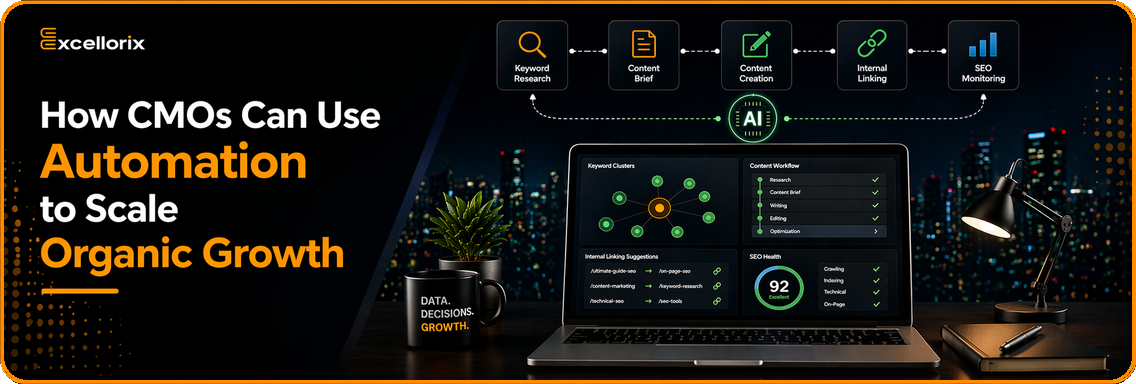
Organic growth is not what it used to be. Search results are more competitive, content expectations are higher, and AI is quietly changing how people find information. What used to work, publishing more content and hoping something ranks, does not really work anymore.
For CMOs, the shift is pretty clear. Growth today is less about volume and more about building a system that actually works over time. That is where automation comes in. Not as a shortcut, but as a way to make SEO execution more consistent.
Why automation matters for organic growth
Most marketing teams do not struggle with ideas. They struggle with getting things done consistently.
There is always more work waiting. More keywords to research, more pages to improve, more content to update, and more data to review. When everything is done manually, progress slows down and quality starts to vary. Automation helps remove that pressure.
It takes care of the repetitive work so your team can spend more time on strategy, messaging, and content that actually performs. That is where real growth comes from. Because organic growth is not just about traffic. It is about attracting the right people and turning that visibility into leads and revenue.
The real problem with manual SEO
Manual SEO still matters, but it has limits. Teams can spend hours updating titles, fixing links, or building content briefs. By the time that work is done, something has already changed. Competitors may have published faster. Search intent may have shifted. Older content may have started slipping. That is usually how SEO declines. It does not fail all at once. It slowly loses momentum.
A few outdated pages here. A few missed links there. Small technical issues that go unnoticed. Individually, none of these feel urgent. Together, they start affecting performance. That is why SEO hygiene matters more than most teams think. It keeps small issues from turning into bigger problems.
What SEO automation actually looks like
SEO automation does not mean handing everything over to tools. It means building a system where repetitive tasks are handled efficiently, while people stay in control of strategy and decisions.
In practice, automation can support things like keyword grouping, content briefs, metadata suggestions, internal linking ideas, technical checks, and performance tracking. Once you understand what can be automated, the next step is deciding where it will have the most impact.
Where CMOs should start
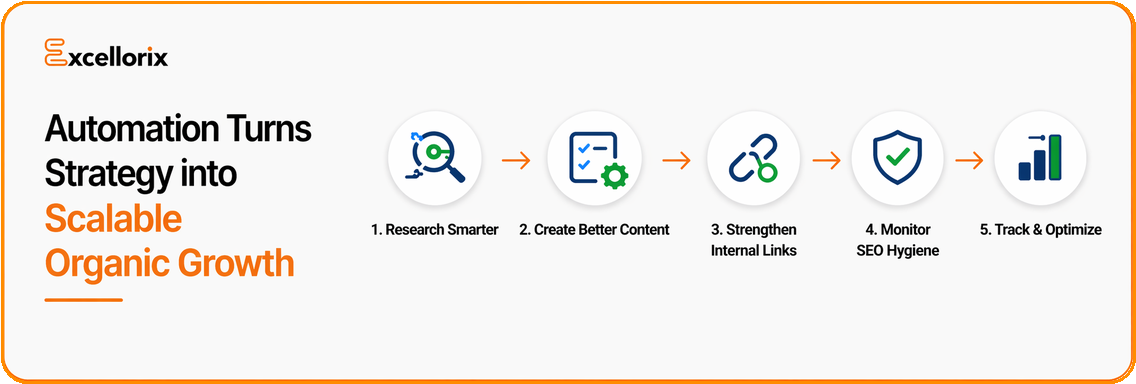
If you want automation to actually help, start with the work that slows your team down the most.
1. Automate keyword research and clustering
Keyword research takes a lot of time when done manually.
Automation can group keywords based on intent and topic much faster. This makes it easier to see what content you should create next and where the gaps are.
It also keeps your strategy focused on real demand instead of guesswork.
2. Build repeatable content workflows
Content does not scale well without a process.
A simple workflow usually includes researching the topic, understanding search intent, creating a brief, writing the draft, editing it properly, optimizing the page, and then tracking performance.
When this process is consistent, your team can produce more without losing quality. That is where automation really helps.
3. Improve internal linking more efficiently
Internal linking is one of those things everyone knows is important but rarely does properly.
As your site grows, it becomes harder to keep track of what should link where. Automation can highlight relevant connections between pages and make this much easier to manage.
This helps both users and search engines navigate your content.
4. Monitor SEO hygiene continuously
SEO hygiene is not exciting, but it is important.
Automation can help you catch broken links, missing metadata, outdated pages, drops in traffic, and technical issues before they become serious problems.
Fixing these early is much easier than trying to recover lost visibility later.
But keeping your site technically sound is only part of the picture. The way content appears in search is also changing.
SEO for AI driven search
Search is no longer just about rankings. AI generated summaries and answer based results are becoming more common. That means your content needs to be easy to understand, not just optimized for keywords.
A few simple things can help. Answer the main question early. Use clear headings. Keep your paragraphs short. Explain ideas in simple terms. Add examples where needed.
You do not need to simplify your thinking. You just need to make it easier to follow.
GEO vs SEO
This shift has also started a new discussion around GEO and SEO.
SEO is about ranking in search results. GEO is about being included in AI generated answers. They are connected, but they are not the same thing.
Strong SEO still matters. Good structure, authority, and relevance all play a role. But GEO pushes you to write more clearly and more directly so your content can be understood quickly. For most CMOs, the takeaway is simple. Build content that ranks, but also content that is easy to interpret.
Final thoughts
CMOs do not need more tasks. They need a system that works. Automation helps teams move faster, stay consistent, and keep their SEO efforts on track. It reduces the time spent on repetitive work and makes execution more reliable. But tools on their own are not enough.
Real growth comes from combining automation with the right strategy, clear priorities, and ongoing improvement. When those pieces come together, SEO becomes a steady and scalable source of growth.
Schedule a Free SEO Strategy Call with our team and get a clear breakdown of what is holding your organic growth back and how to turn your website into a consistent source of qualified traffic, visibility, and leads.
Frequently Asked Questions
What is SEO automation?
SEO automation is the use of tools and AI workflows to handle repetitive tasks like keyword research, reporting, and technical checks. It helps teams save time while keeping their SEO efforts consistent.
How can CMOs use automation to scale organic growth?
CMOs can use automation to speed up research, improve content workflows, monitor performance, and identify gaps more quickly. This allows teams to focus more on strategy and less on manual work.
Is AI generated content good for SEO in 2026?
AI content can work if it is properly reviewed and aligned with user intent. Without human input, it often lacks depth and does not perform as well in competitive search results.
What is the difference between GEO and SEO?
SEO focuses on rankings in search engines. GEO focuses on getting content included in AI generated answers. Both are important, but GEO requires clearer and more structured content.