Skip to content



Search is no longer just about rankings, and the brands that understand this shift are already ahead. For years, SEO was treated as a simple formula. Rank higher, get more clicks, and drive more traffic. That approach worked for a long time, but it is starting to lose its impact in 2026. Search has expanded into a much broader ecosystem where visibility matters more than holding a single position on a results page.
Today, people discover brands across multiple touchpoints. They see organic listings, paid ads, AI generated answers, videos, and more. Because of this, showing up in one place is no longer enough. Brands need to focus on brand visibility in search across the entire experience.
That is where a search visibility strategy comes in, and it explains why top brands are moving beyond traditional SEO.
The Shift From Rankings to Full Search Visibility
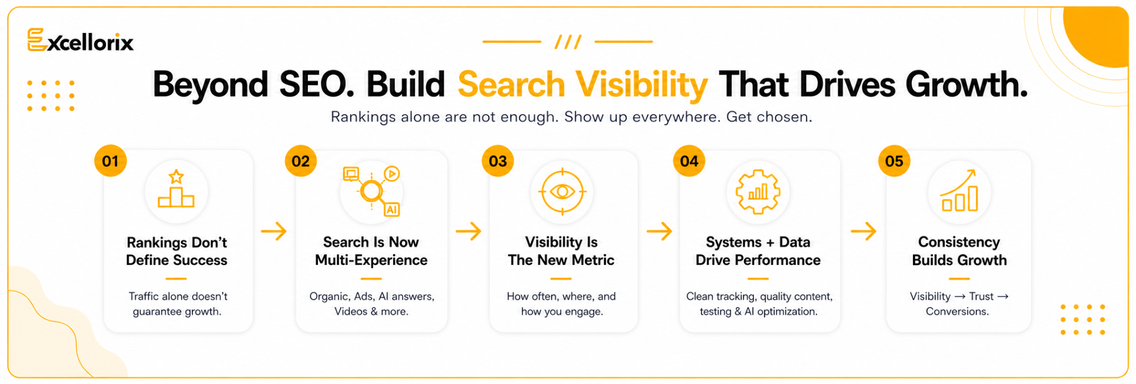
Search results are no longer just a list of links. Users interact with different formats in one search. They see featured snippets, product listings, videos, and AI summaries. In many cases, they are exposed to several brands before they even click on anything. Because of this, rankings alone do not define success anymore.
What matters now is how often your brand appears, where it appears, and how people engage with it. This is where the discussion of SEO vs search visibility becomes important. Instead of focusing only on rankings, businesses now need to build a presence that spans the full search journey.
What a Search Visibility Strategy Means in 2026 for Modern Brands
A search visibility strategy is the system that helps your brand show up consistently across search. Instead of focusing only on keywords, it looks at the bigger picture. This includes total impressions, presence across different formats, user engagement, and how performance changes over time. This broader approach is often referred to as a search presence strategy, where the goal is not just ranking but consistent visibility across platforms.
In practical terms, this changes how marketing works.
You are no longer manually adjusting every detail. Instead, you focus on setting a strong foundation with clear goals, clean data, and quality content. Once that is in place, tools and automation help test, learn, and scale what works. Tools like Looker Studio, Ahrefs, and SEMrush can support this, but they only deliver results when the setup behind them is done properly.
Why Many SEO and Search Visibility Strategies Still Underperform
Even with better tools and smarter systems, many businesses still struggle with search performance. The issue usually comes down to weak foundations. You will often see problems like incomplete tracking, limited content testing, poor structure, and decisions based on unclear data. When these gaps exist, even organic search visibility becomes difficult to improve.
AI systems end up learning from the wrong signals, which leads to inconsistent results. This is why many brands invest in SEO but do not see real growth. The effort is there, but the system is not built to scale.
How AI Search Optimization Is Changing User Behavior
Search engines today rely heavily on behavior. They look at what users click, how long they stay, what they scroll past, and what they engage with. This helps them understand intent much earlier than before. Because of this, visibility is not tied only to keywords anymore.
Brands that consistently create useful and engaging content across different formats start to gain more exposure. Over time, search systems recognize these patterns and reward them with better visibility. This is where AI search optimization becomes important, but it only works when supported by strong content and reliable data.
How a Search Visibility Strategy Drives Real Business Growth
When the system is set up correctly, growth becomes more stable. Instead of guessing what might work, you begin to see clearer patterns. Visibility improves across channels, budgets are used more effectively, and testing becomes more consistent without constant manual effort. This creates momentum. Over time, visibility builds and performance improves naturally.
To reach this point, the foundation needs to be built carefully.
What to Build First in a Search Presence Strategy
Trying to fix everything at once often leads to confusion. A better approach is to build your strategy step by step.
Start with tracking and reporting. If you cannot measure performance accurately, it becomes difficult to improve anything.
Next, define clear benchmarks so you understand what success looks like.
Then begin testing content consistently.
Once this foundation is in place, scaling becomes much easier, and content becomes your main growth driver.
Why Content Is Critical for Brand Visibility in Search
Search is no longer driven only by keywords. Content plays a much bigger role now. The content that performs well is easy to understand, provides clear value, and keeps improving based on how users interact with it. Brands that are doing well today are not just creating more content. They are refining what they already have and building on what works. But even strong content needs direction, and that comes from data.
The Role of Clean Data in Improving Organic Search Visibility
Content brings people in, but data helps you understand what to do next. If your tracking is not accurate, your decisions will be off. Over time, this slows down growth and creates wasted effort. That is why clean data is so important.
Many businesses are now improving their tracking setups to get a clearer picture of user behavior. When the data becomes reliable, it becomes much easier to make better decisions. And when decisions improve, results follow.
A Practical Framework to Improve Search Visibility
If you are building a search visibility strategy, keep it simple and focused.
Start by fixing your data and tracking.
Then monitor performance regularly so you can catch changes early.
Introduce automation where it actually helps instead of overcomplicating things.
Keep testing new content consistently and review your results every week.
This approach helps you stay on track while still allowing room to grow.
Final Thoughts on SEO vs Search Visibility in 2026
Search in 2026 is not about constant manual work. It is about building systems that can learn, adapt, and improve over time.
The brands that are growing consistently are not chasing rankings. They are building visibility across the entire search ecosystem. If your current strategy feels like a constant effort with limited results, it is probably not a traffic problem. It is a visibility problem.
Schedule a Free Strategy Call
Most businesses are not struggling with traffic. They are struggling to be seen. If your brand is not showing up across search consistently, you are losing potential customers before they even click. Rankings alone are not enough anymore.
Book a free strategy call with Excellorix and uncover:
Why your visibility is limited across search
Where your content and structure are falling short
How a search visibility strategy can improve your reach
What changes can turn visibility into real growth
The focus is not just on getting found, but on showing up where it matters.
If you want to build a search presence that actually drives results, this is where it starts.
FAQ
What is a search visibility strategy?
A search visibility strategy focuses on how often and where your brand appears across search results. It goes beyond rankings and looks at your overall presence, including organic results, paid placements, and AI driven answers.
SEO vs search visibility what is the difference?
SEO focuses mainly on improving rankings for specific keywords. Search visibility looks at the bigger picture by focusing on how your brand appears across different platforms and formats.
How can I improve brand visibility in search?
You can improve visibility by creating useful content, maintaining accurate tracking, and testing consistently. Over time, this helps search systems recognize and promote your content more often.
What is AI search optimization?
AI search optimization is about structuring your content in a way that makes it easier for search systems to understand and recommend it. This includes clarity, relevance, and strong engagement.
How do you measure search visibility?
Search visibility is measured through metrics like impressions, share of voice, and how often your content appears across different search features.
What are the key steps in a search presence strategy?
It starts with fixing data and tracking, followed by content creation, testing, and regular optimization based on performance insights.