


Execution is no longer the bottleneck. Thinking is. Here is how we built Excellorix for the landscape that actually exists right now.
There was a time when a drop in traffic meant something was clearly wrong. Rankings slipped. A competitor passed you. Content got stale. The fix was obvious. You identified the problem, you fixed it, traffic came back. That is not what is happening in 2026.
Today, you can be running ads, ranking on page one, publishing consistent content, doing everything that a 2019 playbook tells you to do and still watch performance stall. Not because you are doing something wrong. But because the rules of the game have fundamentally changed.
Search is answering more questions before users ever click. Ads are easier to launch than at any point in history. AI has eliminated most of the manual work that used to separate good agencies from average ones. The moat that large agencies built around production capacity and operational scale is largely gone.
The advantage is no longer in how much you can execute. It is in how clearly you can think. And that changes everything about what a great marketing partner looks like in 2026.
Let’s be honest about what has happened in the last three years. The tools that used to require teams like creative production, campaign management, reporting and optimization have been largely automated. What took a team of eight can now be handled by a focused operator with the right stack. This is not a threat to good marketing. It is a massive opportunity. But only for the teams willing to rebuild around what the new landscape actually demands.
Manual repetitive scheduling and basic optimization are now fully automated for smart teams. Campaigns can go from concept to live test in hours instead of the weeks it used to take. A small AI adapted team can now outperform bloated agency structures.
The agencies that have not adapted are still charging for the labor that AI has replaced. They are billing for account managers who shuffle decks, for production teams that move slowly, and for processes built around the reality of 2020, not 2026.
If you are a small or mid sized business paying a large agency for a bloated team and slow execution, you are not buying results. You are subsidizing an outdated operating model.
Here is something most agencies will not tell you. If you are a small business with two to ten people, you probably do not need a massive agency. You need a strong micro agency or an AI adapted marketing lead who thinks in systems and a tight supporting cast.
You do not need five designers building assets at a pace you cannot use.
You do not need a full production team with four layers of review.
You do not need account managers whose primary job is keeping you on retainer.
You do not need specialists who only own one channel and cannot see the full picture.
What you actually need is strategic thinking that connects your ads, SEO, landing pages and conversion together.
You need one good designer who understands performance creative, not just aesthetics.
You need one good developer who can build and ship landing pages fast.
You need reporting that tells you what is actually happening, not just what looks good in a deck.
That is the model we operate on at Excellorix. Small by design. Fast by necessity. Effective because we built around the tools that exist today, not the team structures of a decade ago.
Traffic is no longer the primary metric for organic performance. This is where a lot of businesses and their agencies are getting confused. You can lose organic traffic in 2026 and still be winning. The real question is where your visibility is showing up.
Is your brand appearing in AI generated search responses
Is branded search volume increasing
Are your conversions holding even as traffic shifts
Are you showing up in zero click answers that build authority
If the answer is yes, you are not losing. You are operating in a new paradigm.
The game has moved from traffic volume to visibility, trust and conversion rate. An agency that still measures success by session counts is using a broken compass. The teams winning today understand that AEO, brand equity and bottom of funnel conversion are where the real leverage exists.
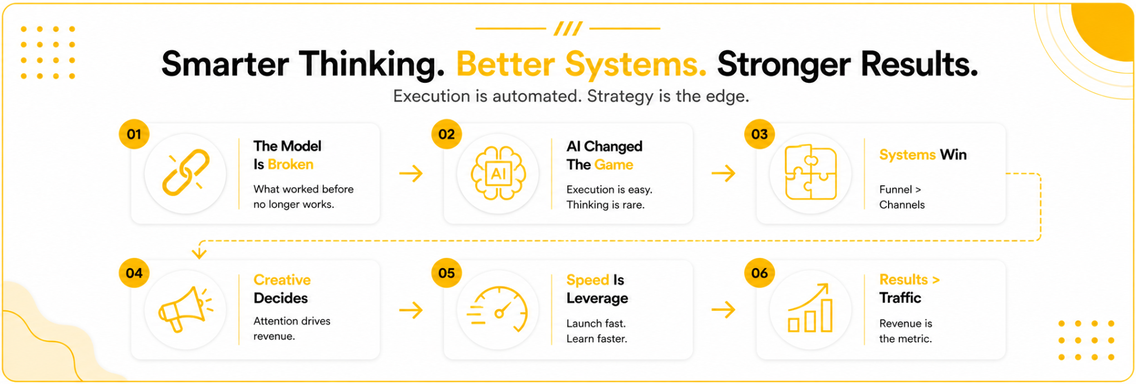
The gap between average and great marketing is getting wider. And the difference is not budget. It is thinking and adaptability. The teams pulling ahead understand the full funnel. They do not treat ads and SEO as separate channels. They connect attention, trust and conversion.
They move fast. Ideas become live tests in hours instead of weeks.
They test constantly with a clear system behind what they are learning.
They think in systems, not channels. A campaign is not just an ad. It is a full sequence from ad to landing page to offer to follow up to retention.
They use AI as a real workflow tool, not a talking point.
Most agencies are still operating like it is 2020. Their workflows, structures and reporting are built for a world that no longer exists. Businesses that recognize this will move ahead quickly. The ones that do not will keep wondering why performance has plateaued.
If you are evaluating a marketing partner or questioning your current one, these questions will tell you everything.
How are you actually using AI in real campaigns today
What parts of your workflow are still manual
How quickly can you go from idea to live test
What does your reporting show beyond basic metrics
Where do funnels usually break and how do you fix them
How are you testing creatives
What has worked recently and what has failed
How do you decide what to scale or cut
How do ads, landing pages and tracking connect
What results have you driven with real context
If the answers are vague or overly theoretical, you already have your answer.
We did not build Excellorix to be the biggest agency. We built it to be the sharpest. The old model works for agencies, not clients. It creates dependency instead of results. It focuses on billable hours instead of outcomes. We built a lean AI integrated performance marketing system designed to move fast and think clearly. We use AI in real workflows across strategy, creative, reporting and analysis. Our clients get faster execution, better data and a partner who understands the full funnel, not just one channel. We work with businesses that want clarity, not comfort. The landscape has changed. We built our agency accordingly.
Performance marketing in 2026 is not about doing more work. It is about building better systems. AI has not replaced marketers. It has changed what drives results.
Strategy matters more than execution.
Creative matters more than optimization.
Data quality matters more than anything else.
If your performance has stalled, the issue is usually not the platform. It is the system behind it.
Most businesses do not have a traffic problem. They have a performance problem. If your campaigns are not converting the way they should, something in your system is misaligned.
Let’s break it down and fix it.
Performance marketing in 2026 is no longer just about driving traffic or running ads. It is about building a system that turns attention into measurable revenue. That means connecting ads, landing pages, tracking, and conversion into one clear flow. The focus is not on activity, it is on outcomes like qualified leads, customer acquisition cost, and return on investment.
Traditional marketing struggles today because execution has become easy. Automation and AI have removed most of the manual work that agencies used to charge for. What used to create an advantage no longer does. The difference now comes from strategy, speed of testing, and how well the entire funnel is connected. If the system behind the campaigns is weak, more effort will not fix it.
Three things drive results today. Clean and accurate data so systems can learn properly. Strong creative that actually captures attention and drives action. And a connected funnel where ads, pages, and offers work together instead of operating in isolation. When these are aligned, performance becomes more predictable and easier to scale.
If you are already spending on ads or generating traffic but not seeing consistent leads or revenue, the issue is usually not effort but structure. A performance marketing agency becomes valuable when you need clarity on what is not working across your funnel and a system to fix it. This includes tracking, campaign structure, landing pages, and conversion flow. If results feel inconsistent or plateaued, it is a strong sign you need a more strategic approach.
You should look beyond promises and focus on how they actually operate. A strong agency will explain how they use data, how quickly they test and launch campaigns, and how they connect ads with landing pages and tracking. They should be able to clearly show what has worked, what has failed, and how they make decisions. If everything sounds vague or overly complex, it usually means the process is not strong. The best partners bring clarity, not confusion.
Tell us about your goals—we’ll show you how Excellorix can help you get there.