
Your team has a launch date, a constrained budget, and more ideas than the timeline can support. One person wants a viral video, another wants a paid acquisition funnel, and someone else is asking how the campaign will prove it generated revenue rather than merely collecting clicks.
The most useful marketing campaigns examples aren’t famous because they had unlimited resources. They’re useful because their underlying mechanics can transfer to a smaller brand, a new product, or a different channel. A strong hook, a clear action, responsive distribution, useful personalization, or a disciplined measurement plan can work without a celebrity, a massive media budget, or a lucky cultural accident.
The ten examples below break each campaign into its brief, mechanics, reported outcomes, and practical transfer point. Each one also identifies where the mechanic fits best across paid media, email, social, launch landing pages, and retargeting. Treat the examples as starting points for tests, not templates to copy blindly.
Table of Contents
- 1. Dollar Shave Club’s “Our Blades Are Fing Great” Launch Video
- 2. Old Spice’s “The Man Your Man Could Smell Like”
- 3. Dove’s “Real Beauty Sketches”
- 4. Spotify Wrapped
- 5. Glossier’s Community-Led Growth Model
- 6. Liquid Death’s “Murder Your Thirst”
- 7. Intel Inside
- 8. truth Anti-Smoking Campaign
- 9. Blendtec’s “Will It Blend?”
- 10. HubSpot Website Grader
- Comparison of 10 Iconic Marketing Campaigns
- Turning Campaign Examples Into Your Next Test Plan
1. Dollar Shave Club’s “Our Blades Are F***ing Great” Launch Video
Dollar Shave Club made a subscription razor service easy to understand through a direct, humorous launch video led by co-founder Michael Dubin. The creative didn’t hide behind polished product language. It made the offer, the category frustration, and the brand personality visible in one piece of content.
The reported early response was strong, with around 12,000 orders in the first 48 hours. That figure comes from the campaign’s widely reported launch history, but it isn’t included in the verified source set for this brief, so it should be treated as contextual rather than a cited performance claim. The same applies to reports about Unilever’s later acquisition.
The transferable mechanic
The useful mechanic was not just humor. It was one memorable creative asset connected to one obvious conversion path. The landing page and checkout needed to answer the question created by the video, namely why someone should subscribe now.
For ecommerce brands, the best transfer channel is usually the launch landing page, supported by paid social and retargeting. Build the offer before releasing the video, then make sure the page preserves the same language, promise, and tone.
- Keep one primary offer: Don’t make a high-attention video lead into a page crowded with product variations.
- Prepare retention flows: Subscription reminders, replenishment emails, and cancellation-save messages protect the economics after the first order.
- Track customer value: Compare acquisition cost with lifetime value from the first cohort instead of judging success by sign-ups alone.
Teams scaling this approach can also review growth marketing for ecommerce brands for guidance on connecting creative, media, and retention.
2. Old Spice’s “The Man Your Man Could Smell Like”
Old Spice launched a recognizable television concept in February 2010, then extended it online through rapid-response videos aimed at consumers and public figures. The campaign generated more than 40 million YouTube views within its first seven days, according to the campaign case study from APAC Effie.
Its strength came from a repeatable response mechanic. Each video kept the same character, visual language, and absurd confidence while turning audience participation into fresh creative. The campaign made speed part of the idea, not merely a publishing advantage.
Speed was part of the creative
The response program produced approximately 1.7 billion total impressions across traditional and digital media over six months. Nielsen reported that Old Spice Red Zone body-wash unit sales were 60% higher year over year by May 2010 and 125% higher by July, figures documented in the same APAC Effie case study.
The strongest transfer channel is social, with extensions into paid social, email, launch landing pages, and retargeting. Set up listening, permissions, approvals, and production before launch. Without agreed response limits, legal and brand reviews can erase the advantage of a fast format.
Practical rule: If audience participation is part of the promise, build the response workflow before the first media impression.
Create a tone guide covering acceptable humor, escalation rules, and subjects the team will avoid. Select strong responses for paid placements, email modules, and retargeting creative. For a repeatable test, track response speed, completion rates, engagement quality, and downstream product actions by channel. The campaign moved quickly because its boundaries were clear.
3. Dove’s “Real Beauty Sketches”
Dove’s “Real Beauty Sketches” built its message around a human insight about self-perception. A forensic-style sketch artist drew women from their own descriptions and then from descriptions supplied by strangers. The contrast gave the audience a simple way to feel the difference between internal criticism and external perception.
The creative worked because the product wasn’t forced into the opening. The brand connected itself to a broader confidence and self-image conversation, then measured the campaign as more than a view-count exercise.
Start with the tension, not the product
For a service or product launch, identify the audience belief that creates friction. It might be embarrassment, uncertainty, mistrust, or the sense that existing solutions weren’t designed for people like them. The campaign’s job is to dramatize that tension clearly.
The best transfer channel is video-led social, with the same insight adapted to landing pages and email. Design for silent autoplay, put the premise in the opening seconds, and use captions so the story survives without sound.
- Use an audience truth: Begin with what customers experience, not with the feature list.
- Connect the insight to the brand: A moving story without a credible brand role becomes entertainment rather than marketing.
- Measure beyond views: Track sentiment, branded search, assisted conversions, and qualitative comments alongside completion behavior.
A brand-purpose idea also carries risk. If the product experience contradicts the message, emotional creative can amplify skepticism. Test the landing page and follow-up emails against the same promise before investing in broader distribution.
4. Spotify Wrapped
Spotify Wrapped turns first-party listening behavior into a personal recap that users can share. Top artists, songs, genres, and listening patterns become colorful story cards, giving customers a reason to distribute branded content through their own social profiles.
That structure gives Spotify several benefits at once. Personalization makes the experience relevant, sharing creates distribution, and the annual timing creates a recurring brand memory. Spotify has reported engagement ranging from tens of millions to more than 100 million users in recent years, but those figures aren’t part of the verified data for this brief, so they aren’t used as performance evidence here.
Make the customer the main character
The transferable mechanic is data transformed into identity. An ecommerce brand could use purchase categories, milestones, replenishment behavior, or product preferences to create a customer recap. A SaaS company might summarize usage patterns, completed projects, or team progress.
The strongest transfer channel is email paired with an in-product or launch landing page experience. Email gets the user to the recap, while shareable mobile cards extend reach beyond the original recipient.
- Audit your data first: Use fields you collect reliably and can explain clearly.
- Design for sharing: Keep cards readable on mobile and make the customer feel represented rather than analyzed.
- Add a relevant next action: Connect the recap to a replenishment reminder, upgrade, recommendation, or loyalty benefit.
Personalization isn’t automatically useful. If the data feels invasive, inaccurate, or commercially manipulative, the share mechanic disappears. Give users a result that is interesting on its own before asking them to buy.
5. Glossier’s Community-Led Growth Model
Glossier grew from Into The Gloss, a beauty blog whose audience supplied opinions, routines, and product feedback. The model used community input not only as promotional content, but also as a source for product development. That distinction matters. Customers were invited into the process before the product reached the market.
The brand’s commonly cited community-led approach doesn’t eliminate paid acquisition. It changes the role of paid media by giving advertising more authentic material to distribute and giving the product team stronger signals about what customers want.
Feedback needs a visible loop
The mechanic transfers best to email and community channels, then flows into social, product pages, and retargeting. Ask for feedback through surveys, reviews, post-purchase prompts, or a dedicated community space. Notably, show what changed because people responded.
- Collect specific feedback: Ask about texture, packaging, use cases, objections, and missing options rather than asking whether customers “like” the brand.
- Request permission for UGC: Credit customers clearly and keep records of usage rights.
- Measure loyalty signals: Review repeat purchase behavior, referral activity, direct traffic, and community participation alongside ROAS.
A common failure is treating community as an unpaid content supply. That approach may produce short-term assets but weakens trust. Customers need to see that their input affects products, education, service, or access.
“Community works when people can identify the consequence of their participation.”
For a launch, publish a short feedback summary, explain which suggestions were adopted, and tell customers which requests weren’t feasible. Transparency makes the loop credible and gives email subscribers a reason to stay involved.
6. Liquid Death’s “Murder Your Thirst”
Liquid Death sells canned water with a heavy metal aesthetic, irreverent language, and entertainment-led marketing. The brand used a deliberately extreme identity to make a commodity category feel distinctive. Its sustainability positioning, centered on reducing plastic bottle use, gives the voice a functional purpose beyond shock value.
The useful mechanic is strong brand coding. A recognizable tone makes a campaign easier to identify across video, social posts, retail packaging, paid ads, and landing pages. It also creates a filter. The brand isn’t trying to sound appropriate for everyone.
Entertainment earns the first response
The best transfer channel is paid social, where entertainment can earn attention before retargeting introduces product details. A music video, stunt, or comic premise can build awareness. Product-focused ads can then explain availability, pack sizes, benefits, or the next purchase step.
The approach has trade-offs:
- A bold voice improves recall: It gives every asset a consistent creative signature.
- A bold voice narrows fit: Humor that attracts one audience can repel another.
- A bold claim needs proof: Sustainability statements should be supported by transparent, verifiable information.
Write a voice guide that covers vocabulary, visual conventions, acceptable exaggeration, and claims that require evidence. Then create two layers of creative. The first earns attention through entertainment. The second helps a qualified prospect decide.
Don’t borrow the surface style. A heavy metal aesthetic won’t fix a weak product position. Find the category convention your brand can challenge without confusing customers about what you sell.
7. Intel Inside
Intel faced a communication problem common in B2B and industrial marketing. The product sat inside another company’s computer, so end buyers couldn’t easily see or evaluate it. The Intel Inside program made the invisible component visible by giving computer manufacturers approved branding and co-op support for displaying the Intel identity in their advertising.
The campaign’s mechanic was ingredient branding across a partner network. Intel didn’t rely only on direct consumer advertising. It aligned the manufacturer, the component brand, and the end buyer around a shared signal.
Give partners a system they can use
This transfers best to partner marketing and paid co-op campaigns, with supporting landing pages for specifiers and end users. A technology supplier, materials manufacturer, or logistics provider can create a clear partner toolkit containing approved logos, copy, claims, ad formats, landing-page modules, and lead-routing rules.
- Define brand rules: Specify where the partner may place the mark and which claims require approval.
- Tie support to activity: Require documented placements, campaigns, events, or landing pages.
- Serve both audiences: Create technical proof for specifiers and plain-language value for the final buyer.
The trade-off is control. A partner network expands reach but introduces inconsistent execution. Review samples before launch, use shared tracking parameters, and give partners templates that reduce the temptation to rewrite the proposition.
For complex products, the customer who uses the product may not be the person who specifies or approves it. Your campaign should map both roles, then give each one a reason to trust the ingredient brand.
8. truth Anti-Smoking Campaign
The truth campaign challenged tobacco industry marketing through youth-focused, research-driven messaging. Rather than relying only on health warnings, it framed tobacco companies and their tactics as the problem. The approach gave young audiences a position they could act on, rather than presenting them as passive recipients of fear-based information.
The transferable mechanic is reframing the category conflict around the audience’s existing values. A campaign can make an audience feel more capable, informed, or independent when it shows how a system affects them.
Research should shape the creative
This works best across social and community channels, where peer language and participation can carry the message. Start with interviews, social listening, surveys, or moderated research. Test whether the audience understands the claim, accepts the tone, and knows what action follows.
- Name the opponent carefully: Critique a practice or system with evidence, not an unsupported accusation.
- Use agency over lectures: People respond differently when the campaign respects their agency.
- Set the measurement plan early: Establish brand, attitude, behavior, or lead indicators before launch.
A campaign involving public health or social behavior needs stronger safeguards than a product promotion. Review language for unintended stigma, prepare responses to criticism, and distinguish correlation from causal impact. The practical principles behind avoiding misleading statistics are especially relevant when a campaign uses research or behavioral claims.
The campaign also shows why channel adaptation matters. A long research finding may work in a report, but social creative needs a concise claim, a credible proof point, and a clear way for the audience to participate.
9. Blendtec’s “Will It Blend?”
Blendtec turned a product demonstration into a repeatable entertainment format. Tom Dickson and the team placed unexpected objects into a blender and asked whether it would blend. Marbles, smartphones, and glow sticks gave viewers a reason to watch even when they weren’t actively shopping for a kitchen appliance.
The core mechanic was proof through spectacle. Instead of listing durability or power claims, the series made the product perform in public. The format could continue because each new object created another episode.
Build demonstrations around objections
The best transfer channel is retargeting, especially when demonstration content appears on product pages after a visitor has shown interest. A paid video can generate awareness, while the product-page version should answer a practical concern such as durability, versatility, setup, or cleaning.
Create a repeatable format with a fixed structure:
- State the customer question: What does the buyer doubt?
- Show the test: Make the demonstration easy to understand without explanation.
- Reveal the result: Avoid hiding the evidence behind a long introduction.
- Connect to the product page: Give viewers a direct route to compare or purchase.
The format’s risk is spectacle without relevance. A stunt may earn views but fail to resolve the buying question. Keep a separate conversion cut that includes product specifications, warranty information, delivery details, or customer support answers. Entertainment gets attention. Evidence helps close the sale.
10. HubSpot Website Grader
HubSpot’s Website Grader made a familiar marketing problem interactive. A visitor entered a website, received an assessment covering areas such as performance, SEO, and mobile readiness, and got recommendations before being asked to take a deeper commercial step.
The mechanic is immediate utility in exchange for qualified intent. A useful assessment does more than collect a form submission. It helps the prospect understand a problem and creates a natural reason to continue the conversation.
Give the lead a credible next step
This transfers best to a launch landing page and email nurture sequence. The assessment should reflect a real pain point, use understandable criteria, and produce recommendations that aren’t generic filler. If every result says “contact sales,” users will treat the tool as a disguised form.
Build the funnel around four decisions:
- Choose a narrow problem: Audit one meaningful area rather than promising to diagnose everything.
- Define qualification signals: Separate urgency, company fit, budget context, and technical need.
- Deliver useful results: Explain what the score means and what the prospect should do next.
- Continue with education: Use email to provide relevant guidance before presenting a service.
A free tool can attract low-intent users, so scoring and routing matter. Send a technical lead to a technical resource, a product-ready prospect to a consultation, and an early researcher to educational content. Excellorix’s SEO and content strategy resources can support that education layer when search visibility and content quality are part of the problem.
The strongest audit tools don’t replace sales discovery. They make the first conversation more informed.
Comparison of 10 Iconic Marketing Campaigns
| Campaign | 🔄 Implementation Complexity | ⚡ Resource Requirements & Speed | 📊 Expected Outcomes | 💡 Ideal Use Cases | ⭐ Key Advantages |
|---|---|---|---|---|---|
| Dollar Shave Club, “Our Blades Are F***ing Great” (2012) | Low, single founder-led creative + clear CTA | Low production cost; moderate ops for landing & subscription | Rapid viral reach and sign-ups; recurring revenue potential | DTC launches, subscription products seeking fast scale | Memorable brand voice; efficient CAC→LTV if retention managed |
| Old Spice, “The Man Your Man Could Smell Like” (2010) | High, TV creative plus real-time response workflows | High production + social monitoring and fast turnaround | Major earned media and engagement lift; short-term sales boost | Legacy brands needing image refresh and social momentum | Persona-driven recall; cross-platform amplification |
| Dove, “Real Beauty Sketches” (2013) | Medium, purpose-led narrative film with wide distribution | Moderate production and PR; measurement for brand lift | Massive organic reach and brand affinity; limited direct sales attribution | Purpose-driven brands seeking emotional positioning | Strong brand affinity and shareability at scale |
| Spotify Wrapped (annual) | High, complex personalization pipeline and UX | High engineering and privacy compliance; low marginal creative cost | Very high organic sharing; retention and engagement lift annually | Apps/SaaS with rich first‑party data focused on retention | Highly shareable personalization; repeatable annual event |
| Glossier, Community-Led Growth Model | Medium, ongoing community programs and feedback loops | Moderate ongoing resources for moderation and content | Strong loyalty and advocacy; slower, durable growth | DTC beauty/lifestyle brands emphasizing community & product feedback | Rich customer insights; lower long-term paid acquisition |
| Liquid Death, “Murder Your Thirst” (2019–) | Medium, consistent brand voice + entertainment stunts | Moderate creative/PR spend; authenticity & sustainability proofing | High earned media within niche audience; retail traction possible | CPG/DTC products needing bold differentiation | Distinctive positioning; entertainment-led virality |
| Intel Inside, Co-op Ingredient Branding (1991) | High, partner coordination and co‑branding program | High budget; partner onboarding and compliance overhead | Long-term brand equity and demand-pull across supply chain | B2B ingredient brands and channel-dependent tech | Aligns ecosystem; builds consumer recognition for invisible tech |
| truth Anti‑Smoking Campaign (2000–) | Medium–High, research-driven creative + multi‑channel activation | Moderate budget with research and evaluation needs | Measured reductions in target behavior; strong public-health impact | Public health and behavior-change initiatives requiring measurement | Evidence-based messaging; strong youth resonance |
| Blendtec, “Will It Blend?” (2006–) | Low, repeatable product-demo format | Low production cost; requires product durability for stunts | High shareability and awareness; measurable sales uplift for niche brands | Product-led brands with clear performance claims | Memorable demo; easy to scale across products |
| HubSpot Website Grader (2008–) | Medium, build and maintain a diagnostic tool | Moderate engineering + content upkeep; scales via SEO | Generates qualified inbound leads; builds trust and authority | SaaS, agencies, and consultancies seeking top‑of‑funnel leads | Demonstrates expertise; converts through immediate value |
Turning Campaign Examples Into Your Next Test Plan
The ten campaigns use different creative styles, but their growth systems share a few practical patterns. Each starts with a hook that can be understood quickly. Each gives the audience a specific reason to watch, share, respond, assess, or buy. Each connects attention to a next step instead of assuming awareness will eventually become revenue.
The distribution mechanic changes by campaign. Dollar Shave Club used a concentrated video and a direct offer. Old Spice extended a creative platform through rapid responses. Spotify converted customer data into shareable identity. Glossier made feedback part of product development. Intel built a partner system around an invisible component. Blendtec turned proof into a series. HubSpot used utility to generate intent.
These mechanics don’t transfer equally to every channel. Use paid media when a clear audience and creative hook can be tested quickly. Use email when the campaign depends on known behavior, lifecycle timing, or follow-up education. Use social when participation, conversation, or creator distribution is central. Use launch landing pages when the campaign needs one focused offer and a controlled conversion path. Use retargeting when the first interaction creates interest but not enough confidence to buy.
Measurement needs the same discipline. Awareness campaigns may need brand lift, sentiment, search demand, or assisted conversions. Acquisition campaigns need acquisition cost, conversion rate, and lead quality. Ecommerce campaigns need customer value and margin context, not only platform-reported ROAS. Retention campaigns should examine repeat purchase behavior, churn, and lifecycle response.
A campaign can receive credit for conversions that would’ve happened without it. That makes incrementality important, particularly across paid search, social, email, organic, and branded demand. The verified research in this brief reports that 66% of surveyed marketers are concerned about tracking users across channels, 57% fear reduced targeting and attribution effectiveness after third-party-cookie loss, and 41% cite cross-channel ROI measurement as a barrier, as reported by Supermetrics via PR Newswire. The same source reports that 46% of marketers use the complementary combination of marketing mix modeling, incrementality testing, and multi-touch attribution.
Start with two examples that match your channel mix. If you sell a visual DTC product, combine the Blendtec demonstration mechanic with the Spotify personalization mechanic. If you sell B2B technology through partners, adapt the Intel Inside model and pair it with a HubSpot-style assessment.
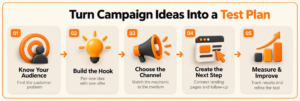
Write a one-page brief covering the audience problem, the hook, the offer, the distribution channel, the conversion path, and the follow-up sequence. Before launch, define the metrics that will judge the test, whether those are CAC, LTV, ROAS, qualified pipeline, repeat purchase, or brand lift. Then decide how you’ll separate incremental results from conversions that were already likely to occur.
Excellorix supports paid media, landing-page design, SEO, analytics, conversion optimization, ecommerce, and lifecycle marketing. Teams building a campaign system can use those capabilities to connect the creative idea with the page, tracking architecture, and optimization process that determine whether the idea produces business value.
Excellorix helps brands build revenue-focused campaigns across paid media, landing pages, SEO, conversion optimization, ecommerce, email, and analytics. Visit Excellorix to connect the campaign mechanic you choose with the measurement and optimization system needed to scale it.