Scaling an ecommerce brand in 2026 is becoming more challenging than ever before. Ad costs continue to rise, competition is stronger across every niche, and customers are far more selective before making a purchase. Even brands with solid products are finding it harder to maintain consistent ROAS when relying only on paid advertising. Because of this, many ecommerce founders are asking a simple question: How do we scale without burning money on ads? The answer is not just “increase budget” or “run more campaigns.” Real growth today comes from building a strong growth marketing strategy for ecommerce that improves the entire customer journey instead of focusing only on acquisition.
At Excellorix Digital Marketing Services, we consistently see the same issue: most ecommerce brands don’t have a traffic problem they have a system problem. Their conversions are weak, retention is inconsistent, SEO is underutilized, and marketing channels don’t work together. That is exactly where modern ecommerce growth marketing becomes critical.
What Ecommerce Growth Marketing Actually Means in 2026
Traditional ecommerce marketing was built around a simple funnel:
Ads → Traffic → Sales
But that model no longer reflects how people actually buy today. Modern customers discover products across multiple touchpoints. They may see a product on TikTok, read reviews on Google, compare alternatives on Reddit, watch YouTube videos, and finally convert days later through retargeting or email. This means a strong growth marketing strategy for ecommerce must optimize the entire journey, not just traffic.
Today, ecommerce growth marketing includes:
- Customer acquisition
- Conversion optimization
- Retention systems
- Customer lifetime value growth
- Brand trust building
- AI-driven personalization
- Multi-platform discoverability
The focus is not just growth, it is profitable and stable growth that does not collapse when ad costs increase.
Why Many Ecommerce Brands Waste Ad Spend
One of the most common mistakes ecommerce brands make is scaling too early. They see early success, increase ad spend aggressively, and expect revenue to scale proportionally. But instead, performance drops. This usually happens because underlying systems are not strong enough.
If your store has:
- Weak product pages
- Slow mobile experience
- Poor trust signals
- Confusing checkout flow
- Generic messaging
then increasing traffic only exposes these problems faster.
This is why conversion optimization is now a core part of any ecommerce marketing strategy 2026. Even small improvements like better product descriptions, stronger visuals, and faster checkout flows can outperform increasing ad spend. In simple terms: traffic amplifies problems, it does not fix them.
Overdependence on Paid Ads Is Risky
Many ecommerce brands still rely heavily on Meta Ads or Google Ads for growth. While paid ads are powerful, depending only on them is risky. Costs are rising, competition is increasing, and audience fatigue happens faster than before. That is why strong ecommerce growth marketing strategies focus on diversification.
This includes:
- SEO and organic search
- Google Shopping
- TikTok content marketing
- Influencer partnerships
- Email marketing
- SMS campaigns
- YouTube content
- Referral programs
The goal is not to use every channel blindly. It is to create stability. A business should not depend on a single traffic source to survive.
Retention Is Now a Growth Lever
Acquiring new customers is expensive. Keeping existing customers is significantly more profitable. However, many ecommerce brands still underinvest in retention and focus almost entirely on acquisition.
Modern retention systems include:
- Email automation flows
- SMS campaigns
- Loyalty programs
- Subscription models
- Personalized product recommendations
- Post-purchase engagement
Returning customers convert faster, spend more, and cost less to market to. This is why retention is becoming a core pillar of any strong ecommerce marketing strategy 2026. If you are thinking about how to scale ecommerce store profitably, retention is often the fastest and most efficient lever to improve margins without increasing ad spend.
AI Is Changing Ecommerce Discovery
AI is reshaping how customers find and evaluate products. People now use AI tools to compare options, summarize reviews, and get purchase recommendations. At the same time, platforms like TikTok and YouTube rely heavily on algorithm-driven discovery. This changes how visibility works.
Modern ecommerce brands now optimize for:
- AI Overviews
- Conversational search
- Structured product data
- Entity-based SEO
- Educational content
- Multi-platform presence
This shift makes SEO more valuable than ever. A strong SEO services strategy now supports not just Google rankings but also AI-driven discovery systems.
What Smart Ecommerce Brands Do Differently
Successful ecommerce brands are not always the ones spending the most. They are the ones operating more efficiently.
They focus on:
- Faster websites
- Clear product messaging
- Strong analytics
- Better attribution tracking
- Continuous testing
- AI-assisted optimization
- Improved customer experience
This is the core of modern ecommerce growth marketing improving systems before scaling spend. If your goal is understanding how to scale ecommerce store operations sustainably, efficiency always comes first.
Simple Ecommerce Growth Framework
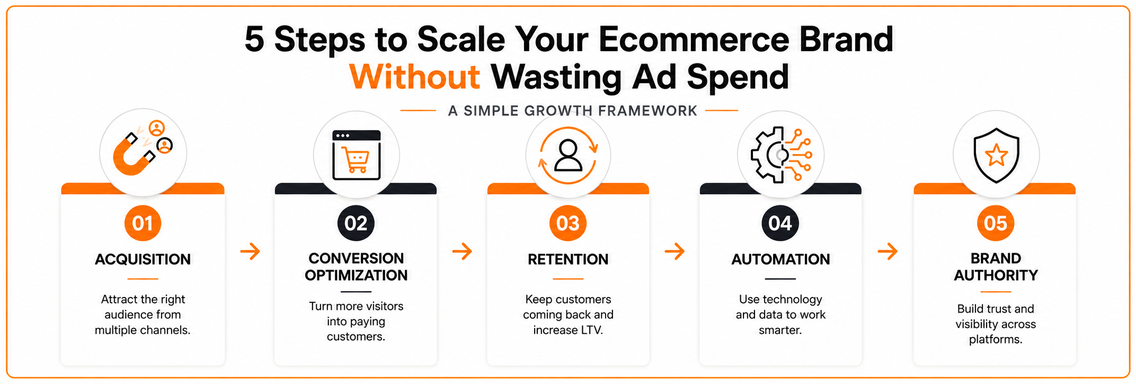
A strong growth marketing strategy for ecommerce includes five connected pillars:
1. Acquisition
SEO, ads, influencers, TikTok, organic content
2. Conversion Optimization
Better product pages, faster site speed, optimized checkout
3. Retention
Email flows, SMS, loyalty programs, subscriptions
4. Automation
AI personalization, predictive analytics, segmentation
5. Brand Authority
Google, YouTube, Reddit, AI search visibility
All five must work together for scalable growth.
Why SEO Is Becoming More Important Than Ever
SEO is no longer just a traffic channel. It is a long-term growth asset. Unlike paid ads, SEO compounds over time and reduces dependency on paid acquisition.
Strong SEO helps ecommerce brands:
- Lower acquisition costs
- Build brand authority
Improve trust - Capture high-intent traffic
- Appear in AI search results
This is why brands focusing on a strong ecommerce marketing strategy 2026 are investing heavily in SEO alongside paid media.
Case Studies Build Trust
Customers are more skeptical today than ever before. Before buying, they want proof that a brand actually delivers results. That is why case studies are essential in ecommerce growth marketing.
Strong case studies typically highlight:
- Conversion rate improvements
- Revenue growth
- CAC reduction
- Retention improvements
- ROAS increase
Real numbers build trust far better than generic claims or testimonials.
Final Thoughts
Scaling ecommerce brands in 2026 is no longer about spending more, it is about building smarter systems.
Successful brands focus on:
- Conversion optimization
- Retention systems
- SEO visibility
- AI-driven discovery
- Multi-channel marketing
- Better data tracking
If you are struggling with rising ad costs or inconsistent performance, the problem is usually not traffic. It is structure. A strong growth marketing strategy for ecommerce fixes that by aligning all channels into one system. And when you understand how to scale ecommerce store profitably, you realize growth is not about more spend. It is about better efficiency.
At Excellorix Digital Marketing Services, we help ecommerce brands improve conversions, retention, and visibility through performance-driven SEO services and growth systems designed for sustainable scaling.
FAQ
What is ecommerce growth marketing?
Ecommerce growth marketing is a full-funnel approach that focuses on improving every stage of the customer journey from acquisition to retention. Instead of only driving traffic through ads, it works on increasing conversions, customer lifetime value, and long-term profitability. It combines SEO, paid ads, CRO, retention systems, and brand building into one unified strategy that helps ecommerce brands grow sustainably rather than relying on short-term spikes in traffic.
How to scale ecommerce store profitably?
To scale an ecommerce store profitably, you need to focus on improving system efficiency before increasing ad spend. This includes optimizing conversion rates, strengthening retention systems, improving product pages, and building diversified traffic sources like SEO and organic content. Once these foundations are strong, scaling becomes more stable because every additional visitor has a higher chance of converting. Without this foundation, scaling usually leads to higher costs and lower margins.
What is ecommerce marketing strategy 2026?
An ecommerce marketing strategy 2026 is a modern approach that combines multiple channels and technologies to drive sustainable growth. It includes SEO, paid advertising, AI-driven personalization, retention marketing, and CRO. The focus is no longer on single-channel dominance but on building an integrated system where acquisition, conversion, and retention all work together. This helps ecommerce brands reduce dependency on ads and improve long-term profitability.
Why do ecommerce brands struggle to scale?
Most ecommerce brands struggle because they scale too early without fixing foundational issues. Common problems include weak conversion rates, poor website experience, lack of retention systems, and overdependence on a single advertising channel. When these issues exist, increasing traffic only exposes inefficiencies. As a result, costs rise faster than revenue, making scaling unsustainable.
Is SEO still important for ecommerce brands?
Yes, SEO is extremely important for ecommerce brands in 2026. It is no longer just about ranking on Google. It is about being discoverable across search engines, AI tools, and content platforms. SEO helps ecommerce brands attract high-intent traffic, reduce dependency on paid ads, and build long-term authority. It also compounds over time, meaning the value increases as content and rankings strengthen.
How does retention improve ecommerce growth?
Retention improves ecommerce growth by increasing the value of existing customers. Returning customers are more likely to buy again, spend more per order, and convert faster compared to new users. This reduces overall acquisition costs and increases profitability. Strong retention strategies include email marketing, SMS campaigns, loyalty programs, and personalized recommendations, all of which help build long-term customer relationships.