
Most advice about SEO unique content starts with the wrong test: run a plagiarism checker, change the wording, add the target keyword, and publish. That process can produce text no competitor has copied word for word, yet still offer nothing a reader, buyer, or search system needs.
Modern originality is harder and more useful. A defensible page contributes first-party evidence, direct experience, original analysis, distinctive examples, or clearer decision support. Google’s guidance says publishers shouldn’t just copy or rehash existing material. Content should serve an identifiable audience, provide useful and reliable information, demonstrate expertise, and add substantial value beyond rewriting other sources. Google’s SEO Starter Guide makes that standard clear.
Table of Contents
- Redefining Originality for Modern Search
- The Hidden Costs of Duplicate Pages
- Building a First-Party Evidence Layer
- Designing for Citations in AI Search
- Remediating Legacy Duplication Issues
- Transitioning from Volume to Value
Redefining Originality for Modern Search
A page can pass a plagiarism check and still have no competitive value. Replacing “ecommerce SEO strategy” with “online retail search strategy” changes the wording, not the information. If a page repeats the definitions, checklists, and generic recommendations already available elsewhere, searchers have little reason to choose it.
Search systems assess more than phrasing. Google asks whether content serves people, reflects first-hand expertise, and helps readers complete their task. Its guidance on creating helpful content questions pages that copy or rewrite existing material without adding substantial value. The practical standard is usefulness, reliability, topical focus, and visible evidence of expertise.
Practical rule: If a capable competitor could reproduce your page without speaking to a customer, using your product, or examining your data, the page probably lacks a meaningful evidence layer.
Two articles can target the same query about reducing Shopify checkout friction and deliver very different value. One repeats familiar advice about trust badges, shipping information, mobile design, and payment options. The other draws on anonymized support-ticket objections, annotated checkout screenshots, product-category recommendations, and a record of which friction points the team tested. It may be shorter, yet it gives readers stronger grounds for a decision.
The evidence test
Before drafting, ask four questions:
- What do we know firsthand? Identify customer patterns, implementation experience, product testing, internal research, or specialist judgment.
- What decision will this page support? Design the content for comparison, diagnosis, planning, or purchase, not information retrieval alone.
- What can we show? Screenshots, calculations, process diagrams, dated observations, and original examples let readers assess the claims.
- What would be difficult to copy without access to our business? That answer often identifies the page’s most defensible material.
A focused SEO content strategy turns those answers into publishing decisions. The target keyword still helps identify demand and intent. It should not dictate the page’s substance.
Keyword placement, headings, metadata, and internal links support discovery. They cannot make interchangeable advice useful, nor can they substitute for evidence that helps a reader act. Uniqueness is not a wording exercise. It is a contribution standard.
The Hidden Costs of Duplicate Pages
Near-duplicate pages don’t multiply your search opportunities. They create a selection problem.
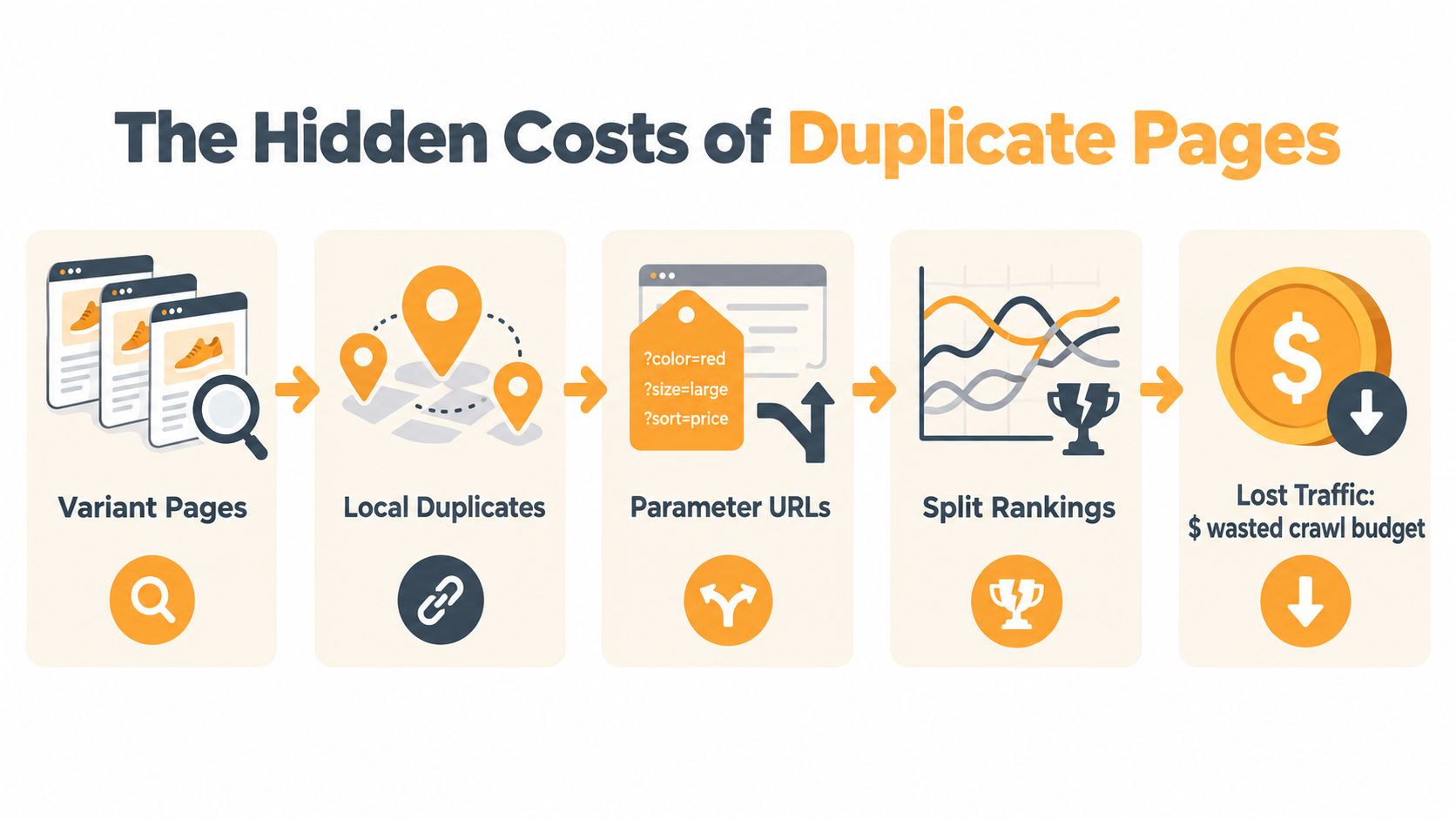
Suppose a retailer publishes separate URLs for every color variant, campaign tag, and filtered category combination, while keeping the same primary product copy on each page. A service firm may do something similar with location pages that change only the city name. A manufacturer might syndicate identical product descriptions across distributors. Each URL looks like an asset in the CMS, but search systems may treat the pages as one content cluster.
Google explains that when multiple pages contain identical or highly similar primary content, its systems group them and select a canonical URL. The preferred version is generally the one considered most representative, complete, and useful. Signals can include redirects, HTTPS consistency, sitemap inclusion, and rel="canonical" annotations. Google’s canonicalization documentation also explains that duplicates are crawled less frequently to reduce unnecessary crawling.
How the operational cost accumulates
The damage isn’t limited to a canonical tag report.
- Discovery becomes noisier. Crawlers encounter multiple URLs representing substantially the same resource.
- Indexing becomes less predictable. Google may select a different canonical from the one the team intended.
- Internal signals become fragmented. Links, sitemaps, redirects, and canonical annotations can point in different directions.
- Editorial capacity gets diluted. Writers and reviewers maintain pages that don’t represent distinct user needs.
- New assets compete with technical clutter. A site that continually generates near-duplicates makes it harder to distinguish genuinely new content from URL variations.
The right mental model is not “duplicate pages receive no value.” It’s “duplicate pages enter a selection process.” Search engines decide which version best represents the cluster, and the other URLs don’t become proportional ranking opportunities.
A canonical tag also isn’t a substitute for differentiation. If two pages serve different audiences or search intents, they may deserve separate URLs, but they need materially different content and clear purpose. If they serve the same intent, consolidation is usually cleaner.
Audit the page family, not just the page
Group URLs by template and intent. Look for product variants with identical descriptions, location pages with interchangeable body copy, faceted navigation URLs, campaign parameters, and syndicated articles. Then classify each group:
| Situation | Preferred action |
|---|---|
| Same intent and same primary content | Consolidate to one preferred URL |
| Permanent replacement | Use a server-side redirect |
| Temporary or tracking variation | Control URL generation and canonical signals |
| Distinct audience or intent | Keep separate, then add substantive differentiation |
| Necessary duplicate for usability | Preserve only when technical signals clearly identify the preferred version |
This work should happen before commissioning more pages. Producing additional copy on top of unresolved duplication increases the inventory without improving the information architecture.
Building a First-Party Evidence Layer
Originality starts before drafting. Define the evidence a page will contribute, rather than asking a writer to make generic research “unique” after the fact. The assignment should identify a specific contribution that competitors cannot reproduce from the same public sources.
Start with the page’s decision
Every target page needs a distinct search intent and a decision it supports. A query about industrial sensor maintenance may require troubleshooting criteria. A query about healthcare software may require implementation considerations and expert review. A product comparison may need fit criteria, limitations, and evidence from actual use.
Write the decision in one sentence:
“After reading this page, the intended audience should be able to choose, diagnose, compare, or implement ______.”
Then identify the evidence needed to support that decision. A Shopify brand might use anonymized customer questions, product testing notes, returns data, or checkout recordings. A professional-services firm might draw on recurring project patterns, implementation screenshots, and interview notes from delivery teams. A manufacturer could contribute operating conditions, maintenance observations, or application-specific recommendations.
This framing ties originality to business value. The page earns attention by helping a reader make a better choice, not by rearranging familiar keywords.
Build the brief around proof
A useful brief should answer these questions:
- Audience and intent: Who is searching, and what decision are they trying to make?
- Proprietary question: What can this business answer better than a general publisher?
- First-hand source: Which customer-facing, technical, product, or delivery expert will contribute?
- Evidence format: Will the page use screenshots, original calculations, interview findings, product tests, or anonymized patterns?
- Objection addressed: What concern prevents the reader from taking the next step?
- Boundaries: Which claims require specialist review, particularly in healthcare, finance, safety, or technical manufacturing?
- Update record: What date, method, or version information will show when the evidence was collected?
Use the answers to shape the page architecture. A thin original detail surrounded by generic paragraphs does not create defensible content. The evidence should determine the examples, explanations, recommendations, and calls to action.
Make evidence useful, not merely proprietary
First-party information matters when readers can evaluate it. A private opinion without context adds little. Connect each insight to an observable problem, a method, and an action.
For example, replace “customers often struggle with onboarding” with the recurring step where they hesitate, the interface or process involved, the method used to identify the issue, and the check another organization should perform. Remove personally identifying information, separate observed patterns from assumptions, and label dated findings clearly.
People-first content guidance supports evaluating whether a page contributes genuine value. First-party insights can offer information commodity pages cannot replicate, while also resolving objections that copied summaries leave unanswered. That combination can support conversions because it demonstrates relevant expertise without relying on unsupported claims.
A shorter page with credible evidence can outperform a long guide assembled from common knowledge. The defensible asset is not the word count. It is the combination of evidence, interpretation, and decision usefulness.
Designing for Citations in AI Search
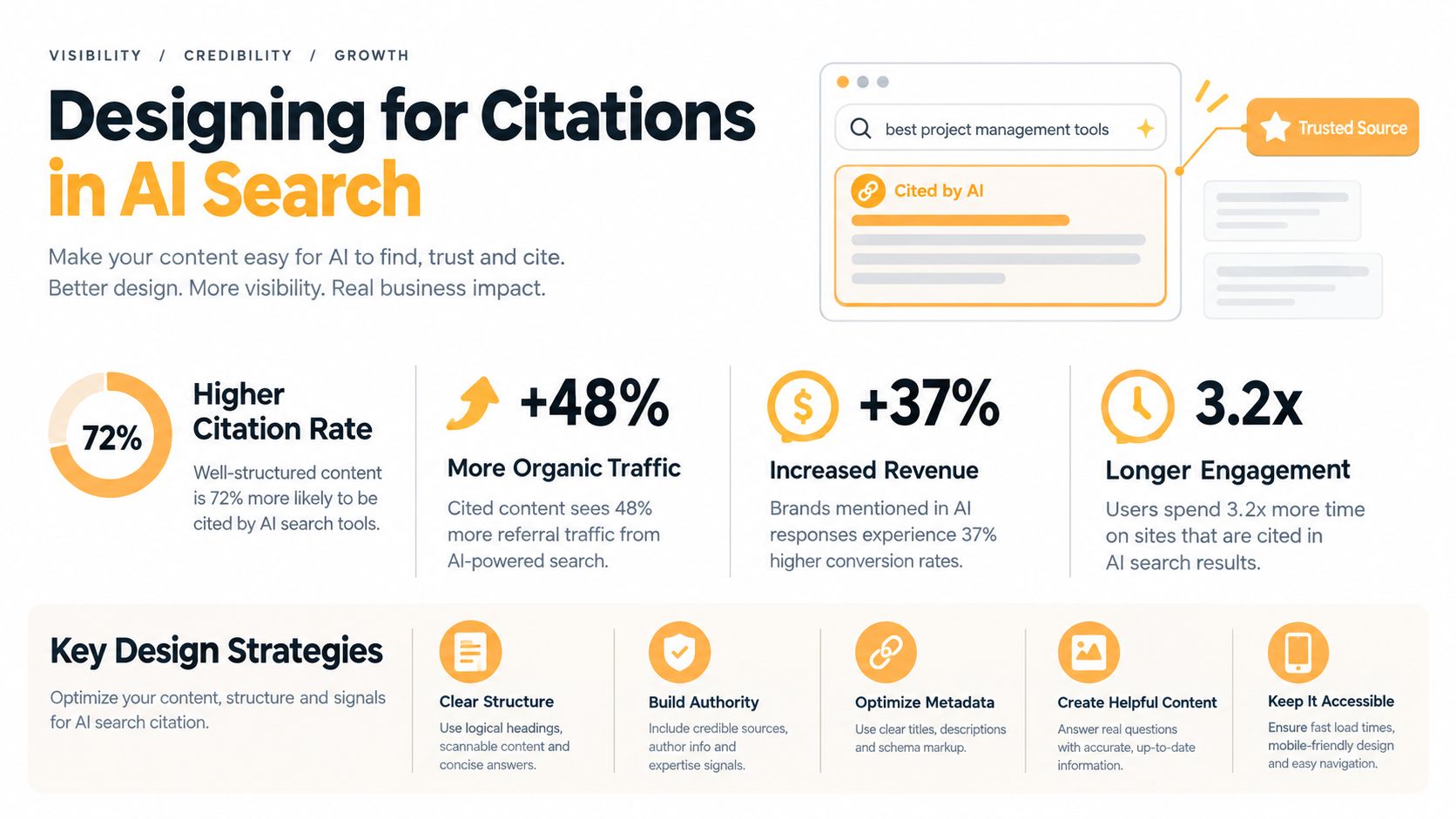
AI summaries change the value of being visible in search. A page may still rank, but the user may receive a synthesized answer before visiting the source. That makes traditional click acquisition only part of the job. Your content must also give search systems a reason to identify, summarize, and attribute your contribution.
A 2025 Pew analysis found that 18% of Google searches produced an AI summary. Users clicked a traditional result on 8% of visits when a summary appeared, compared with 15% when it did not. These figures are documented in Pew Research Center’s analysis of Google AI summaries.
Structure claims so they can be verified
Citable content makes its important claims easy to locate and assess. Use clear headings, direct answers, descriptive author information, visible publication and update dates, and links to primary evidence. Keep observed results separate from recommendations, and don’t present an internal opinion as an industry fact.
A claim-level review can be simple:
- Claim: What exactly is being asserted?
- Source: Is it based on internal data, a primary external source, or professional judgment?
- Method: How was the observation produced?
- Date: When was the information collected or last reviewed?
- Scope: Where does the claim apply, and where might it not apply?
- Action: What should the reader do with it?
This format improves trust for people as well as machines. It also protects the brand from vague claims that survive editorial review because nobody can identify who owns them.
Earn the visit after the summary
A page needs more than a concise answer if it wants to attract a click. Give the reader something the summary can’t fully reproduce: an interactive calculator, a detailed implementation sequence, original screenshots, downloadable source material, a comparison grounded in real constraints, or a methodology they can inspect.
Don’t hide the answer behind an oversized introduction. Put the direct conclusion near the relevant heading, then provide the evidence and practical implications. Search systems can extract the answer, while motivated readers can continue into the details.
The strategic shift is subtle. You’re not trying to manipulate AI systems into mentioning a brand. You’re publishing work that is recognizable, attributable, and useful enough to cite. Proprietary evidence, clear authorship, transparent methodology, and consistent entity information make that contribution easier to identify.
Remediating Legacy Duplication Issues
New content won’t fix an old URL architecture that sends conflicting signals. Begin with a crawl and a URL inventory, then compare pages by primary content rather than by title alone. The most important question is whether two URLs serve the same user need with substantially the same information.
Include parameter URLs, faceted navigation, internal search pages, print versions, trailing-slash variations, HTTP and HTTPS variants, syndicated articles, and location or service pages built from one template. Review the sitemap, internal links, redirects, and canonical annotations together. A canonical tag that conflicts with the sitemap or navigation isn’t a complete solution.
Choose consolidation deliberately
Use a permanent server-side redirect when an old URL has no independent purpose and should be replaced by a preferred page. Update internal links and the sitemap so they point directly to the destination. Avoid redirect chains, and preserve relevant page context when mapping old URLs to new ones.
Use a self-referencing canonical on the preferred page when the URL should remain indexable and may have technically similar variants. Canonicalization is a hint, not an instruction that overrides every other signal, so the preferred page should also be the strongest version in terms of content, links, accessibility, and consistency.
Google expects publishers to help identify the preferred URL with signals such as HTTPS consistency, sitemap inclusion, redirects, and rel="canonical" annotations. Google’s ranking systems documentation provides the relevant technical context.
Validate what Google selected
After implementation, inspect representative URLs in Google Search Console. Compare the user-declared canonical with the canonical Google selected. If Google chooses a different URL, investigate rather than repeatedly changing tags. The cause may be weak differentiation, inconsistent internal links, duplicate body content, redirect behavior, or a preferred URL that isn’t clearly more complete and useful.
A practical remediation sequence looks like this:
- Inventory: Export indexable URLs and group them by template, parameter, intent, and primary content.
- Decide: Mark each group as consolidate, redirect, canonicalize, noindex where appropriate, or differentiate.
- Implement: Apply redirects, self-referencing canonicals, sitemap cleanup, and internal-link updates.
- Rebuild: Add original evidence only to pages with a distinct audience or search intent.
- Validate: Check representative URLs in Search Console and monitor indexing behavior.
Use the technical SEO audit checklist to organize this work across templates, indexation, canonical signals, internal links, and crawl diagnostics. The objective isn’t to force every URL into the index. It’s to make the preferred resources obvious and reserve crawl and editorial attention for pages that deserve to exist.
Transitioning from Volume to Value
“Publish more” is an easy operating principle because teams can measure output immediately. It tells writers how many briefs to complete, but it doesn’t tell them whether the business has contributed anything worth finding. A stronger system measures the quality of the evidence and the usefulness of the decision support.
The shift doesn’t require abandoning scalable production. It requires putting evidence into the production line. A content team can create repeatable interviews, reusable data-cleaning processes, screenshot libraries, expert review workflows, and page templates that preserve clarity without flattening every topic into the same article.
A practical operating checklist
- Remove weak inventory: Consolidate pages that target the same intent without distinct value.
- Define the contribution: Write the proprietary question each new page will answer.
- Assign an expert: Name the person responsible for first-hand input and review.
- Capture proof: Collect examples, screenshots, calculations, tests, or anonymized patterns.
- Separate claims: Distinguish sourced facts, observed results, recommendations, and opinions.
- Support the decision: Address the objection that could prevent a qualified reader from acting.
- Measure business movement: Connect organic landing pages to qualified leads, product engagement, assisted conversions, or revenue workflows.
- Refresh the evidence: Update pages when the product, process, data, or recommendation changes.
The result is a content portfolio that competitors can’t reproduce by paraphrasing. It also gives sales and customer-success teams a more useful asset than a generic traffic page. Buyers can see how the organization thinks, what it has observed, and how it handles constraints.
SEO frameworks that work at scale should make originality repeatable, not optional. The winning model is fewer interchangeable pages, clearer technical signals, and more evidence tied to real decisions.
Excellorix helps growth teams combine technical SEO remediation, evidence-led content creation, on-page optimization, and conversion-focused measurement. Visit Excellorix to discuss how to consolidate duplicate assets and build SEO content that earns trust, supports citations, and contributes to revenue.