
Most Shopify marketing advice starts with traffic. Launch more campaigns, publish more content, add another channel, and keep increasing spend until revenue catches up. That approach treats the store as a destination for clicks instead of what it has become: a connected commerce system where acquisition, merchandising, checkout, payments, and retention determine whether demand turns into profit.
A store can have healthy traffic and weak economics. Customers may land on the wrong product page, abandon after seeing delivery costs, struggle to pay on mobile, or buy once and never return. A useful Shopify marketing strategy therefore asks a harder question than “How do we get more visitors?” It asks, “Where does qualified demand become less valuable, and which system should we fix first?”
Table of Contents
- Building a Full-Funnel Shopify Marketing Foundation
- Designing a Multi-Channel Acquisition Mix
- Optimizing Checkout and Landing Page Conversions
- Structuring Retention and Lifecycle Campaigns
- Measuring Profitability Beyond Last-Click ROAS
- Scaling Your Shopify Store with AI and Data
Building a Full-Funnel Shopify Marketing Foundation
The expensive mistake is treating marketing as a traffic department. Paid media, SEO, merchandising, development, and retention often optimize separate dashboards, while the store loses value between them. A profitable Shopify strategy connects those decisions to the customer path, from discovery through checkout, fulfillment, and repeat purchase.
Shopify’s scale raises the cost of disconnected decisions. In fiscal 2025, Shopify facilitated $378.4 billion in gross merchandise volume, up from $292.3 billion in 2024, a 29% increase, according to the company’s fiscal 2025 filing. That GMV includes orders facilitated through apps and channels, net of refunds and inclusive of shipping, duties, and taxes. Shopify now links product discovery, checkout, payments, transaction data, and post-purchase activity across multiple touchpoints.
Replace channel reports with a customer path
Build reporting around the sequence that turns demand into contribution:
- Traffic source: Record whether the customer arrived through paid search, paid social, organic search, email, an external channel, or another source.
- Product engagement: Track the landing page, product viewed, variant selection, review interaction, and add-to-cart behavior.
- Checkout progression: Measure checkout starts, payment selection, errors, completed orders, and refunds.
- Customer value: Connect the first order to repeat purchases, acquisition cost, margin, and lifetime value.
This structure changes how campaign performance gets judged. A low cost per click matters only if the resulting visitors reach suitable products, complete payment, and remain profitable after fulfillment, returns, and future support. A campaign can look efficient in an ad platform while attracting low-margin orders or customers who never buy again.
Practical rule: Do not increase acquisition spend to compensate for a product page or checkout problem. Fix the point where demand loses value first.
Shopify’s revenue mix supports the same operating view. In fiscal 2025, merchant solutions generated approximately $8.8 billion, or 76% of total revenue, while subscription solutions generated about $2.8 billion, or 24%, as reported in the same filing. For merchants, that mix reflects a platform built around transactions and commerce services, not only storefront subscriptions.
The team planning a growth marketing system for ecommerce brands should connect campaign reporting to product margins, inventory, payment behavior, fulfillment, returns, and repeat purchasing. Traffic still matters, but it should determine neither budget nor success by itself. Checkout performance and retention economics set the ceiling on what acquisition can profitably support.
Build one shared measurement language
Use consistent events and naming across Shopify, Google Analytics, Google Ads, Meta, email platforms, and reporting dashboards. The team should distinguish product views, add-to-cart events, checkout starts, purchases, refunds, and repeat purchases.
One taxonomy can serve several teams. A paid media manager can adjust audiences, a merchandiser can improve product presentation, and a retention manager can build a replenishment flow from the same definitions. If each function defines conversion differently, the business cannot tell whether growth reflects genuine demand or reporting noise.
Designing a Multi-Channel Acquisition Mix
A brand-owned Shopify store gives merchants control, but relying on one storefront or one ad network creates concentration risk. A resilient acquisition mix combines paid search, paid social, organic search, email capture, external commerce channels, and emerging AI discovery. The objective isn’t to appear everywhere. It’s to give each channel a clear role and evaluate the channels against the same commercial outcome.
Start with intent. Paid search captures demand that already includes a product or problem. Paid social creates demand through creative, demonstrations, and audience signals. SEO supports research and product discovery over time. Email and SMS convert permission into a direct relationship. AI tools may influence consideration while sending the customer to the storefront for the transaction.
Organize channels around jobs
Assign each channel a job before assigning it a budget:
- Capture existing demand. Use product feeds, search campaigns, and high-intent landing pages for people actively comparing or looking to buy.
- Create qualified interest. Use paid social creative, creator content, educational assets, and product demonstrations to explain why the product fits a specific need.
- Support evaluation. Build comparison content, buying guides, detailed product pages, reviews, and clear delivery information.
- Recover and retain. Use abandoned-cart, browse, post-purchase, replenishment, and win-back campaigns based on behavior rather than a single generic audience.
This structure prevents a common error: comparing a discovery channel with a bottom-funnel channel using the same last-click metric. A social campaign may introduce a customer who later searches for the brand. A search campaign may close the sale without creating the original demand. Blended CAC, contribution margin, payback period, and repeat-purchase behavior provide a more useful view than isolated platform ROAS.
Google and Meta ads require a full-funnel strategy because campaign performance depends on landing-page quality, product availability, offer structure, and checkout completion. Changing bids won’t repair a weak feed or a confusing product page.
Treat product data as an acquisition asset
Structured product data deserves the same governance as ad creative. Product titles, descriptions, variants, prices, availability, shipping details, images, reviews, and category attributes should remain consistent across Shopify, Google Merchant Center, social catalogs, and other commerce destinations.
This matters beyond traditional search. Shopify reported that orders attributed to AI search increased 15 times from January 2025, although the growth began from a small base and was self-reported. The company also reported that shoppers arriving through structured Catalog data convert at roughly twice the rate of shoppers arriving through scraped or third-party product data. Those figures appear in the Shopify earnings call transcript.
The practical response isn’t to promise “AI rankings.” Audit whether conversational tools can understand the product accurately. Check variant attributes, structured data, reviews, return information, shipping coverage, and feed completeness. Then annotate analytics when AI-assisted visits or mentions appear, because discovery may happen in an AI tool while checkout still occurs on the Shopify storefront.
Shopify can also support distinct commercial experiences for different audiences. A DTC buyer may need lifestyle messaging and a fast wallet checkout, while a wholesale buyer may need account terms, catalog rules, negotiated pricing, and a different purchasing workflow. Channel diversification only works when the store can preserve accurate measurement while adapting the experience to the customer.
Optimizing Checkout and Landing Page Conversions
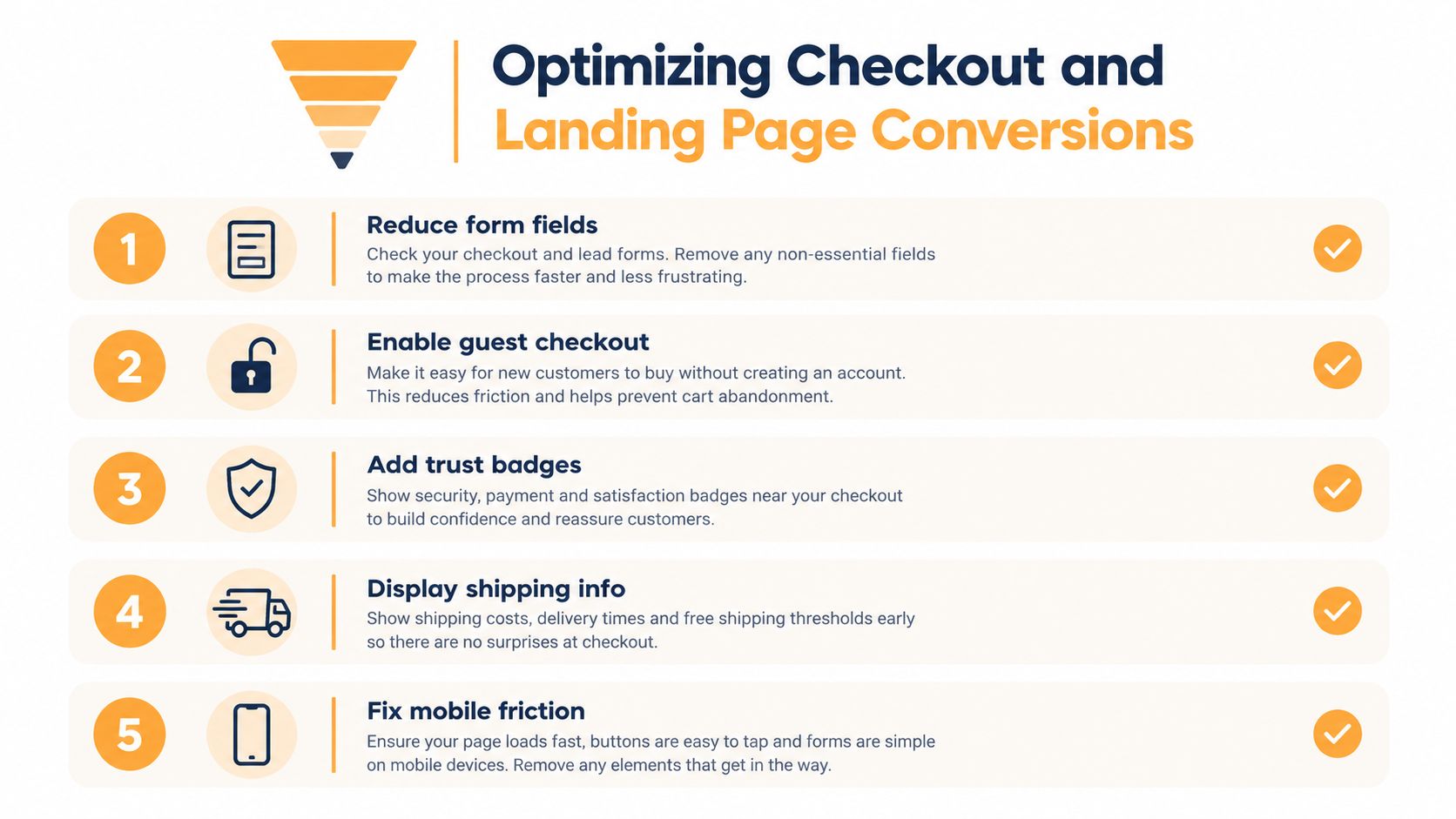
More traffic won’t solve a checkout that makes customers work too hard. Baymard’s global benchmark places average cart abandonment at 70.19%, while its review of 344 leading US and European ecommerce sites found that 65% had mediocre-or-worse checkout performance. The same research found that the average US checkout displayed 23.48 form elements by default, as documented in Baymard’s checkout usability research.
These benchmarks aren’t a forecast for every Shopify store. They are a warning against treating checkout as a minor implementation detail. A customer can be convinced by an ad, persuaded by the product page, and still leave because the store hides delivery costs, rejects an address, requires account creation, or offers an unfamiliar payment method.
Diagnose the actual leak
Begin with segmentation, not design opinions. Break conversion and abandonment down by device, country, channel, product, and new versus returning customer. A blended conversion rate can hide a serious mobile issue or make a single high-performing audience appear to validate the entire checkout.
Use analytics to identify the step with the sharpest decline. Then reproduce that step through mobile usability testing and session recordings. Watch for unclear error messages, fields that reset after an error, slow-loading payment components, discount-code distractions, and delivery information that appears too late.
A disciplined diagnostic sequence looks like this:
- Establish the baseline. Record completed-order rate, checkout-start-to-purchase rate, revenue per visitor, and refund rate.
- Locate the drop-off. Compare the same step across device, traffic source, country, and customer type.
- Reproduce the friction. Use recordings and test orders to experience the problem as the customer does.
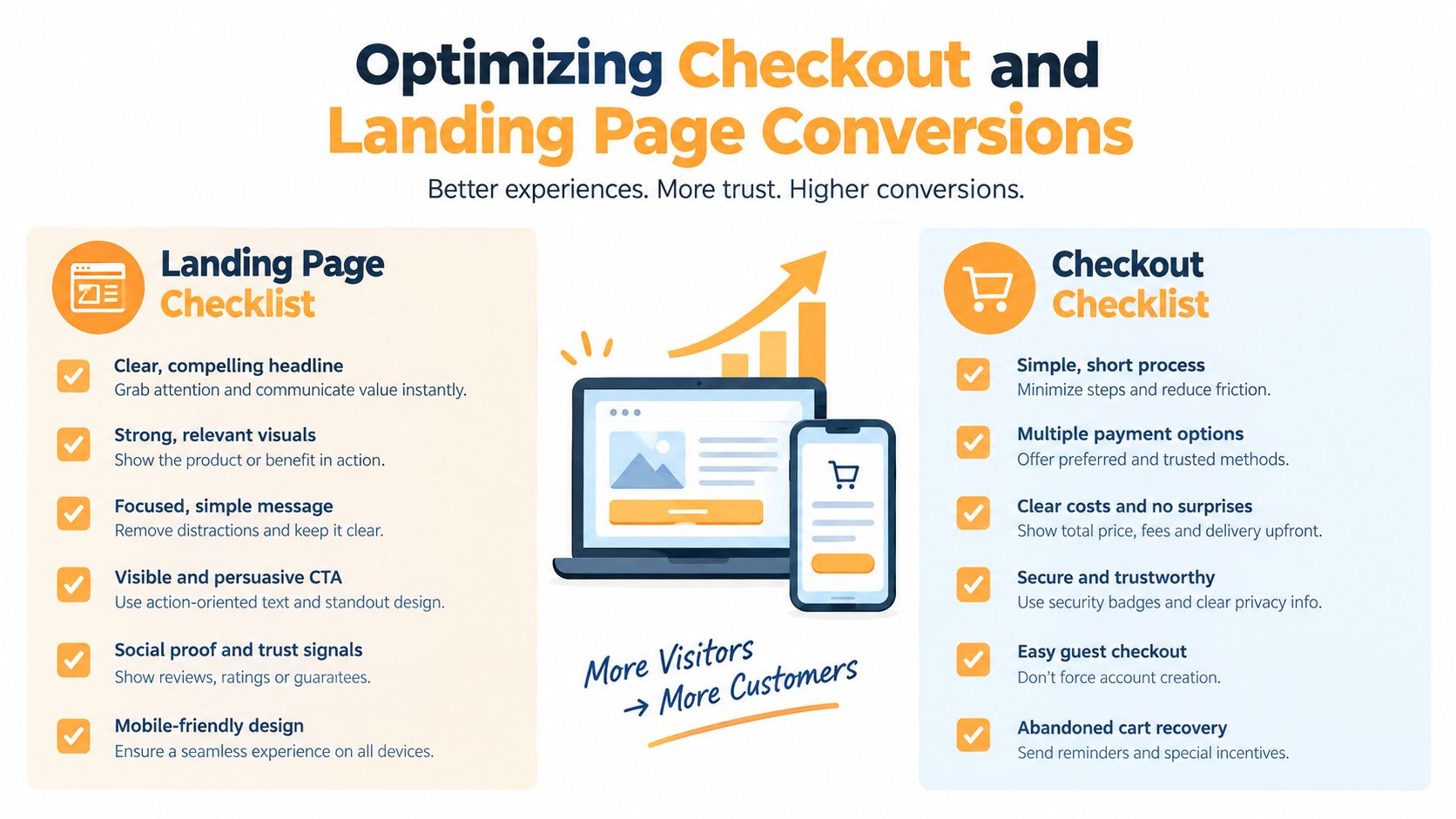
- Remove unnecessary effort. Reduce fields, enable guest checkout, add address autocomplete, and expose delivery costs, taxes, returns, and payment options before the final step.
- Test one meaningful change. Keep the primary metric, minimum detectable lift, sample requirement, and test duration defined before launch.
A checkout test isn’t successful because more people click the payment button. It’s successful when more qualified visitors complete profitable orders without creating a return or margin problem.
Improve the page before buying more traffic
Landing pages should continue the promise made in the ad or search result. If an ad emphasizes a specific use case, the destination should show that use case immediately, with matching language, relevant proof, a clear product choice, and a visible path to purchase. Sending every audience to the homepage creates unnecessary interpretation work.
Mobile-first design matters because mobile friction can disappear inside account-level averages. Keep the primary product benefit, price, variant choice, delivery expectation, reviews, and add-to-cart action visible without forcing the customer to hunt through the page. Compress heavy media, remove distracting app elements, and make sticky purchase controls useful rather than intrusive.
Test cautiously. Early fluctuations can make a weak variation look promising, especially when teams compare multiple changes without accounting for the extra chance of a false winner. The aim is not to produce a constant stream of “winning” tests. It’s to build reliable evidence about which changes improve completed orders and customer economics.
A focused ecommerce checkout optimization guide should lead to a prioritized backlog, not a collection of cosmetic recommendations. Field reduction, express wallets, transparent landed cost, and error recovery deserve attention before decorative redesigns.
Structuring Retention and Lifecycle Campaigns
Acquisition gets the budget because it produces visible activity. Retention often gets a newsletter and a discount code. That imbalance can leave a Shopify store dependent on increasingly expensive first orders while existing customers receive generic messages that train them to wait for promotions.
Retention works when it reflects customer behavior. A replenishable product, a considered purchase, a seasonal item, and a high-return product each require a different lifecycle. The message should reflect why the customer bought, what they may need next, and whether another purchase is economically sensible.
Shopify’s 2025 owner survey found that 54% of B2C businesses considered customer relationships, rather than mass acquisition campaigns, their primary competitive advantage, according to the survey analysis from OptiMonk. The point isn’t that every merchant should reduce acquisition. It is that relationships deserve measurement alongside reach.
Segment by commercial intent
Start with the first order. A customer who bought a starter product needs a different follow-up from someone who bought a premium bundle. Useful segmentation inputs include:
- First-order intent: Identify whether the initial purchase was exploratory, replenishment-led, gift-oriented, or a high-consideration decision.
- Product cycle: Time reminders around expected usage or replacement, not an arbitrary calendar schedule.
- Margin and return risk: Avoid treating every repeat order as equally valuable.
- Behavior: Separate customers who engage with education, reviews, support, and product recommendations from customers who respond only to discounts.
- Predicted value: Use purchase history and engagement to prioritize high-potential customers without assuming every subscriber will become loyal.
The first post-purchase message should reduce buyer uncertainty. Explain setup, usage, care, compatibility, or expected results. A useful education sequence can lower support pressure and create a reason to remain engaged without asking for another purchase immediately.
Test loyalty without sacrificing margin
Discounts can produce a short-term order, but they can also reduce contribution margin and condition customers to delay purchases. Test alternatives such as early access, product education, bundles, service recovery, community participation, replenishment reminders, and useful post-purchase content.
Measure the outcome at cohort level. Compare repeat-purchase rate, net revenue after returns, contribution margin, and customer support behavior. An email with a high click rate may still be unprofitable if it drives low-margin orders or attracts customers who return the product. A quieter educational flow may create stronger economics over time.
Lifecycle automation should also respond to negative signals. A return, delivery complaint, failed payment, or low product engagement should change the next message. Sending a promotional campaign to a customer with an unresolved service issue can turn a recoverable problem into a permanent loss.
Retention principle: A customer database isn’t an asset because it contains many addresses. It’s an asset when the business understands which relationships can produce profitable future demand.
Measuring Profitability Beyond Last-Click ROAS
Last-click ROAS answers a narrow question: how much reported revenue followed a platform’s attributed click? It doesn’t show whether another channel created the demand, whether the order carried healthy margin, whether the customer will return, or whether the platform counted the purchase twice.
A reliable Shopify measurement system starts with event integrity. Use consistent UTM parameters, consent-aware analytics, platform-supported or server-supported purchase tracking, and deduplicated events for product views, add-to-cart, checkout starts, purchases, refunds, and repeat purchases. Validate the implementation with test orders and reconciliation against Shopify’s order records.
Create a shared profitability view
Build cohorts by first-touch source, product category, geography, margin, and customer status. Then evaluate how those cohorts behave after the initial transaction. A campaign that looks efficient on first-order ROAS may have weak repeat purchasing or high refund exposure. Another campaign may appear less efficient at first while producing stronger payback and lifetime value.
Use the funnel constraint to decide what to do next:
- If qualified sessions are weak, improve channel targeting, creative, SEO coverage, or product-feed quality.
- If product engagement is weak, review message match, merchandising, price communication, and product-page proof.
- If checkout completion is weak, investigate the friction described earlier instead of buying more clicks.
- If retention is weak, segment the post-purchase experience and inspect margin after incentives and returns.
Shopify Payments penetration reached 65.6% in 2025, according to Shopify’s Q4 2025 results release. Payment availability, checkout speed, fraud controls, and localized purchasing options therefore belong in acquisition analysis. A campaign can acquire the right customer and still lose the order if the final payment experience doesn’t meet that customer’s expectations.
Use a measurement matrix
| Metric Category | Vanity / Platform Metric | Full-Funnel Profitability Metric |
|---|---|---|
| Acquisition | Clicks and attributed conversions | Blended CAC by first-touch source |
| Advertising | Last-click ROAS | Contribution margin after media, discounts, returns, and fulfillment |
| Engagement | Landing-page sessions | Product-page engagement and revenue per visitor |
| Checkout | Checkout starts | Checkout-start-to-purchase rate and completed-order rate |
| Retention | Email opens and clicks | Repeat-purchase rate, payback period, and LTV |
| Revenue | Gross sales | Net revenue and cohort-level profit |
Budget increases should follow marginal economics, not a platform recommendation. Increase spend only when the additional customers remain within the target CAC and payback range. If marginal CAC rises, first check creative fatigue, audience quality, landing-page relevance, inventory, offer margin, and checkout completion before assuming the channel has reached its limit.
Measurement also needs governance. Keep attribution windows consistent when comparing campaigns, document platform changes, separate new and returning customers, and annotate major promotions or site releases. A dashboard earns trust when the team can explain why a number changed, not merely when it displays a number.
Scaling Your Shopify Store with AI and Data
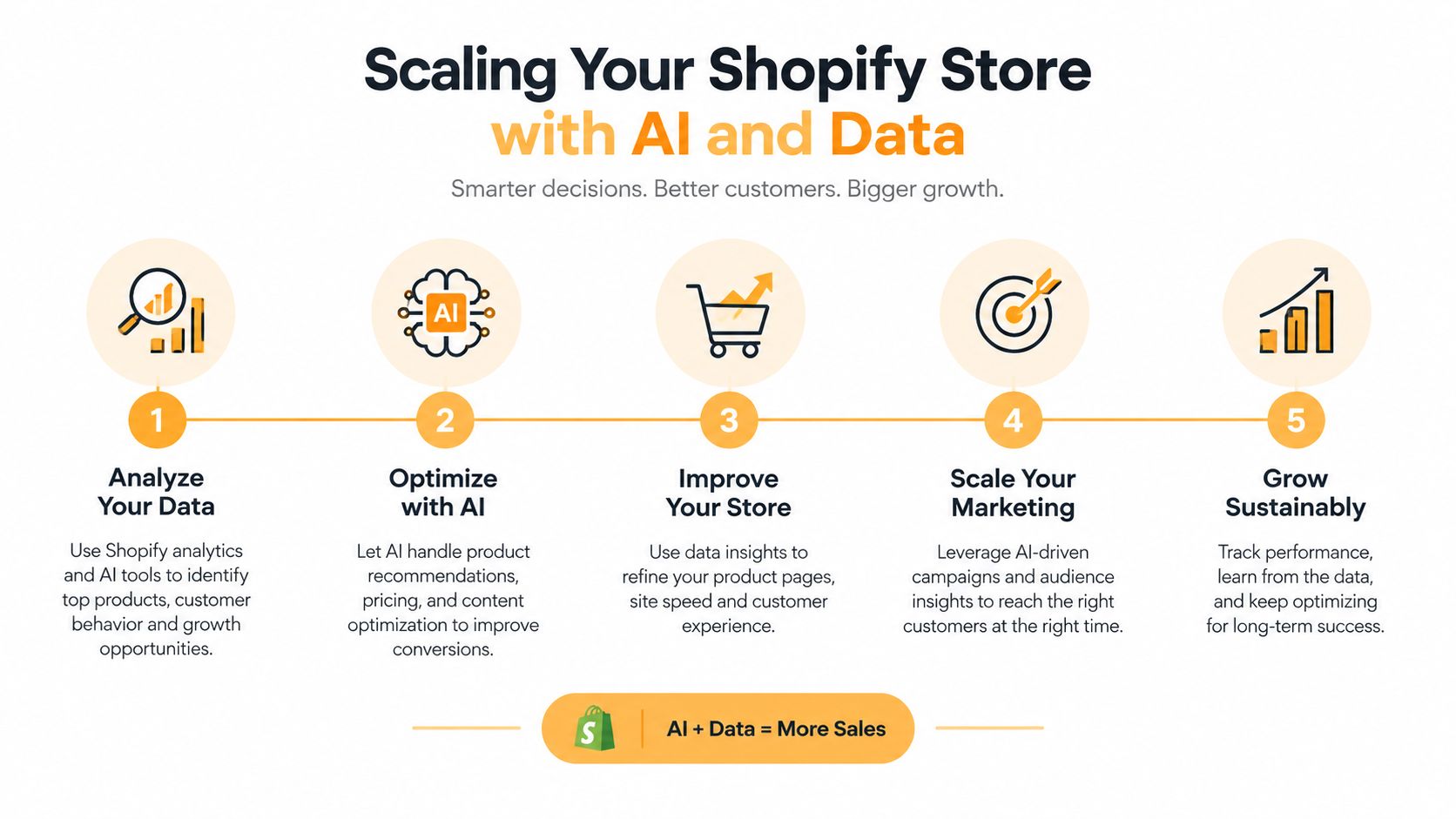
Scaling should come after the operating system works. Adding channels, automations, and AI tools to a broken measurement setup creates faster confusion. The sequence should protect data quality while increasing the team’s ability to produce, test, and learn.
Use a phased scaling roadmap
Phase one, establish control. Audit event tracking, product data, feed health, consent handling, catalog structure, landing pages, checkout, and lifecycle triggers. Define the commercial metrics that determine whether a channel receives more budget.
Phase two, remove constraints. Fix the highest-impact product-page and checkout issues. Improve product information, payment visibility, mobile usability, and error recovery before expanding acquisition. Connect returns and margin data to campaign and cohort reporting.
Phase three, accelerate production. Use AI to support creative variations, product-description drafts, audience analysis, reporting summaries, and workflow automation. Keep human review over claims, brand voice, product accuracy, exclusions, and compliance. AI can increase iteration speed, but it can’t decide whether a discount destroys contribution margin without the right business inputs.
Phase four, expand deliberately. Add a channel when the team can define its role, measurement path, landing experience, and budget guardrails. AI discovery deserves structured product data, accurate feeds, clear shipping information, reviews, and assisted-conversion annotations. It doesn’t justify unsupported promises about visibility.
Phase five, institutionalize learning. Maintain a dashboard that connects traffic source, product engagement, checkout, payment adoption, refunds, repeat purchases, CAC, margin, and LTV. Review it on a fixed operating cadence so creative, media, merchandising, development, and retention decisions stay connected.
The most effective operating model keeps strategy, creative, media, analytics, and implementation accountable to the same revenue targets. Excellorix offers Shopify ecommerce marketing support across paid media, SEO, shopping-feed optimization, product-page and checkout conversion work, analytics, and email and SMS retention campaigns.
If your Shopify store is generating traffic but you can’t clearly connect acquisition to checkout completion, margin, and repeat purchases, visit Excellorix to discuss a measurement-led growth system. The right starting point is a practical audit of tracking, product data, landing pages, checkout friction, and lifecycle economics, followed by a prioritized plan for profitable scale.