

You’ve got the same problem I see on stale sites all the time. Traffic has flattened, leads are softer, and someone is still opening the same giant seo audit checklist that looked thorough on paper but didn’t tell the team what to fix first. The site is technically “audited,” yet the pages that drive revenue are still leaking visibility.
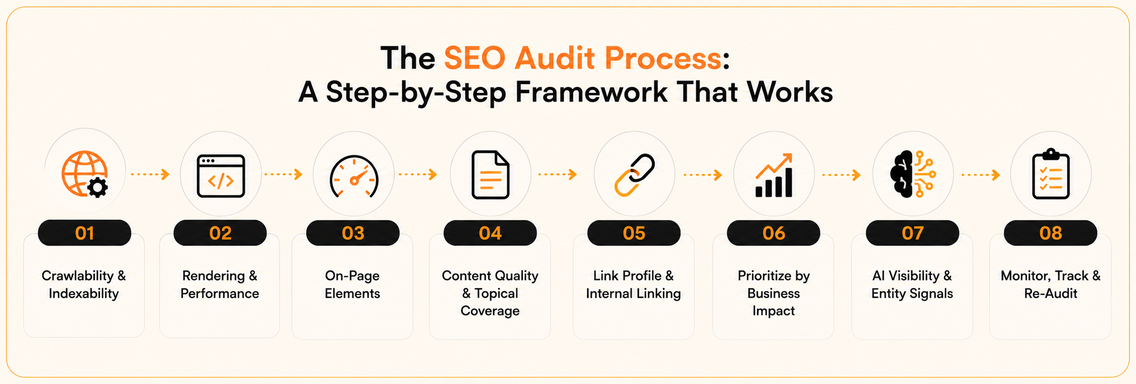
The fix is not a longer checklist. It’s a better order of operations, starting with crawlability and indexability, then rendering, then template performance, then structured data, then internal linking, and only after that, business impact. That sequence matters because a site can be perfectly documented and still be strategically misdiagnosed.
Modern audits also have to account for AI-era visibility, not just blue-link rankings. Search engines and answer engines now surface pages differently, and a site that’s legible to humans but messy to machines can miss both classic rankings and AI citations.
Why Most SEO Audits Miss What Matters
A marketer gets the crawl report, the rank tracker, and a 90-line checklist, then spends two days ticking boxes. Robots.txt checked. Meta titles reviewed. A few broken links fixed. The report looks complete, but the site still isn’t recovering because nobody asked which issues were suppressing the pages tied to leads, demos, or products.
That’s the common failure mode. Most audits flatten every issue into the same queue, which makes a minor template cleanup feel as urgent as an indexation problem on a money page. Contemporary technical frameworks don’t work that way, they start by verifying what search engines can access, then what they can render, then what the template is doing, then what the structured data says, then how internal links distribute context, and finally what deserves priority from a business standpoint.
” Practical rule: if a page can’t be crawled or indexed cleanly, you don’t have an SEO problem yet, you have a visibility problem.
A better seo audit checklist follows an evidence-first hierarchy. It asks whether a page is reachable, whether the rendered version matches the HTML, whether the template performs at scale, whether the structured data is accurate, and whether the site’s internal architecture pushes authority to the right URLs.
That order prevents wasted effort. It also keeps the audit tied to outcomes instead of cosmetics, which is the difference between a spreadsheet exercise and a growth system.
The Four Pillars of Every SEO Audit
Think of the audit as four lenses, not four steps to finish in sequence. Technical SEO asks whether search engines can reach and render the site. On-page SEO asks whether each page signals its topic clearly. Content asks whether the page deserves to rank. Off-page and internal authority flow asks whether the site is trusted and whether that trust reaches the right URLs.
What each pillar answers
- Technical SEO: Can it be found, crawled, and indexed without friction?
- On-page SEO: What is this page about, and is that obvious to search engines?
- Content: Is this the best answer for the query, or just another passable page?
- Off-page and internal links: Is the page trusted, and does authority flow toward it?
The same broken product page can fail for different reasons under each lens. Technically, it might be blocked by a canonical conflict. On-page, it might have a vague title and a duplicated H1. Content-wise, it might lack enough detail to satisfy the search intent. Off-page, it might be buried behind weak internal links and never receive enough context or authority.
That’s why the checklist should be applied to a prioritized page list, not to the entire site in a vacuum. A checkout page, a top service page, and a revenue-driving category page deserve a different level of scrutiny than a low-value archive page.
The four-pillar model also keeps teams from over-fixing one layer while ignoring the others. A technically perfect page with thin content still won’t rank well for competitive queries, and a strong article with no internal links can stay invisible. The point is to diagnose the whole path from discovery to trust.
Technical Foundation Checks for Crawlability and Indexability
The first technical pass is simple in concept and messy in practice. Check robots.txt, validate the XML sitemap, compare canonical tags against the URLs you want indexed, inspect redirect chains and loops, and look for broken internal and external links, duplicate content, thin pages, and orphan URLs. If you skip the crawl layer, every other recommendation sits on a shaky base.
Start with the URLs search engines can actually reach
Open robots.txt first, because accidental blocks are still one of the easiest ways to lose visibility. I’ve seen staging subdomains left exposed, important folders blocked, and parameter rules that accidentally prevented core pages from being crawled. Then compare your sitemap to the pages that should be indexed, not every URL the CMS can generate.
” A sitemap is a shortlist, not a dump of everything the platform can publish.
From there, inspect canonical consistency. A parameterized URL that bypasses the preferred canonical, or a faceted navigation system that creates near-infinite duplicates, can waste crawl attention fast. Large sites are especially vulnerable because indexation problems scale with every template, filter, and variant page.
Use logs and indexation data to separate noise from risk
Crawl tools can show you a long list of issues, but not all of them matter equally. Log files and indexed-URL validation tell you whether search bots are spending time where you need them to, or getting stuck on low-value duplicates and blocked paths. That’s the difference between a surface audit and a real diagnostic.
The 2026 technical guide from RivuletIQ recommends starting with the site inventory, then crawling HTML and rendered versions, then validating what’s indexed, and only then moving into template-level review and logs, a sequence that keeps the audit grounded in evidence rather than guesses about bot behavior (RivuletIQ technical audit framework).
For large sites, the risk is not just that duplicate URLs exist. It’s that revenue pages sit too deep, get diluted by faceted patterns, or never earn enough crawl attention to move reliably. Fix those first. Low-traffic template noise can wait.
Check the indexation blockers that hit revenue first
- Blocked money pages: Make sure product, service, and checkout-adjacent pages aren’t blocked by robots rules or accidental noindex tags.
- Duplicate URL patterns: Clean up trailing slash variants, parameters, and faceted filters before they multiply.
- Orphan pages: Find important pages with no internal links pointing to them, because search engines struggle to discover and prioritize them.
- Redirect chains: Collapse unnecessary hops, especially on URLs tied to conversions or inbound links.
If you need a fuller crawl and audit workflow for implementation planning, the web audit guide from Excellorix is a useful reference point for teams that want the technical work organized around business priorities.
Core Web Vitals and Rendering Performance Checks
A site can have clean titles, tidy canonicals, and solid content, then lose ground because the template is slow or unstable. That is why Core Web Vitals belong in an audit. The useful thresholds are Largest Contentful Paint under 2.5 seconds, Interaction to Next Paint under 200 milliseconds, and Cumulative Layout Shift under 0.1. They are standard checkpoints because they connect loading speed, responsiveness, and visual stability to search performance, not just user comfort, as reflected in Google’s Search Central guidance on Core Web Vitals.
A single bad URL rarely tells the full story. Product pages often share the same hero loader, font stack, header script, and tag manager setup, so the problem sits in the template and affects every page built from it. Fixing that shared layer usually gives more return than chasing isolated page outliers.
Rendering deserves the same attention as raw load speed. On JavaScript-heavy builds, compare the rendered page with the initial HTML and check whether important content appears late, shifts after load, or depends on scripts that Googlebot may not process in the same way users do. If users see the page first and bots see something thinner or slower to resolve, the site has a rendering mismatch that needs to be addressed.
Search Console helps here because it groups page-experience issues into a usable triage layer instead of forcing a manual review of every URL. Pair those reports with mobile responsiveness checks, HTTPS coverage, and a review of third-party tags across the load path. Chat widgets, analytics stacks, and personalization scripts often create more drag than teams expect, especially when they run on every template.
” Practical rule: if performance varies across similar pages, inspect the shared template before you spend time polishing individual URLs.
The audit should separate business impact from cosmetic work. A homepage that loads a little slower is worth noting, but a checkout step, product detail page, or lead-gen template with unstable layout and slow input response deserves first attention because it affects revenue, not just impressions. AI-era visibility also depends on rendering quality. If crawlers and answer engines cannot reliably extract the page’s main content, structured data, and supporting entities, the page is harder to use in AI summaries and generative results.
What to look for in the field
- LCP delays: Usually tied to hero media, server response, or render-blocking assets.
- INP issues: Often caused by heavy JavaScript and third-party scripts.
- CLS shifts: Common when images, banners, or dynamic modules do not reserve space.
- Mobile failures: Usually show up first on navigation, forms, and popups.
This belongs in an SEO audit because performance changes how often a page gets clicked, how long users stay, and how reliably search systems can serve it. If the site feels slow or unstable, rankings rarely hold for long.
On-Page Element Checks for Every Page Type
On-page SEO is still where a lot of audits go wrong because teams check whether tags exist, not whether they work. Titles, meta descriptions, headings, alt text, schema, and URL structure need to be judged by clarity and consistency across templates, not by whether the CMS filled in a field. A page with a title tag isn’t automatically well optimized.
Pass or fail on the core signals
A title tag should identify the page clearly and stay unique across the site. A meta description should describe the page accurately and earn the click, even though it isn’t a direct ranking signal. A page should have one clear H1, with H2s and H3s that follow a logical hierarchy instead of repeating the same phrase in every subheading.
Schema matters for interpretation, especially on product, article, FAQ, breadcrumb, and organization pages. Product pages without Product schema leave search engines guessing about pricing, availability, and review context. Blog posts with duplicate H1s or service pages with bloated titles usually suffer from template logic, not copywriting mistakes.
Keep the audit practical
- Title tags: Check for uniqueness, clear keyword placement, and truncation risk on the most important templates.
- Meta descriptions: Verify that they match the page and aren’t duplicated across dozens of URLs.
- Headings: Confirm a single H1 and readable nesting below it.
- Alt text: Make it descriptive and useful, not stuffed with terms.
- URL structure: Keep slugs readable, stable, and aligned with page intent.
- Schema: Validate that what’s marked up is visible on the page.
Internal anchor text sits in the overlap between on-page and linking work. Audit it for variety and relevance, not for exact-match repetition. If every internal link uses the same keyword-rich phrase, the structure starts to look forced and can stop helping the page in practice.
On-page fixes are usually cheap and high-confidence. They should move early in the queue because they improve how the page is read and displayed, even when the larger strategic problem lies elsewhere.
Content Quality and Topical Coverage Checks
A content audit works best when you treat the site like a portfolio, not a stack of published URLs. Some pages deserve to rank because they answer a real query cleanly and support a business goal. Others exist because they were shipped, not because they solve a search problem. The job is to separate pages that still earn their place from pages that are just taking up crawl budget and internal links.
Look past word count and ask what the page actually adds
Short pages are not automatically weak. A page is weak when it repeats what a stronger URL already says, misses the search intent, or fails to add anything a searcher cannot get from the SERP or a competitor. Pages with too few internal links, pages that overlap with another topic, and pages that have drifted out of date all need different fixes.
Search Console and analytics give you the first clue. If a page has impressions but poor clicks, or traffic but weak engagement, the issue is often content-market fit rather than indexing. Review the queries sitting just outside page one, the pages that almost convert, and the topic gaps competitors cover more fully.
If a page is well written but still does not perform, ask why Google is not ranking it, not just whether the copy reads well. That is usually the better question, and it is worth reading why Google isn’t ranking your content before you start rewriting blindly.
Build a topical map around intent clusters
A real topical map does more than list blog ideas. It separates commercial pages, solution pages, and support content so each page has a clear role. For a niche like industrial automation services, that might mean a hub page for automation services, then spokes for PLC programming, machine vision integration, preventive maintenance, controls engineering, and industry-specific use cases. If the site has a strong hub but no supporting pages, or plenty of supporting pages but no hub, the structure is incomplete.
Strong content has to do two jobs at once, answer the query and give the rest of the site a reason to trust that page.
That is also where the business priority comes in. A topic map should show where revenue sits, where organic traffic is leaking, and where AI systems are likely to pull answers from your content or from someone else’s. The HubSpot SEO audit framework is useful because it pushes teams to connect content to business outcomes instead of treating every page as equally important.
Decide whether a weak page should be kept, fixed, or removed
- Update: The page has value, but it needs freshness, stronger examples, or better coverage.
- Rewrite: The intent is off, or the structure is too weak to salvage with small edits.
- Merge: Two or more pages are competing for the same query or the same intent.
- Remove or noindex: The page has no strategic role, no traffic, and no realistic path to value.
If a page fails because it never answered the user well enough, content fixes usually beat a technical tweak on a money page. Relevance changes rankings more often than cosmetic cleanup does, and weak topical coverage is one of the fastest ways to lose ground without noticing it.
Link Profile and Internal Linking Checks
A site can have clean templates and solid content, yet still underperform because authority is not flowing where it should. That is why link work belongs in an seo audit checklist, not as a cleanup note at the end. External links still matter, but the internal layer is the part that many can control right away.
A healthy external profile has some diversity, some relevance, and no obvious spam pattern. A healthy internal structure routes authority, context, and click paths toward the pages that matter for revenue, lead quality, and AI-era visibility. If those paths are weak, the site can look busy and still fail to send signals that search systems use.
Check external links for trust and risk
Start with referring domains, anchor text patterns, and the quality of the sites linking in. A few weak links are normal. Clusters of spammy directories, irrelevant foreign domains, or manipulative anchor text deserve attention because they can muddy trust signals and make the profile harder to defend if a manual review ever happens.
Link velocity helps too, not because every site needs constant growth, but because a flat profile can show stalled authority while competitors keep earning coverage. If the site has clearly toxic links, try removal first and use disavow carefully. It is a cleanup tool, not routine maintenance.
Audit the internal network for leverage
The internal graph usually gives the biggest return. Find pages with strong authority but too few outbound internal links. Find orphan pages. Find high-traffic blog posts that never point to pricing, service, or product URLs. Then check whether navigation-heavy templates are burying the pages you need to promote.
One blog with two hundred posts and no links to the pricing page is a common failure mode. The site can publish for weeks and still miss the fastest path to revenue because traffic lands on informational pages and never gets guided onward. A single internal linking fix can outperform another month of content production if it pushes authority toward a conversion page.
Orphan pages deserve special attention. They often get indexed late, receive weak signals, or sit outside the main crawl path altogether. That does not mean every orphan should be deleted. It means someone needs to decide whether the page deserves a link path, a rewrite, a merge, or removal.
What to scan first
- Orphan pages: no internal inbound links means low discoverability.
- High-authority pages: these should pass context to important commercial URLs.
- Anchor balance: branded, topical, and descriptive anchors should all appear naturally.
- Template overload: too many links above the fold can reduce usefulness on navigation-heavy pages.
Internal linking is the highest-ROI link work because the site controls it completely. External link building is still valuable, but it is slower, less certain, and less directly tied to immediate remediation.
Prioritizing Audit Fixes by Business Impact
Most checklists stop at completeness. That is the wrong finish line. A business should rank audit findings by impact, confidence, effort, and risk, because the easiest fix is rarely the most valuable one. At that point, a technically correct audit becomes a commercial plan.
A broken checkout template and a weak blog post are not the same kind of problem. The checkout issue usually carries higher impact because it affects revenue directly, and the diagnosis is often high confidence because the failure is visible. It may take more effort to fix, but the return is clear. A low-traffic blog post is easier to rewrite, yet the upside is often much smaller.
That is why prioritization beats completion. If a team works through the list in the order it was discovered, it often spends the first week on low-risk cosmetics while the revenue pages stay broken. The smarter move is to rank every issue and place it into a sprint based on business return, not on how tidy the checklist looks.
Use a simple decision matrix
- Impact: Does the issue affect revenue pages, lead quality, acquisition cost, or AI visibility?
- Confidence: Is the cause clear, or are we guessing?
- Effort: How much dev, content, or coordination is required?
- Risk: Could the fix create regressions or unintended side effects?
If a finding is high impact and high confidence, it moves up. If it is low impact and low urgency, it waits. That aligns with the ICE and RICE prioritization methods used in business planning, where teams weigh reach, impact, confidence, and effort instead of treating every task as equal. The same logic applies in SEO audits. A fix that touches a money page, a high-intent query, or an AI-visible answer deserves more weight than a tidy but marginal cleanup.
Use the 30-day sprint rule
Pick the top three fixes, assign owners, and commit to getting those done before expanding the queue. That keeps the audit tied to outcomes and stops the team from scattering effort across twenty small tasks that do not move the business. If the issues affect CAC, LTV, or ROAS, they belong near the top whether they are technical, content-based, or structural.
A good audit does not end with a long spreadsheet. It ends with a short list of work that changes revenue, visibility, or both.
Auditing for AI Visibility and Entity Signals
Classic SEO checklists still stop too early. A site can rank well in blue links and still be invisible in AI Overviews, answer engines, and generative results if the entity signals are weak, inconsistent, or hard to parse. That’s why AEO and GEO now belong in the audit, not in a separate side project.
Make the brand legible to machines
In practical terms, answer engine optimization is about making it easy for search and AI systems to pull a direct answer from your site. Generative engine optimization is about being understandable enough to be cited, summarized, or recommended inside AI-generated responses. That means the site needs clean Organization and Person schema, consistent author identity, accurate business information, and structured content that answers questions directly.
The 2026 guidance from SpyFu notes that modern audits increasingly include AI visibility, entity clarity, and SERP feature gaps, while many older templates still treat them as an afterthought (SpyFu SEO audit perspective).
Check the entity signals that influence citations
- Organization data: Make sure the brand is clearly identified across the site.
- Authorship: Keep author names, bios, and profile links consistent.
- About page: Connect the company to verifiable profiles and real-world identity.
- Structured answers: Use FAQ and HowTo schema where the page format supports it.
- Outbound citations: Link to trusted sources when you’re making claims that need grounding.
For a DTC brand, the classic SEO setup can look fine while AI systems still skip the site because the schema is inconsistent, authorship is fuzzy, or the brand is represented differently across pages and profiles. That’s a visibility problem, not just a markup problem.
If you need a trust-focused lens on how brands get filtered before ranking or citation, the trust-signals guide from Excellorix is a practical companion to this layer.
The point is not to bolt on a new checklist. These checks belong inside the technical, on-page, and content pillars already covered. AI systems read structure, consistency, and trust, then decide whether your site is a reliable source worth surfacing.
SEO Audit Quick Reference
| Pillar | Check | Signal to Look For | Typical Tool |
|---|---|---|---|
| Technical | Robots.txt | Important paths blocked, staging rules exposed | Browser, Search Console |
| Technical | XML sitemap | Missing key URLs, redirects, noindex pages included | Search Console, crawler |
| Technical | Canonicals | Conflicting preferred URLs, parameter duplicates | Screaming Frog, crawler |
| Technical | Orphan pages | Important URLs with no internal inbound links | Screaming Frog |
| Technical | Redirect chains | Multiple hops, loops, avoidable redirects | Screaming Frog |
| Technical | Indexation | Crawled but not indexed, blocked, duplicate variants | Search Console |
| Technical | Priority order | Revenue pages blocked first, noise later | Log files, crawl data |
| On-page | Title tags | Duplicates, truncation, weak topic signals | Screaming Frog, page source |
| On-page | Meta descriptions | Missing, duplicated, off-message | Screaming Frog |
| On-page | Headings | Multiple H1s, messy nesting, unclear hierarchy | Page source, crawler |
| On-page | Schema | Missing or invalid Product, Article, FAQ, BreadcrumbList | Rich Results Test |
| On-page | URL structure | Unreadable, unstable, over-optimized slugs | Crawler |
| Content | Intent match | Page doesn’t answer the query cleanly | Search results, manual review |
| Content | Thin pages | Little unique value, no supporting links | Crawl + editorial review |
| Content | Cannibalization | Multiple URLs competing for one query | Search Console |
| Content | Topic coverage | Missing hub-and-spoke support pages | Keyword research tools |
| Content | Freshness | Decaying pages losing relevance | Search Console, analytics |
| Link profile | External anchors | Over-optimized or unnatural anchor mix | Backlink tools |
| Link profile | Referring domains | Weak relevance, low trust, stalled growth | Backlink tools |
| Link profile | Internal links | High-value pages underlinked, pricing page neglected | Crawler, site architecture map |
| AI/entity | Organization and Person schema | Inconsistent identity, weak authorship | Schema validator |
| AI/entity | FAQ and HowTo coverage | Direct-answer pages missing structure | Rich Results Test |
| AI/entity | Brand consistency | NAP, bios, and About page mismatch | Manual review |
| AI/entity | Priority order | Pages that should earn citations first | Search, AI visibility checks |
Treat this table as a working sheet, not a trophy. The right audit isn’t the one with the most findings, it’s the one that turns the most important findings into a ranked action plan you can execute every quarter.
If you want an SEO audit that’s tied to revenue, not just diagnostics, Excellorix can help you prioritize the fixes that matter most across technical SEO, content, internal linking, and conversion paths. Visit Excellorix to see how its SEO and web audit work can support a more focused growth plan.