Skip to content




You spend hours researching a topic, writing a blog, choosing the right keyword, and finally hitting Publish. Then comes the exciting part. You wait for Google to pick it up and send visitors your way. A few days later, you search for your article. Nothing. A week passes, and your page is still nowhere to be found. At that point, one question naturally comes to mind: Why is my website not ranking on Google? If this sounds familiar, you’re not the only one. Many businesses believe that publishing quality content is enough to earn search rankings. It would certainly make life easier, but that’s not how Google works.
Search engines don’t reward effort. They reward value. Every day, thousands of new pages compete for the same searches. Google’s job is to decide which pages are most likely to help users. If another website provides a clearer answer, a better experience, or stronger credibility, it will usually earn the higher position. That’s why publishing more content doesn’t always lead to more traffic.
Publishing a Blog Is Only the Starting Point
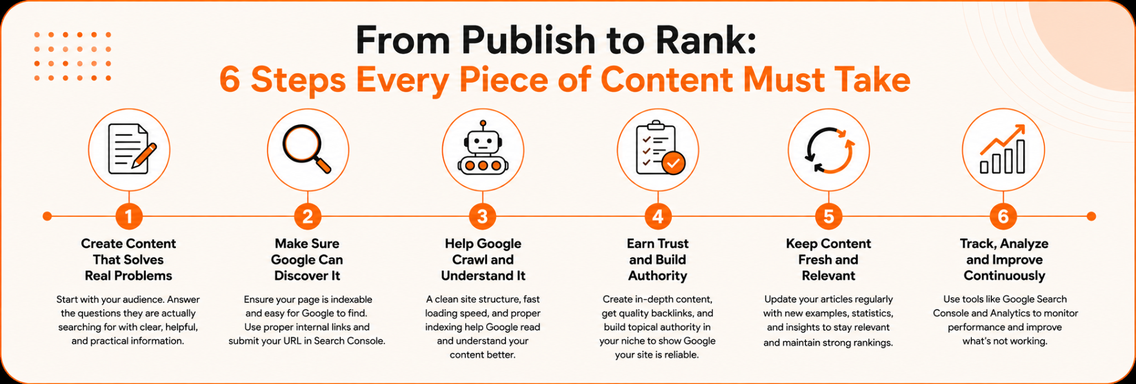
Think of your article as a new applicant interviewing for a job. Submitting the application doesn’t guarantee an interview. It simply puts your name into the process. Your content follows a similar journey. Before Google can rank a page, it first needs to discover it, crawl it, understand what it’s about, and decide whether it’s worth adding to its search index. Only after that does it compete against other pages targeting the same topic.
If any step is interrupted, your article may never have a real chance to rank. This explains why many website owners experience Google indexing issues without realizing it. They keep publishing new blogs, assuming the previous ones simply weren’t good enough, when the real problem may lie elsewhere. Understanding that difference changes the way you approach SEO. Instead of writing more content immediately, you begin looking at the factors that influence whether Google can actually use your content in search results.
Why Your Content Might Never Reach the Ranking Stage
Many people assume the hardest part of SEO is writing a good article. In reality, getting your content noticed is often the bigger challenge. Google doesn’t automatically treat every published page as ranking-worthy. It evaluates whether the page can be trusted, whether it offers something useful, and whether it deserves a place in search results. If those signals aren’t strong enough, the page may stay invisible, even if the writing itself is solid. This is why people often search why Google is not indexing my website after publishing several blogs with little or no traffic. The problem isn’t always the content. Sometimes Google simply hasn’t processed the page the way you expected.
Your Content Should Solve a Problem, Not Fill a Space
Here’s an honest question. Why did you write your latest blog? If the answer is, “Because we needed another article this week,” that’s a warning sign. Successful content begins with the reader, not the publishing calendar. Someone searching online is trying to solve a problem, compare options, or understand something better. They aren’t looking for another article that repeats the same advice they’ve already read five times.
Before you start writing, think about the questions your audience is likely asking. Then answer those questions clearly, using examples and practical advice instead of generic statements. When readers finish your article feeling like they’ve learned something useful, you’ve already taken a step in the right direction.
Don't Ignore the Clues Google Gives You
Imagine driving a car while ignoring every warning light on the dashboard. It wouldn’t be a smart idea. Yet many website owners do something similar with their SEO. They publish content month after month but rarely check Google Search Console indexing reports. Those reports can reveal pages that haven’t been indexed, crawl errors, or technical issues preventing Google from understanding your website properly. Instead of guessing why rankings have stalled, use the information Google is already providing. Once you’ve confirmed that search engines can discover and process your pages correctly, the next step is making your entire website more trustworthy. That’s where many businesses unknowingly fall behind their competitors.
Build Authority Instead of Chasing Every Keyword
Once Google can crawl and understand your website, another question comes into play.
Why should it trust your content over everyone else’s?
That’s where many websites struggle. They publish articles on every trending topic they can find. One week it’s SEO, the next it’s social media, then email marketing, and after that website design. While each article may be helpful on its own, together they don’t build a clear area of expertise. Google prefers websites that consistently demonstrate knowledge within a subject. If your business offers SEO, create content that explores different parts of search optimization instead of jumping between unrelated topics. Over time, those connected articles help establish topical authority, making it easier for Google to understand what your website is known for.
Don't Let Your Best Content Collect Dust
Writing a new blog isn’t always the smartest move. Sometimes the page that needs attention is one you’ve already published. Search habits change. Competitors improve their articles. New information becomes available. If your content stays the same for years, it slowly loses its value, even if it ranked well in the past. Instead of constantly asking, “What should we publish next?” ask, “Which article could be more useful today?” Updating existing content with fresh examples, clearer explanations, better formatting, and current information often delivers stronger long-term results than producing another average blog. Quality improvements almost always beat quantity.
Good Content Needs a Strong Foundation
Many businesses focus all their energy on writing but overlook everything happening behind the scenes. Even an excellent article can struggle if your website loads slowly, important pages aren’t connected properly, or technical issues make it difficult for search engines to understand your content. That’s why SEO isn’t just about keywords. It’s also about website structure, user experience, page performance, and technical optimization. This is where experienced SEO services become valuable. Instead of guessing why rankings have stalled, professionals can identify the underlying issues, improve your website’s technical health, and build a strategy that supports both users and search engines.
Creating great content is important. Making sure Google can easily discover, understand, and trust that content is just as important. The final step is knowing how to evaluate every article before it goes live. A simple review process can prevent many common SEO mistakes before they affect your rankings.