
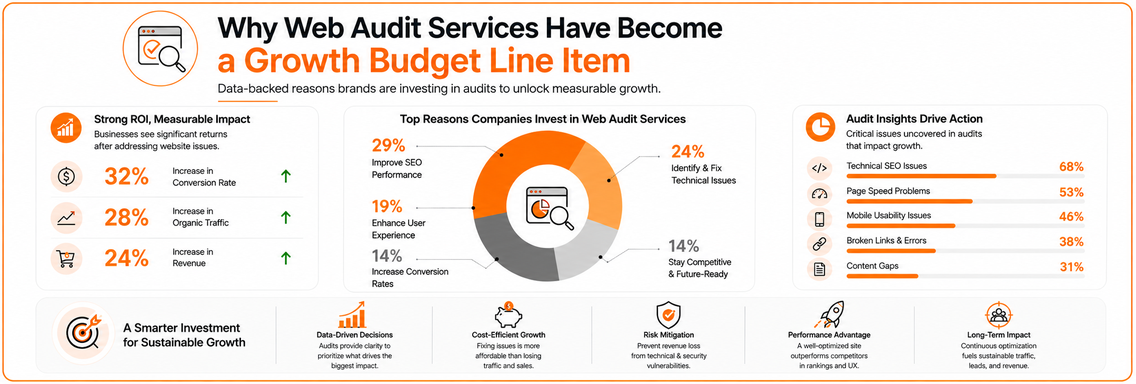
A 2024 to 2033 market forecast puts the global website audit service market at USD 2.42 billion in 2024, on track for USD 10.04 billion by 2033, with a 17.1% CAGR from 2025 to 2033 Business Research Insights. That kind of growth tells you something blunt, website audits are no longer a cleanup exercise after launch, they’re a recurring growth function tied to SEO, conversion paths, performance, and technical remediation.
Teams usually learn that the hard way. A site can look fine in a board deck and still lose traffic, waste paid media spend, frustrate users, and bury revenue because the underlying architecture is messy, slow, or hard to index. The best web audit service work turns those issues into a fix list developers can use, then ties the fixes to measurable business outcomes.
Why Web Audit Services Have Become a Growth Budget Line Item
The market keeps expanding because the underlying problems are still common. An industry review citing a 2025 WebAIM Million analysis says 94.8% of the top one million homepages had detectable WCAG 2.2 Level A/AA accessibility failures, with an average of 51 accessibility errors per page WhiteHat SEO review. That same review also cites a 2026 audit sample of 100,000+ websites where only 6.8% earned an A score, the median score was 71/100 (C+), 71.2% failed a critical performance check, and 58.4% failed mobile Largest Contentful Paint specifically.
Those numbers explain why audits keep moving out of the “fix it later” bucket. If a site is carrying technical debt, accessibility debt, and performance debt at the same time, the problem is not a single broken page. It is a system that needs structured triage, clear ownership, and fixes that can be implemented.
Why the budget conversation changes
“Practical rule: if the site influences demand generation, ecommerce revenue, or lead quality, an audit should be treated like a recurring operating expense, not a one-off rescue project.
For ecommerce teams, that usually means product pages, collection templates, and checkout paths. For B2B teams, it is service pages, landing pages, forms, and CRM handoff. In both cases, the audit only matters if it helps people remove friction that blocks discovery or conversion.
The budget case gets stronger when the work is framed around faster load times, better crawlability, cleaner indexation, and fewer dead ends in the conversion path, not just “SEO cleanup.” The market forecast from Business Research Insights points in the same direction, since organizations are budgeting for this service as an ongoing line item rather than a one-time purchase Business Research Insights.
A useful way to judge the shift is simple. The more channels you buy, the more expensive hidden site issues become. Paid traffic sent to slow, confusing, or poorly structured pages raises acquisition cost without creating more demand. Organic traffic sent to pages search engines cannot confidently crawl or index never gets a fair shot at conversion.
The gap is usually not in diagnosis, it is in execution. A web audit service should produce implementation-ready specifications, not a long list of findings that sit in a slide deck. That matters because a site can look healthy on paper and still miss the business questions leaders care about, which is the point raised in what business owners often miss.
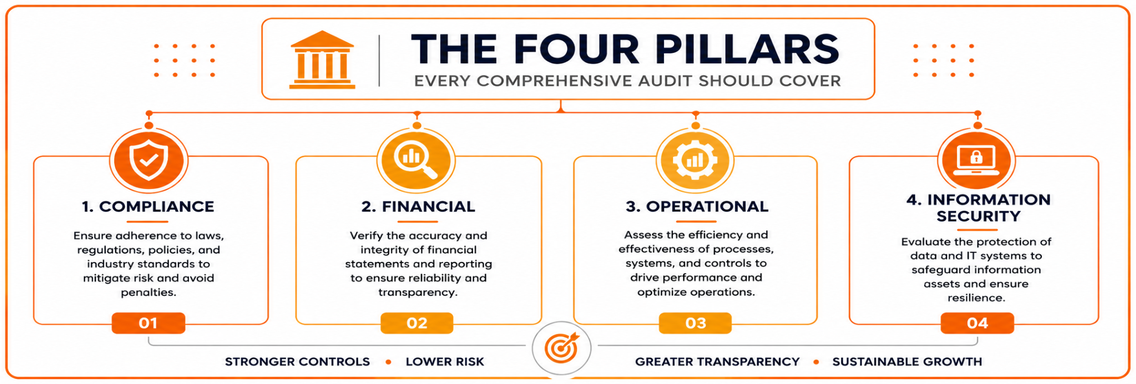
The Four Pillars Every Website Audit Should Cover
A web audit service that earns its keep does more than run a crawler and hand over warnings. It has to show whether search engines can reach the right URLs, whether users can move through the site without friction, whether pages load fast enough to feel usable, and whether the experience still works for people using assistive technology. If the report stops at findings, the team still has to guess at what to fix first and how those fixes connect to revenue. That gap is where audits usually fall short, and it is why stronger programs now sit closer to a search visibility strategy than a narrow SEO checklist, as outlined in this view of search visibility strategy.
Technical SEO and crawlability
This is the foundation. Auditors should verify robots.txt, XML sitemaps, redirect chains, internal linking, and canonical tags, then compare those signals with Google Search Console coverage and crawler output OuterBox. If those pieces conflict, the search engine may see the wrong page, miss the right one, or spend crawl budget on duplicates that should never have been indexed.
Canonicalization matters more than many teams expect. A page can look fully published to the content team and still split equity across competing URLs if the canonical tag, internal links, and redirect logic are not aligned.
Performance and Core Web Vitals
Google’s commonly used benchmarks are LCP ≤ 2.5 seconds, INP ≤ 200 ms, and CLS ≤ 0.1 OuterBox. Strong audits do not stop at a sitewide average, they trace the problem to the template, script, image, or font pattern causing it. That is the difference between a useful specification and another generic performance note.
“A slow hero image on a homepage template is a template problem, not a vague “speed issue.”
That distinction matters because developers can act on a template, but they cannot do much with a report that only says the site is slow. A good web audit service should identify the exact page pattern, asset type, or script behavior that needs to change, then spell out the fix in terms a build team can use.
Accessibility and user paths
Accessibility checks should look for the patterns that block real users, not just automated flags. The WebAIM figures show how widespread the issue is at scale, which is why a serious audit needs to include semantic structure, contrast, labels, keyboard flow, and error handling WhiteHat SEO review. In practice, that also helps conversion, because the same gaps that frustrate assistive technology users often frustrate everyone else too.
A good audit should also check the business path, not just the page itself. Forms, product discovery, service navigation, and checkout friction need to be examined as a flow. If a user cannot move from interest to action cleanly, the site is leaking opportunity even if the homepage looks polished.
A useful test for scope is simple. If a proposal only covers crawl errors and page titles, it is not a full evaluation. If it covers technical SEO, performance, UX flow, and accessibility together, it is starting to look like a real audit that can be implemented, measured, and tied back to business outcomes.
The Emerging Dimension of AI Visibility and Answer Engine Readiness
Traditional audit scopes still overfocus on blue-link SEO. That leaves a gap, because a page can be indexable, fast enough, and accessible, yet still be weak in AI-mediated discovery.
Why conventional SEO checks aren’t the whole story
A useful audit now has to ask a second question after crawlability: can the page be quoted, summarized, or used as a source by answer engines? That lens sits alongside classic checks for technical health, but it changes what a team looks for in the content itself. A page can rank respectably and still fail when systems try to extract a clean answer.
Pages written only for human scanning often create that problem. They bury the answer, rely on vague headers, or leave entity relationships unclear, so a machine can crawl them without confidently interpreting them. That is the gap between being findable and being usable in synthesized results.
The practical shift is already visible in broader search visibility planning, not just keyword work. A search visibility strategy asks how the site performs across traditional rankings, AI summaries, and other discovery surfaces, which is closer to how buyers now encounter information. For audit work, that means the question is no longer only whether a page exists in the index, but whether it is structured well enough to be pulled into a response.
What to ask an audit provider
A serious provider should be able to explain how it evaluates content for being cited or summarized by AI systems. That usually means looking at structured data quality, the clarity of definitions, consistent terminology, and whether the page makes entity relationships obvious enough for retrieval systems to understand.
“If the content is hard for a smart editor to summarize, it is usually hard for an answer engine too.
The trade-off is practical. Teams can spend all their time tuning for classic rankings and still miss the discovery layer buyers are already using. They can also overcorrect and chase every new surface without a clear standard for what should change on the page.
A better audit asks for implementation-ready guidance. Which sections need rewriting for direct answers, which terms need to be defined more consistently, which schema elements are missing, and which pages should be reviewed first because they matter most for visibility in AI-driven results. That gives the content team something they can ship, rather than another broad recommendation with no execution path.
That distinction matters because the work is not just being visible. It is being understandable, summarized correctly, and still measurable after the fix goes live.
What Strong Audit Deliverables Actually Look Like
A weak audit hands over a PDF, a spreadsheet full of warnings, and a vague suggestion to prioritize technical fixes. That is documentation theater. An implementation-ready deliverable looks more like a technical specification that a developer, SEO lead, designer, or analyst can act on immediately.
From findings to fixes
Strong audit workflows recommend exporting crawl results into a structured table, prioritizing errors by impact, linking each issue to documentation or examples, and assigning the fix to the right specialist Serpstat. That matters because the visible symptom is often not the root cause. A 404 might come from deleted content, a migration redirect failure, or a rewrite rule problem.
When audits stop at symptom reporting, teams waste time triaging. When the audit correlates crawl data with server logs, Search Console data, and real-user performance data, the root cause becomes much easier to isolate.
What to expect in the deliverable
An implementation-grade package usually includes:
- Priority ranking by business impact, not just technical severity.
- Clear ownership, so the fix lands with the right specialist.
- Evidence for each issue, including example URLs or screenshots.
- Documentation links, so the team can validate the recommendation.
- Dependencies and sequencing, so a developer does not patch the wrong layer first.
A generic report often skips those details. It tells you what is broken, but not what to fix first, who should fix it, or what data proves the issue matters.
| Audit Deliverable Quality Comparison | Generic Report | Implementation-Ready Specification |
|---|---|---|
| Issue framing | Lists errors in bulk | Prioritizes by business impact |
| Ownership | No clear assignee | Maps each fix to the right specialist |
| Evidence | Automated warnings only | URLs, examples, logs, and screenshots |
| Root cause analysis | Usually absent | Links symptom to underlying cause |
| Execution support | Vague recommendations | Developer-ready next steps |
A useful benchmark is simple. If the document still needs a senior strategist to translate it before work can begin, it is not finished. A stronger audit package should also connect the fix list to downstream commercial work, for example by showing where a technical issue overlaps with a conversion leak, the kind of pattern a conversion rate optimization review from Excellorix is meant to surface. That keeps the deliverable focused on revenue impact, not just issue volume.
Connecting Audit Findings to Revenue Measurement and Attribution
The primary question is how quickly a fix changes conversion or revenue, and how the team will prove it after launch. Many audit reports stop at diagnosis. The better ones define what success looks like before a developer writes the first line of code.
Measurement has to be set before the fix ships
A web audit service should connect findings to the measurement plan before implementation starts. If that step is skipped, the team can improve a CTA, reduce form friction, or clean up page copy and still have no clean read on whether the change affected CAC, ROAS, or pipeline quality.
The practical setup starts with the event path. It also needs an agreed post-launch window, so the team knows when to check results and what level of change counts as meaningful. Without that, reporting turns into a guess based on partial signal.
What attribution should cover
A usable post-fix setup usually includes:
- Event tracking, so the team can see which actions changed.
- Lead quality checks, not just raw form submissions.
- Experiment design, where possible, so changes are testable.
- Post-launch monitoring, to catch regressions early.
- Channel-level review, so paid, organic, and direct behavior are interpreted correctly.
“A fix that increases traffic but lowers qualified leads is not a win.
That problem shows up often in B2B and ecommerce audits. Teams celebrate a lift in surface metrics, then discover the new traffic is less qualified or the form change pulled in weaker leads. A useful audit should force that conversation early, because the revenue result is what matters.
The measurement conversation should also include where the fix sits in the customer journey. A technical issue on a high-intent page has a different business effect than the same issue on a top-of-funnel page. A solid review of conversion rate optimization and revenue leaks helps frame those trade-offs, since it ties site issues to commercial loss instead of treating them as isolated defects.
The standard is accountability. If the audit recommends a fix, the team should know which metric it is expected to move, how long to wait before judging it, and what signal will confirm the change worked. That is the difference between an audit that documents problems and one that supports business decisions.
What to Expect During a Professional Audit Engagement
A professional engagement usually starts with access, not analysis. The auditor needs crawl access, analytics access, Search Console access, and enough context from the client team to understand which pages, funnels, and markets matter most. If the client can’t provide that, the audit will still find issues, but it may miss the ones that matter most.
The engagement usually moves in phases
The first phase is discovery. The client and auditor align on goals, platforms, market segments, and known pain points. Then the audit team crawls the site, reviews templates, compares search signals, and checks performance and accessibility patterns across representative page types.
The next phase is synthesis. Good auditors separate noise from real problems, compare findings across tools, and decide which issues deserve attention first. It’s also where incomplete analytics, limited staging access, or missing historical context can slow the work down.
” The cleanest audit findings usually come from teams that share data early and let the auditor see both production behavior and implementation constraints.
The final phase is handoff. A serious provider doesn’t just drop a file and disappear. It walks the client through findings, recommends sequencing, and helps the implementation team understand what can be fixed quickly versus what needs deeper development work.
Where engagements often get stuck
Most friction comes from avoidable gaps:
- Incomplete analytics access makes revenue attribution harder.
- No staging environment limits safe verification.
- Siloed teams delay ownership decisions.
- Old migrations or redesigns complicate root-cause analysis.
This is why the best audits feel collaborative. The auditor isn’t trying to become the owner of every fix. The job is to produce clarity, reduce rework, and hand implementation teams something they can trust.
When that happens, the audit stops being a report and starts functioning like a working document for change.
How to Evaluate and Select the Right Web Audit Service Partner
Start with the provider’s logic, not its tool stack. A real partner should be able to explain how it prioritizes findings, how it links issues to business impact, and how it turns raw data into implementation steps. If the conversation stays stuck on crawling software and generic scorecards, you’re probably looking at a report seller, not a strategy partner.
Questions that separate real operators from checkbox vendors
Ask how they handle prioritization. Ask how they assign fixes to the right specialist. Ask whether they correlate crawl data with logs, analytics, and real-user data. Then ask what they do after the audit to help your team verify the fixes.
A strong provider should also understand your business model. Ecommerce, B2B, healthcare, and industrial sites all fail in different ways, and the best recommendations reflect that. A good partner knows when a CRO issue belongs in a design sprint, when a technical fix belongs with engineering, and when the problem is really measurement.
What to look for before you sign
- Business KPI alignment, not just technical scoring.
- Implementation-ready deliverables, not a generic PDF.
- Proof of post-audit support, especially for complex sites.
- Experience in your platform and industry, so the findings are relevant.
- Transparent pricing and scope, so there are no surprises after kickoff.
- Measurement discipline, so fixes can be validated after launch.
The wrong choice usually looks efficient at first. The provider delivers a fast report, uses impressive terminology, and highlights dozens of issues. Then your team spends weeks translating it into work, and nobody can prove whether the fixes changed revenue.
A better choice is a partner that treats the audit as the start of a measurable improvement cycle. Excellorix works in that lane by combining website design and development, SEO, and conversion optimization under one delivery model, which is useful when the fix requires both technical changes and revenue-oriented testing.
If your site has traffic, leads, or sales riding on it, don’t settle for a report that creates more questions than answers. Visit Excellorix to talk about a web audit service that connects technical findings to implementation, measurement, and real business outcomes.