Skip to content



Ask a business owner how their website is performing, and you’ll usually hear one of two answers.
“We’re getting more traffic.”
Or:
“We’re ranking for more keywords.”
Neither answer is wrong. The problem is that neither answer tells the full story. Over the years, I’ve noticed something interesting. Many businesses spend a lot of time reviewing website reports but very little time asking whether those reports actually reflect business growth. A website can attract thousands of visitors every month and still struggle to generate qualified leads. It can rank well on Google and still fail to support sales. It can even look modern and professional while quietly losing opportunities every day. That is why evaluating website performance has become much more important than simply checking traffic numbers. Today’s websites do far more than provide information. They build trust, answer questions, support sales conversations, and influence purchasing decisions. In many cases, your website becomes the first employee a potential customer interacts with.
And like any employee, performance should be measured by results, not activity. This is one reason more businesses are investing in conversion rate optimization services and conducting a detailed website conversion audit. They want to understand not only how many people are visiting their website, but also what those visitors are doing once they arrive and where opportunities for conversion funnel optimization exist. The challenge is that many business owners are looking in the wrong places for answers
The Traffic Trap Most Business Owners Fall Into
Traffic is easy to understand. If the numbers go up, it feels like progress. That is why traffic reports often become the centerpiece of marketing discussions. But traffic can sometimes create a false sense of confidence. Imagine owning a retail store in a busy shopping center. People walk through the doors every day. They browse products. They spend time looking around. Then they leave. Very few make a purchase. After a while, you probably would not care how many people entered the store. You would want to know why they were not buying. The same thing happens online. A website may attract visitors through SEO services, paid advertising, referrals, social media, or content marketing. Yet if those visitors are not taking meaningful actions, the traffic itself becomes far less valuable. One business owner we worked with saw website traffic increase consistently for almost six months. Every report looked positive. The problem? Lead volume stayed almost exactly the same. After reviewing visitor behavior, it became clear that people were landing on the website, exploring a few pages, and leaving without finding a clear next step. The issue was not visibility. The issue was performance. That distinction matters.
The Data Many Businesses Never Look At
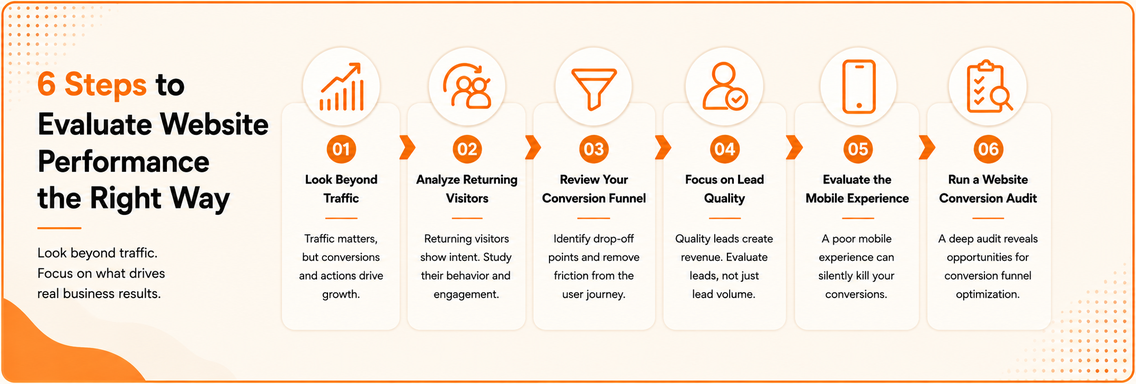
Most analytics platforms provide more information than the average business owner will ever use. The challenge is knowing which data actually matters. Many businesses focus heavily on new visitors. New traffic feels exciting because it suggests growth. What often gets ignored is returning traffic. Think about your own buying habits. Most people do not discover a company and immediately make a purchase. They research. They compare options. They get distracted. Then they come back later. Your customers behave the same way. Returning visitors are often some of the most valuable people on your website because they have already shown interest. Looking at visitor behavior through the lens of meaningful website performance metrics often reveals a very different story than traffic reports alone. Questions worth asking include:
- Do returning visitors spend more time on the website?
- Which pages do they visit most often?
- Do they convert at a higher rate?
- What content keeps bringing them back?
Sometimes the answers reveal opportunities that traffic reports completely miss.
Why Good Leads Matter More Than More Leads
Another common mistake is treating every lead equally. On paper, more leads sounds great.
In reality, not all leads have the same value. A website generating fifty qualified inquiries may outperform a website generating two hundred unqualified inquiries. This is where meaningful website performance metrics become much more valuable than simple lead counts. Metrics tied to lead quality, engagement, and buying intent often provide deeper insights than raw traffic numbers. The goal is not simply generating inquiries. The goal is generating opportunities. That is a very different objective. A sales team does not benefit from spending hours sorting through poor-fit inquiries. They benefit from speaking with people who actually need their services. That is why businesses should focus on lead quality alongside lead quantity when evaluating website performance.
The Mobile Experience Nobody Checks
Here is a surprisingly common situation. A business owner reviews website performance and everything appears normal. Traffic looks healthy. Conversions seem acceptable. Nothing appears unusual. Then someone reviews device-level data. Suddenly, a different story appears. Desktop visitors convert at a healthy rate. Mobile visitors struggle. Considering that mobile traffic now accounts for a significant percentage of website visits, this can become a serious growth issue. The challenge is that mobile issues are often subtle. A button may be difficult to tap. A form may require too much scrolling. Important information may be buried lower on the page. None of these issues seem dramatic on their own. Together, however, they can quietly reduce conversions. That is why evaluating performance by device often reveals insights that overall averages hide.
What a Website Conversion Audit Often Reveals
Most business owners know when something feels off. Traffic may be growing. Marketing campaigns may be generating clicks. The website may even look better than it did a year ago. Yet results fail to match expectations. This is usually where a website conversion audit becomes valuable. A professional website conversion audit often uncovers issues that business owners never realized existed. A form may ask for too much information. A call-to-action may be unclear. A pricing page may create uncertainty. Mobile visitors may experience usability issues that desktop visitors never encounter. The interesting part is that many of these problems remain invisible until someone takes a closer look. Businesses often assume they need more traffic when the real opportunity lies in improving what happens after visitors arrive.
Looking Beyond Numbers and Understanding Behavior
Numbers matter. Reports matter. Data matters. But numbers alone rarely tell the full story. Behavior often provides the missing context. Why are visitors leaving certain pages? Why do some pages perform better than others? Why are users abandoning forms? Why do some traffic sources convert more effectively than others? This is where conversion funnel optimization becomes valuable. By understanding how visitors move from awareness to consideration and eventually to action, businesses can identify opportunities that traditional analytics reports often overlook. The goal is not simply collecting data. The goal is learning from it.