Skip to content



A managing partner opens the monthly pipeline report and sees the same pattern again. A smaller competitor, with less obvious depth, appears above the firm for the searches that matter, then receives the enquiry before anyone on the partner team knows a buyer was looking. The issue isn’t necessarily expertise. It’s that the competitor has made its expertise easier to find, understand, and trust.
SEO for professional services should be treated as a lead-generation efficiency system, not a traffic contest. Search is unusually important in this market: one study found that paid and organic search together drove 75% of inbound traffic for professional services firms, while organic search converted at over 12.3% for inbound calls and form submissions, compared with a 1.7% average conversion rate across channels (Ruler Analytics professional services marketing statistics).
The practical question is simple: which pages attract qualified demand, prove the firm can solve the problem, and make the next conversation easier? The playbook below answers that question across service architecture, technical foundations, authority, local visibility, measurement, and implementation.
Why Professional Services Firms Need a Different SEO Playbook
A law firm, consultancy, accounting practice, or specialist healthcare provider doesn’t sell a standard product from a shelf. The buyer may need partner approval, internal consensus, regulatory review, or a significant commitment of time and money before making contact. The sales cycle is trust-heavy and inquiry-based, so a page that attracts the wrong visitor can consume senior staff capacity without creating commercial value.
That changes what every important page must do. It should perform at least one of three jobs:
- Capture existing demand: Reach someone searching for a defined service, jurisdiction, industry, or problem.
- Create demand through authority: Explain an emerging issue well enough that a buyer recognises the firm as a credible option.
- Qualify the enquiry: Set expectations around fit, scope, location, experience, and the next step before a consultation.
E-commerce can often optimise around product discovery, price, availability, and checkout friction. Professional services sites must communicate judgment, experience, credentials, and risk management. Thin copy, vague claims, and generic bios don’t merely underperform. They can make the firm look less capable than it is.
Search visibility is part of reputation
Search has become a discovery layer for service buyers. A market-facing report found that 78% of service buyers conduct an online search before deciding, while 92% of online searchers choose businesses on the first page (service-based business marketing statistics). The same report notes that 57% of B2B businesses receive more leads from search engines than from any other source.
That means the competitor appearing first is shaping the shortlist before a partner speaks to the buyer. Your website needs to answer the questions a prospect asks during comparison, not just announce that your firm offers a service.
AI search makes the evidence standard stricter. As buyers increasingly encounter summarised answers and recommendations, firms need clear service definitions, named subject-matter experts, visible credentials, and consistent references beyond their own domain. Keyword repetition won’t establish who is qualified to advise on a complex matter.
” Practical rule: Build every page for the buyer who may forward it to a colleague, a general counsel, a CFO, or a procurement lead and ask, “Why this firm?”
The rest of the program should therefore optimise for qualified inbound, not sessions alone. A page with modest traffic and strong enquiry intent can be more valuable than a popular article that produces no commercially relevant conversation.
Mapping Service Pages and Personas with Search Intent
Start with a service-to-search map before commissioning content. Don’t begin with a list of high-volume keywords. Begin with the work the firm wants more of, the language buyers use, and the people involved in the decision.
Build the map in three passes
First, list services in buyer language. Internal labels often obscure intent. “Restrictive covenant advisory” may be accurate inside a legal practice, but “employment lawyer for non-compete disputes” is closer to how a prospective client might search. Record the formal service name, buyer phrasing, industry context, geography, and the commercial outcome.
Next, separate intent. Commercial searches signal provider evaluation, such as “hire M&A advisor” or “commercial litigation solicitor.” Informational searches ask for understanding, such as “how to value a SaaS company.” Navigational searches look for a known firm, professional, office, or resource. Each type needs a different page and call to action.
Then, attach a persona. A general counsel may need jurisdiction, risk, and precedent. A founder may need speed, cost clarity, and practical guidance. A CFO may focus on financial exposure and implementation. An HR lead may search for a narrowly defined employment issue before involving legal leadership.
A regional accounting firm, for example, shouldn’t place “tax preparation” and “R&D tax credit consultant” on one broad page. The first may serve an individual or small-business buyer looking for recurring compliance support. The second may serve a finance leader or founder looking for specialist advice tied to eligible development activity. Different intent, different proof, different conversion path.
Use architecture to prevent cannibalisation
A single subject can support several pages without creating duplication. Consider SaaS valuation:
- A pillar guide explains the valuation process, key methods, and decision factors.
- A SaaS valuation advisory service page targets buyers seeking help.
- An M&A valuation page addresses transaction-specific requirements.
- A fundraising valuation page addresses founders preparing for investment.
- A supporting post answers “how to value a SaaS company.”
- Another explains common valuation mistakes during diligence.
The pillar should link to the services, while each service page links back to the relevant explanation and proof. Don’t create three pages that all target the same broad phrase with interchangeable copy.
| Service | Primary Intent | Example Queries | Target Persona | Page Type |
|---|---|---|---|---|
| Employment disputes | Commercial | employment lawyer for non-compete disputes | General counsel, HR lead | Service page |
| SaaS valuation | Informational and commercial | how to value a SaaS company, SaaS valuation advisor | Founder, CFO | Pillar guide plus service page |
| R&D tax credits | Commercial | R&D tax credit consultant | CFO, finance director | Specialist service page |
| Office location | Navigational | firm name city office | Existing referral or shortlist buyer | Location page |
| Due diligence | Commercial | M&A due diligence advisor | Founder, CFO, acquirer | Service deep dive |
Use the resulting map to decide what deserves a landing page, what belongs in thought leadership, and what should remain a navigational resource. Neutral benchmark data places commercial and professional services landing pages at a 6.1% median conversion rate, while service landing pages average 2.7% SEO conversion and the broader SEO average is 2.4% (Unbounce professional services conversion benchmark). The implication is clear: route valuable intent to focused service pages instead of asking generic blog posts to carry the entire acquisition burden.
Technical Foundations That Actually Move the Needle
A professional services firm doesn’t need a theatrical 200-point audit before fixing obvious barriers. Start with the technical problems that prevent important pages from being crawled, understood, loaded, or used.
Clean the crawl and index
Review robots.txt, XML sitemaps, canonical tags, redirects, status codes, and indexation in Google Search Console. Split sitemaps by content type where useful, such as services, locations, experts, and articles, so the team can identify which section is accumulating errors or weak pages.
Then remove or consolidate thin practice-area pages. A firm with separate pages for every minor variation, office, and legacy service can scatter internal authority across URLs that offer little distinct value. Orphaned pages, old campaign URLs, duplicate bios, and faceted resource filters deserve particular scrutiny.
For a structured audit workflow covering crawl, indexation, on-page elements, and performance checks, use this 2026 SEO audit checklist.
Prioritise experience signals
Google documents Core Web Vitals as real-world signals covering loading, interactivity, and visual stability (Google’s Core Web Vitals documentation). In practical terms:
- LCP asks how quickly the main content appears.
- INP reflects how promptly the page responds to interaction.
- CLS measures whether content shifts unexpectedly while loading.
Benchmark important service and location pages with a crawl, PageSpeed Insights, and Search Console. Fix oversized images, render-blocking resources, unnecessary scripts, unstable fonts, and layout shifts before producing a large content backlog. Mobile performance deserves priority because buyers often research a firm between meetings, while a slow consultation page can lose the enquiry before the visitor reads the proof.
Make entities understandable
Use relevant structured data for services and experts, including ProfessionalService, LegalService, FAQ, and Person where the markup accurately reflects visible page content. Person profiles should identify real credentials and expertise. Review markup requires particular care, especially where professional rules restrict how testimonials or ratings may be presented.
Firm sites also commonly publish boilerplate attorney bios across several offices. Give each expert a distinct profile with practice focus, jurisdiction, experience, publications, speaking activity, and links to relevant service pages. Schema supports machine interpretation, but it can’t compensate for thin or duplicated visible content.
Content Pillars and Thought Leadership That Earn Authority
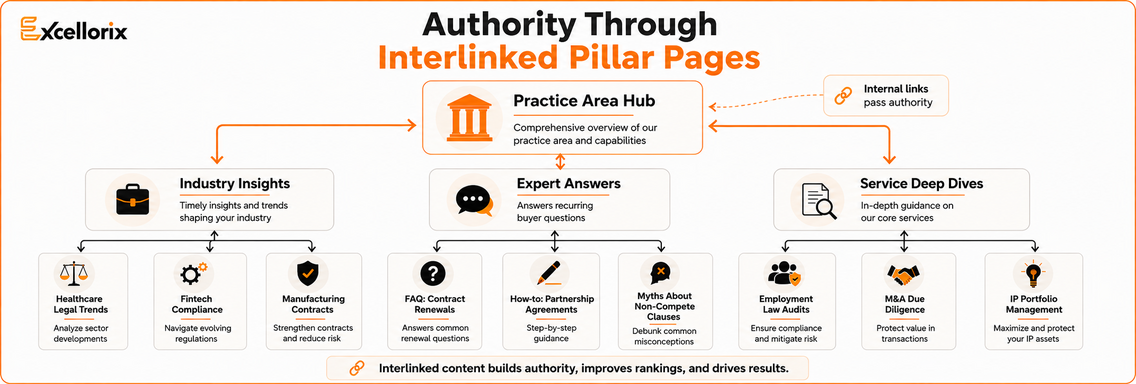
Professional services authority compounds when the site demonstrates depth around a defined practice area, industry, and set of buyer questions. A disconnected stream of articles may attract impressions, but a structured knowledge system helps both buyers and search systems understand what the firm knows.
Build hubs around commercial themes
Take an M&A advisory practice. The main hub should explain the service, the situations it covers, the people involved, the firm’s approach, and the evidence a buyer needs before contacting the team. Supporting pages can cover due diligence, earnouts, integration planning, valuation, and relevant regulatory developments.
Each supporting page should link back to the hub and across to related service pages, case material, and consultant bios. A due diligence article should point to the due diligence service, the relevant M&A advisors, and a related explanation of transaction risk. Internal links should help a buyer progress from question to evaluation, not merely distribute links for search engines.
A firm should also organise content by audience and industry where those distinctions change the advice. A healthcare compliance hub won’t answer the same concerns as a fintech compliance hub, even if both sit within regulatory consulting.
Make authors visible and accountable
AI-generated search experiences increase the importance of extractable evidence, author credibility, and off-site references, as discussed in Forrester’s analysis of AI search and B2B accountability. Put the author’s name, role, credentials, relevant experience, and professional profile directly on substantive articles. Link the author to a complete bio, and connect that bio to the services and topics they cover.
Long-form explainers outperform short posts when the buyer needs context, trade-offs, and a defensible recommendation. That doesn’t mean every article should be lengthy. It means the page must answer the primary question and likely follow-up questions, including how to compare providers, verify experience, assess jurisdiction, and decide whether specialist support is necessary.
” Editorial standard: If a partner wouldn’t attach their name to the advice in a client email, don’t publish it under the firm’s brand.
Refresh flagship pages on a recurring editorial schedule. Update regulatory references, examples, internal links, author details, and calls to action. Retire pages that add no distinct value, then redirect or consolidate them into a stronger resource. Teams that need a practical operating model can compare this content marketing approach for lead generation, then adapt it to their practice structure.
Local Signals, Reviews, and Link Earning for Service Brands
A firm serving defined cities, jurisdictions, or regional industries needs local visibility that matches its actual footprint. The priority isn’t creating a location page for every place mentioned in a partner biography. It’s making each genuine office and service area clear, credible, and easy to contact.
Start with Google Business Profile. Verify the firm name, category, address, phone number, hours, website, services, photos, and office-specific landing page. Multi-office firms should maintain distinct profiles only where they have legitimate staffed locations. Each profile should point to the correct location page, not a generic homepage.
Reviews require governance. Create a repeatable request process for appropriate clients, but don’t script praise, pressure clients, or make claims that breach professional conduct rules. Ask for an honest account of the service experience, provide a direct review route, and let the client decide. The firm should monitor patterns in feedback rather than treating review collection as a one-off campaign.
For a detailed process covering profile completeness, categories, services, and local consistency, use this Google Business Profile optimisation guide.
Earn references that strengthen the brand
Quality beats quantity in local citations. Correct listings on professional associations, chambers, legal directories, industry bodies, and reputable business publications are more useful than a mass submission to low-quality directories. Keep the firm name, address, phone number, and service descriptions consistent, but don’t mistake directory volume for authority.
The strongest links usually come from real expertise:
- Regulatory commentary: Provide useful analysis when a rule or policy changes.
- Original research: Publish a survey, benchmark, or practical market review that others can cite.
- Partner bylines: Contribute helpful analysis to respected business or industry publications.
- Professional participation: Turn speaking, association work, and event contributions into accurate profile pages and references.
| Tactic | Compounding Value | Typical Effort | Conversion Influence |
|---|---|---|---|
| Reputable industry publication | High | High | High |
| Original research with media outreach | High | High | High |
| Professional association profile | Medium | Low | Medium |
| Local chamber or business listing | Medium | Low | Low to medium |
| Generic directory submission | Low | Low | Low |
| Partner byline with relevant audience | High | Medium | Medium to high |
Judge every placement by audience relevance, editorial credibility, permanence, and the likelihood that a prospective client will encounter it. A link that reinforces a specialist’s authority can support both search visibility and buyer confidence.
Measuring What Matters Beyond Rankings and Traffic
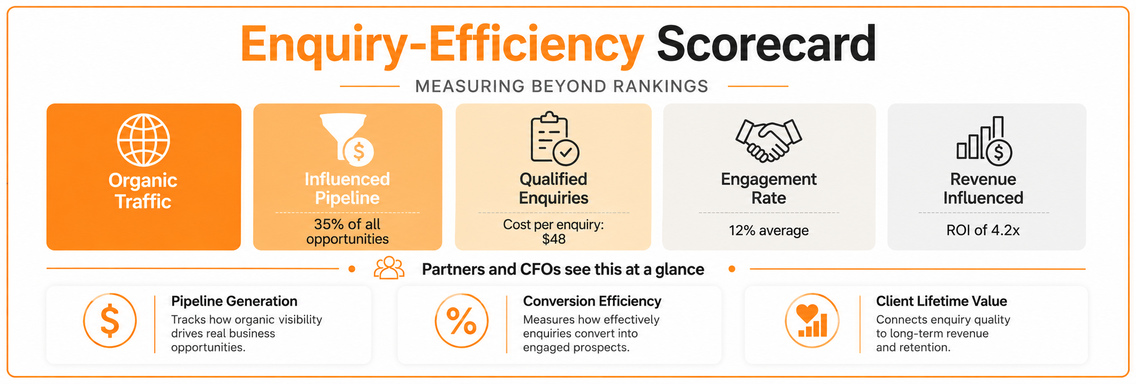
A partner doesn’t fund SEO to admire a line chart of impressions. The reporting model should connect organic discovery to qualified conversations, pipeline stages, and revenue influence.
Build the scorecard in layers:
- Visibility: Track non-branded search exposure, priority service terms, and the pages appearing for valuable intent.
- Engagement: Measure meaningful actions such as service-page visits, expert-profile views, consultation starts, calls, and form submissions.
- Qualification: Separate relevant enquiries from students, job seekers, vendors, duplicate submissions, and matters outside the firm’s scope.
- Pipeline: Connect source, landing page, service line, owner, stage, and opportunity value in the CRM.
- Commercial outcome: Review assisted conversions, influenced pipeline, won matters, and the time between first organic touch and engagement.
A professional services buyer rarely converts in one visit. One person may read an explainer, return through a branded search, review an expert biography, download a guide, and contact the firm after an internal discussion. First-touch attribution overclaims the article. Last-touch attribution overclaims the contact page. A multi-touch view is more useful, provided the team documents its weighting rules and applies them consistently.
Report by service line
The managing partner needs to know which practice areas are attracting the right demand. A monthly report should show:
- Qualified organic enquiries: Count and categorise the enquiries that meet agreed fit criteria.
- Cost per qualified enquiry: Compare SEO investment with the number of commercially relevant enquiries, not raw form volume.
- Assisted conversion paths: Identify the pages that helped a buyer before the final contact.
- Pipeline by practice: Show opportunities influenced by organic search, grouped by service.
- Pipeline velocity: Track movement from enquiry to consultation, proposal, and engagement.
- Content decisions: State which pages will be expanded, refreshed, consolidated, or stopped.
Don’t use a universal conversion threshold to judge every page. Service intent, geography, brand familiarity, urgency, and the quality of the enquiry all affect performance. Benchmark context still matters: the neutral data cited earlier places commercial and professional services landing pages at a 6.1% median conversion rate (Unbounce’s professional services benchmark), but the firm should use its own qualified-enquiry and CRM data for investment decisions.
” Reporting test: If a CFO can’t tell which service line received better-fit enquiries and which content assisted them, the dashboard is measuring activity rather than growth.
A Phased 90/180/365-Day Implementation Plan
A credible SEO program ships in stages. Partners should be able to review what changed, what evidence emerged, and what the team will prioritise next without waiting for a vague promise of future visibility.
Days 1 to 90 build the base
Start with technical triage, indexation cleanup, Core Web Vitals remediation, Google Business Profile governance, citation corrections, and the service-to-persona map. Select the three service pages with the clearest commercial intent and improve their copy, internal links, proof, calls to action, and enquiry tracking.
Instrument analytics and CRM fields at the same time. Capture the first landing page, source, service line, qualification status, and pipeline stage. Without that foundation, later reporting will rely on memory and incomplete attribution.
Days 91 to 180 create authority
Launch a substantial pillar for each priority practice area, then build supporting explainers around recurring buyer questions. Ask partners and subject-matter experts to review content before publication, but give one person editorial ownership so approval doesn’t stall every asset.
Begin digital PR outreach around genuine commentary, original research, conference participation, and useful bylines. The objective is not to collect random links. It’s to make the firm and its experts easier to verify across trusted external contexts.
Days 181 to 365 scale proven clusters
Use the enquiry scorecard to expand clusters that attract qualified opportunities. Refresh service pages that receive relevant visibility but fail to convert, consolidate overlapping articles, improve location pages, and operationalise compliant review requests across offices.
A two-day-per-week developer window limits the number of technical changes the firm can safely ship. Plan around that constraint. Bundle related fixes, reserve time for QA, and avoid launching a content program that creates more templates, filters, and URLs than the development team can support.
| Phase | Focus Areas | Key Deliverables | Owner | Success Metric |
|---|---|---|---|---|
| Days 1 to 90 | Foundation and measurement | Technical triage, service map, profile cleanup, three priority page upgrades, CRM tracking | SEO lead, developer, partner sponsor | Clean priority pages and reliable enquiry categorisation |
| Days 91 to 180 | Authority and attribution | Practice-area pillars, supporting content, expert review workflow, PR outreach, pipeline dashboard | SEO lead, writer, PR contact, subject experts | Qualified organic enquiries and attributable assisted journeys |
| Days 181 to 365 | Scale and optimisation | Cluster expansion, service-page refreshes, consolidation, review process, monthly pipeline readouts | SEO lead, writer, developer, office leads | Stronger pipeline contribution by priority service line |
| Role | Core Responsibility |
|---|---|
| Partner sponsor | Resolve priorities, approve positioning, protect subject-matter access |
| Fractional SEO lead | Own strategy, technical backlog, intent map, and reporting |
| Content writer | Produce service pages, explainers, and refreshes |
| Developer | Ship performance, indexation, template, and tracking fixes |
| PR contact | Secure relevant commentary, bylines, and external references |
The firm should judge the program by the quality and commercial movement of enquiries, not by whether every page reaches a preferred ranking position. A focused roadmap with accountable owners will outperform a larger backlog that no one can publish, measure, or maintain.
Excellorix helps professional services firms connect high-intent SEO, technical remediation, content strategy, conversion optimisation, and reporting tied to leads and revenue. Visit Excellorix to discuss an SEO program built around your priority services, buyer personas, and pipeline data.