


Most small business blogs don’t fail because people aren’t trying hard enough. They fail because the approach is usually wrong from the beginning. A business decides to “start blogging,” publishes a few articles, and expects results to follow naturally. For a short time, it feels like progress. The website looks active, content is going out, and there is a sense that SEO is being handled. But after a few months, things usually look the same. Traffic is inconsistent, leads don’t improve, and the blog slowly becomes something that gets updated only when there is time.
The real issue is that most content is not connected to a clear content marketing strategy for small business growth. It’s created in isolation, without fully understanding what customers are actually searching for or why they are searching in the first place.
When that connection is missing, even well-written content struggles to perform.
Content marketing is often misunderstood as a visibility tactic. More blogs, more keywords, more rankings. But the real purpose is much simpler. It is about helping people make decisions. Before someone contacts a business or buys a service, they usually spend time researching. They compare options, look for clarity, and try to reduce uncertainty. That is exactly where content plays its role.
A strong blog to generate leads doesn’t push for immediate action. Instead, it helps the reader understand their problem better and feel confident about what to do next. When clarity increases, trust naturally follows. And trust is what eventually leads to conversions.
If you spend time reading blogs in any industry, you’ll notice something quickly. Most of them sound almost identical. Same structure. Same points. Just slightly different wording. That’s because a large amount of content today is created to target keywords rather than to actually help readers.
Search engines are getting better at detecting this. Readers are too. What performs better now is content that feels grounded in real understanding. Something that shows experience rather than just summarizing what others have already said. This is where a strong content SEO strategy becomes important. Not as a keyword exercise, but as a way to ensure content actually matches search intent and provides real value.
Traffic is often treated as the main success metric in content marketing. More visitors, more impressions, more clicks. But traffic by itself doesn’t mean much.
A website can attract thousands of visitors and still generate very few leads if those visitors are not relevant. On the other hand, a smaller audience with strong intent can create consistent business results. That’s why Content marketing for small business website growth should focus on relevance, not just reach. It is not about getting more people. It is about getting the right people.
Not every search has the same meaning behind it. Some people are exploring. Some are comparing. Some are ready to act. Most businesses treat them all the same, and that is where content loses effectiveness.
For example, someone searching “what is SEO” is in learning mode. But someone searching “SEO services pricing for small business” is already thinking in terms of budget and decision-making. A successful blog to generate leads focuses more on these high-intent searches because they are much closer to conversion.
SEO used to be treated as a separate technical task. Add keywords, build links, optimize pages. That approach doesn’t work the same way anymore. Today, search engines care more about usefulness than anything else.
A strong content SEO strategy is less about technical tricks and more about structure, clarity, depth, and how well the content answers real questions. If content genuinely helps users, SEO performance usually follows naturally.
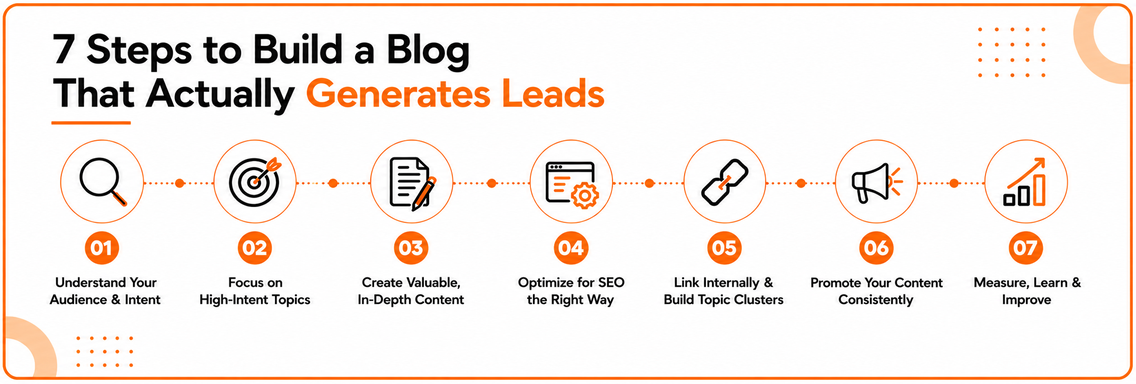
There is a common belief that large companies dominate content marketing. They have bigger budgets, bigger teams, and more resources. But small businesses have something more valuable.
Proximity to customers. They hear real objections during conversations. They understand confusion points. They know what people ask before making a decision.
At Excellorix, many of the strongest content ideas come directly from these conversations, not keyword tools. Because real questions always outperform guessed topics.
Businesses that succeed with content don’t treat it as random publishing. They follow a structured content marketing strategy for small business growth where every article has a purpose. They focus on topics that connect directly to customer needs instead of chasing trends.
Over time, content starts building on itself. One article supports another. Authority grows gradually. Eventually, the website becomes a trusted resource instead of just a digital brochure. That is when leads become consistent.
A good blog doesn’t feel complicated. It doesn’t try to sound overly polished or impressive. It simply explains things in a way that makes sense. It usually follows a natural flow. A problem is introduced, explained clearly, and then the reader is guided toward understanding what to do next.
When done properly, it also connects naturally to services like SEO services, website optimization, or local SEO without feeling forced or sales-driven. The reader doesn’t feel pushed. They feel helped.
Many businesses assume success comes from publishing more content. In reality, consistency matters far more than volume. A few strong, useful articles every month will outperform a large number of low-quality posts. Consistency builds trust with search engines and helps establish authority over time. It also creates a library of content that continues working in the background. That’s why a clear content marketing strategy for small business is essential. It keeps everything focused instead of scattered.
A blog only becomes valuable when it starts helping people make decisions. Not when it is perfect. Not when it is heavily optimized. But when it is genuinely useful. The businesses that succeed with Content marketing for small business website growth are the ones that focus on clarity, intent, and consistency rather than just volume. When combined with a strong content SEO strategy, content becomes a system that consistently generates qualified leads instead of random traffic.
At Excellorix, we help businesses build exactly that content systems designed for visibility, trust, and conversions. If your blog is not bringing in consistent leads, it is usually not a content problem. It is a strategy problem. If you want clarity on what’s missing, you can schedule a call with Excellorix and we’ll break down your current content and show you exactly how to improve it.
It is the process of using blogs and content to attract the right audience, build trust, and generate leads over time by answering real customer questions.
A blog to generate leads works by helping users understand their problem better and guiding them toward taking action when they are ready.
It is a structured approach to planning content based on customer intent, business goals, and search behavior.
A content SEO strategy focuses on creating structured, useful content that aligns with search intent and improves visibility in search engines.
Most blogs fail because they lack direction, ignore intent, and are not built around a clear content marketing strategy for small business.
Tell us about your goals—we’ll show you how Excellorix can help you get there.