
U.S. search advertising generated $102.9 billion in 2024 and represented nearly 40% of all digital ad revenue. Effective PPC management is now a fundamental requirement for commercial survival, not an optional add-on service.
The commercial question isn’t whether paid search deserves attention. It does. The harder question is whether your campaigns create incremental profit or just claim credit for demand that already existed. That distinction separates a bid operator from a revenue-minded performance marketer.
PPC management has matured from keyword selection and bid changes into signal architecture. The manager’s job is to connect advertising activity with qualified leads, purchases, margin, customer value, and controlled experiments. Platforms can automate execution, but they can’t decide whether a cheap lead is commercially useful, whether reported ROAS reflects genuine growth, or whether a campaign would have produced the same customers without advertising.
Table of Contents
- Why Modern PPC Management Is a Revenue Discipline
- Architecting a High-Performance Account Structure
- The Signal Architecture Feeding the Algorithm
- Bidding Strategies for Profitable Scaling
- Beyond ROAS Proving Incrementality
- The Optimization Playbook for Agencies
Why Modern PPC Management Is a Revenue Discipline
The scale of search advertising changes the standard for account management. The IAB and PwC report on 2024 internet advertising revenue records $258.6 billion in total U.S. internet advertising revenue, with search generating $102.9 billion, or 39.8% of the total. Search was the largest reported digital advertising segment by revenue, and it grew 15.9% from the previous year.
That scale creates opportunity, but it also exposes weak management. A business can buy substantial visibility while attracting low-intent clicks, duplicate leads, existing customers, or prospects who never become profitable accounts. Reporting traffic and platform-attributed conversions doesn’t prove that advertising created commercial value.
The operating model has changed since Google’s early advertising system. Search Engine Journal’s history of Google Ads describes AdWords launching in October 2000 with approximately 350 advertisers, initially showing short text ads beside search results. In 2002, Google moved toward a true cost-per-click model, charging advertisers when users clicked rather than for exposure. That transition established the foundations of measurable PPC, including keyword targeting, auction-based placement, budget control, click tracking, and ongoing optimization.
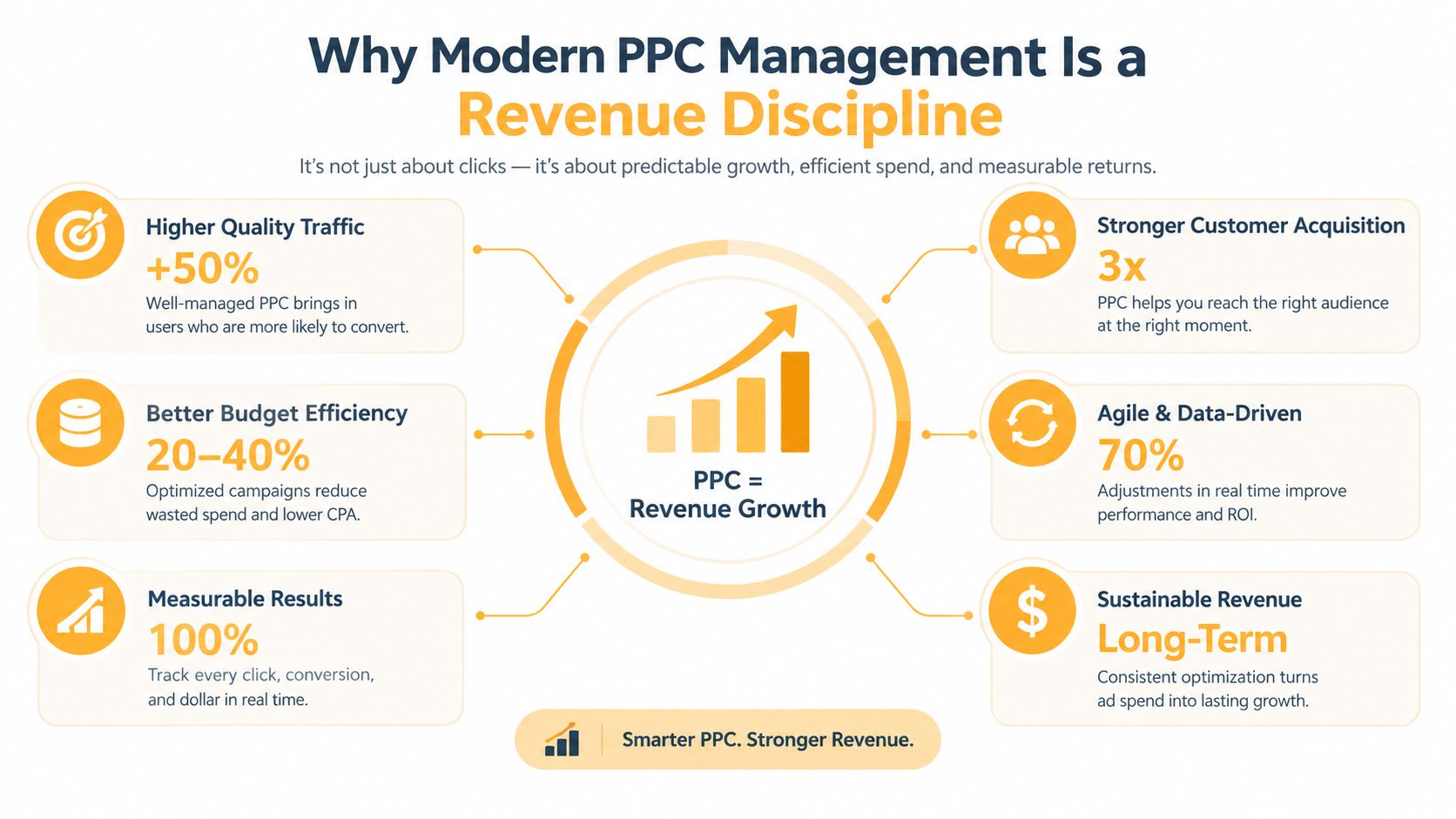
The metric hierarchy needs to change
Clicks and conversions still matter, but they sit below business outcomes in the measurement hierarchy. A useful account review asks:
- Traffic quality: Are users searching with commercial intent, or are campaigns purchasing curiosity?
- Conversion quality: Do form fills become qualified opportunities, booked consultations, purchases, or revenue?
- Acquisition economics: Can the business support the cost after considering margin, refunds, sales effort, and customer value?
- Incremental contribution: Would the customer have converted without the ad?
A campaign with strong reported ROAS can still waste budget if it intercepts users who were already about to buy. A campaign with modest last-click performance may create valuable new demand, assist longer buying journeys, or introduce customers who generate meaningful downstream value. The manager must evaluate both possibilities rather than accept the platform’s preferred interpretation.
Practical rule: Optimize the account toward the outcome the business wants more of, not the event the platform can record most easily.
For agencies, this means PPC management should include commercial diagnosis, tracking governance, landing-page alignment, creative decisions, and executive reporting. Bid changes are only one intervention. The discipline is deciding which signals deserve budget, which outcomes deserve optimization, and which reports deserve trust.
Architecting a High-Performance Account Structure
Account structure should make two things easy: algorithmic learning and human diagnosis. If campaigns mix unrelated intent, products, geographies, audiences, or conversion values, performance data becomes difficult to interpret. The platform may find conversions, but the manager can’t confidently explain why they happened or whether the resulting traffic deserves more budget.
Start with the business model. Ecommerce accounts usually need product, category, brand, and shopping priorities that reflect margin and inventory realities. Lead-generation accounts need separation by service line, market, urgency, and qualification standard. A manufacturer selling complex equipment shouldn’t place research queries, replacement-part searches, and high-value project terms under one undifferentiated objective.
Build around intent and value
Use campaign boundaries to express meaningful commercial differences. Within each campaign, group tightly related themes that can share ads, landing pages, budgets, and conversion expectations. Don’t create microscopic structures merely to appear precise. Excessive fragmentation starves campaigns of useful learning and makes management laborious.
A practical architecture often includes:
- Demand capture campaigns for explicit, high-intent searches where the user is close to taking action.
- Discovery campaigns for broader themes where the account can identify new queries, audiences, or creative opportunities.
- Brand protection campaigns when branded demand requires separate budget and reporting.
- Value-separated campaigns when products, services, territories, or customer types have materially different economics.
- Remarketing or retention activity where the audience and message differ from first-touch acquisition.
Broad match can help discover demand, but it needs strong conversion signals, query review, exclusions, and budget guardrails. Exact or closely controlled intent capture can protect valuable searches, but it won’t replace discovery. Treat the two as complementary jobs, not ideological alternatives.
Ad copy should make a specific promise that the landing page fulfills. If an ad promotes an industrial consultation, send the visitor to a page about that consultation, not a generic homepage. If a product campaign emphasizes a feature, the page should make that feature easy to verify and connect it to a clear action.
A clean account doesn’t guarantee profit. It gives you a reliable place to find the reason for profit or loss.
Let structure support measurement
Name campaigns and ad groups according to decisions a manager will make later. A useful naming system identifies the market, intent, offer, and objective without forcing someone to open every setting. Keep conversion actions consistent across comparable campaigns, while allowing different primary goals when the businesses genuinely differ.
Search terms deserve their own management loop. Add exclusions when queries reveal irrelevant intent, but don’t blindly remove every term that hasn’t converted yet. Review the wording, landing page, buyer stage, and available data before deciding whether a query is wasteful or under-tested.
Quality Score can provide diagnostic clues about ad relevance, expected click performance, and landing-page experience, but it isn’t a profit metric. Use Google Ads Quality Score guidance to investigate relevance problems, then judge the fix by qualified outcomes and economics.
The Signal Architecture Feeding the Algorithm
Conversion tracking isn’t a reporting accessory. It is the information layer that automated bidding uses to decide which users, queries, placements, and auctions deserve preference. If the account counts every form submission equally, the system will learn to find more form submissions, not necessarily more qualified business.
The first design decision is to define the conversion that represents commercial value. For ecommerce, that usually means a completed purchase with transaction value. For lead generation, it may mean a qualified opportunity, booked consultation, sales-accepted lead, or closed revenue. A brochure download or low-friction form fill can remain a secondary observation, but it shouldn’t automatically control bidding.
Connect consented first-party data to commercial outcomes
Google Enhanced Conversions supplements the standard conversion tag with consented first-party information, such as email addresses, phone numbers, names, or addresses. The data is normalized and hashed with SHA-256 before transmission, allowing Google to compare hashed values with data from signed-in accounts and improve attribution.
The Google Ads documentation on Enhanced Conversions also describes Enhanced Conversions for Leads and offline conversion imports. Google states that offline lead conversion data can be sent through the Google Ads API, and its guidance recommends Enhanced Conversions for Leads for more accurate measurement. The API guidance allows hashed conversion data to be sent up to 24 hours after the conversion.
The practical workflow is straightforward, but it requires ownership across marketing, analytics, sales, and technology:
- Capture the visit: Store the Google click identifier and campaign metadata when the visitor arrives.
- Persist the relationship: Pass those values into the CRM with the lead record.
- Qualify the outcome: Record qualification, opportunity stage, revenue, refund, or cancellation status.
- Return validated value: Import the meaningful outcome into Google Ads.
- Audit the handoff: Check consent, formatting, timestamps, deduplication, and match quality.
This architecture matters most when the sale doesn’t happen during the session. B2B, healthcare, professional services, and industrial buying journeys often require human follow-up and commercial validation. Optimizing only toward the initial form fill teaches the platform to favor the easiest submissions, even when sales teams reject them.
Signal architecture principle: Don’t change bids to compensate for bad measurement. Fix the measurement before asking automation to spend more.
A manager should inspect diagnostics before scaling automated bidding. Compare platform conversions with CRM and analytics records, test browser and consent edge cases, and confirm that primary actions reflect the business objective. Google’s current conversion-tracking framework reinforces the distinction between installing a Google tag and connecting enhanced, value-rich measurement.
For a broader perspective on automation and control, see this analysis of the future of PPC, AI automation, and smarter campaign management. The manager’s role isn’t disappearing. It is moving upward, from manual bid operator to signal architect and quality-control owner.
Bidding Strategies for Profitable Scaling
Automated bidding is useful when the account supplies reliable conversion data and a clear economic objective. It becomes dangerous when the system receives shallow signals, unstable goals, or an incentive to buy cheap conversions regardless of downstream value. The right choice depends on what you can measure and what the business can afford.
| Strategy | Primary Goal | Best For |
|---|---|---|
| Maximize Conversions | Generate as many selected conversions as the budget can support | Accounts with a clearly defined conversion action and a priority on volume |
| Target ROAS | Pursue conversion value against a specified return objective | Ecommerce or value-based accounts with dependable transaction values |
| Value Rules | Adjust the value assigned to conversions based on business context | Accounts where customer value varies by audience, location, device, or other criteria |
Choose the strategy after checking the signal
Maximize Conversions is appropriate when conversion actions are comparable and the account needs to prioritize acquisition volume. It should not be used to hide poor lead qualification. If one low-quality form fill is treated the same as a revenue-producing opportunity, the bidding system has no reason to prefer the latter.
Target ROAS is more defensible when transaction values or revenue-weighted outcomes are complete and trustworthy. It can help the platform distinguish a high-value purchase from a low-value purchase, but it won’t understand margin unless the value passed into the system reflects the economics you care about.
Value Rules can express differences the standard conversion value misses. A new customer may be more valuable than an existing customer. A service area may produce stronger margins than another. A qualified enterprise opportunity may deserve more weight than a small inquiry. Use these rules carefully and document the rationale, because artificial values can produce impressive platform efficiency while damaging the actual business result.
Keep automation inside human guardrails
Automation should handle auction-time execution. Managers should control the objective, conversion definitions, budget boundaries, exclusions, landing-page quality, and escalation rules. Don’t change several major variables at once, because you won’t know which intervention produced the result.
Set guardrails around:
- Lead quality: Review whether conversions reach the qualification standard used by sales.
- Spend concentration: Check whether automation is over-investing in one query theme, audience, or product.
- Margin exposure: Separate revenue from profit when costs, discounts, fulfillment, or sales effort vary.
- Budget pacing: Prevent a strong short-term signal from consuming budget intended for other commercial priorities.
- Recommendation acceptance: Require evidence that an automated recommendation supports the business objective.
Bid adjustments can still matter as part of a broader control system, especially when clear business differences exist. Don’t apply demographic or device changes just because a segment has a higher conversion rate. A segment may convert more often while producing lower-value customers.
Automation is the mechanism. The manager remains accountable for the objective and the quality of the feedback.
Beyond ROAS Proving Incrementality
Platform-reported ROAS answers a narrow question: how much recorded value did the system assign to ad interactions relative to spend? It doesn’t answer the more important question: how much additional profit did advertising create?
Last-click attribution can over-credit branded searches, returning visitors, and users who were already close to purchase. A customer may click an ad immediately before converting, but that timing doesn’t establish that the ad caused the conversion. If the customer would have bought through an organic result, direct visit, email, or saved bookmark, the reported return may exaggerate the campaign’s incremental contribution.
Ask the counterfactual
Incrementality measures what happened because of advertising compared with what would have happened without it. That requires a test design, not another dashboard column.
A useful experiment begins with a clear decision. Do you want to know whether branded search creates additional customers? Whether prospecting produces new demand? Whether a remarketing audience adds purchases beyond natural conversion? Each question needs a defined population and an outcome that reflects business value.
A practical holdout framework can include:
- Test unit: Select a geography, audience, campaign group, or other separable population.
- Control condition: Withhold or restrict exposure in a comparable group.
- Primary outcome: Use qualified pipeline, new-customer contribution, purchase value, or incremental profit.
- Timing plan: Account for seasonality, sales cycles, promotions, and delayed conversions.
- Decision threshold: Define in advance what level of observed difference would justify scaling, reducing, or redesigning spend.
Google introduced lower-spend incrementality testing thresholds in 2025 and expanded cross-channel measurement, according to its 2025 update on AI, campaign measurement, and first-party data. That direction makes causal measurement more accessible to smaller advertisers, but platform availability doesn’t remove the need for disciplined experiment design.
Reconcile experiments with platform reporting
Don’t treat incrementality and attribution as competing reports. They answer different questions. Platform attribution helps managers understand which interactions preceded recorded outcomes. Incrementality helps leaders estimate the additional outcomes caused by advertising.
A campaign can show strong attributed ROAS and weak incremental profit if it captures existing demand. Another can show weak last-click ROAS while introducing valuable new customers who convert later through other channels. The correct decision depends on contribution margin, customer type, downstream value, and the experiment result.
Google’s newer measurement capabilities, including first-party-data connections through Data Manager, make CRM and offline outcomes more central to optimization. The Google Ads recap covering automation and measurement developments supports that strategic shift, but automation still doesn’t establish causality by itself.
Executive test: If you paused the campaign, would the business lose profitable customers, or would the platform simply lose credit?
Create an experiment calendar and report both views. Show platform-attributed revenue, qualified outcomes, customer type, margin assumptions, and incremental findings in the same decision record. Reduce spend when attribution looks excellent but the holdout shows little additional value. Scale when the campaign produces incremental profit, even if last-click reporting understates its role.
The Optimization Playbook for Agencies
A repeatable PPC management workflow should protect the account from two opposite failures. One is neglect, where budget leaks through irrelevant queries, broken tracking, weak pages, or stale creative. The other is overreaction, where managers make constant changes without enough evidence to understand the effect.
The operating rhythm should match the decision. Technical tracking checks happen whenever implementation changes. Search-term and budget reviews happen frequently enough to catch waste. Strategic evaluations happen after the business has enough evidence to judge lead quality, value, and incrementality.
Start with the measurement audit
Before reviewing bids, confirm that the account is optimizing toward the correct outcome. Check the Google tag, consent behavior, primary conversion actions, transaction values, CRM fields, click identifiers, offline imports, and duplicate handling. A campaign can’t improve toward revenue when revenue never returns to the bidding system.
Use an audit to establish the baseline and expose structural risks. This PPC audit service guide can help teams evaluate account structure, tracking, targeting, creative, landing pages, and reporting before they make a long list of tactical changes.
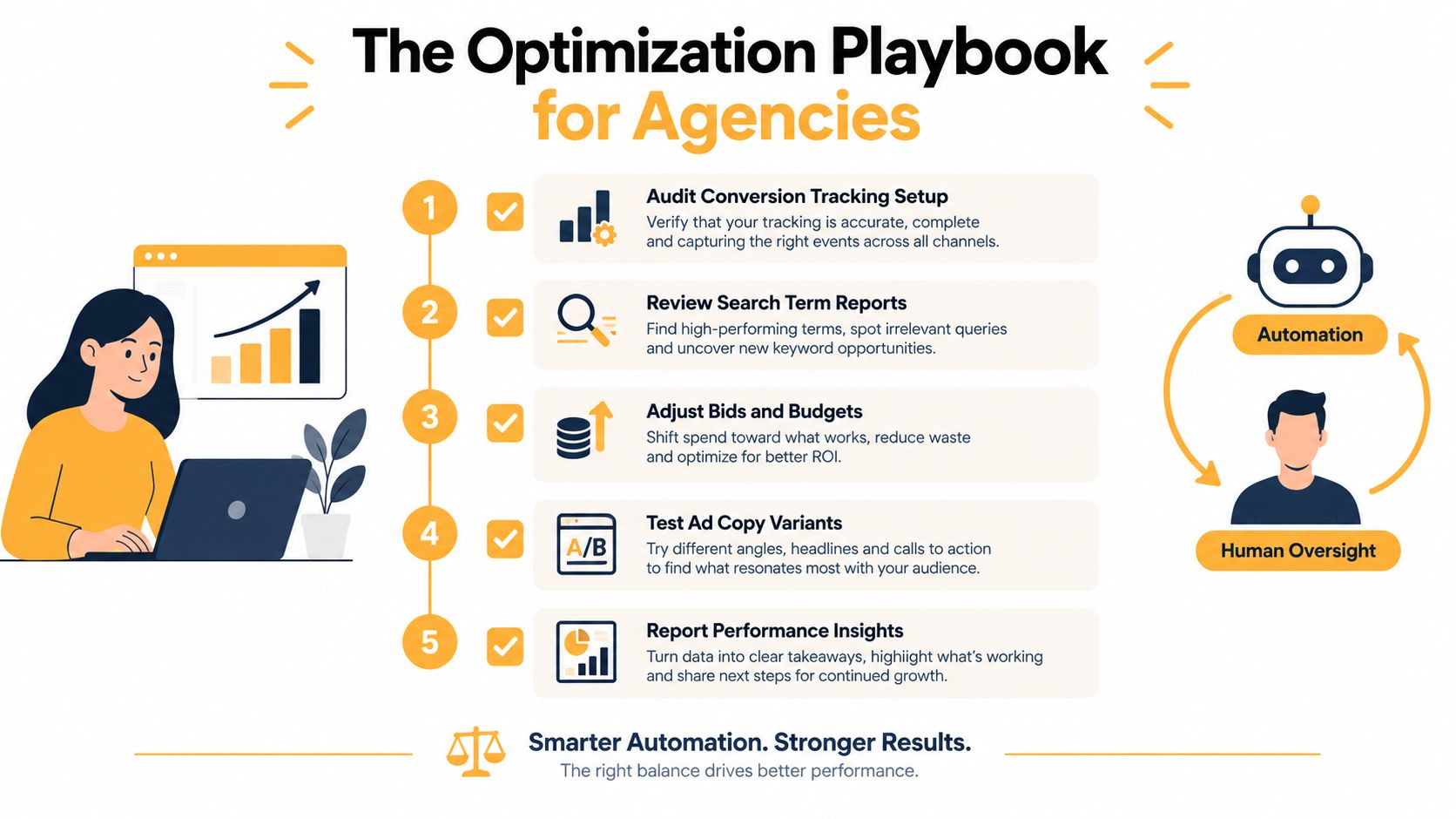
Use a controlled review cadence
At the account level, inspect spend pacing, conversion integrity, budget constraints, major performance shifts, and unexplained changes in lead quality. Confirm that campaigns still serve the intended markets and offers.
At the search-term level, review queries for irrelevant intent, new commercial themes, competitor context, and opportunities for exclusions. Don’t judge a query only by whether it has converted. Consider whether it belongs in a different campaign, requires a better landing page, or needs more qualified tracking.
At the creative level, compare messages against the landing-page promise. Test a meaningful difference, such as a clearer qualification statement, stronger proof, a different offer, or a more specific call to action. Retire weak creative only after considering audience, intent, placement, and conversion quality.
At the landing-page level, verify speed, message match, form behavior, mobile usability, trust signals, and the path to completion. Paid traffic can’t rescue a page that makes the visitor work to understand the offer.
At the business level, reconcile platform results with CRM stages, revenue, cancellations, refunds, margin, and new-customer status. A media report that stops at the click or form fill is incomplete for a revenue-focused client.
Make every change auditable
Record the hypothesis, change, affected campaigns, expected outcome, and review date. Avoid simultaneous restructuring, bid-strategy changes, landing-page redesigns, and tracking modifications unless a technical emergency requires them. Otherwise, the team loses the ability to attribute improvement or deterioration to a specific decision.
Use dashboards to support decisions, not decorate presentations. A useful report connects spend to qualified pipeline, purchases, customer value, and experiment findings. It should make clear what changed, why it changed, what the team recommends next, and what evidence would reverse that recommendation.
The strongest PPC manager doesn’t spend every day adjusting bids. They protect the signal, challenge the attribution, improve the offer, and keep the account aligned with commercial reality. That is how automation becomes a scaling tool instead of a fast way to optimize the wrong outcome.
Excellorix helps businesses connect Google Ads and paid social campaigns with conversion tracking, landing-page optimization, creative testing, bid strategy, and revenue-focused reporting. If your platform-reported ROAS looks strong but qualified pipeline or profit doesn’t follow, visit Excellorix to assess the account’s signal architecture and build a more accountable PPC growth system.