Skip to content



Your acquisition dashboard is getting harder to defend. Ad spend hasn’t changed much, but fewer customers are coming through, finance wants cuts, and the campaigns with the highest reported cost are first on the chopping block. Meanwhile, branded search looks efficient, remarketing claims plenty of conversions, and nobody can explain how much new demand either channel created.
Knowing how to reduce customer acquisition cost means separating cheaper conversions from better acquisition economics. You need to know which customers wouldn’t have arrived without your marketing, what they contribute after delivery costs, and whether they stay long enough to repay the investment. Otherwise, you can improve the dashboard while weakening the business.
Table of Contents
- The CAC Reduction Sequence at a Glance
- How to Audit CAC You Can Trust
- Targeting and Creative Tests That Lower Cost per Customer
- Landing Page and Checkout Fixes That Recover Wasted Spend
- Pricing and Retention Moves That Make Higher CAC Pay
- Set a Monthly CAC Review and Pick Your First Test
The CAC Reduction Sequence at a Glance
Cutting ad spend first can remove productive acquisition before you’ve identified the waste. A prospecting campaign might look expensive because it introduces unfamiliar buyers, while another campaign collects credit when those buyers return. Cutting the introduction and protecting the final click is an easy mistake.
Use a fixed sequence instead. Establish trustworthy costs, improve audience and message fit, repair conversion friction, then assess whether pricing and retention support the acquisition investment. Change one major component at a time so you can explain the result.
The sequence below keeps the team focused on diagnosis before budget cuts.
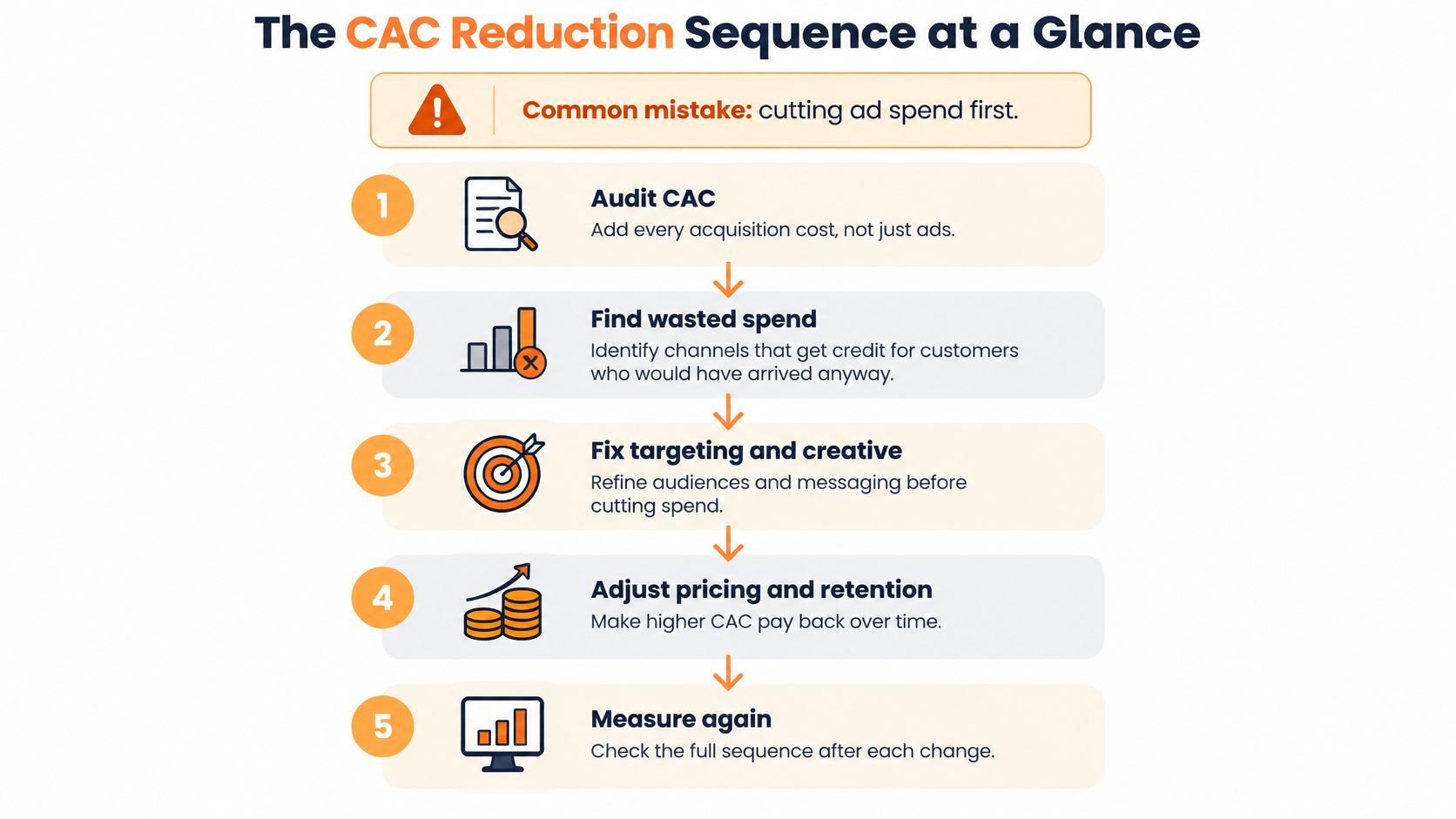
CAC Reduction Phases, Metrics and First Moves
| Phase | Metric to watch | First move |
|---|---|---|
| 1. Audit CAC | Fully loaded CAC and payback months by channel | Rebuild CAC with all costs and split branded search and remarketing out |
| 2. Targeting and creative | Cost per new customer and click-to-customer rate | Run one structured creative test per channel |
| 3. Landing page and checkout | Add-to-cart rate and purchase rate by device | Fix the largest drop-off in the funnel |
| 4. Pricing and retention | Early and later cohort retention and gross margin per customer | Compare payback for each acquisition source |
| 5. Measurement cadence | Incremental CAC and CRM-matched revenue | Set a monthly review and select a single test for each cycle |
The order matters because each decision relies on the previous diagnosis. Better creative won’t solve a broken checkout. A faster checkout won’t make an unprofitable offer sustainable. And none of those improvements can be judged reliably if you count returning customers as new acquisitions.
Assign an owner to each phase. Finance should approve cost definitions, marketing should own experiments, and sales or operations should validate customer quality. A shared spreadsheet with agreed definitions is more useful than an advanced dashboard that different teams interpret differently.
Practical rule: Set the evaluation window and required customer sample before launch. Don’t shorten either because early results look exciting.
For a short-cycle purchase, a proposed testing window of two to four weeks can be a starting plan, not a guarantee of sufficient evidence. Extend it when customer volume is low or the buying cycle is longer, and don’t declare a winner until the agreed sample has matured.
How to Audit CAC You Can Trust
Blended CAC can flatter channels that receive credit for customers who were already likely to buy. Start with a cost model that separates reported acquisition, incremental acquisition, and cash recovery rather than treating them as interchangeable.
Bring finance, marketing, and whoever owns customer records into the same review.
Build the Cost and Customer Ledger
-
Add the full acquisition expense. Include media, agency and creative fees, acquisition tools, allocated sales salaries, commissions, and acquisition-related onboarding. Account for first-order discounts consistently, either as an acquisition expense or reduced contribution, never both.
-
Count new paying customers. Divide acquisition costs by new customers in the corresponding period, with cohorts keyed to first purchase. For lead-generation businesses, keep signup and qualified-lead costs separate from customer CAC, and allow for the delay between lead creation and payment.
-
Separate channel and campaign costs. Break branded search and remarketing away from prospecting, and document how you allocate shared labor and software. Don’t give every platform full ownership of the same customer.
If your reporting currently uses “acquisition” to mean anything from a form submission to a purchase, Arlo Inc.’s guide to calculate your true cost per acquisition is a useful companion for clarifying the conversion event. Your CAC ledger should still end with a paying customer, not an intermediate action.
Test What the Campaign Actually Adds
-
Create a low-risk holdout. Withhold the campaign from a randomly selected eligible audience, or use comparable regions when audience randomization isn’t practical. Compare new-customer outcomes against the exposed group while accounting for baseline differences, promotions, and spillover between regions.
-
Match conversions to revenue records. Join platform events to CRM or order records using transaction identifiers, campaign parameters, and permitted customer identifiers. Remove duplicate events, refunds, returning purchasers, and unpaid deals before comparing channel outcomes.
-
Calculate contribution-based payback. Divide fully loaded CAC by monthly contribution per customer for a simple estimate. When churn, repeat purchases, or expansion change contribution over time, track cumulative cohort contribution until it covers acquisition cost instead.
For incremental CAC, divide the campaign costs being evaluated by the additional customers attributable to the intervention. Keep a fully allocated view alongside that experiment-specific calculation so a promising marginal result doesn’t conceal an unaffordable operating model.
Use the video as a discussion prompt, then validate every calculation against your own ledger.
Interpret Payback in Context
There isn’t a universal acceptable payback period. Sona’s B2B SaaS benchmark guide reports roughly 11 months below $5,000 in annual contract value, versus about 22 months at $50,000 to $100,000.
Long B2B sales cycles require acquisition cohorts that remain open until deals mature. Healthcare and health-tech teams should also distinguish inquiry, appointment, completed service, and collected revenue without sending sensitive patient information into advertising systems.
Build a marketing analytics dashboard around those definitions. The output should be a defensible channel scorecard containing fully loaded CAC, incremental CAC, contribution-based payback, and the maturity of the underlying cohort.
Targeting and Creative Tests That Lower Cost per Customer
Seeding audiences with every buyer teaches an advertising system to find more average buyers, including discount seekers and customers who quickly leave. Start with customers who combine strong contribution, repeat purchasing or renewal, and manageable service costs.
Build customer lists in Shopify or your CRM using those characteristics, then use eligible records for custom audiences and lookalike seeds where supported. Exclude existing customers from prospecting, and keep reactivation campaigns separate so a repeat purchase doesn’t masquerade as acquisition.
Match the Message to the Buying Problem
Personalization should demonstrate that you understand the buyer’s task, not merely insert their name. A manufacturer evaluating a supplier needs different proof from a consumer deciding whether a product fits their routine.
According to Salesforce’s State of the Connected Customer 2024, as summarized by Grownomics, 76% of customers expected companies to understand their needs, while 84% said personalized experiences made them more loyal. Use that as a reason to improve relevance, not as evidence that any particular personalized ad will lower CAC.
Give the creative team concrete inputs:
- Define the problem. Map each ad group to a buying obstacle, such as implementation effort, uncertain fit, or switching risk.
- Choose relevant proof. Use a product demonstration, clearly scoped testimonial, service explanation, or compatibility detail that answers that obstacle.
- Keep the promise consistent. Carry the same offer and qualification language from the ad into the destination page.
- Watch fatigue. Review frequency alongside declining customer conversion, rather than replacing creative because it feels old internally.
Use these priorities to structure audience and messaging work.
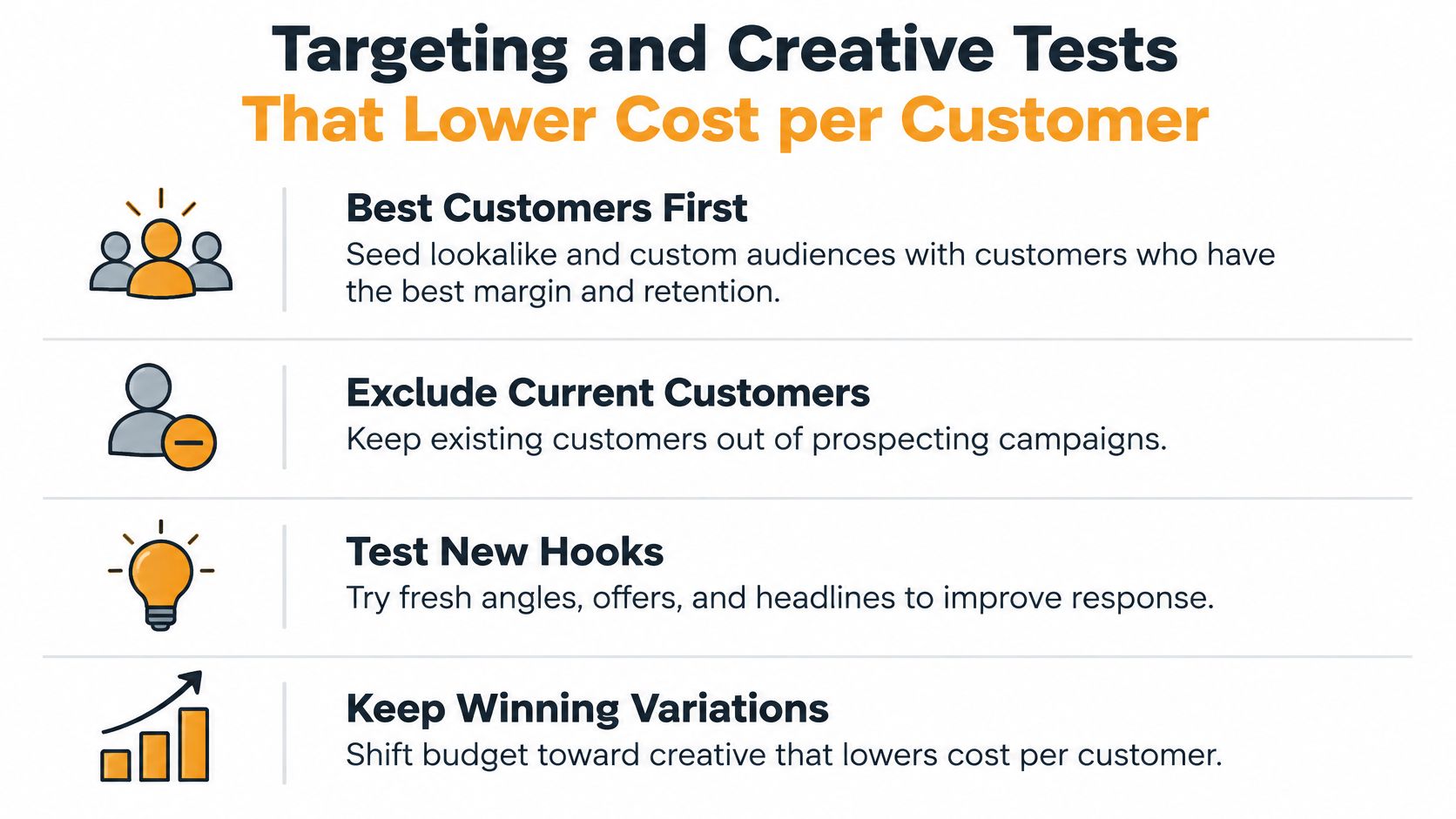
Run Tests You Can Interpret
Choose a variable before building variants. If you’re testing the opening hook, keep the offer, proof, format, and destination unchanged. If you’re comparing entirely different concepts, call it a concept test rather than pretending you’ve isolated the winning element.
On a constrained budget, test fewer meaningful alternatives instead of spreading spend across a large matrix. Give each variant a defined spending allowance and write the pause rule before launch, including how you’ll handle delayed purchases.
A cheaper click is useful only when the people clicking remain likely to become worthwhile customers.
Diagnose the bottleneck before changing bids. AdManage.ai’s guide to fix CPM, CTR, and CVR bottlenecks provides a framework for separating delivery cost, response, and conversion issues. For paid search, review Google Ads Quality Score alongside search terms and downstream customer quality, not as a substitute for them.
Small samples need restraint. Use qualified leads or add-to-cart events as directional signals, but confirm purchases and customer quality before scaling. An ad that generates curiosity can win on click-through rate while losing on every measure that pays the bills.
Landing Page and Checkout Fixes That Recover Wasted Spend
Measure the funnel before redesigning it. A conversion gain lowers CAC only when you preserve customer quality and account for the cost of the change. Removing qualification questions may generate more submissions while leaving sales with fewer suitable buyers.
In GA4, map the path from landing-page visit through product view, add to cart, checkout, and purchase. For services, map form start, submission, qualification, booked consultation, and paid engagement. Validate those events against Shopify or CRM records before trusting the drop-off report.
Common Conversion Leaks and Their Fixes
| Leak | How to check | Fix |
|---|---|---|
| Slow mobile landing page | Mobile speed report and session data by device | Compress hero images and defer non-essential scripts |
| Ad and page message mismatch | Compare ad headline with page headline for the same campaign | Mirror the ad offer and wording on the landing page |
| Long lead form | Count fields and compare completion by form version | Cut fields to the essentials and collect the rest later |
| Weak trust signals | Compare engagement and conversion where relevant proof is absent or present | Add specific proof close to the action button |
| Checkout friction | Step-by-step checkout drop-off report | Offer guest checkout and remove optional steps |
Check mobile performance on an actual phone, not just a desktop preview. Use PageSpeed Insights to identify heavy assets, then confirm that the page renders, responds, and accepts input under realistic conditions. Don’t remove necessary functionality merely to improve a diagnostic score.
Message match comes next. If an ad promises a specific service package, buyers shouldn’t have to search through a general homepage to find it. Put the offer, eligibility conditions, and next action where the visitor can understand them immediately.
Separate Technical Friction From Buyer Hesitation
A form field that repeatedly produces errors is a usability problem. A buyer leaving after seeing shipping charges may be rejecting the economics of the offer. Those require different fixes.
Segment reports by device, acquisition source, and new-customer status. A page that works for someone searching your company name may leave a cold prospect without enough explanation or proof. Test prospecting destinations separately instead of applying the branded-search winner everywhere.
For ecommerce, Receiver’s checkout recovery strategies for ecommerce teams can help organize follow-up once the checkout itself works. Use the ecommerce checkout optimization guide to structure the on-site audit, including guest checkout, input handling, and unnecessary steps.
Prioritize the largest credible, recoverable drop-off, not the largest percentage decline. Consider traffic volume, buying intent, and implementation effort. Fix broken behavior before testing cosmetic alternatives, and don’t use abandonment emails to compensate for a checkout customers can’t complete.
Pricing and Retention Moves That Make Higher CAC Pay
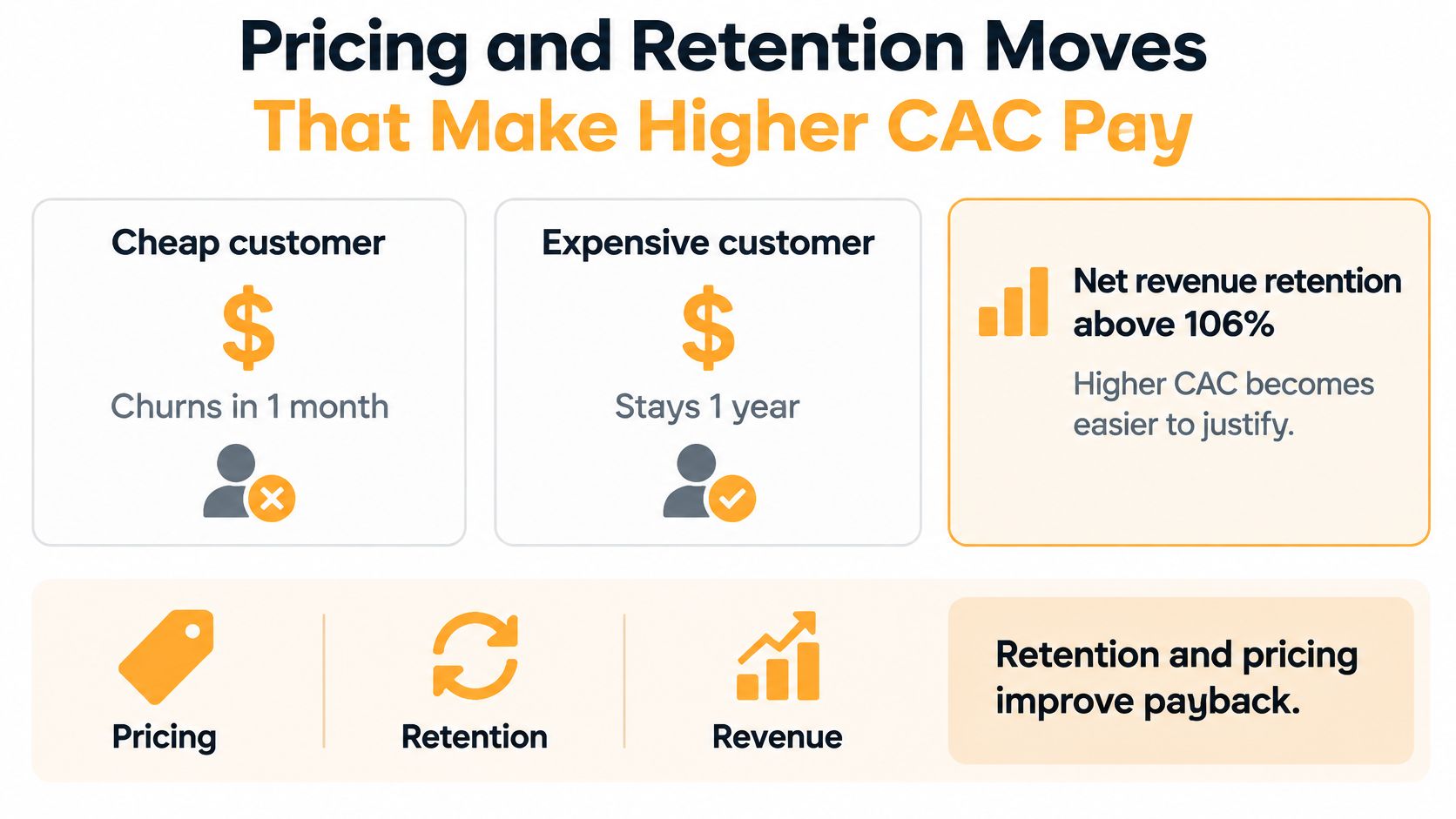
A cheap customer who leaves quickly can be less profitable than an expensive customer who keeps buying. The acquisition price alone doesn’t settle the comparison. What matters is how much contribution you retain after fulfillment, support, refunds, and ongoing service.
Digital Applied’s SaaS benchmark compilation reports that companies combining net revenue retention above 106% with CAC payback below 10 months achieved median growth of 71%, while those with retention below 98% and payback above 15 months grew a median 10%. That association doesn’t prove causation, but it supports evaluating acquisition efficiency alongside retention rather than in isolation.
The comparison below illustrates why an upfront acquisition price needs a longer-term contribution view.
Improve the Experience After the Sale
Retention work doesn’t retroactively lower historical CAC. It improves the return on that acquisition expense and may reduce how much replacement acquisition you need.
- Shorten time to value. Assign an onboarding owner and define the first useful customer outcome, such as completing setup or receiving the initial service deliverable.
- Trigger relevant education. Send lifecycle email based on missing actions, product usage, or replenishment needs rather than an identical promotional calendar.
- Align service expectations. For consultancies and professional services, document scope, response expectations, responsibilities, and handoffs before delivery begins.
- Address cancellation reasons. Offer a pause, suitable plan, or practical support when it solves the actual problem. Don’t subsidize customers indefinitely with blanket discounts.
Compare acquisition cohorts at consistent early and later checkpoints. Include first-order margin, repeat contribution, refunds, renewal behavior, and support demands. A channel with stronger repeat revenue can still disappoint if those customers require expensive servicing.
Separate Cash Collection From Economic Payback
Annual prepayment brings cash in earlier, but it doesn’t automatically improve gross-margin payback. You still owe future delivery, and a prepayment discount can reduce contribution. Track cash recovery separately from earned contribution.
A higher starting tier can support acquisition economics when buyers receive appropriate value. It can also reduce conversion or increase churn if you force smaller customers into an unsuitable package, so assess total cohort contribution rather than revenue per initial sale alone.
Feed permitted downstream quality signals into Google and Meta through offline conversion imports or value-based optimization where suitable. Use realized revenue and margin-informed values rather than optimistic lifetime estimates, and keep health-related or other sensitive information out of advertising uploads.
Scale channels whose customers generate durable contribution, even when their front-end CPA is higher. Don’t pay more merely because retention might improve later.
Set a Monthly CAC Review and Pick Your First Test
Run the monthly review as a decision meeting, not a presentation of platform screenshots. Each channel owner should arrive with reconciled results, an explanation of uncertainty, and a proposed action. Finance should be able to reproduce the economics without accepting the advertising platform’s attribution model.
Use a Repeatable Decision Routine
-
Set a channel-specific payback target. Base it on available cash, delivery margin, purchase timing, and observed customer persistence. A target is a financing decision as well as a marketing goal.
-
Monitor leading indicators weekly. Review click costs, qualified-lead costs, add-to-cart behavior, and new-customer volume. Use them to detect broken tracking or deteriorating performance, not to declare an experiment successful before purchases mature.
-
Reconcile results monthly. Compare fully loaded and incremental CAC with CRM-matched customer revenue. Investigate discrepancies using matched transaction counts and matched revenue separately, since conversion counts and dollars aren’t comparable units.
-
Choose the next test from the largest actionable gap. An acquisition-quality problem calls for a different experiment from a mobile checkout failure. State the suspected cause and the change that would disprove it.
-
Approve scale and pause rules before launch. Document the spending limit, evaluation window, required sample, customer-quality guardrail, and control group. Name the person authorized to stop a test if tracking or customer experience breaks.
-
Turn the result into a budget decision. Move spend only when the evidence supports the move, and preserve enough capacity to test new demand sources. Record inconclusive findings instead of forcing every experiment into a win or loss.
Keep the dashboard compact enough that someone can identify the required decision without a separate explanation.
| Dashboard measure | Required context |
|---|---|
| Fully loaded CAC | Target, prior month, and cost-allocation method |
| Incremental CAC | Control design, estimated lift, and uncertainty |
| Payback months | Contribution basis and cohort maturity |
| Early and later retention | Consistent observation windows and cohort size |
| Revenue per customer | Refund treatment, margin, and acquisition source |
Launch a Controlled Remarketing Test
A practical first experiment is to test whether remarketing adds customers or mostly receives credit for existing intent. Randomly assign an eligible audience to an exposed group and an advertising holdout, using a platform-supported experiment where available. Keep other offers and campaign changes stable during the test.
Choose the holdout size from baseline conversion volume and the smallest improvement worth acting on. If the audience can’t support a useful result, narrow the decision or extend the observation period rather than choosing an arbitrary split.
Budget discipline: An inconclusive test is a reason to improve the experiment, not permission to claim the campaign worked.
This quarter, put the experiment on the calendar: name the owner, select the audience, calculate the required holdout, and fix the results-read date. Decide in advance what incremental customer contribution would justify keeping, increasing, or removing the spend. That gives the next budget conversation a defensible basis beyond whichever platform reports the most conversions.
Excellorix offers paid media management, conversion optimization, lifecycle email, and marketing analytics to connect acquisition spend with customer revenue. Visit Excellorix to discuss a CAC audit that identifies your first test, the tracking it needs, and the payback criteria for your next budget decision.