Skip to content



58% of U.S. adults in Pew Research Center’s March 2025 study conducted at least one Google search that produced an AI-generated summary, according to Pew’s browsing analysis. Your next customer may encounter an answer about your business before they ever reach your website.
That changes how to drive traffic to your website. You still need discoverable pages, effective campaigns, and useful content, but qualified outcomes matter more than raw sessions. A visit is valuable when it moves the right person toward a purchase, consultation, or sales conversation, not when it appears in a dashboard.
Table of Contents
- Traffic Sources Compared at a Glance
- Plan Your Traffic Before You Spend
- Build a Technical SEO Base for Organic Visits
- Create Content That Earns Clicks and Citations
- Run Paid, Social, Email and Referral Campaigns
- Measure Traffic Quality and Fix Conversion Leaks
- Choose Your First Channel This Month
Traffic Sources Compared at a Glance
Traffic channels compared by time, cost and fit
| Channel | Typical Time to Results | Main Cost | Best For |
|---|---|---|---|
| Organic search | Gradual, after crawling and ranking | Content and technical work | Durable demand that matches buyer queries |
| Paid search | Once approved campaigns start serving | Pay per click | Commercial terms, launches, high-value audiences |
| Paid social | Once approved ads reach the audience | Pay per click or impression | Awareness and retargeting visitors |
| Organic social | After consistent publishing and participation | Time and content production | Community, brand reach, repeat visits |
| After sending to an existing list | Email tool and list building | Launches and repeat visits | |
| Referral and partners | After placements and introductions go live | Partnership and outreach effort | Authority and niche audiences |
In BrightEdge’s 2019 analysis, organic and paid search together accounted for 68% of trackable website traffic, while organic search alone averaged 53.3% across industries. Industry, brand strength, geography, and attribution settings change the mix, so those historical figures are benchmarks, not targets every website should expect to match.
Choose intent before reach
Search deserves attention because the visitor tells you what they need. Someone searching for an industrial equipment maintenance provider is closer to a purchasing decision than someone casually watching a maintenance video.
Organic search lets you build pages around that demand without paying for each click. The trade-off is the work required to earn visibility: technical maintenance, useful pages, and evidence that helps buyers trust you.
Paid search buys access to relevant searches while those pages develop. It’s useful for launches and commercial queries, but you’re renting visibility, and poor targeting can turn a modest test into expensive, irrelevant visits.
Social, email, and referrals solve different problems. Social introduces your offer, email brings interested people back, and partners can introduce you to buyers who already trust their recommendations. None should be judged solely on whether it generates more sessions than search.
Selection rule: Choose the channel that puts your offer closest to a buying decision, not the channel with the largest audience.
List your current traffic sources, including offline referrals that lead people to your site. Mark the pair closest to where buyers already search, compare options, or ask for recommendations. Those are better starting points than opening accounts on every available platform.
Plan Your Traffic Before You Spend
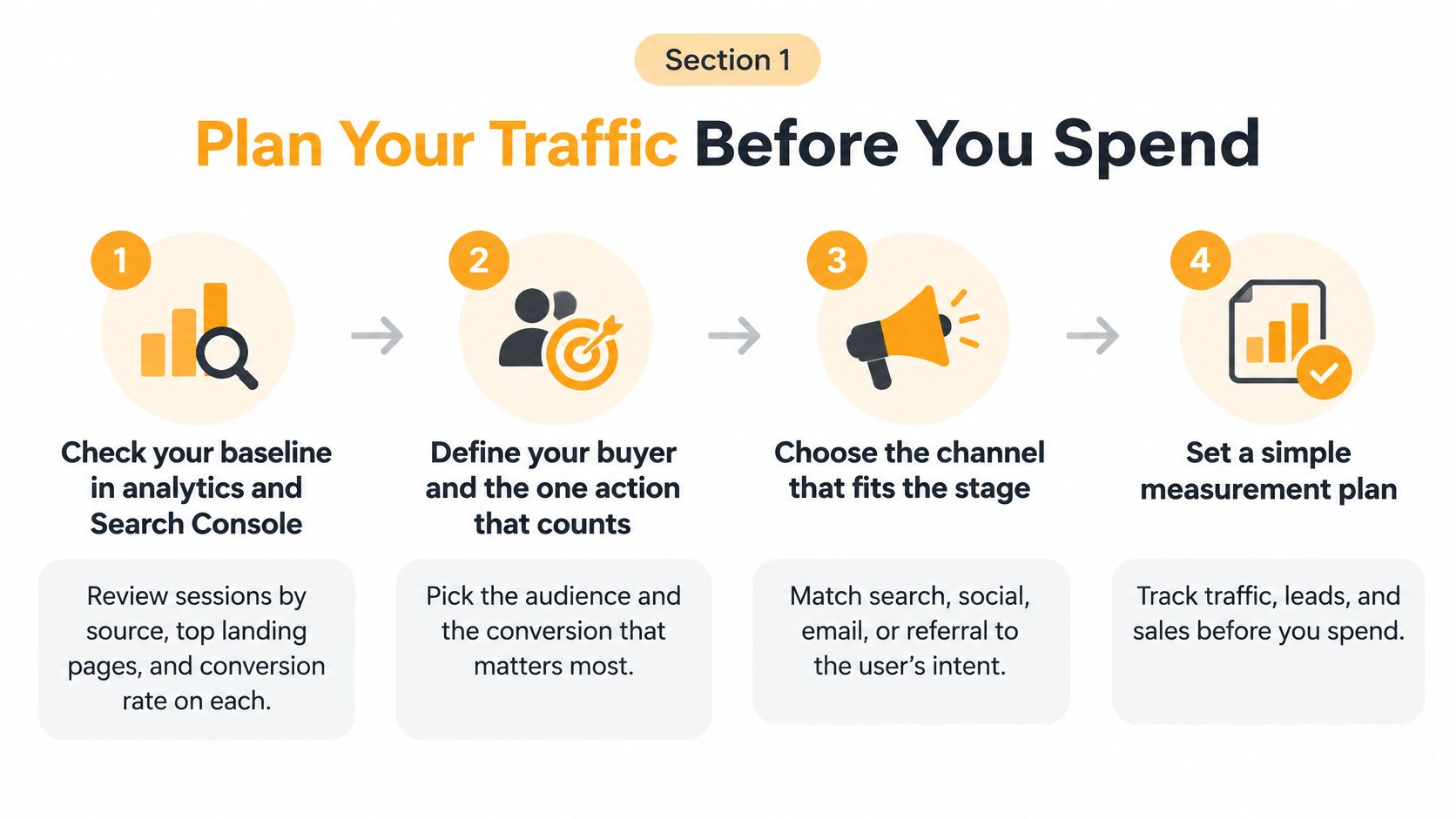
A traffic plan needs a defined buyer, a measurable outcome, and a landing experience that works. Without those, you won’t know whether a disappointing campaign failed because of its audience, its offer, or the website.
-
Check your baseline in analytics and Search Console. In Google Analytics, review acquisition sources and landing pages alongside completed purchases or qualified enquiries; in Search Console, inspect queries, clicks, and indexed pages. Don’t mistake branded searches from existing customers for new customer acquisition.
-
Define your buyer and the action that counts. Specify the service area, purchasing need, and qualification criteria, then choose a primary outcome such as a completed purchase or sales-ready enquiry. A form submission shouldn’t count as success if the person needs something you don’t sell.
-
Test the experience on a phone first. Mobile devices generated more than 63% of global web-page requests in December 2024, according to DataReportal’s Digital 2025 overview. Open your intended landing page on a real phone, complete its main action, and check menus, text, form inputs, confirmation messages, and analytics events rather than trusting a desktop preview.
-
Choose a focused channel pair. Match the channels to the buyer’s situation: search for active demand, social for discovery, email for existing interest, or partners for trusted introductions. Copying a competitor’s channel mix ignores differences in budget, reputation, and customer base.
-
Set a monthly outcome target and attribution rules. Define the qualified leads or purchases you want, the maximum acceptable acquisition cost, and how campaign links will be labelled. Use consistent source, medium, and campaign tags on external campaign links, but don’t add campaign tags to internal navigation or try to tag organic search results.
Check whether you’re ready to launch
Your baseline doesn’t need to be elaborate. It needs to be reliable enough to distinguish a real enquiry from a tracking error.
- Acquisition visibility: You can identify which sources bring visitors to each priority landing page.
- Working conversion events: A test purchase, form submission, or tracked call appears correctly.
- Lead qualification: Someone owns the decision about whether an enquiry fits your business.
- Usable mobile pages: Visitors can read the offer and complete the action without struggling.
- Campaign ownership: A named person controls the budget, reviews results, and records changes.
If any of these are missing, resolve them before spending. Otherwise, you’ll pay to discover problems you could have caught with a test visit.
Build a Technical SEO Base for Organic Visits
Start with crawlability and indexability, not a bigger publishing schedule. A useful page can’t attract organic visitors if search engines can’t access it or understand which version belongs in results.
-
Inventory the pages you want indexed. Export URLs from your content management system and compare them with a crawl and Search Console. Submit a sitemap containing canonical, indexable pages, including important pages and recently updated content, rather than every filtered or administrative URL.
-
Check what Googlebot can access. Use Search Console’s URL Inspection tool to inspect priority pages and their rendered output. Confirm that required HTML, CSS, JavaScript, and images are accessible, especially when navigation or product details depend on scripts.
-
Control duplicate crawling carefully. Review robots.txt rules, faceted navigation, parameters, and canonical tags. Don’t block essential assets or use robots.txt as a removal tool for already indexed URLs; search engines need access to see a page-level indexing instruction.
-
Monitor indexing and search performance. Investigate unexpected exclusions, broken internal links, redirect chains, and template errors before publishing more pages. Fixing a shared product template is usually more useful than correcting the same problem manually across individual products.
Verify usability with field measurements
Use the thresholds in Google’s Core Web Vitals guidance as your performance checks: Largest Contentful Paint under 2.5 seconds, Interaction to Next Paint under 200 milliseconds, and Cumulative Layout Shift below 0.1.
Core Web Vitals targets to check
| Metric | Target | What It Measures |
|---|---|---|
| Largest Contentful Paint | Under 2.5 seconds | How quickly the main content loads |
| Interaction to Next Paint | Under 200 milliseconds | How quickly the page responds to taps and clicks |
| Cumulative Layout Shift | Below 0.1 | How much content jumps around while loading |
Look at real-user field data when it’s available, not just a favourable laboratory score. A test on a powerful computer won’t necessarily reflect a customer opening your page on a slower phone.
Start with oversized hero images, unnecessary scripts, unstable banners, and slow server responses. Don’t strip out useful content merely to improve a score, and don’t assume passing performance thresholds guarantees rankings.
Set a realistic implementation horizon
Most businesses start seeing meaningful ranking and organic traffic improvements within 3 to 6 months of starting SEO work. Highly competitive industries or websites with significant technical issues may need 6 to 12 months to build strong momentum. Treat those as planning expectations, not a promise for an individual page.
Crawl-budget management is mainly a concern for very large, frequently changing websites. Most smaller businesses should prioritize clean templates, sensible internal links, and clear indexing instructions.
Affiliate Landscape’s guide can help you get started with DIY SEO, while our technical SEO audit checklist provides a structured inspection route. Segment ongoing reports by template, device, country, and organic landing page so sitewide totals don’t hide a broken page type.
Create Content That Earns Clicks and Citations
Pew’s March 2025 browsing study, discussed in DLR Media’s analysis of AI Overviews, found traditional-result clicks in 8% of visits with an AI overview, compared with 15% without one. That doesn’t make content pointless. It makes interchangeable explanations a weaker investment.
Publish material that helps a buyer complete a task or make a decision. A generic definition is easy to summarize elsewhere; a detailed selection method, transparent service criteria, or useful implementation example gives someone a reason to visit.
Build pages around decisions
- Question-led articles: Answer the main query immediately, then explain the process, exceptions, and trade-offs. Google’s Year in Search 2025 report says searches beginning with “How do I…” reached an all-time high, increasing 25% year over year, which supports using clear task-based language when it fits the topic.
- Comparison and fit pages: Explain who each option suits, what changes the cost, and when your service isn’t appropriate. Publish pricing ranges only when you can substantiate them, rather than manufacturing precision for a comparison table.
- Expert pages: Show a named method, visible authorship, and documented results you can support. Explain the conditions behind a result so readers can judge whether it applies to their situation.
Give each page a clear next step that matches intent. An early-stage reader might need a planning worksheet; someone evaluating implementation support may be ready for a consultation.
Our guide to building a small-business blog that generates leads can help connect topic selection with those next steps. Don’t make every article end with an identical sales pitch.
Test AI discovery without abandoning established channels
TechCrunch’s report on Similarweb’s June 2025 figures puts AI referrals to the world’s top websites at more than 1.13 billion, against approximately 191 billion Google referrals that month. That comparison supports experimentation, not replacing your main acquisition program.
I would publish a question-led page addressing a commercially relevant problem and give it a defined observation period before expanding the approach. Record its search visibility, identifiable AI referrals, relevant enquiries, and changes in branded demand.
Fewer visits can still be useful if more of those visitors are suitable buyers. More citations without qualified demand aren’t a business result.
Keep the main budget aligned with channels that already produce customers. Expand answer-focused content when you see credible commercial signals, while recognizing that a rise in branded searches alone doesn’t prove AI exposure caused it.
Run Paid, Social, Email and Referral Campaigns
Paid search. Start with high-intent commercial terms, separate branded from non-branded campaigns, and set campaign-level daily budgets before launch. Review search terms and add negative keywords to exclude unsuitable needs. The common failure is sending every query to the homepage instead of matching the ad to a relevant offer.
Paid social. Choose Meta, TikTok, or YouTube according to where buyers consume relevant content; retarget eligible visitors to important pages; and prepare alternative creative before launching. Refresh ads when qualified response weakens, not merely because a calendar says to. Optimizing for cheap clicks rather than suitable enquiries is the expensive mistake.
Bring interested people back
Email. Build a permission-based welcome sequence for subscribers, segment messages by what people requested, and give each message a primary destination. A guide subscriber needs different follow-up from someone requesting a quote. Don’t buy lists: permission and relevance matter more than a large contact count.
Organic social. Publish where buyers already discuss the problem, share customer proof with permission, and participate in relevant niche communities before posting promotional links. Our guide to social media marketing for small businesses helps prioritize that work. The common failure is treating followers as an audience you automatically own or can reliably move off-platform.
SleekPost’s guide to helping solo creators extend content reach is useful for turning a substantial article into platform-specific posts. Repurpose the underlying insight, not just the opening paragraph and a repeated link.
Borrow relevant trust
Referral and partner traffic. Offer useful guest contributions to publications buyers read, maintain accurate listings in relevant directories, and invite customers or complementary businesses to share suitable case studies. Give each placement a destination that matches its context. Chasing link volume without audience relevance wastes outreach effort.
For an initial monthly test, pair a paid channel with an earned channel and assign each a spending limit or delivery schedule. Record creative, audience, offer, and landing-page changes so results remain interpretable.
Budget discipline: Don’t fund more distribution just because a campaign is busy. Fund it when the resulting enquiries meet your qualification criteria.
Measure Traffic Quality and Fix Conversion Leaks
Checkout friction points and their reported share
| Friction Point | Reported Share | First Fix to Test |
|---|---|---|
| Unexpected extra costs | 40% | Show shipping and tax estimates before checkout |
| Forced account creation | 18% | Make guest checkout prominent |
| Overly long or complex checkout | 17% | Remove unnecessary fields and test payment methods by market |
These reported abandonment reasons come from Baymard’s checkout research, which also reports a 70.22% average cart-abandonment rate. They’re useful test priorities, not proof that the same issues explain abandonment on your store.
Buying more traffic before examining checkout can increase spending without fixing why customers leave. Treat acquisition and purchase as a measured chain, with the same attention given to a failed payment step as an underperforming ad.
Locate the commercially important drop-off
Capture campaign source, medium, and campaign name where available, then combine them with product, device, and geographic reporting dimensions. Don’t insert personal or sensitive information into campaign URLs.
Inspect the path from session to product view, add-to-cart, checkout start, and purchase. For services, substitute offer-page view, form start, completed enquiry, qualified opportunity, and closed sale.
Test the friction affecting the most commercially important visitors first. That might mean making guest checkout visible, preserving entered information after an error, simplifying an enquiry form, or explaining delivery costs earlier.
Score channels by economics
- Qualified conversion rate: How often suitable visitors become viable enquiries or customers, not merely form submissions.
- Revenue per visitor: Revenue divided by the relevant visitor total, using a consistent definition across comparisons.
- Customer-acquisition cost: Acquisition spending divided by new customers, with the included costs stated clearly.
- Contribution margin: What remains after the costs needed to fulfil and acquire the order.
- Incremental impact: The additional outcomes attributable to the campaign or change, rather than every conversion recorded during it.
For content-led acquisition, TheContentMap explains how to turn performance data into editorial decisions. Use that approach to distinguish pages that attract readers from pages that assist profitable decisions.
Capture demand that analytics can miss
A buyer might discover your name in an AI answer and later arrive through branded search or a direct visit. Preserve first-touch and later campaign information in your CRM, use call tracking where appropriate, and add an optional discovery-source question to enquiry forms.
Compare these signals rather than treating any single answer as perfect attribution. Self-reported sources reflect memory, direct traffic includes several arrival paths, and branded searches can rise for reasons unrelated to AI.
Filter suspicious traffic before interpreting growth. According to figures reported by Statista, fraudulent bots accounted for 37% of global web traffic in 2024; that’s not a measurement of your own site’s bot share.
Exclude internal tests and obvious spam, then run controlled experiments with a predefined primary metric. Protect refund rate, margin, and lead quality as guardrails so an apparent conversion improvement doesn’t conceal worse customers or less profitable orders.
Scale a channel only when its landing page and purchase or enquiry process support acceptable economics.
Choose Your First Channel This Month
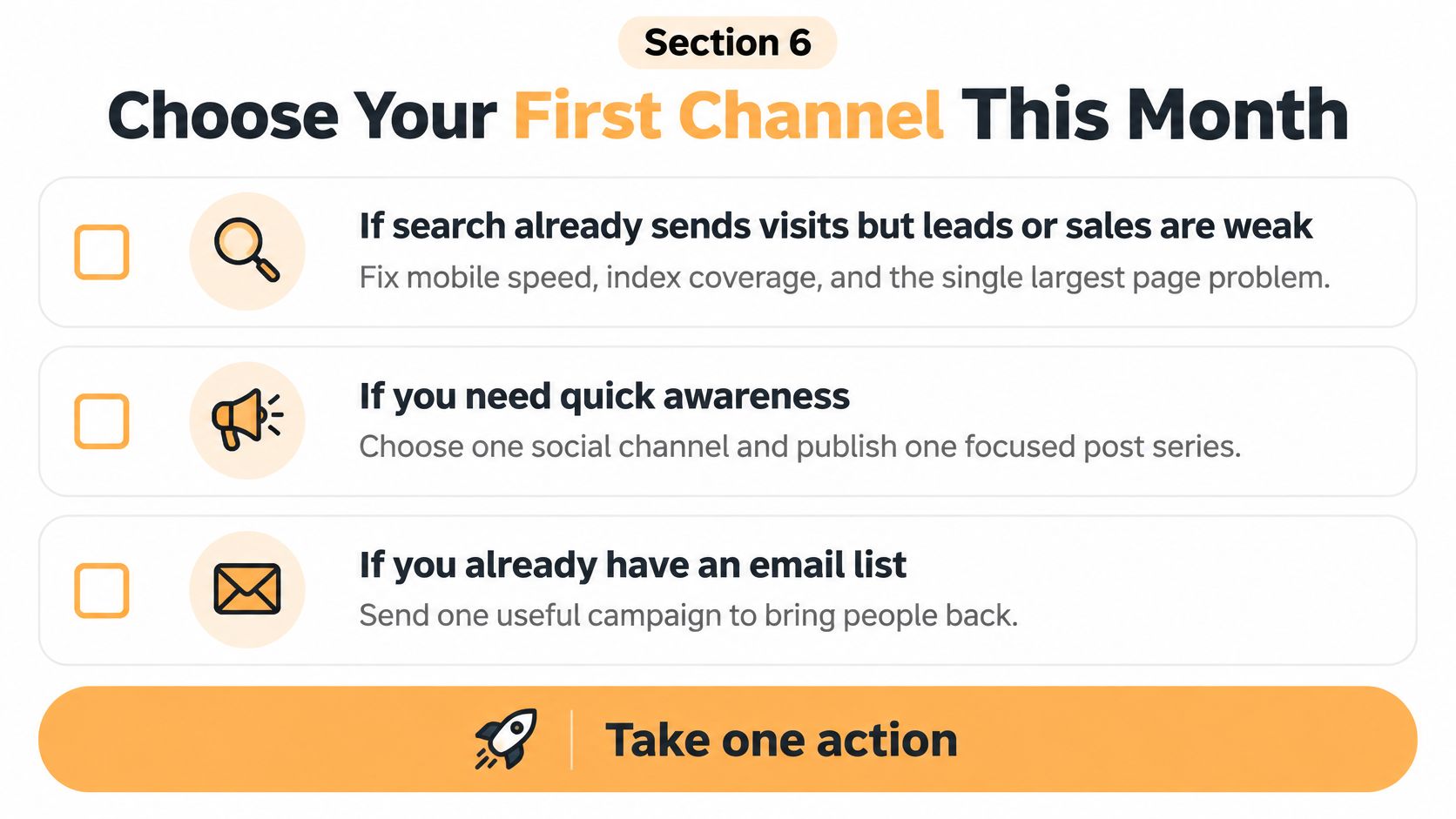
Choose the first action according to your constraint, not the channel you’d most enjoy running.
- Existing search visits, weak sales: Inspect mobile usability, index coverage, and the largest form or checkout problem. Fix the obstacle before adding another acquisition expense.
- New website, fixed launch, available budget: Start tightly scoped paid search for commercial terms while your important pages become discoverable organically.
- Local or specialist service, limited search demand: Begin with relevant referral partners and directories. Send visitors to a focused click-to-call or enquiry page, then use permission-based email to follow up.
Keep the test small enough to judge
Run your chosen channel alongside a sensible comparison channel, and resist adding another during the month. At the monthly review, compare qualified leads, revenue per visitor, or cost per qualified lead against the target you set.
Keep the channel that meets the target. Pause a channel with poor economics, but distinguish a failed offer from an organic program that hasn’t had enough time to develop.
You don’t need an agency to make that decision. You need dependable tracking, a clearly defined customer, and the discipline to stop paying for activity that doesn’t move the business forward.
Excellorix offers a free SEO audit reviewing your rankings, traffic, technical foundation, and competitive environment. For an existing website, our free growth plan includes a technical audit and a ranked view of where the funnel is leaking revenue. Visit Excellorix to identify which traffic opportunities and conversion fixes deserve attention first.