


Social media marketing for small business in 2026 is no longer about posting every day just to stay visible. Most people scroll past generic content within seconds. What actually works now is building trust, creating useful content, and showing up consistently enough that people remember your business when they are ready to buy.
The businesses getting results are usually not the loudest brands online. They are the ones following a clear social media strategy for small business instead of posting randomly without direction. They understand that social media is no longer just a branding tool. It has become part of the customer journey from discovery to trust to conversion. A lot of small businesses still approach social media without a real system. One week they post constantly, the next week they disappear completely. They chase trends that do not fit their audience, try to stay active on every platform, and expect fast results without a clear plan behind the content. That usually creates frustration instead of growth.
In 2026, audiences want fast answers, short videos, proof, and brands that feel authentic. People want content that sounds human instead of content that feels overly polished or robotic. The good news is that small businesses do not need huge budgets or viral content to grow anymore. They need consistency, clarity, and content that solves real problems. This guide breaks down what actually works right now, including platform selection, content strategy, SEO support, and practical ways to turn attention into real business growth.
Before talking about what works, it helps to understand why so many businesses struggle with social media in the first place. The biggest issue is not that social media stopped working. It is that most businesses use it without structure. They post whenever they remember, copy competitors without understanding their own audience, or create content with no clear purpose behind it. Over time, that creates inconsistent branding, weak engagement, and content that feels disconnected. Many business owners eventually assume social media is a waste of time when the real problem is the strategy behind it.
A smarter approach is to treat social media like part of your overall marketing system instead of treating it like an afterthought. Every piece of content should support a goal. That goal might be building trust, educating potential customers, generating leads, increasing website traffic, or encouraging direct inquiries. When the purpose becomes clear, content becomes easier to create and easier to measure. Another common issue is platform confusion. A local restaurant, a fitness coach, a digital agency, and an ecommerce brand should not all use the exact same strategy. The best social media platforms for business depend entirely on where your audience spends time and how they prefer to discover brands online.
Trying to be everywhere usually spreads businesses too thin. The smartest brands focus only on the best social media platforms for business based on where their audience is most likely to engage and take action.
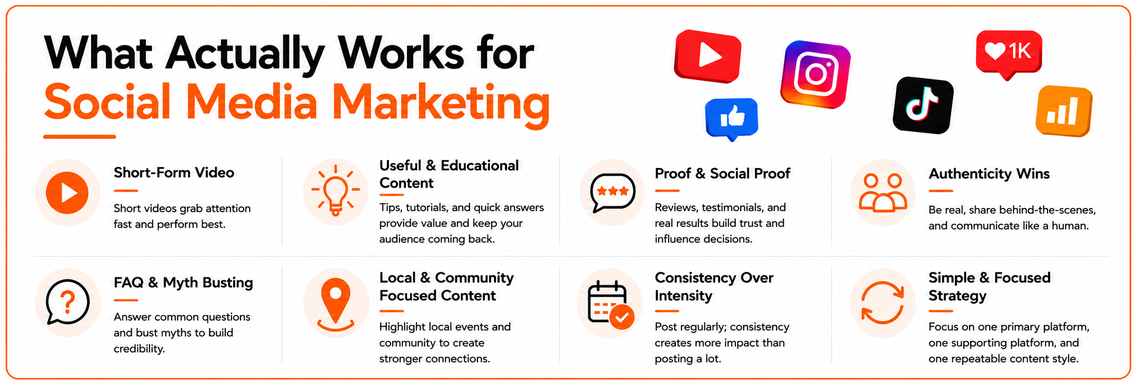
Once you remove the random posting approach, the next step is understanding what audiences actually respond to in 2026. Right now, social media rewards useful content far more than perfectly polished feeds. People connect more with brands that feel relatable, honest, and clear. Short form video still performs extremely well, but only when it gets to the point quickly. Long intros, trend copying, and overly scripted content tend to lose attention fast. The content formats performing best right now include educational tips, customer stories, behind the scenes content, quick tutorials, FAQ style videos, myth busting posts, and local community focused content.
Most effective social media marketing tips 2026 are surprisingly simple. Businesses that stay consistent, create useful content, and communicate like real people are still outperforming brands chasing every trend online. Most successful small businesses are also simplifying their strategy. Instead of trying to dominate every platform, they focus on one primary platform, one supporting platform, and one repeatable content style.
For example, a business might use Instagram Reels for visibility, WhatsApp for customer communication, and testimonials for trust building. That approach is much easier to maintain than constantly trying to create different content for every platform.
Consistency matters more than intensity now. Businesses that show up regularly with useful content usually outperform businesses that disappear for weeks and suddenly return with aggressive sales posts.
Of course, even strong content will struggle if it is posted on the wrong platform. The smartest brands in 2026 are not asking, “What platform is trending?” They are asking, “Where will customers trust us fastest?” That one shift changes the entire strategy.
Instagram and Facebook
Instagram and Facebook still work extremely well for local businesses, restaurants, beauty brands, gyms, home services, and community driven businesses. Visual storytelling, customer reviews, and local engagement perform especially well here.
TikTok
TikTok remains strong for fast attention, personality driven brands, educational short videos, and younger audiences. The platform rewards authenticity far more than polished production quality.
YouTube Shorts
YouTube Shorts works well for educational businesses, tutorials, searchable content, and long term visibility. Unlike some platforms, YouTube content can continue bringing traffic long after posting.
LinkedIn
LinkedIn is ideal for B2B companies, agencies, consultants, and service providers. Thought leadership and expertise based content perform strongly there.
Pinterest
Pinterest works especially well for ecommerce, fashion, home inspiration, DIY content, and planning based searches. It is also one of the strongest platforms for evergreen traffic.
WhatsApp
Many small businesses underestimate WhatsApp. It works extremely well for follow ups, customer support, appointment reminders, and repeat customer communication.
The best strategy is usually not about being everywhere. It is about showing up where your audience is most likely to trust you and take action.
A strong social media strategy for small business does not need to be overly complicated. It usually starts with three simple questions.
Once those answers become clear, content planning becomes much easier.
Many small businesses overcomplicate content creation because they think every post needs to feel unique or viral. In reality, repeatable content systems work far better over time. A balanced strategy often includes educational posts, customer proof, behind the scenes content, FAQs, offer posts, local content, and quick tips. This combination works because it feels natural. People do not want to feel like they are constantly being sold to. They want to feel informed and understood first. This is also where testimonials and case studies become powerful. When people see proof after understanding the problem, the content feels more believable and less promotional.
Once the strategy is clear, the next step is creating content that people actually want to engage with. The content performing best in 2026 usually feels useful first and promotional second. People are overwhelmed with marketing. Most users can instantly tell when a brand is trying too hard to sell something. Content focused entirely on promotion often gets ignored.
Businesses that teach, explain, or simplify something valuable tend to build trust much faster. A strong content mix usually includes educational content, short videos, customer proof, behind the scenes posts, and direct offer content.
And honestly, many brands still post content that sounds like a formal corporate announcement from another universe. People are not looking for speeches while scrolling social media. They want clarity, personality, and content that feels real.
Social media creates attention quickly, but attention disappears fast when posting stops. That is why many businesses now combine social media with SEO services to create more stable long term growth. Social content helps brands get discovered, while SEO services help businesses stay visible in search results long after a social post loses momentum. For example, a short video can introduce a topic, a blog post can rank on Google, local SEO services can improve visibility in local searches, and optimized landing pages can convert traffic into leads. That combination creates a much stronger marketing system overall.
Businesses relying only on social media often experience unpredictable reach because algorithms constantly change. SEO creates another traffic source that businesses can build steadily over time. For local businesses especially, combining social media with SEO services can significantly improve visibility, trust, and lead generation.
Creating good content is important, but structure and readability also matter if you want that content to perform long term. Good SEO hygiene includes using keywords naturally, writing clear headings, keeping paragraphs short, answering questions directly, and making content easy to skim. This helps both readers and search systems understand the content faster. It also makes content easier to reuse across Google snippets, AI overviews, social captions, FAQs, and email marketing campaigns.
Simple structure usually performs better than overly complicated writing.
At the end of the day, most successful small business accounts are not growing because they constantly go viral. They grow because they stay useful, clear, and consistent over time. Social media marketing for small business still works extremely well in 2026, but random posting does not. Businesses seeing real results are focusing on clear messaging, useful content, customer trust, platform focus, and consistent visibility.
The businesses growing fastest right now are not necessarily posting more content. They are following a smarter social media strategy for small business that focuses on consistency, trust, and long term visibility. You do not need to be on every platform or follow every trend. You need a strategy your business can realistically maintain long term. And if you want stronger long term growth instead of depending only on unpredictable algorithms, combining social media with SEO services is one of the smartest ways to build a more sustainable marketing system.
If you are looking for a clearer content strategy, stronger visibility, or a social media system that actually supports business growth, schedule a strategy call and let’s build a plan that works for your business instead of chasing random trends every week.
Social media marketing for small business is the process of using platforms like Instagram, Facebook, LinkedIn, TikTok, and YouTube to attract attention, build trust, and generate leads or sales. In 2026, successful social media marketing focuses more on useful content and relationship building than simply posting every day.
The best platform depends on your audience and business type. Instagram and Facebook work well for local and visual businesses, LinkedIn is strong for B2B services, and TikTok or YouTube Shorts are excellent for discovery based content. Most small businesses get better results by focusing on one main platform instead of trying to manage everything at once.
Start by identifying your audience, your business goals, and the type of content your customers care about most. Then choose one or two platforms and create a simple content system around education, trust building, and customer engagement.
Yes, short videos are still one of the most effective content formats because they grab attention quickly and make information easier to consume. Businesses using short videos for tutorials, FAQs, customer stories, and quick tips are still seeing strong engagement.
Consistency matters more than posting constantly. For most small businesses, posting three to five times per week is enough if the content is valuable and targeted properly. A realistic schedule is usually more effective than trying to post every single day without a strategy.
The best social media marketing tips 2026 include focusing on one primary platform, creating useful content consistently, showing real customer proof, and communicating in a more human way. Businesses should also combine social media with SEO services to improve long term visibility.
Yes, many businesses still grow through organic social media content, especially when they consistently create educational and trust based content. Paid ads can help accelerate reach, but organic content remains important for building credibility and audience trust.
In many cases, businesses struggle because the content is too broad, inconsistent, or unclear. Sometimes the offer is weak, the platform choice is wrong, or the content attracts views without encouraging action. Improving messaging, adding customer proof, and creating stronger calls to action can help improve lead quality significantly.
Tell us about your goals—we’ll show you how Excellorix can help you get there.