B2B buyers spend only 17% of their total purchasing time meeting potential suppliers, while 83% prefer digital self-service interactions rather than relying entirely on sales representatives, according to Gartner-summarized B2B buying research. That should change how you define conversion rate optimization.
A form submission is only one possible signal. The essential work happens earlier, while buyers search, compare, review security information, inspect pricing, validate fit, and decide whether your company deserves a place in the shortlist. B2B conversion rate optimization is a revenue discipline, not a button-color exercise. The right question isn’t “How do we get more forms?” It’s “How do we turn existing buyer intent into qualified pipeline, efficient acquisition, and durable customer value?”
Table of Contents
- Why B2B Conversion Happens Before Sales Ever Talks
- The Full-Funnel Audit Checklist
- Prioritizing Experiments by Revenue Impact
- Landing Page and Form Tactics That Actually Move Pipeline
- Designing Self-Service Paths Without Losing High-Intent Buyers
- Measuring CRO Against CAC and LTV
Why B2B Conversion Happens Before Sales Ever Talks
When buyers spend most of their purchasing time away from supplier conversations, your website carries a large part of the sales experience. Landing pages, search results, product pages, calculators, comparison content, documentation, and pricing interactions must answer the questions a sales representative used to handle in a meeting.
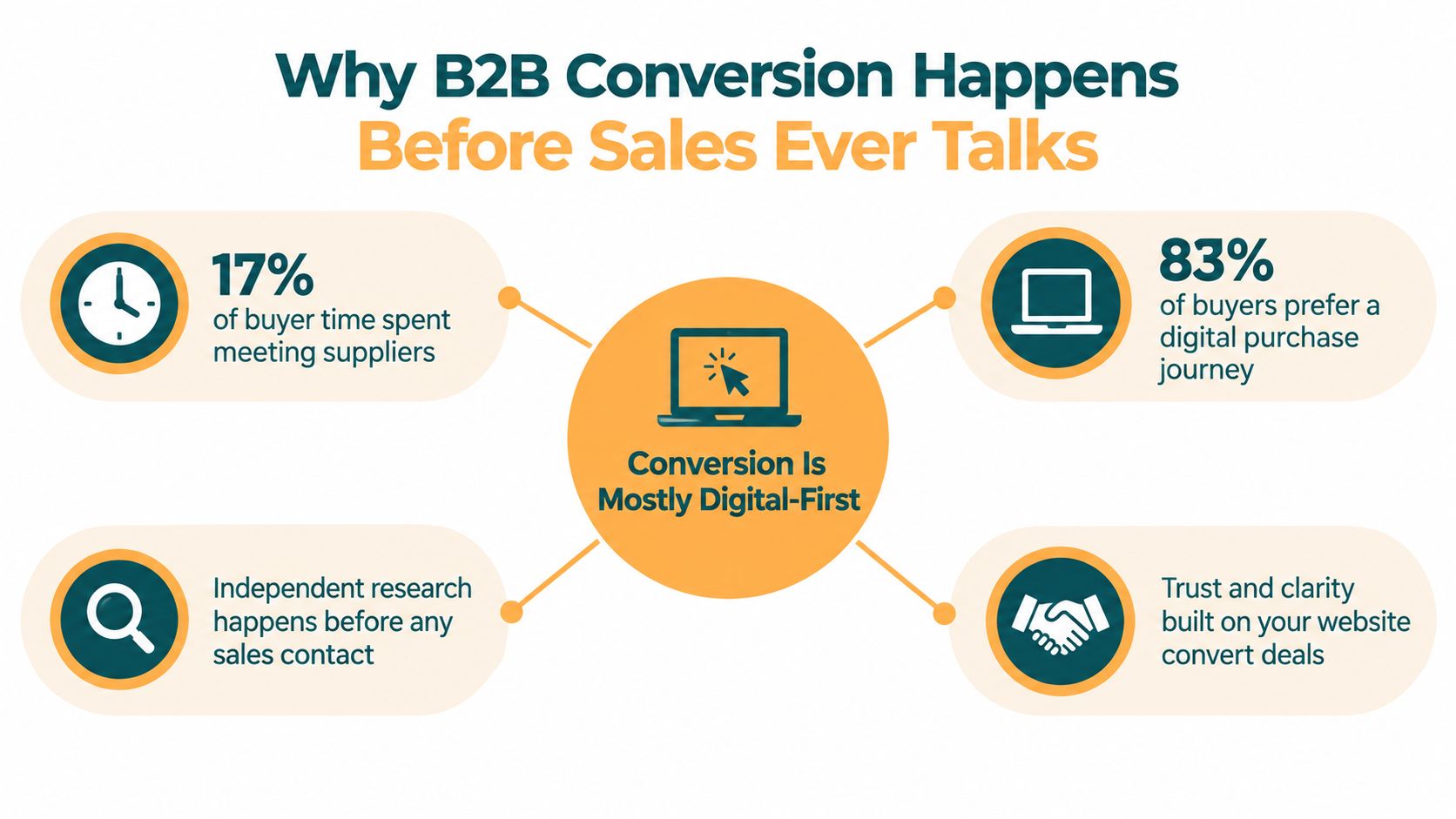
That doesn’t make human selling irrelevant. It changes where human involvement creates the most value. Buyers can often research capabilities and requirements independently, but they may still need a specialist to judge organizational fit, implementation risk, or a complex use case. Your CRO program should make both modes work together instead of forcing every visitor into the same demo request.
A conversion is a progression, not a single event
For a B2B organization, meaningful conversions can include:
- Qualified inquiry: A contact matches the target market and has a plausible business need.
- Demo or consultation request: A buyer signals readiness for a direct conversation.
- Content engagement: A stakeholder downloads a useful asset and enters a measurable nurture path.
- Pricing interaction: A visitor reviews a pricing range, configures an option, or uses a cost calculator.
- Account creation: A user begins an evaluation or activates a product experience.
- Buying-stage progression: An account moves from research to comparison, evaluation, or sales acceptance.
The commercial value of each action differs. A technical guide download shouldn’t carry the same weight as an accepted sales opportunity, but it can reveal which accounts are educating themselves and what information they still need. Treating every event as an equal conversion produces misleading reports and encourages teams to optimize low-intent activity.
Practical rule: Define conversion by the buyer’s next valuable step, then connect that step to CRM progression.
Why the form-only model fails
A final form report can’t tell you whether buyers found the right landing page, understood the offer, trusted the proof, or located the implementation details they needed. It also hides the people who influence a deal without submitting anything. A compliance reviewer may consume security documentation, while a budget owner returns through branded search after another stakeholder shares a comparison page.
That’s why analytics should connect page engagement and microconversions with marketing-qualified leads, sales acceptance, opportunity creation, win rate, customer-acquisition cost, and lifetime value. For professional-services firms, manufacturers, healthcare organizations, and technology companies, the strongest conversion paths let several stakeholders self-educate while preserving clear, measurable routes to sales engagement.
The Full-Funnel Audit Checklist
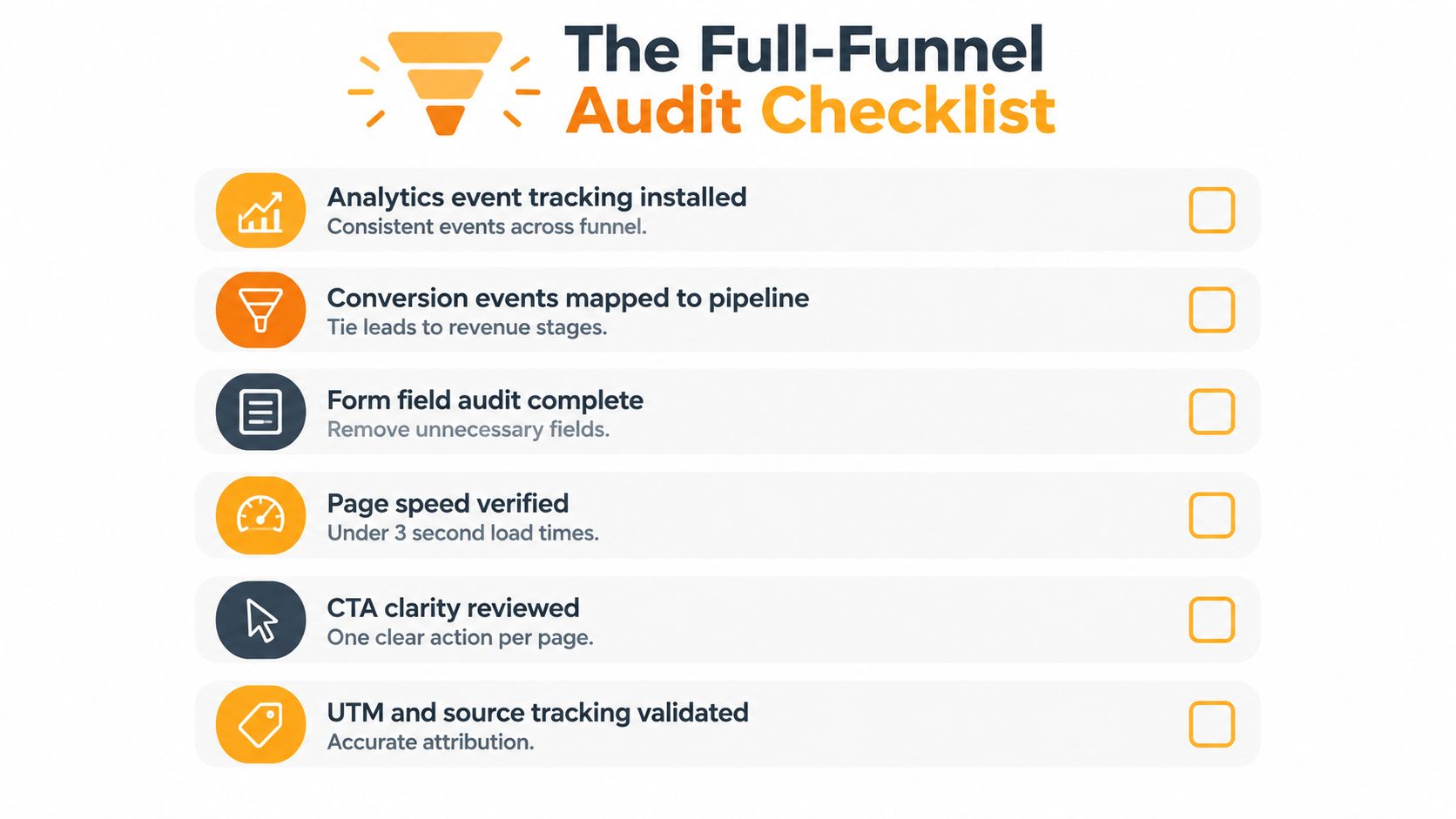
Start with instrumentation before changing copy or design. If your analytics platform records a form completion but can’t connect that event to an accepted lead or closed-won opportunity, you don’t have a CRO measurement system. You have a collection of surface metrics.
Build a consistent event taxonomy
Ask an analyst or RevOps owner to verify each event from the first visit through revenue:
- Session and source data: Preserve source, medium, campaign, landing page, device, and account context.
- Landing-page view: Record the page and intent category, not just the URL.
- CTA interaction: Distinguish primary calls to action from navigation and secondary links.
- Form start and completion: Capture abandonment by field where privacy and consent requirements allow.
- MQL and SQL: Import status changes from the CRM instead of estimating quality from marketing activity.
- Opportunity and closed-won revenue: Connect the original interaction and account to commercial outcomes.
Then segment performance by channel, device, industry, company size, and buying stage. A blended conversion rate can conceal a mobile usability problem, poor-fit paid traffic, or a strong industry segment that deserves more investment.
Establish stage-level baselines
Benchmark data places average B2B website visitor-to-lead conversion near 2.6%, with top-quartile performance around 4.5%, while funnel syntheses report approximately 31% lead-to-MQL, 13% MQL-to-SQL, 30% to 59% SQL-to-opportunity, and 22% to 30% opportunity-to-customer conversion in B2B lead-generation benchmark data. These figures are directional context, not targets to copy. Your baseline should show where your own funnel loses qualified demand.
Look for breaks such as:
- A high landing-page engagement rate followed by weak form starts.
- Strong form completion followed by poor sales acceptance.
- Healthy SQL creation followed by weak opportunity progression.
- A channel that produces many leads but little pipeline.
- Duplicate records that inflate conversion counts.
Find the reason behind the leak
Quantitative reporting identifies the location of friction. Qualitative evidence explains it. Review session recordings, interview recent buyers, inspect form-abandonment data, and ask sales representatives which objections appear repeatedly in calls.
Check whether visitors can answer five questions quickly:
- Is this relevant to my organization?
- What business outcome does it support?
- Can I trust the provider?
- What will implementation require?
- What should I do next?
Don’t repair the most visible metric. Repair the stage where qualified demand stops moving.
Finally, validate attribution. Brand traffic and high-intent search traffic shouldn’t sit in one undifferentiated report. Duplicate leads, missing campaign parameters, disconnected CRM stages, and cookie-based attribution loss can make a clean-looking dashboard commercially unreliable.
Prioritizing Experiments by Revenue Impact
A headline conversion-rate lift can be a poor business result. If a shorter form produces more inquiries but fewer sales-accepted leads, the test created administrative work rather than pipeline. Conversely, a change that reduces raw submissions while improving opportunity quality may lower reported conversion and improve revenue efficiency.
The difference comes from prioritization. Rank experiments by expected business impact, confidence in the diagnosis, implementation effort, and the stage of the funnel they influence. Put more weight on lead-to-opportunity, opportunity-to-customer, CAC, LTV, and revenue per visitor than on inexpensive microconversions.
B2B buyers face long, complicated journeys. A synthesis of buying research reports 88 touchpoints across four channels, an average duration of 272 days from first touch to revenue, 77% of buyers describing their purchase as very complex or difficult, and buying groups involving 6 to 11 stakeholders in B2B buyer-journey research. A single-page test rarely captures that entire commercial path.
Choose the metric before the variant
Use one principal hypothesis, one isolated change, and one primary metric. Define guardrails before launch, including lead quality, sales acceptance, meeting attendance, opportunity creation, and revenue. Document the minimum sample and test duration in advance, then avoid stopping because an early result looks promising.
| Experiment Type | Funnel Stage | Primary Metric | Guardrail Metric |
|---|---|---|---|
| Problem-led headline | Landing-page engagement | Qualified CTA interaction | MQL rate |
| Form simplification | Lead capture | Completed qualified forms | SQL acceptance |
| Industry-specific proof | Evaluation | Opportunity creation | Sales-cycle quality |
| Pricing or fit calculator | Consideration | Pricing interaction to opportunity | Lead-to-opportunity rate |
| Meeting-booking flow | Sales engagement | Attended qualified meetings | Opportunity creation |
| Comparison content | Shortlist formation | Returning-account progression | Win rate |
Why common scoring systems fall short
ICE-style scoring can help teams compare ideas, but it often overvalues easy tests with visible traffic. A button-label experiment may be simple to launch and easy to measure, while a security-documentation improvement requires coordination across marketing, product, sales, and legal. The second test may influence a more valuable objection, even if its immediate form impact is harder to observe.
Use effort and confidence as filters, not as the definition of value. A useful prioritization question is: If this test wins, which downstream stage should improve, and how will the CRM prove it?
Avoid changing several elements at once. If you rewrite the headline, replace the proof, shorten the form, and alter the booking flow in one release, you may create a better page but learn little about why it worked. Underpowered tests create the same problem. They encourage false certainty, especially on low-volume B2B pages.
Landing Page and Form Tactics That Actually Move Pipeline
The most reliable landing-page improvements remove a mismatch between what the visitor expected and what the page delivers. Match the page to the ad or search intent, state the business outcome above the fold, provide proof that fits the buyer’s industry and risk level, and give the visitor one obvious next action.
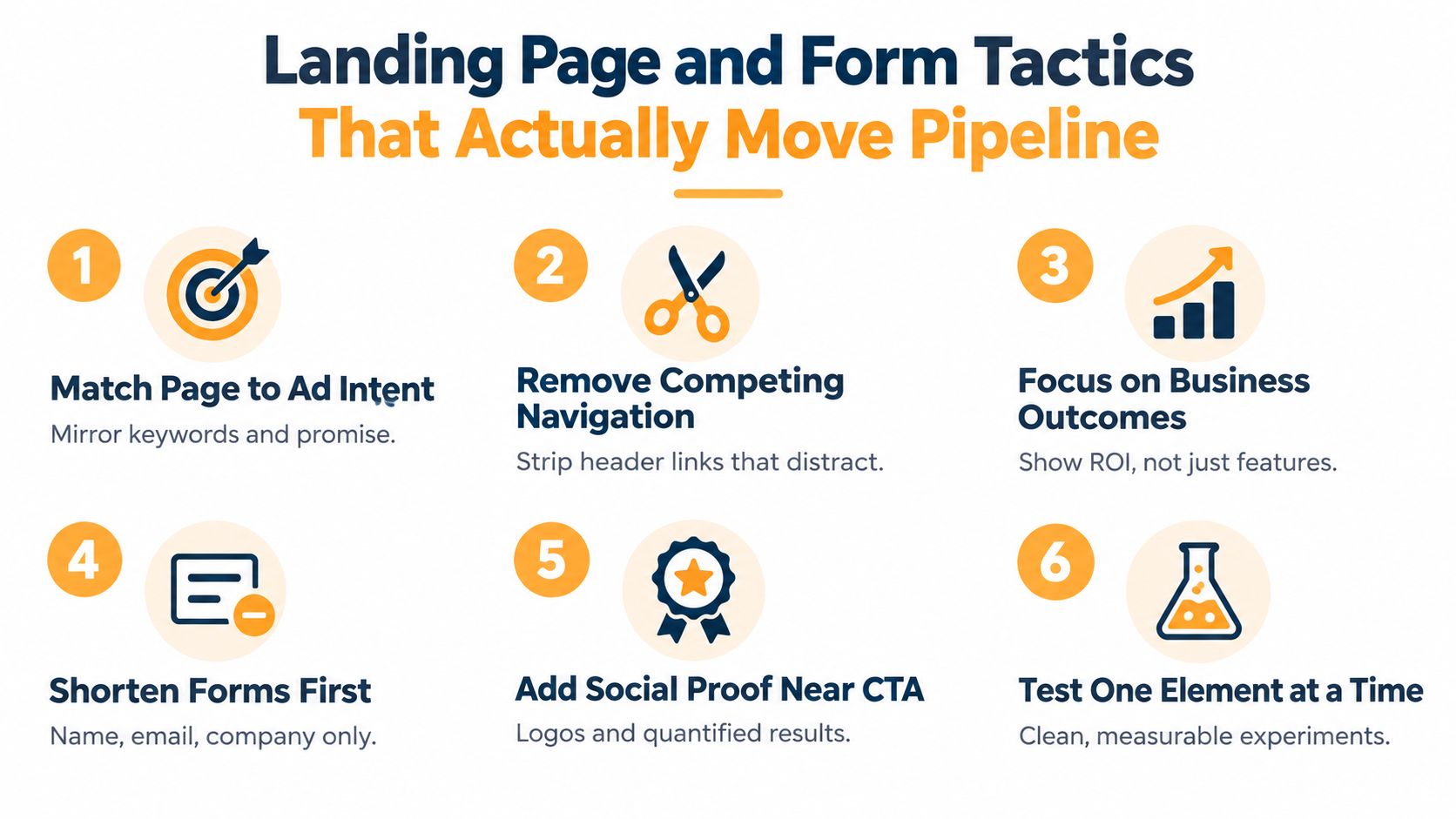
Reduce competing navigation when the page serves a focused campaign. A visitor who arrived for a manufacturing compliance solution shouldn’t have to choose among broad corporate links, unrelated services, and several competing CTAs. A dedicated page can still provide access to essential trust and legal information, but its hierarchy should reflect the intended buying action.
An analysis of 18,639 landing pages found that pages with a single CTA averaged a 13.5% conversion rate, compared with 10.5% for pages containing more than five links, according to landing-page benchmark analysis. The same source reports a median landing-page conversion rate of 6.6% across industries and a B2B-specific average of roughly 2.35%. Those benchmarks don’t prove that removing links will cause an identical result in your market, but they support testing choice reduction instead of assuming visitors need more options.
Four tests worth running
Test the message before the decoration. Compare a feature-led headline with one that names the buyer’s problem and desired business outcome. Watch qualified CTA interaction and MQL rate, not just clicks.
Move relevant proof beside the decision. Place industry-specific customer evidence, implementation detail, or security documentation close to the primary CTA. Measure SQL acceptance and opportunity creation to ensure the proof attracts the right audience.
Shorten the form progressively. Start with the information required to route and respond to the inquiry. Add further qualification after the first conversion through enrichment, follow-up questions, or a later booking step. Monitor form completion alongside MQL rate and sales acceptance.
Change the meeting flow, not only the button. Test an immediate calendar option against a confirmation step or a choice between self-service resources and a consultation. Track meeting attendance, SQL acceptance, and opportunity creation.
A form is a trade-off between visitor friction and sales context. Remove friction that sales doesn’t use, but don’t remove the information required to identify a legitimate buying opportunity.
Use landing-page split testing when the page has enough qualified traffic to support a controlled comparison. If volume is limited, combine observed behavior, buyer interviews, and sales feedback rather than declaring a weak test conclusive.
Designing Self-Service Paths Without Losing High-Intent Buyers
Many B2B teams treat a demo request as the only worthwhile conversion. That model creates a bad incentive: hide pricing, implementation requirements, security information, and comparisons so the buyer has to talk to sales before receiving basic answers.
The evidence points toward a hybrid experience. Gartner reports that 61% of B2B buyers prefer an overall rep-free buying experience, while still wanting seller input for contextual fit judgments. The same research reports that 69% encounter inconsistencies between a company’s website and its sales team, as summarized in B2B buyer behavior research.
Give each stakeholder a shareable answer
The researcher may need a clear capabilities page and comparison guide. A compliance reviewer may need security documentation, data-handling details, and implementation requirements. A budget owner may need pricing context, business outcomes, and a concise internal justification. A technical evaluator may need integrations, architecture information, or a realistic deployment path.
Useful self-service components include:
- Interactive fit assessment: Help buyers identify whether the solution matches their requirements.
- Transparent pricing ranges: Set expectations without pretending every engagement has identical scope.
- Implementation guidance: Explain dependencies, responsibilities, timing considerations, and internal resources.
- Security documentation: Put risk-reduction information where evaluators can find it.
- Comparison tools: Help buyers distinguish your approach from alternatives without forcing a call.
- Role-specific proof: Give each stakeholder evidence they can share internally.
Human support should appear where judgment matters. Offer a specialist conversation for diagnosis, unusual requirements, or organizational fit. Don’t use a sales call as a gate for information a buyer could reasonably evaluate alone.
Govern the message across teams
Website copy, paid advertising, sales decks, email sequences, and representative conversations should describe the same offer and constraints. If marketing promises simplicity while sales introduces complex requirements later, the buyer experiences the inconsistency as risk.
Message governance belongs in CRO because inconsistent claims can suppress conversion after a visitor has already shown intent. Review high-impact pages with sales, customer success, product, and legal stakeholders, then document approved positioning and proof. This protects the buyer experience while giving sales a more informed conversation when human help is genuinely needed.
Measuring CRO Against CAC and LTV
The final test of B2B conversion rate optimization is not whether more visitors submit forms. It’s whether the company creates more qualified pipeline and revenue from its acquisition investment.
Connect each experiment to a commercial chain: landing-page interaction, qualified lead, sales acceptance, opportunity, closed-won revenue, acquisition cost, and customer lifetime value. A shorter form that raises submissions but lowers opportunity creation can increase apparent conversion while worsening CAC. A qualification change that lowers lead volume but improves opportunity-to-customer performance may be the better economic decision.
Report the result at account and stage level. Track revenue per visitor, qualified pipeline per channel, sales acceptance, opportunity creation, win rate, CAC, and LTV. Use microconversions to diagnose behavior, but use pipeline and revenue to decide whether the experience created value.
Last-click attribution is losing context
AI-generated discovery makes this harder. Forrester data reported by Digital Commerce 360 indicates that AI-generated traffic represented 2% to 6% of B2B organic traffic in 2025 and was growing by more than 40% per month. The same reporting describes AI-referred visitors as more informed and more engaged.
A buyer may discover your company in an AI-generated answer, return later through direct traffic, visit several pages, and convert after an interaction your analytics never attributed to the original discovery event. Last-click reporting assigns credit to the final visit, not necessarily to the content or reputation that placed your company in consideration.
Use a blended view:
- Assisted conversions: Identify content and channels that influence later actions.
- Branded-search lift: Monitor whether more buyers search for the company after exposure.
- Returning-account behavior: Track repeat visits, content sequences, and account engagement.
- Account-level pipeline: Connect multiple stakeholders and sessions to opportunities where possible.
- Revenue-level experiment results: Compare pipeline quality and win outcomes, not only page rates.
The page with the highest immediate conversion rate isn’t automatically the page with the highest commercial value.
A practical marketing analytics dashboard should make these relationships visible without forcing executives to interpret disconnected tools. Keep the dashboard focused on decisions: which segments produce qualified opportunities, where prospects stall, and which experiments improve revenue efficiency.
Roll out winners cautiously
Release winning variants gradually, then monitor CRM quality for at least one full sales cycle. Check whether lead routing, sales acceptance, meeting attendance, opportunity creation, and revenue remain healthy after the initial result. Re-baseline by industry, device, channel, and buying stage instead of assuming one uplift applies across the entire audience.
Excellorix combines funnel audits, landing-page experimentation, analytics implementation, SEO, paid media, and website optimization for organizations that need CRO connected to broader growth performance. If your B2B site is generating activity without enough qualified pipeline, visit Excellorix to discuss an audit and a revenue-focused experimentation plan.