 Skip to content


Eight of 15 Facebook ad campaigns tested in a 2019 study produced a statistically significant lift in sales, so yes, Facebook advertising can work when the creative, audience, and offer align. It isn’t automatic, though, and a weak attribution setup can make profitable advertising look ineffective.
The more useful question is different: are your ads creating new demand, or are they receiving credit for customers who would’ve converted anyway? That measurement gap explains why one brand reports excellent ROAS while another sees disappointing platform numbers from campaigns that still influence revenue.
Facebook remains a serious performance channel because it combines broad reach, fast creative feedback, and optimization toward business outcomes. But advertisers need to judge it through incrementality, contribution margin, lead quality, and customer value, not isolated screenshots from Ads Manager.
Table of Contents
- Does Facebook Advertising Work
- Understanding Meta Advertising Scale and Reach
- Real Performance Benchmarks by Campaign Type
- How to Measure Incrementality Correctly
- The Measurement Gap Behind Weak ROAS Reports
- When Facebook Ads Stop Being Economically Viable
- Building a Revenue-Driven Facebook Ads Strategy
Does Facebook Advertising Work
One brand scales Meta ads profitably; another pauses after paying for clicks that never convert. The difference rarely lies in the platform alone. Offer quality, audience fit, conversion friction, and measurement determine whether Facebook produces business value.
Controlled measurement provides better evidence than a single advertiser’s dashboard. The 2019 Facebook ad study cited by the American Marketing Association’s advertising effectiveness analysis tested 15 campaigns, and 8 produced a statistically significant lift in sales. Just over half of the measured campaigns therefore generated a sales impact that cleared a statistical threshold.
That finding supports Facebook’s ability to influence purchasing behavior, not a promise of profitable results for every advertiser. A relevant offer delivered to a suitable audience has a stronger chance than a generic awareness message shown to an unqualified segment. Profit still depends on conversion rate, contribution margin, customer value, and the cost of reaching each buyer.
Why campaign context changes the answer
Kantar’s digital ad effectiveness research, summarized in the same AMA resource, reported that 47% of positive deltas were statistically significant and found social media, specifically Facebook and Instagram, effective at driving brand impact. Brand impact does not equal immediate revenue, but it matters for products that require consideration before purchase.
A practical review starts with three questions:
- Can Facebook reach the right people? Usually, yes, where the audience is large enough to support testing.
- Can the ads create measurable response? Campaign evidence says they can, but results are not consistent by default.
- Can the response be profitable? Only when the offer, landing page, economics, and tracking support it.
Clean attribution should come before confidence in a ROAS anecdote. Set up server-side conversion tracking, reconcile event data with orders and qualified leads, and compare exposed regions or randomized holdouts with a control group. That incrementality test shows whether Facebook generated additional outcomes rather than receiving credit for demand that would have converted anyway.
Practical rule: Treat Facebook as a testable acquisition system, not a guaranteed sales machine.
Channel choice also depends on buyer intent. Some prospects search for a known solution, while others discover a need while browsing. A coordinated Google and Meta advertising strategy can address both behaviors, provided the team deduplicates conversions and evaluates incremental profit rather than platform-reported ROAS alone.
Understanding Meta Advertising Scale and Reach
Reach creates a practical advantage that many small advertisers underestimate. Meta estimated its advertising reach at 2.28 billion people in January 2025, equivalent to 27.9% of the world’s population and 41.1% of internet users, according to Meta advertising reach data published by Pace Ads. The estimate also recorded an increase of 93.3 million people year over year, or 4.3%.
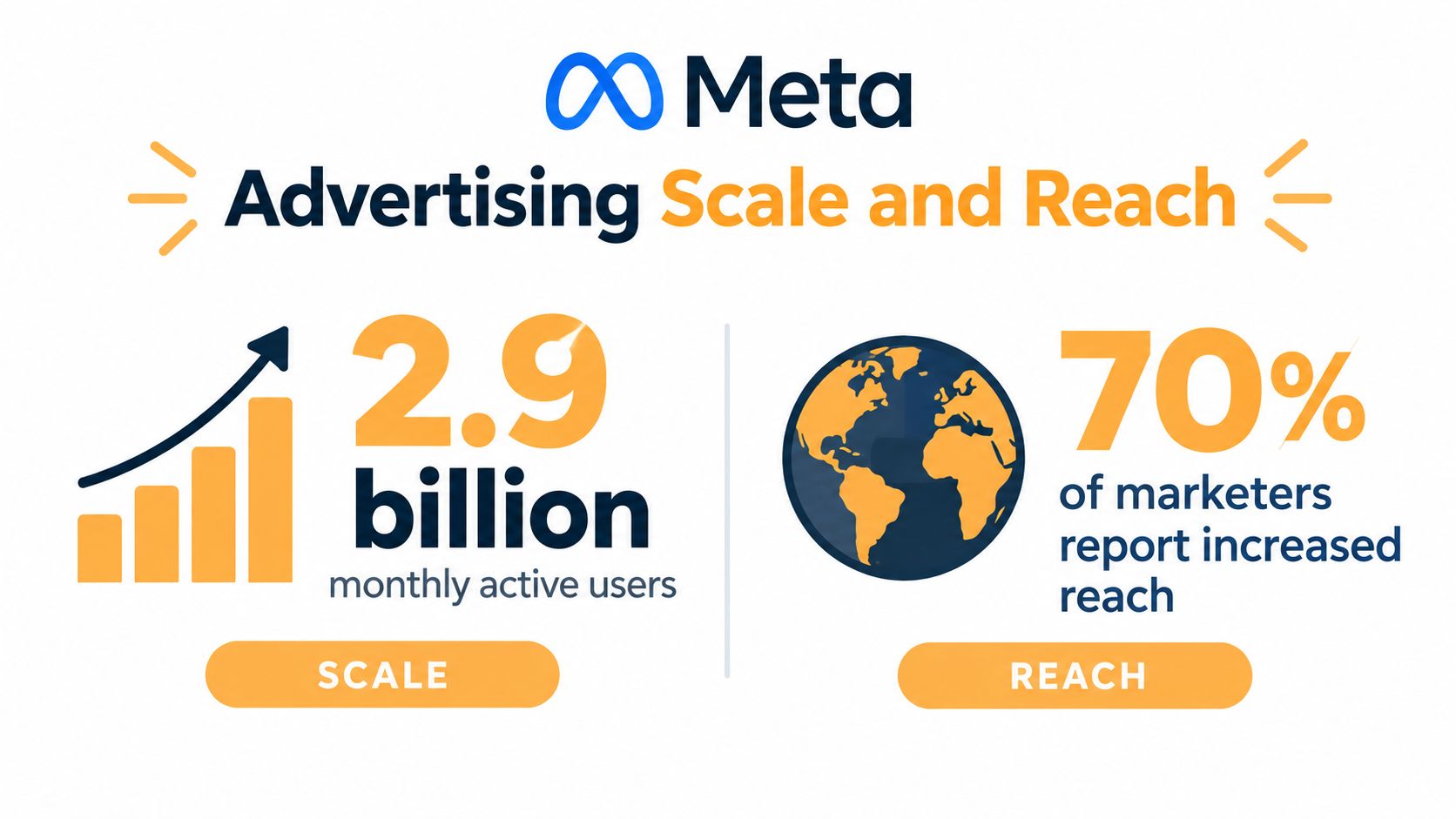
Large reach doesn’t make an ad persuasive. It does make experimentation more viable. A business can compare different hooks, formats, audience definitions, and conversion events without exhausting its addressable market immediately, particularly in major markets where Facebook remains heavily used.
What scale enables
A performance account needs enough delivery to distinguish a genuine pattern from random fluctuation. Meta’s breadth can support testing across several funnel roles:
- Demand creation: Introduce a problem, category, or point of view to people who aren’t actively searching.
- Consideration: Explain the mechanism, demonstrate the product, or address an objection.
- Conversion: Present a clear offer to people who already understand the value.
- Re-engagement: Return qualified visitors or leads to a relevant next step.
The advantage is less about collecting impressions and more about giving the delivery system room to find people likely to complete the selected event. That only works when the event represents business value. Optimizing for cheap traffic can produce cheap traffic. Optimizing for qualified leads or purchases gives the system a more useful signal, assuming the signal is tracked accurately.
A broader audience can also outperform overbuilt targeting. Tight audience rules may look precise but can restrict delivery and prevent the algorithm from finding adjacent buyers. The right balance depends on the offer, conversion volume, creative quality, and market size.
This overview of AI and automation in Meta Ads is relevant for the same reason. Automation can help process signals and distribute delivery, but it can’t rescue a poor offer or unreliable conversion data.
Meta’s scale is therefore an input, not a strategy. It gives advertisers room to test, but the account still needs disciplined hypotheses and a measurement plan.
A useful visual explanation of how reach, targeting, and delivery fit together appears below.
Real Performance Benchmarks by Campaign Type
A benchmark becomes useful only after you identify the campaign objective. Comparing a lead-generation campaign with an ecommerce purchase campaign is like comparing a completed enquiry with a completed checkout. Both matter, but they require different user journeys and different optimization signals.
Aggregated 2025 to 2026 Meta benchmarks report a lead-generation CTR of around 2.59% and a lead-generation conversion rate of around 7.72%, according to Superscale’s Meta Ads benchmark analysis. The same analysis places broader cross-industry conversion estimates at roughly 8%, while ecommerce median conversion rates are closer to 1.53%.
These figures shouldn’t become universal targets. They show why objective and intent matter. A lead form can reduce friction by keeping the user within the platform. An ecommerce purchase usually requires more commitment, including product evaluation, shipping considerations, payment, and checkout completion.
Lead generation versus ecommerce
| Campaign type | What the algorithm optimizes toward | Main performance constraint |
|---|---|---|
| Lead generation | A deeper lead event rather than a simple visit | Lead quality and follow-up speed |
| Ecommerce | Product or purchase behavior | Product-page clarity, offer strength, and checkout friction |
| Traffic | Visits or clicks | Weak commercial intent if the event is too shallow |
Lead campaigns often perform better than traffic campaigns because the optimization event is closer to the desired business outcome. But a low-cost lead isn’t automatically valuable. If sales staff can’t contact prospects promptly, or if the form attracts people outside the service area, the apparent efficiency is misleading.
Ecommerce teams need to connect ad promise to product-page experience. A discount-led ad should land on a page where the offer is immediately understandable. A problem-led ad needs proof, product context, and a clear next step. Slow pages, unclear delivery terms, and a complicated checkout can erase the benefit of strong media buying.
The benchmark is a diagnostic, not a verdict. If your rate differs, investigate the event quality, audience intent, creative promise, and landing-page experience before changing the channel.
The practical comparison is simple. Lead generation can tolerate a shorter conversion path, but it demands downstream qualification. Ecommerce can produce direct revenue, but it carries more conversion friction and exposes unit economics more quickly.
How to Measure Incrementality Correctly
ROAS answers a narrow question: how much revenue the platform attributes to spend. It doesn’t answer whether those conversions would’ve occurred without the ads. To answer that, you need a comparison between people exposed to advertising and a similar group that wasn’t exposed.
Meta’s incrementality framework uses a test-and-control split. Ads are withheld from the control group, while the test group receives the campaign. The advertiser then compares conversion behavior between the groups, as described in Measured’s explanation of Facebook incrementality testing.
A workable testing process
-
Define the business outcome. Choose a purchase, qualified lead, activated account, or another event that reflects revenue quality. CTR can help diagnose creative, but it shouldn’t be the final success measure for a revenue campaign.
-
Create a defensible control group. The control group must resemble the test population and remain withheld from the relevant advertising exposure. If the groups differ materially, the observed difference may reflect audience composition rather than advertising.
-
Run the test without constant interference. Frequent budget, audience, or creative changes can contaminate the comparison. Set the test period and decision rules before reviewing the outcome.
-
Compare downstream behavior. Measure conversion rate, CAC, revenue, margin, repeat behavior, and lead quality where applicable. A campaign that produces more leads but fewer qualified opportunities may have poor incremental value.
-
Calculate incremental efficiency. Compare the additional conversions or revenue associated with the test group against the advertising cost. This is more meaningful than accepting every platform-attributed conversion as caused by the platform.

The tracking layer matters
Implement Meta’s Conversions API alongside browser-side measurement where appropriate. Server-side event transmission can give the system a cleaner view of important actions, but it doesn’t replace consent, accurate event definitions, deduplication, or CRM reconciliation.
A strong test connects ad exposure to the business database. For lead generation, that means importing qualification and sales outcomes rather than stopping at form completion. For ecommerce, it means reconciling purchases and revenue with the store backend.
Incrementality testing takes more planning than reading a dashboard. It also produces a more credible answer to whether Facebook advertising works for your business.
The Measurement Gap Behind Weak ROAS Reports
A weak reported ROAS doesn’t always mean weak advertising. Privacy changes have reduced the amount of browser-based behavior that platforms can observe, so advertisers may lose visibility into part of the customer journey even when the ads influence demand.
Recent attribution coverage emphasizes the need for clean server-side data, Conversions API implementation, and multi-touch or media-mix modeling as browser tracking weakens. One 2026 attribution guide states that attribution windows have been reduced to 1-day click and 1-day view, and that advertiser-declared data sources are required, as outlined in Adamigo’s Meta privacy and consent guide.
That changes how a buyer should interpret platform reporting. If an interaction isn’t captured, the conversion may disappear from the reported path. If a conversion is captured by several systems, more than one channel may claim it. Both errors can distort budget decisions.
Signs your measurement is compressed
Look for mismatches rather than one alarming metric:
- Platform revenue and backend revenue diverge: Confirm event coverage, purchase values, and deduplication.
- Leads rise but qualified opportunities don’t: Audit form fields, CRM mapping, and sales-stage imports.
- Direct traffic increases after campaigns launch: Consider whether users saw an ad and returned through another route.
- Reported results change after consent updates: Compare tracking coverage before judging media efficiency.
- Campaigns look different by device or browser: Investigate signal loss before rewriting the creative strategy.
A reported conversion is not the same as an incremental conversion.
Teams often make the wrong correction. They reduce spend because the dashboard undercounts assisted demand, or they scale because the platform claims conversions that other channels also influenced. A reliable setup compares platform reporting with analytics, CRM, ecommerce records, and controlled tests.
The common examples of misleading statistics are a useful reminder that a precise-looking number can still answer the wrong question. Improve data collection first, then decide whether the media deserves more or less budget.
When Facebook Ads Stop Being Economically Viable
Facebook advertising can work operationally while failing financially. Delivery may be stable, CTR may look healthy, and leads may arrive, but the business still loses money because the margin cannot absorb acquisition cost or the sales process can’t convert the demand.
A 2026 benchmark-style analysis argues that Meta is usually more viable for high-margin ecommerce and subscription offers, while low-margin ecommerce often needs strong lifetime value to support the channel, as discussed in Admanage’s analysis of Facebook Ads economics. The principle is straightforward. A business with more contribution margin or repeat purchase potential has more room to acquire a customer.
The economic filters
Before scaling, calculate the maximum acquisition cost the business can tolerate. Use contribution margin rather than top-line revenue, and account for fulfilment, refunds, payment fees, sales commissions, onboarding, and support. A campaign can show positive revenue ROAS and still fail the margin test.
Subscription businesses may have more room because the first transaction isn’t the only source of value. That doesn’t make them automatically safe. Churn, failed payments, trial quality, and payback timing determine whether early acquisition is sustainable.
Low-margin retailers face a narrower path. They need a strong offer, efficient fulfilment, repeat demand, or another strategic reason to accept a lower initial return. If none exists, improving product economics or prioritizing a channel with stronger existing intent may be wiser than forcing Meta to work.
Saturation creates another limit. Independent evidence from a clinical recruitment study found that the first three Facebook ad campaigns were the most cost-effective, while the researchers called for further work on saturation, ad design, and audience response, as reported in the study coverage. The finding doesn’t establish a universal campaign limit, but it supports a practical warning: audiences fatigue, and repeated exposure eventually needs a new creative angle or a broader prospecting pool.
Watch for rising acquisition cost, declining qualified response, repeated comments that reveal fatigue, and deteriorating conversion quality. When those signals persist after creative, offer, landing-page, and tracking checks, the problem may be economic saturation rather than a minor campaign setting.
Building a Revenue-Driven Facebook Ads Strategy
A durable Facebook program connects four operating loops: creative testing, audience development, conversion optimization, and measurement. Start with a business outcome, then work backward to the event Meta should optimize toward and the evidence your finance or sales team will accept.
For creative, test distinct customer problems and proof points rather than making superficial variations of the same ad. For audiences, compare broad delivery with qualified first-party inputs, but judge the result through incremental outcomes. For conversion, align the landing page with the exact promise in the ad.
Tracking should join browser events, server-side events, CRM outcomes, and backend revenue. Review platform metrics for diagnosis, then use CAC, contribution margin, lead quality, and incrementality for decisions. A/B tests help compare messages and pages, while holdout tests help determine whether the channel itself creates additional demand.
Excellorix is one option for teams that need Meta PPC management alongside conversion tracking, pixel setup, retargeting strategy, creative testing, landing-page work, and performance reporting. The operating model matters more than the vendor label. Facebook advertising works best when someone owns the full chain from impression to qualified revenue.
Excellorix can audit your Meta tracking, connect campaign data with downstream business outcomes, and manage creative and conversion testing across Facebook and Instagram. Visit Excellorix to discuss a measurement-led paid media program built around incremental growth, not platform-reported ROAS alone.


