

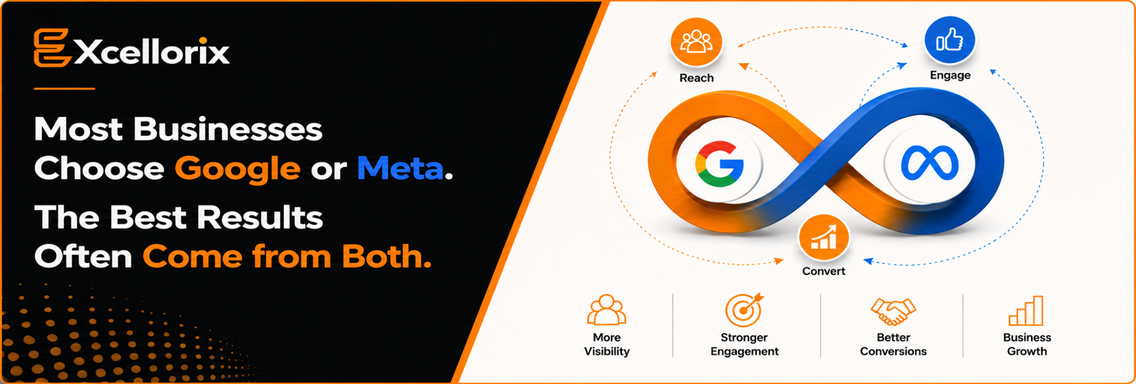
If you’re planning to invest in paid advertising, chances are you’ve asked the same question that thousands of business owners ask every year.
Should I spend my budget on Google Ads or Meta Ads?
At first glance, it seems like a simple decision. One platform must be better than the other, right? Not really. The biggest mistake businesses make isn’t choosing Google over Meta or Meta over Google. It’s assuming customers make decisions on a single platform. They don’t. Today’s buyers jump between social media, search engines, websites, reviews, emails, and even conversations with friends before making a purchase. They might discover your business while scrolling Instagram during lunch, search for your services on Google a few days later, visit your website, compare competitors, and only reach out when they’re completely confident. Every one of those interactions influences the final decision. That’s why successful businesses no longer think about individual platforms. Instead, they build a Google and Meta ads full funnel strategy that supports customers from the moment they discover a brand until the moment they become paying clients. The goal isn’t simply generating clicks. The goal is creating enough trust that choosing your business feels like the obvious next step.
When advertising results slow down, many businesses immediately blame the platform. If Google Ads aren’t producing enough leads, they shift more budget to Meta. If Meta campaigns aren’t delivering sales quickly enough, they move everything back to Google. Unfortunately, neither decision solves the real issue. Changing platforms without understanding how customers actually buy is like replacing the steering wheel when the destination is programmed incorrectly. Before deciding where your advertising dollars belong, ask yourself something more important.
What does my customer’s buying journey actually look like?
That question changes the conversation completely because modern customers rarely follow the straight path businesses expect. Understanding that journey is where every successful advertising strategy begins.
The answer is surprisingly simple. Most customers don’t wake up one morning, search for your business, and make a purchase before lunch. Instead, they collect information over time. They notice brands, compare options, read reviews, and slowly build confidence before deciding who deserves their business. Think about the last service you purchased. Maybe you hired a marketing agency, bought business software, or looked for a contractor. Chances are you didn’t choose the first company that appeared on your screen. You explored different options until one business felt more trustworthy than the rest. Your customers behave exactly the same way. That’s why understanding the Meta Ads customer journey and the Google Ads customer journey is far more valuable than debating which platform is better. They aren’t competing with each other. They’re helping customers at different moments of the same buying process.
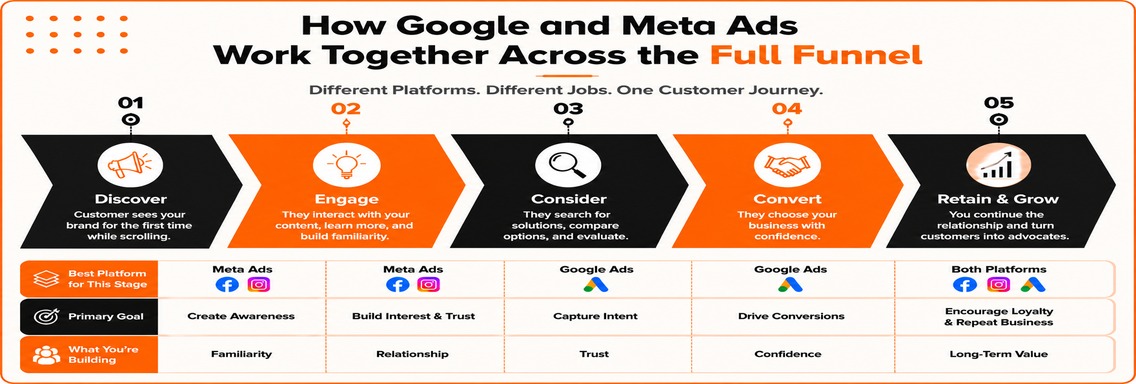
One reason businesses struggle with paid advertising is because they expect every campaign to produce immediate sales. That’s asking too much from a single interaction. The Meta Ads customer journey usually begins when people aren’t actively looking for a solution. They’re scrolling through Facebook or Instagram to relax, catch up with friends, or watch short videos. That doesn’t mean they’re the wrong audience. It simply means they’re at an earlier stage.
A useful video, customer success story, or educational post introduces your brand without asking for an immediate commitment. Instead of pushing for a sale, you’re creating familiarity. Even if they don’t click today, they’ll remember your business when the need eventually arises. Days later, something changes. A business owner realizes their website isn’t generating enough leads. A homeowner decides it’s finally time to replace the roof. An ecommerce brand wants to improve online sales. Now they’re actively searching for answers. That’s when the Google Ads customer journey becomes critical. Google places your business in front of people who already have a problem and are looking for someone to solve it. Instead of creating awareness, it captures existing demand.
By this stage, your brand may already feel familiar because of earlier interactions on Meta. That familiarity builds trust, and trust often becomes the deciding factor when customers compare similar businesses. This is exactly why more companies are investing in cross-platform advertising. Rather than expecting one platform to do everything, they allow each channel to contribute at the right time. The result is a smoother experience for the customer and a stronger marketing strategy for the business. The challenge, however, isn’t simply using both platforms. It’s making sure they work together instead of operating like two completely separate campaigns. That’s where many businesses unknowingly leave opportunities on the table.
Using both platforms doesn’t automatically create better results. Many businesses run Google Ads and Meta Ads at the same time, but each campaign tells a different story. The messaging changes, the offers are inconsistent, and the landing pages don’t match what customers expected after clicking the ad. From the business owner’s perspective, everything seems organized because each campaign is running. From the customer’s perspective, the experience feels disconnected.
Imagine someone watches a short Facebook video explaining how to generate more qualified leads. A few days later, they search Google for help and click your ad. Instead of finding a page that expands on the same topic, they’re taken to a generic homepage with completely different messaging. That small disconnect creates doubt. Customers rarely stop and think, “This company’s marketing isn’t aligned.” They simply leave and continue looking for another business. Successful cross-platform advertising removes those moments of confusion. Every click should feel like the next step in the same conversation, regardless of where the customer comes from.
Another common mistake is giving all the credit to the platform that generated the final click. Let’s say someone discovers your business through Instagram. They watch one of your videos, visit your profile, and move on without contacting you. A week later, they remember your company while searching on Google. They click your ad, explore your website, and finally request a quote. Most reporting tools will show Google as the source of the conversion. Technically, that’s correct. But it doesn’t tell the whole story. Without the earlier interaction on Meta, that customer might never have searched for your business in the first place. That’s why businesses that rely only on last-click reporting often underestimate the value of social advertising. The real goal isn’t to prove that one platform is better than the other. It’s to understand how every interaction influences the final decision. When you view marketing this way, the conversation shifts from comparing platforms to improving the entire customer experience.
Customers don’t care which platform introduced your business. They care about whether every interaction feels helpful, relevant, and consistent. Your Facebook ad shouldn’t tell one story while your Google ad tells another. Your landing pages shouldn’t force visitors to start their research all over again. Every touchpoint should answer the next question a customer is likely to have. This is also where SEO services become an important part of the strategy.
Paid advertising creates visibility, but SEO keeps your business discoverable long after an ad has been clicked. A helpful blog, an informative service page, or a well-optimized resource can reinforce the same message customers first saw in your ads. Instead of relying entirely on paid campaigns, you’re building long-term credibility that continues supporting the buying journey. When Google Ads, Meta Ads, SEO, and your website all work together, marketing stops feeling like a collection of individual campaigns. It becomes one connected system that guides customers naturally from curiosity to confidence and, ultimately, to conversion.
The discussion around Google Ads and Meta Ads often focuses on choosing a winner. In reality, the businesses achieving consistent growth have stopped asking that question altogether. They’ve realized that customers don’t think in platforms. They think in problems, solutions, and trust. Someone may discover your business through a social media post, return after seeing a customer testimonial, search Google when they’re ready to compare options, and finally become a customer after reading your website. Every interaction plays a role, even if only one platform receives credit for the conversion. That’s why a Google and Meta ads full funnel strategy delivers stronger long-term results than relying on a single channel. It allows your business to stay visible throughout the entire buying journey instead of appearing only when someone is ready to purchase.
The real advantage isn’t running more advertisements. It’s creating a connected experience where every touchpoint builds on the previous one. When the Meta Ads customer journey creates awareness, the Google Ads customer journey should continue that conversation instead of starting over. Supported by consistent messaging, valuable content, and effective cross-platform advertising, your marketing becomes easier for customers to follow and easier for your business to scale. To strengthen that strategy even further, combine paid campaigns with professional SEO services. While Google and Meta Ads generate immediate visibility, SEO helps your business earn long-term search visibility, answer customer questions, and build credibility before prospects ever speak with your sales team. Together, they create a marketing system that delivers both short-term wins and sustainable growth.
At Excellorix, we help businesses build marketing strategies that connect every stage of the customer journey. From paid advertising and landing page optimization to SEO services and conversion strategy, we focus on creating campaigns that work together instead of competing with each other. If you’re investing in Google Ads or Meta Ads but treating them as separate marketing channels, you could be missing valuable opportunities. Schedule a free strategy call with Excellorix, and we’ll help you build a full-funnel strategy that attracts better-qualified leads, improves conversion rates, and supports long-term business growth.
It depends on your goals and how your customers make buying decisions. If people are actively searching for your products or services, Google Ads can capture that demand. If you want to introduce your business to new audiences and build brand awareness, Meta Ads is an excellent choice. For many businesses, combining both platforms delivers the best results.
A Google and Meta ads full funnel strategy uses different platforms to support different stages of the buying journey. Meta introduces your brand and builds familiarity, while Google captures customers who are actively searching for a solution. Together, they create a smoother path from discovery to conversion.
The Meta Ads customer journey often begins with educational or engaging content that introduces your brand to potential customers. As their interest grows, the Google Ads customer journey takes over when they search for more information or compare businesses. Together, they create a connected experience that builds trust before a purchase is made.
Customers rarely rely on one platform before making a buying decision. Cross-platform advertising keeps your brand visible across social media, search engines, websites, and other digital touchpoints. This consistency improves brand recognition, strengthens trust, and increases the likelihood of conversion.
Tell us about your goals—we’ll show you how Excellorix can help you get there.