


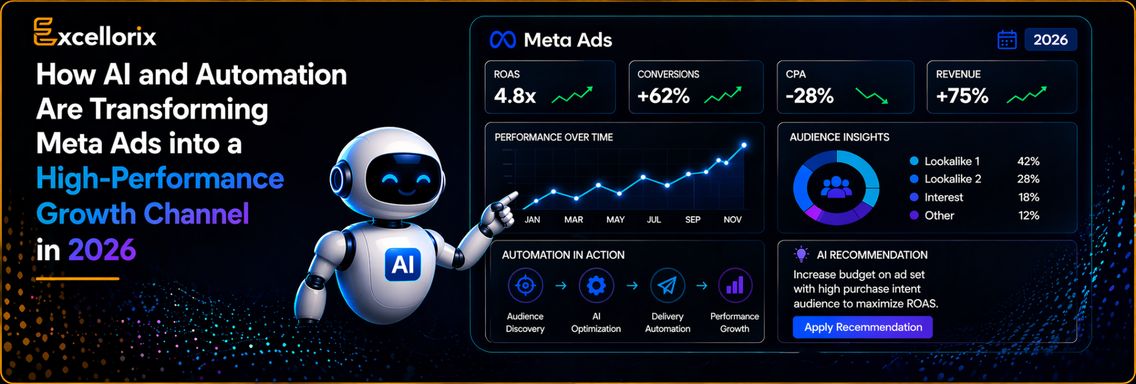
Meta Ads in 2026 work very differently from how they used to a few years ago. What was once a highly manual process of adjusting bids, testing audiences, and constantly tweaking campaigns has now shifted into something far more adaptive.
Today, AI in Meta Ads plays a central role in how campaigns are delivered, optimized, and scaled. This shift has also changed what it means to be a marketer. It is no longer about controlling every small setting inside an ad account. The focus has moved toward strategy, creative direction, and building systems that allow automation to do its job effectively. Still, many advertisers have not fully adapted. They continue making frequent manual changes, over-managing campaigns, and interrupting the learning process that modern systems rely on. That is usually where Meta Ads optimization 2026 efforts start to fail.
To understand this shift properly, it helps to first break down what Meta Ads automation actually means today.
Meta Ads automation is no longer just a feature inside Ads Manager. It is now the core system behind performance delivery. Instead of manually managing everything, AI now handles key parts of execution such as:
Budget distribution across campaigns and ad sets
Reducing spend on underperforming ads automatically
Testing multiple creative variations at scale
Expanding targeting based on real user behavior signals
Your role is not to constantly intervene but to guide the system with the right inputs. Meta’s native tools like Advantage Plus campaigns are built around this idea. You set the objective, and the system manages delivery, testing, and optimization. At scale, many advertisers also combine this with external tools to improve reporting depth and apply more structured Facebook Ads automation across accounts.
However, tools alone do not guarantee results. Performance depends heavily on setup, tracking quality, and creative strategy.
A common misunderstanding is that automation automatically improves performance. In reality, it depends on how well the system is structured.
In most accounts that struggle, a few patterns appear repeatedly:
Tracking is incomplete or not properly configured
Creative testing is inconsistent or too limited
Campaign structures are overly complex or outdated
Decisions are made without reliable data inputs
So even though AI is running the campaigns, it is often optimizing based on weak or inaccurate signals.
This is one of the main reasons brands fail to improve Meta Ads performance even after increasing budgets or switching tools. As Meta’s system becomes more advanced, these issues become even more visible.
Meta’s algorithm in 2026 is significantly more predictive than before. Instead of focusing only on clicks or conversions, it now studies deeper behavioral signals like scrolling patterns, engagement speed, hesitation, and interaction depth. This allows the system to predict purchase intent much earlier in the journey. Because of this, audience targeting has become less important than creative and messaging quality. The system can now identify potential buyers based on behavior rather than manually defined interests. This is where AI advertising strategies have become essential.
The success of a campaign now depends more on how well you feed the algorithm than how tightly you define the audience. However, the system still depends on two things above everything else: strong creative inputs and clean tracking data. Without these, even the most advanced AI in Meta Ads cannot deliver stable performance.
When implemented correctly, automation becomes one of the strongest drivers of scale in Meta Ads.
Audience expansion now happens automatically based on real buying behavior instead of assumptions or interest stacking
Budget allocation shifts dynamically toward the best performing ads without manual intervention
Creative testing becomes faster, allowing multiple variations to run and optimize at the same time
Value-based optimization helps prioritize users who are more likely to generate long-term revenue
Real-time performance signals help reduce wasted spend and improve efficiency
These systems together form the backbone of modern Facebook Ads automation and make scaling far more predictable when set up properly.
Trying to automate everything at once usually creates confusion instead of clarity. A better approach is to build automation in layers.
Start with reporting so you can clearly see what is happening inside your campaigns in real time.
Next, introduce budget rules that allow scaling when performance meets defined thresholds.
After that, focus on structured creative testing so new ideas are continuously being introduced into your campaigns.
This is one of the most important parts of Meta Ads optimization 2026 because creative performance is now a major growth driver. Once these foundations are stable, scaling becomes far more predictable.
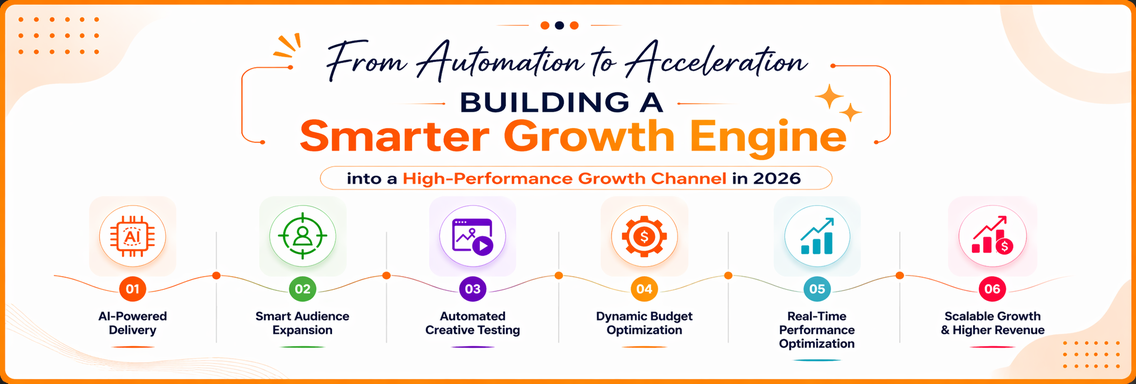
There was a time when targeting decisions were the biggest driver of performance. That is no longer the case. In 2026, creative is often the difference between a winning and losing campaign. The algorithm can distribute ads efficiently, but it cannot fix weak messaging or poor creative execution.
High-performing ads usually follow a simple pattern:
They grab attention in the first few seconds
They communicate a clear and simple message
They are continuously tested and improved over time
This is why brands that consistently improve Meta Ads performance are the ones that invest heavily in creative testing rather than only adjusting targeting.
Creative drives attention, but tracking teaches the system what success actually looks like. If tracking is not properly set up, Meta’s AI ends up optimizing based on incomplete or misleading signals. This is one of the biggest reasons campaigns fail to scale consistently.
Proper conversion tracking, especially server-side tracking, ensures that Meta receives accurate data across the entire customer journey.
Once tracking is fixed, performance improvements often become immediate and noticeable.
A simple and effective structure usually follows this path.
Start with tracking and data accuracy to ensure the system is learning from correct inputs.
Then set up monitoring systems that make performance changes visible early.
Introduce controlled automation for scaling and optimization using both native tools and Facebook Ads automation layers where needed.
Finally, build a continuous creative testing system that feeds fresh inputs into the algorithm regularly.
Instead of reacting daily, it is better to review performance on a weekly basis so the system has time to stabilize and optimize properly.
Meta Ads in 2026 are no longer about manual control. They are about system design. The advertisers who succeed are not the ones constantly tweaking campaigns. They are the ones who build strong foundations, provide clean data, and use AI in Meta Ads the right way.
AI has not removed marketers from the process. It has simply changed their role. Strategy, creative thinking, and data quality now matter far more than constant manual optimization.
Most Meta Ads accounts do not have a traffic problem. They have a system problem that quietly limits how efficiently their ads turn spend into revenue. If your campaigns are getting clicks but not delivering consistent results, something inside your Meta Ads structure is not working the way it should. Let’s take a closer look at what is holding it back.
Book a free strategy call with Excellorix and find out
Why your Meta Ads are getting traffic but not converting into consistent sales
How AI powered Meta Ads optimization can improve performance and reduce wasted spend
Where your tracking, creative, or audience setup may be causing hidden performance issues
How Facebook Ads automation and AI advertising strategies can improve scaling decisions across campaigns
What kind of system changes can help improve Meta Ads performance and unlock stable growth
The goal is not just to increase traffic or ad spend. It is to turn your existing campaigns into a predictable growth system built on structure, data, and smarter execution.
If you’re focused on scaling with Meta Ads optimization in 2026, this is the right place to start.
AI in Meta Ads refers to Meta’s machine learning system that automatically optimizes campaign delivery. It analyzes user behavior, engagement patterns, and conversion signals to decide who sees your ads, when they see them, and how budgets are allocated. This reduces manual work and improves efficiency over time.
Meta Ads optimization 2026 is far more automated and predictive. Instead of relying heavily on manual targeting and bid adjustments, performance now depends on creative quality, tracking accuracy, and how well the system is trained with data. AI now handles most optimization decisions in real time.
Facebook Ads automation means using Meta’s built-in AI tools or third-party systems to manage campaigns automatically. This includes budget allocation, audience targeting, creative testing, and performance optimization without constant manual intervention.
To improve Meta Ads performance, focus on three things first: clean tracking setup, consistent creative testing, and simplified campaign structure. Once these are stable, automation and AI can optimize your campaigns more effectively and improve ROAS.
AI advertising strategies are approaches that rely on machine learning to scale campaigns. Instead of manually controlling every targeting decision, advertisers focus on strong creatives, proper data signals, and letting AI handle optimization, audience expansion, and delivery.
Most scaling issues come from weak inputs, not the automation itself. Poor tracking, limited creatives, or inconsistent data signals prevent AI from optimizing correctly. Fixing these foundations usually improves results faster than increasing budget or changing tools.
Tell us about your goals—we’ll show you how Excellorix can help you get there.