Skip to content



Marketing is no longer as simple as it used to be. A few years ago, a customer might discover a business through a Google search, visit the website, and make a purchase. Today, the buying journey is much more complex. A potential customer may first see your brand on Facebook or Instagram. A few days later, they might search for your company on Google, read reviews, visit your website, leave without taking action, and then return after seeing a retargeting ad. Modern customers rarely make decisions after a single interaction. That is why more businesses are choosing a full funnel marketing agency instead of managing separate marketing vendors for SEO, paid advertising, social media, and email marketing.
When different agencies focus only on their individual channels, marketing often becomes fragmented. One team reports rankings, another reports clicks, and another celebrates engagement metrics. Meanwhile, business owners care about one thing. Revenue. A full funnel marketing agency helps connect every marketing activity to that ultimate goal.
What Is a Full Funnel Marketing Agency?
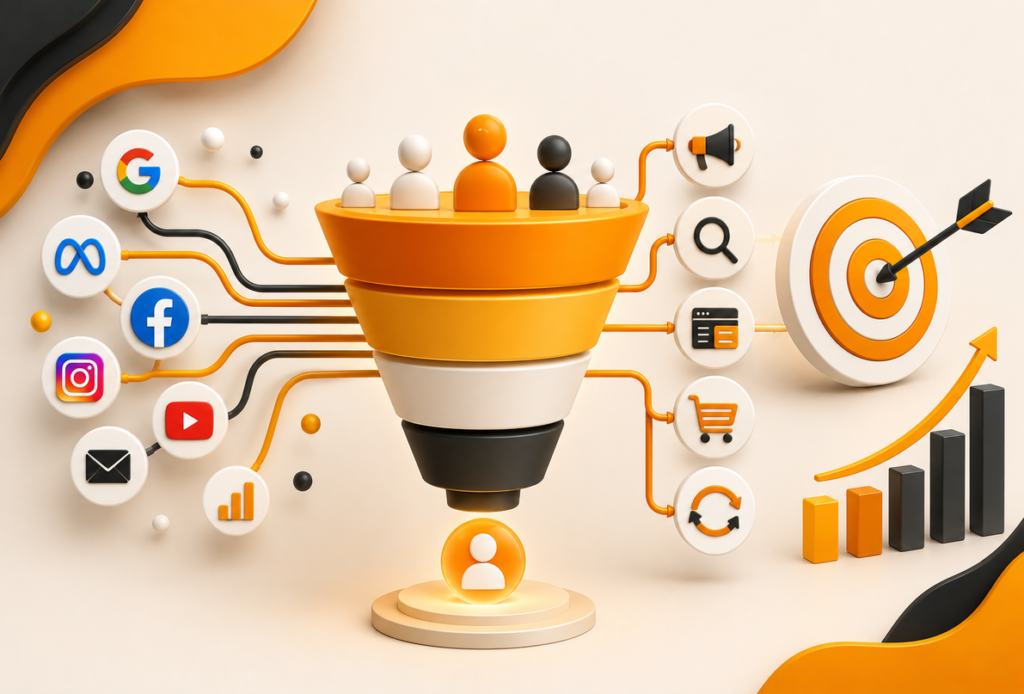
A full funnel marketing agency manages every stage of the customer journey, from brand awareness to customer retention. Instead of treating SEO, paid advertising, content marketing, conversion optimization, and email marketing as separate efforts, a full funnel approach combines them into one growth strategy.
The goal is not simply to drive traffic. The goal is to turn visitors into leads, leads into customers, and customers into long-term advocates for your brand. To accomplish this, agencies create a structured customer acquisition funnel that guides prospects through every stage of the buying process. This approach ensures that every marketing channel works together instead of competing for attention and budget.
The Problem With Managing Channels Separately
Many businesses assume hiring separate specialists is the best approach. On paper, it sounds logical. One agency handles SEO. Another manages Google Ads. A third takes care of social media. Someone else manages email campaigns. The challenge is that customers do not experience marketing in separate departments. They experience one brand.
Imagine building a house with four contractors who never speak to one another. One handles plumbing. Another installs electrical systems. A third manages flooring. The fourth works on roofing. The result would likely be delays, confusion, and expensive mistakes.
The same thing happens in marketing. The SEO team creates content that is disconnected from paid advertising campaigns. The paid media team drives traffic to landing pages that have not been optimized for conversions. Social media promotes one message while email campaigns communicate something entirely different. These disconnects create friction. Trust decreases. Conversions suffer. Most importantly, it becomes difficult to identify what is actually driving growth.
Why Full Funnel Marketing Delivers Better Results
A connected marketing strategy creates a better experience for customers and better outcomes for businesses. Instead of optimizing channels individually, every activity supports the same objective. A well-planned full funnel paid media strategy helps businesses reach potential customers at different stages of the buying journey while keeping messaging consistent. Here are some of the biggest benefits.
Better Budget Allocation
When all marketing data is managed under one strategy, businesses gain a clearer view of performance. Instead of making decisions based on isolated reports, they can see how different channels contribute to revenue. This is one reason many companies invest in a full funnel paid media strategy. It provides better visibility into the customer journey and helps allocate budget more effectively.
Consistent Customer Experiences
Customers interact with brands through multiple touchpoints before making a purchase. They may click an ad, read a blog post, visit a landing page, and subscribe to an email list before becoming a customer. If each interaction feels disconnected, trust can quickly disappear. A full funnel approach ensures consistent messaging across every stage of the journey, helping businesses build credibility and improve conversion rates.
Faster Optimization
When one team manages the entire funnel, insights can be applied across multiple channels. For example, a high-converting landing page can improve both paid advertising and organic traffic performance. Likewise, successful blog content can be repurposed into email campaigns, social media content, and ad creatives. Every channel benefits from shared learnings.

Why Google and Meta Work Better Together
One of the biggest mistakes businesses make is treating Google and Meta as competing platforms. In reality, the strongest campaigns use both. A successful google and meta ads strategy recognizes that customers are not always ready to buy immediately. Google captures existing demand. People search when they are actively looking for a product or service. Meta creates demand. It introduces your brand to people before they begin searching.
For example, someone might discover your business through a Facebook ad. A few days later, they search for your company on Google, visit your website, and eventually convert after seeing a retargeting campaign. That is not two separate marketing channels. That is a connected customer acquisition funnel working exactly as intended.
A strong google and meta ads strategy helps businesses stay visible throughout the customer journey while improving lead quality and conversion rates.
AI Search Is Changing Marketing
The rise of AI-powered search is creating another major shift in digital marketing. Today, customers discover businesses through:
- Google AI Overviews
- ChatGPT recommendations
- Voice search
- Traditional search engines
- Social media platforms
This means visibility is no longer limited to Google rankings. Businesses need strong content, authority, and consistent messaging across multiple channels. That is why SEO services are becoming increasingly connected to broader marketing strategies. Businesses with a well-structured customer acquisition funnel are often better positioned to adapt because they are not dependent on a single traffic source. Instead, they create multiple pathways for customers to discover and engage with their brand.