Skip to content


If your customer acquisition cost has been increasing over the past year, you’re not imagining it. One month, your campaigns are generating qualified leads at a healthy cost. A few months later, you’re spending more money for the same results. Naturally, the first reaction is to increase the budget, launch another campaign, or test a new advertising platform. Sometimes that works, but usually only for a while. Soon enough, costs begin climbing again, leaving you wondering whether paid advertising is still worth the investment. Many marketers immediately point to higher advertising costs or increased competition. While those factors certainly influence performance, they’re rarely the biggest reason CAC keeps rising. The real issue often sits beneath the surface.
Most companies still treat paid advertising as a way to generate quick conversions instead of building a system that consistently turns interested prospects into customers. Every campaign is expected to do everything at once, from introducing the brand to closing the sale. That approach worked when online advertising was less competitive. It doesn’t work nearly as well today. Modern buyers rarely make decisions after a single interaction. Before filling out a form or making a purchase, they compare providers, read reviews, visit websites multiple times, and look for proof that they’re making the right decision.
If your strategy only targets people who are ready to buy today, you’re competing for the smallest and most expensive audience available. That’s one of the biggest reasons customer acquisition cost continues to rise. A smarter approach is to build a full funnel paid media strategy that supports buyers throughout their decision-making process instead of focusing only on the final click. When every campaign has a clear role, your advertising becomes more efficient, your conversion rates improve, and acquiring new customers becomes significantly more sustainable.
Why Customer Acquisition Costs Continue to Rise
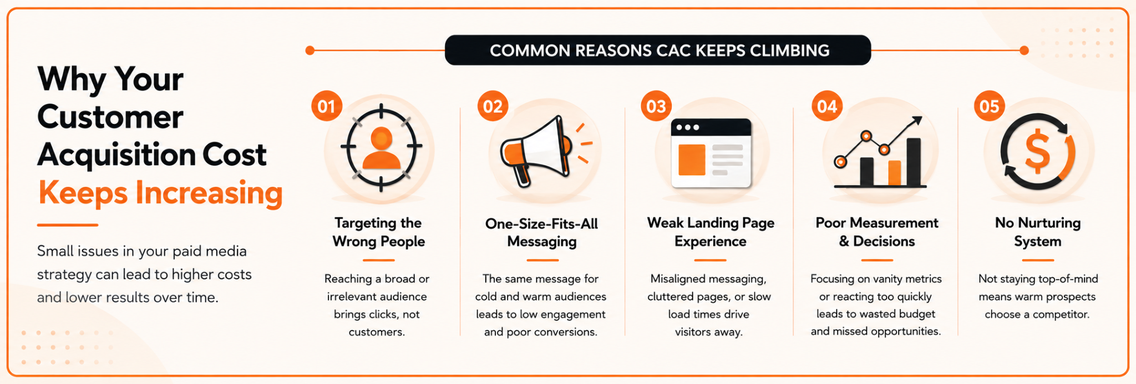
There isn’t one single reason CAC increases. It’s usually the result of several small problems working together. One campaign begins losing momentum. A landing page stops converting as well as it once did. Competitors become more aggressive with their offers. Existing ads start feeling familiar to the same audience. Individually, none of these issues seem serious. Together, they create a steady increase in acquisition costs that becomes difficult to ignore. The encouraging part is that most of these problems are within your control. Once you understand what’s driving costs higher, you can begin improving the parts of your strategy that have the biggest impact instead of simply increasing your advertising budget.
Common Mistakes That Quietly Drive Up Acquisition Costs
If your advertising costs continue to increase, the problem isn’t always your budget. In many cases, it’s the way campaigns are structured. Small strategic mistakes can quietly reduce performance month after month until every new customer becomes more expensive to acquire. Here are some of the most common ones.
Treating Every Click the Same
Not everyone who clicks your ad is ready to buy. Some visitors are researching. Others are comparing providers. A few may simply be trying to understand whether your solution fits their needs. Yet many advertisers send every visitor to the same landing page with the same message and the same call to action. That’s where opportunities are lost. Someone discovering your business for the first time needs information that answers “Why should I care?” A returning visitor is more interested in proof, pricing, or customer results. When every audience receives the same experience, conversion rates naturally decline because the content doesn’t match their intent.
Chasing More Traffic Instead of Better Traffic
When lead volume starts falling, many businesses respond by increasing their budget or broadening their targeting. It feels like the quickest solution. Unfortunately, it often brings in more visitors who were never likely to convert in the first place. More clicks don’t automatically mean more customers. A campaign attracting 100 highly qualified visitors will usually outperform one bringing in 1,000 people with little interest in your offer. Improving traffic quality almost always delivers a better return than simply increasing traffic volume.
Making Decisions Too Quickly
Paid advertising needs data before meaningful improvements can be made. However, it’s common to see campaigns paused after only a few days because they haven’t produced immediate results. Constantly changing budgets, audiences, or creatives resets the platform’s learning process and makes performance less stable. The strongest accounts aren’t adjusted every day. They’re reviewed consistently, but decisions are based on trends rather than daily fluctuations. Fixing these mistakes can improve campaign performance. But lowering customer acquisition cost consistently requires something more than isolated improvements. It requires every campaign to work together with a clear purpose instead of operating independently. That’s where a full funnel paid media strategy creates a measurable advantage.
How a Full Funnel Paid Media Strategy Lowers CAC
At this point, many businesses try to solve rising acquisition costs by making isolated improvements. They test new ad copy, refresh creatives, or adjust bidding strategies. Those changes can help, but they’re rarely enough on their own.
The bigger opportunity lies in how your campaigns work together. A full funnel paid media strategy isn’t about creating more campaigns. It’s about giving each campaign a specific job instead of expecting every ad to generate an immediate sale.
Reach the Right People Before They’re Ready to Buy
Waiting until someone is actively searching for your product means entering the most competitive stage of the buying process. By then, several competitors are already fighting for the same customer. A full-funnel approach starts much earlier. Instead of speaking only to people who are ready to purchase today, it introduces your brand to audiences who are beginning to explore a problem or look for solutions. This early exposure creates familiarity. Later, when those same people start comparing providers, your business isn’t another unfamiliar name. It’s already part of the conversation. That recognition often leads to higher click-through rates and stronger conversion rates without increasing ad spend.
Keep the Conversation Going
Most visitors won’t convert the first time they land on your website. That isn’t a failure. It’s simply how buying decisions work.
Instead of treating every visitor as a lost opportunity, successful advertisers create follow-up campaigns based on how people interacted with their website. For example:
- Someone who visited your pricing page might see customer success stories.
- Someone who watched a product video could receive an offer for a consultation.
- Someone who added a product to their cart may only need a simple reminder to complete the purchase.
Each interaction builds on the previous one instead of starting from scratch. Over time, this approach reduces wasted ad spend because you’re communicating with people who have already shown genuine interest.
Spend More Where It Matters
Not every campaign deserves the same budget. Some campaigns are designed to introduce your brand, while others exist to convert high-intent prospects. Looking at performance across the entire funnel makes it easier to identify where your investment is creating the greatest return. Instead of increasing budgets across every campaign, you can allocate more spend to the stages that consistently move prospects closer to becoming customers. That’s one of the biggest advantages of a full funnel paid media strategy. It helps you invest with purpose instead of relying on guesswork. The strategy creates a stronger foundation, but maintaining strong performance requires continuous refinement. That’s where paid media optimization becomes essential.
The Role of Paid Media Optimization in Improving Efficiency
A well-structured funnel gives your campaigns direction. Paid media optimization ensures those campaigns continue improving instead of gradually becoming less effective. Many advertisers think optimization is something they do once a month. They review the numbers, make a few adjustments, and move on. The highest-performing campaigns don’t work that way. They’re built on continuous learning, where small improvements made consistently produce much bigger results over time.
Focus on the Metrics That Predict Growth
It’s easy to become obsessed with clicks and impressions because they’re visible every day. But those numbers don’t always tell you whether your campaigns are generating revenue.
Instead, look at metrics that reveal how efficiently your advertising is turning interest into customers.
Ask questions like:
- Which audience generates the highest-quality leads?
- Which landing page converts the best?
- Which ad creative brings in customers instead of just clicks?
- Which campaigns produce repeat purchases?
These insights help you invest more confidently because your decisions are based on performance, not assumptions.
Test One Change at a Time
One of the quickest ways to create inconsistent results is changing too many things at once. If you update the audience, increase the budget, replace the creative, and launch a new landing page on the same day, you’ll never know what actually influenced performance. A better approach is to test one variable at a time. For example, keep the audience and budget the same while testing two different headlines. Once you have enough data, keep the better-performing version and move on to the next test. Small, controlled experiments make optimization much more reliable than making several changes all at once.
Make Every Click Count
Generating traffic is only half the job. What happens after someone clicks your ad has an equally important impact on your customer acquisition cost. A landing page should immediately answer three questions:
- What are you offering?
- Why should someone choose you?
- What should they do next?
If visitors have to search for those answers, many will leave before taking action. Even simple improvements, like reducing unnecessary form fields, strengthening your headline, or making your call to action more visible, can increase conversions without increasing ad spend. When you combine ongoing testing with regular paid media optimization, every campaign becomes more efficient over time instead of more expensive. The final piece of the puzzle is measuring success correctly. Looking at customer acquisition cost alone only tells part of the story. The most successful advertisers track a wider set of performance metrics before making important decisions.
Key Metrics to Monitor Beyond CAC
Customer acquisition cost is one of the most important marketing metrics, but it should never be the only one guiding your decisions. Looking at CAC alone is like checking the final score without watching the game. You know the outcome, but you don’t know what influenced it. Tracking a few additional metrics gives you a clearer picture of what’s working and where improvements are needed.
Conversion Rate
A steady stream of traffic doesn’t guarantee business growth. If plenty of people are clicking your ads but very few are taking action, the issue may have nothing to do with your targeting. It could be your landing page, offer, or messaging. Improving your conversion rate means getting more value from the traffic you’re already paying for, which naturally helps reduce customer acquisition cost.
Return on Ad Spend (ROAS)
A campaign with a higher CAC isn’t automatically underperforming. If that campaign consistently generates larger purchases or higher-value customers, it may still deliver a stronger return overall. That’s why ROAS deserves just as much attention as acquisition cost. It helps you understand whether your advertising is creating profitable growth rather than simply generating cheaper leads.
Cost Per Qualified Lead
Not every lead has the same value. Generating a large number of enquiries means very little if most of those prospects never become customers. Instead of celebrating the lowest cost per lead, focus on the quality of those leads. A slightly higher investment that attracts better-qualified prospects often produces stronger long-term results.
Final Takeaway
If your advertising costs keep increasing, don’t assume the answer is a larger budget. More spending won’t fix campaigns that lack direction. The most successful advertisers lower customer acquisition cost by improving the entire system behind their campaigns. They understand who they’re targeting, deliver the right message at the right time, and continually refine performance through paid media optimization. A well-executed full funnel paid media strategy doesn’t rely on one campaign to produce immediate results. Instead, every stage works together to move potential customers closer to a purchase while making your advertising investment more efficient over time. The goal isn’t simply to spend less. It’s to generate better results from every dollar you already invest.
Ready to Improve Your PPC Performance?
If your campaigns are generating traffic but your acquisition costs continue to rise, it may be time to rethink your strategy instead of increasing your budget. At Excellorix, we build data-driven PPC campaigns that focus on sustainable growth, smarter audience targeting, continuous paid media optimization, and measurable business results. Whether you’re launching new campaigns or improving existing ones, our team can help you build a full funnel paid media strategy designed to reduce wasted ad spend and improve long-term performance. Schedule a free PPC strategy call today and discover where your campaigns can become more efficient.
Frequently Asked Questions
Is a full funnel paid media strategy suitable for small businesses?
Yes. A full funnel paid media strategy isn’t only for large brands with massive budgets. Small businesses can apply the same approach by prioritizing the channels that matter most. Even with limited ad spend, reaching new audiences, nurturing interested prospects, and converting high-intent buyers can improve campaign efficiency over time.
How long does it take to reduce customer acquisition cost?
There’s no fixed timeline because every account starts from a different position. Businesses with accurate conversion tracking and consistent campaign data often notice improvements within a few weeks, while larger structural changes may take several months. The focus should be on steady improvement rather than overnight results.
Can a higher customer acquisition cost still be profitable?
Absolutely. A higher customer acquisition cost isn’t always a problem if the customers you acquire generate more revenue over time. Instead of chasing the lowest possible CAC, evaluate whether your campaigns are delivering profitable growth and meeting your overall business goals.
When should I change my paid media strategy?
Review your strategy if your acquisition costs continue increasing, lead quality starts declining, conversion rates remain flat despite higher spending, or your campaigns have stopped scaling. These are often signs that your current approach has reached its limit and needs a more structured strategy.