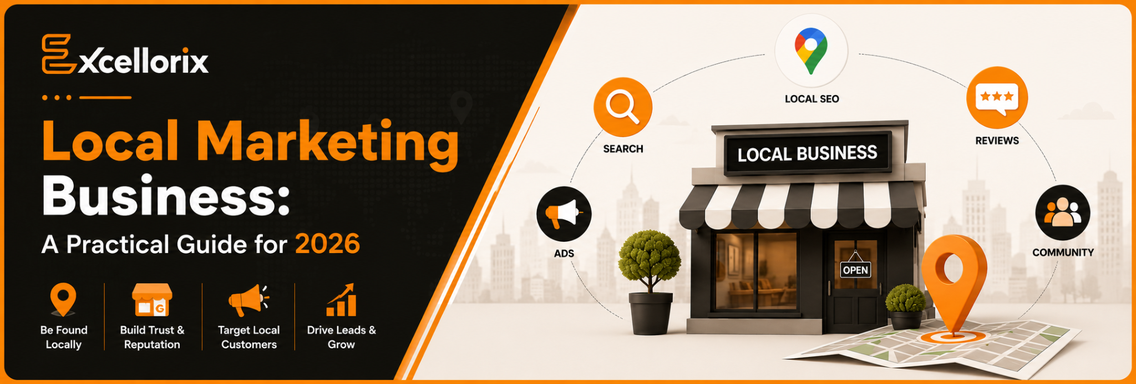
84% of consumers searched for a local business in the past three months, and near-me queries have grown 900% in two years. A local marketing business should therefore build a coordinated trust system across search, maps, reviews, advertising, community references, and AI-generated answers, not rely on a single ranking tactic.
That shift changes what “local marketing” means in 2026. A buyer may discover a company through Google Maps, an AI Overview, a voice assistant, a neighborhood group, or a social ad, then call, request directions, or visit without ever browsing a traditional website. The business that wins isn’t necessarily the one with the most content. It’s the one whose facts remain consistent, specific, and credible wherever discovery happens.
The practical standard is simple: make the business easy for people and machines to understand. That means accurate listings, useful location pages, descriptive reviews, clear services, trustworthy third-party mentions, fast mobile experiences, and campaigns tied to real leads.
Why Local Marketing Is Now a Core Growth Channel
Local demand is already mainstream. 84% of consumers searched for a local business in the past three months, while 80% of U.S. consumers search for local businesses online at least weekly and 32% do so daily, according to BrightLocal’s local SEO statistics. Near-me behavior has expanded even faster, with near-me queries growing 900% in two years, as documented in Google’s local-search behavior research.
That makes local marketing a business operating system, not a promotional channel. Your website, Google Business Profile, directories, reviews, advertisements, social posts, and community relationships all describe the same entity. If those descriptions conflict, customers hesitate and search systems have less confidence in what to show.
The old national-marketing model tried to reach a broad audience and let geography sort itself out later. A local company can’t afford that inefficiency. A plumber, bakery, clinic, roofer, or neighborhood retailer competes for attention close to the customer’s current location, often when the customer already has a practical need.
” Operating principle: Every local touchpoint should answer the same questions clearly: who are you, what do you offer, where do you serve, when are you available, and why should someone trust you?
Google’s research found that 4 in 5 consumers use search engines to find local information, including addresses, directions, hours, and product availability. Local intent also moves quickly offline. Half of consumers who conducted a local search on a smartphone visited a store within a day, and 18% of smartphone local searches led to a purchase within a day, compared with 7% for non-local searches, according to BrightLocal’s cited consumer data.
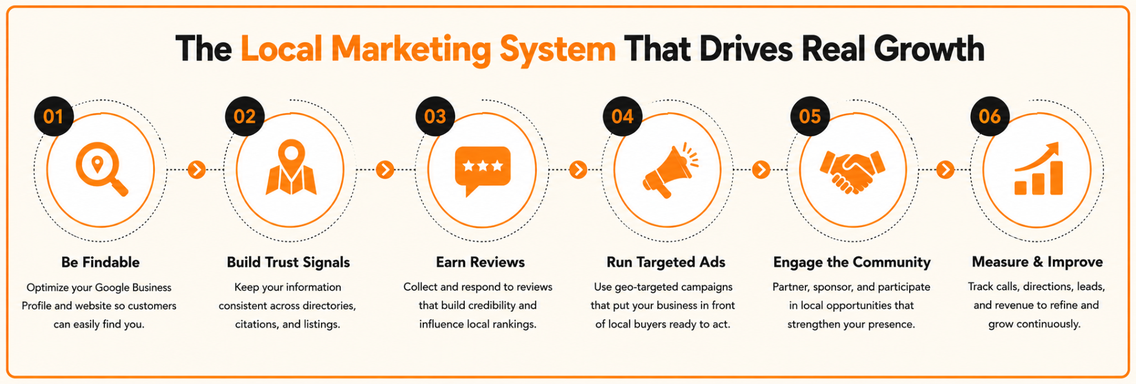
Build the system around four pillars: SEO, citations, local ads, and community. SEO makes the business discoverable, citations confirm its identity, advertising captures demand or creates timely awareness, and community activity supplies the human proof that automated systems can’t manufacture.
For a practical starting point, use this Google Business Profile optimization guide to audit the profile that often becomes a customer’s first interaction with the business.
The Four Pillars of a Local Marketing Business
A physical storefront gives the analogy a business owner can use immediately. SEO is the sign on the road, citations are the business listings in every directory, ads are the paid announcements that put the store in front of nearby buyers, and community is the reputation that turns a location into a familiar landmark.
SEO makes the business findable
Local SEO covers the website, service pages, location pages, internal links, technical performance, and Google Business Profile. Its job is to connect a real customer need with a clear local answer. A service-area company needs pages that explain where it operates and which problems it solves. A storefront needs useful information about products, access, hours, and nearby intent.
Measure this pillar through qualified organic calls, contact forms, profile actions, and relevant search visibility. Generic rankings aren’t enough if they don’t produce actions.
Citations confirm the entity
A citation is a business reference on a directory, map, chamber site, industry site, or local publication. The essential data includes the business name, address or service area, phone number, website, category, and hours. Inconsistent records create friction for customers and ambiguity for search engines.
Don’t treat citation building as a mass-submission exercise. Prioritize platforms that customers, local organizations, and search systems can reasonably use to validate the company.
Ads buy controlled access to demand
Map-based ads and geo-targeted Search or Social campaigns serve different jobs. Search and map ads can capture existing intent, while social campaigns can promote an event, seasonal offer, or new location to a defined area. Both require accurate conversion tracking and a landing experience that matches the promise in the ad.
Community creates durable familiarity
Partnerships, local participation, press mentions, events, and useful education make the business part of the area it serves. Community activity can earn references that support branded search, referrals, citations, and the wider entity profile.
Run the pillars in sequence. Repair the foundation first, test paid acquisition second, then use community to deepen trust. If you blend all four into one vague “marketing” bucket, you won’t know which weakness is costing you customers.
Winning the Local SEO Foundation First
Start with the asset that customers often see before your website, your Google Business Profile. Claim and verify it, then check every field against the actual business. The profile should use the actual business name, the correct operating address or eligible service-area setup, accurate hours, a working phone number, a useful website URL, and the most specific primary category available.
Don’t use a virtual office address where the business isn’t eligible to receive customers. Don’t stuff categories. Don’t insert keywords into the business name unless those words are part of the legitimate name. These shortcuts create compliance and trust problems instead of durable visibility.
Execute the profile in a strict order
-
Choose the primary category carefully. Pick the category that best describes the main revenue-generating service. Add secondary categories only when they represent genuine offerings.
-
Write services as customer language. Use searchable phrases that describe what the company does, such as emergency drain cleaning, family dental exams, or custom birthday cakes. Each service should connect to a relevant page or a clear explanation.
-
Add real photos consistently. Show the storefront, staff, equipment, finished work, interior, products, and service context. Avoid stock images. For a mobile service, photos should help customers recognize the team and understand the work.
-
Publish useful profile updates. Use posts for new services, seasonal information, events, practical advice, and legitimate offers. A post shouldn’t be a keyword dump.
-
Build a review workflow. Ask every satisfied customer at the right moment, give them a direct process, and respond to every review. The planning target in this playbook is 10 to 20 new reviews per month, but the request must remain voluntary and honest. Never script identical praise or offer incentives for positive sentiment.
An optimized profile is complete, current, specific, and supported by evidence outside Google. It answers a customer’s immediate questions without forcing them to call for basic information.
” Audit test: Open the profile as if you’ve never heard of the business. Can you identify its primary service, service area, hours, proof of quality, and next action in under a minute?
Before spending on ads, complete the local SEO checklist for Raleigh small businesses or adapt the same sequence to your market. Paid traffic can’t repair a confusing profile. It only sends more people to it.
Choosing Between Local Ads and Geo-Targeted Campaigns
Local advertising has two useful paths, and they shouldn’t be evaluated by clicks alone. Map-based ads capture buyers already looking for a nearby provider. Geo-targeted Search and Social campaigns create or shape demand around a defined place, offer, audience, or event.
| Dimension | Map-Based Ads (Maps + LSAs) | Geo-Targeted Search & Social |
|---|---|---|
| Primary job | Capture high-intent local demand | Build awareness, promote offers, and support events |
| Typical fit | Service-area businesses and storefronts with urgent or direct needs | Retail promotions, launches, seasonal campaigns, and neighborhood events |
| Trust inputs | Reviews, profile completeness, hours, services, and verification | Creative quality, landing-page clarity, audience relevance, and local proof |
| Main conversion signals | Calls, qualified leads, and direction requests | Qualified forms, calls, store actions, and offer responses |
| Main failure mode | Paying for visibility before the profile is credible | Reaching a local audience without a compelling reason to act |
Use Maps and Local Service Ads when the customer is likely to search with a problem already in mind. A locksmith, HVAC contractor, personal injury attorney, or nearby urgent-care provider usually benefits from intent capture. A bakery promoting a holiday collection or a gym advertising an open house may need Search and Social to reach people before they search.
Set a controlled test budget you can sustain and measure. The practical brief for this plan uses a cap of $20 per day for an initial LSA or Search test, not as a universal budget recommendation, but as a disciplined starting limit for a solo owner. Adjust only after you can separate qualified calls and forms from irrelevant inquiries.
Don’t optimize for impressions or cheap clicks. Track driving-direction requests, phone calls, qualified lead forms, booked appointments, and revenue-producing visits. A campaign with fewer clicks can be healthier if those clicks come from customers who can buy.
Avoid branded awareness campaigns on Maps while the profile still has weak reviews, wrong hours, incomplete services, or poor photos. You’re paying to amplify the first impression, so improve that impression before increasing its reach.
Account-Based Marketing as the Digital Trade Show
More reviews won’t solve every local visibility problem. Reviews matter, but AI systems and search engines also need consistent entity information, useful third-party references, and evidence that the business belongs in a specific community.
Use three categories to make community work concrete.
Partnerships create connected demand
Work with businesses that serve the same customers without competing directly. A physical therapist can partner with a running shop. A bakery can collaborate with a coffee business. A home-services company can build referral relationships with complementary contractors.
The useful outputs are practical: co-hosted events, bundled offers, referral swaps, shared email exposure, and legitimate mentions on partner websites. Don’t manufacture links. Create something worth mentioning, then make the relationship visible.
Presence keeps the entity recognizable
Choose a small set of places where local trust already forms. That may include a chamber of commerce, neighborhood association, relevant trade directory, local publication, business district, or niche community website. Keep the business name, service description, contact details, and location information consistent.
Participation earns stronger proof
Teach something useful. Run a workshop, free clinic, product demonstration, neighborhood cleanup, or public Q&A. The point isn’t to stage a photo opportunity. It’s to give local people a reason to remember the business and local organizations a reason to reference it.
Skip generic Yelp ads, mass directory submissions, and ribbon-cutting PR that produces no meaningful audience or relationship. Those activities can create noise without creating trust.
A better approach is to build marketing assets that continue working after the event, such as a useful guide, partner page, local resource, event recap, or educational video. This guide to compounding marketing assets offers a practical way to turn community activity into reusable visibility.
” Community rule: Show up where local customers already gather, contribute something useful, and document the relationship accurately.
That combination helps reinforce the same business entity across websites, profiles, articles, event pages, and AI-generated answers. It won’t replace strong service delivery. It gives satisfied customers and local organizations more credible ways to confirm it.
Preparing for AI Overviews and Zero-Click Local Search
Ranking in the map pack is no longer the whole job. 84% of consumers searched for a local business in the past three months, according to Rio SEO’s 2025 local search consumer behavior study. The same study reports that 60% click AI-generated overviews in Google Search and that total local search views across Maps and Search fell 13.2% year over year in Q4 2025, with each figure tied to the study. Treat those findings as a reason to strengthen local SEO, not abandon it.
Your target is broader than a blue-link visit. Make the business clear enough for direct answers about services, location, availability, hours, and comparisons. Machine-readable trust signals now matter alongside rankings.
A service-area business needs geographic precision
A one-truck HVAC company may serve several nearby communities without operating a customer-facing office. Its website should explain each service area with useful, distinct information rather than thin duplicate pages. Configure its profile for an eligible service area, and keep the company’s identity consistent across listings and partner mentions.
Use LocalBusiness, Service, FAQ, and Review structured data only when those types accurately describe visible page content. Schema does not guarantee inclusion in an AI answer. It gives search systems clearer information about the relationship between the company, its services, and its locations.
A storefront needs product and access clarity
A neighborhood bakery has a different discovery problem. Customers may need today’s hours, specialty products, parking information, dietary options, directions, or event details. Put those facts on the profile and website where customers can verify them quickly. Use real photos to show the location, products, staff, and customer experience.
Reviews such as “great place” provide little context. Truthful descriptions of the service received and relevant location give readers and automated systems stronger evidence. Do not script keywords for customers. Ask open questions about what they enjoyed instead.
Keep the name, address, phone number, hours, categories, services, and descriptions aligned across important listings. Add authoritative mentions from relevant local organizations, partners, and publications. AI discovery is not a separate project. It depends on the same trust foundation, expressed consistently and in formats machines can interpret.
Two Mini-Cases of a Local Marketing System in Action
A local marketing system should stay consistent while the channel mix changes. A service-area HVAC company needs demand capture and coverage clarity. A walkable bakery needs visual proof, timely promotions, and repeat neighborhood contact.
| Pillar | Service-Area HVAC (one-truck) | Storefront Bakery (walkable neighborhood) |
|---|---|---|
| SEO | Service pages, service-area explanations, emergency-intent content, and call-focused mobile paths | Product pages, menu clarity, neighborhood relevance, access information, and visual content |
| Citations | Accurate service-area details across 30 citations | Priority listings on Yelp, TripAdvisor, and relevant food blogs |
| Local ads | Local Service Ads launched in the second week after the profile foundation is ready | Geo-targeted Meta ads connected to promotions and a loyalty SMS list |
| Community | Sponsor a local high school sports team and reply to every review | Saturday sampling at a farmers’ market and relationships with nearby businesses |
The HVAC owner should put more weight on call quality, response speed, service coverage, and profile trust. The bakery should put more weight on foot-traffic signals, product photography, weekly updates, nearby reach, and repeat visits.
Don’t copy the bakery’s social strategy for the HVAC company, or the HVAC company’s lead strategy for the bakery. Copy the operating discipline: accurate identity data, a clear offer, a measurable action, consistent proof, and a channel mix matched to how customers buy.
The same rule applies to budget. A service-area company may prioritize high-intent lead capture, while a storefront may justify awareness around a specific promotion. Neither should judge success by the same surface metric.
A 90-Day Local Marketing Plan and What to Measure
A solo owner can build the system in stages. The first month is about accuracy and measurement. The second creates repeatable visibility. The final month removes waste and turns the strongest activities into the next quarter’s operating plan.
Weeks 1 and 2 establish the baseline
Audit the Google Business Profile, correct the name, address, phone number, hours, categories, services, photos, and website links. Fix NAP information across the top 10 directories, install call and form tracking, and record baseline profile views, direction requests, phone calls, and form submissions.
Don’t launch every channel during the audit. You need to know whether later changes produce better actions.
Weeks 3 through 6 build the foundation
Finish the profile, expand citation work toward 40 profiles, publish the first 12 profile posts, and create a simple review request workflow. Launch one small LSA or Search test capped at $20 per day, then judge it by qualified calls and forms rather than impressions.
Weeks 7 through 10 add local reach
Start one partnership or participation tactic, then launch geo-targeted Social only when the offer and landing page are clear. Add accurate LocalBusiness and FAQ schema to relevant site pages. Keep the campaign focused on one audience and one measurable action.
Weeks 11 through 13 cut waste
Review every channel. Stop campaigns that produce poor-quality inquiries, preserve the tactics that generate meaningful actions, and put more effort into the top two performers. Set the next quarter’s targets from actual calls, forms, direction requests, booked work, and revenue.
Ignore follower count, raw impressions, and generic rankings when they don’t connect to customer action. The four operating metrics that deserve attention are Google Business Profile views, direction requests, phone calls, and form submissions, with qualified outcomes tracked wherever possible.
The principle is local trust at scale. Every pillar should make the same business easier to find, understand, verify, and choose. A local marketing business that follows that standard won’t depend on one ranking position or one advertising platform.
If your local visibility is fragmented across Google Business Profile, citations, reviews, landing pages, ads, and community channels, Excellorix can help connect those pieces into a measurable growth system. Visit Excellorix to assess your local SEO foundation, conversion tracking, paid campaigns, and AI-ready visibility before you spend more on traffic.