

Getting traffic to your website is easier than it used to be. Converting that traffic into actual customers is where most businesses struggle today. A lot of websites attract visitors consistently through ads, SEO, social media, and content marketing. But once users land on the page, they leave without booking a call, filling out a form, or making a purchase. That pattern has become far more common in 2026.
Search behavior has changed quickly over the last two years. AI generated search summaries answer questions instantly, privacy updates reduced tracking accuracy, and mobile users expect faster and smoother experiences than ever before. People are also more selective with where they spend their money. If a website feels slow, generic, or untrustworthy, visitors move on within seconds. The good news is that improving your conversion rate usually does not require a complete redesign. In many cases, small changes create the biggest results.
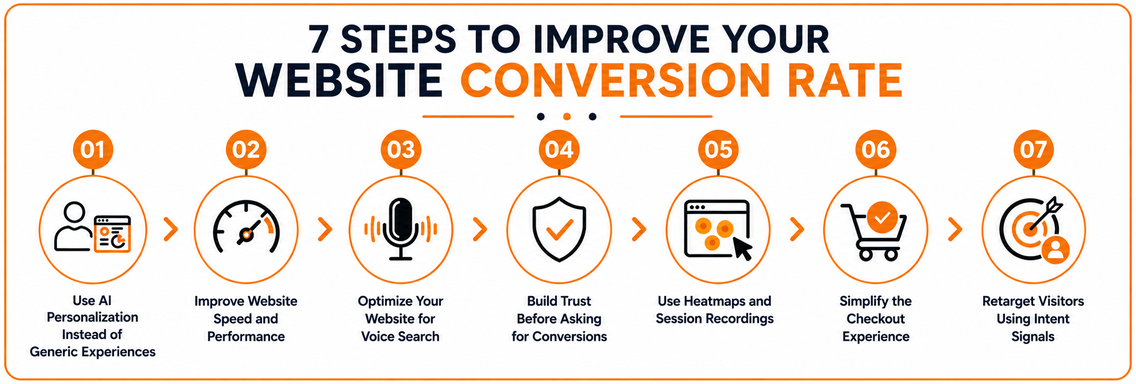
If you are trying to understand how to improve your website conversion rate, these are seven practical fixes businesses are using right now to increase leads, sales, and customer engagement. These website conversion rate tips are designed to help businesses improve user experience while finding practical ways to increase website conversions over time.
At Excellorix, these are some of the same CRO and SEO strategies we use to help businesses improve performance and generate better quality conversions.
A few years ago, getting traffic from Google was enough to grow consistently online. Businesses focused mainly on rankings, keywords, and click volume. Today, that approach alone is no longer enough. Users now expect websites to load instantly, answer questions clearly, and feel personalized from the first interaction. At the same time, AI search tools often give users direct answers before they even click through to a website. That means every visitor who lands on your page matters more than before.
Many websites still rely on outdated layouts, slow loading pages, and generic messaging. Even strong traffic numbers struggle to convert when the user experience feels frustrating. This is why modern conversion optimization is no longer just about design. Modern conversion optimisation strategies now combine user behavior, trust building, technical SEO, mobile experience, and personalization together.
Once businesses understand where users lose interest, improving conversions becomes much easier.
Most websites still show the exact same homepage to every visitor. Someone browsing beginner fitness products sees the same offers as a professional athlete. A first time visitor gets the same messaging as a returning customer. That usually creates disconnect.
People engage more when content feels relevant to them personally. When users instantly see products, offers, or messaging aligned with what they actually want, they stay longer and interact more naturally. A few years ago, personalization felt like something only large brands could afford. In 2026, it has become much more accessible. Simple personalization changes can already improve engagement.
You can start by:
Tools like Dynamic Yield, GA4 audience segmentation, and Optimizely make this process much easier than before.
One ecommerce business working with the Excellorix SEO service team improved engagement significantly after implementing personalized product recommendations across high intent landing pages. Even highly personalized pages struggle to convert, however, if the website itself loads slowly. Once users become interested, speed becomes the next major conversion factor
Website speed still has one of the biggest impacts on conversion rates. People have become extremely impatient online. If a page takes too long to load, most users leave before they even interact with the content. This problem becomes even more noticeable on mobile devices.
Many business owners believe their website speed is acceptable because it feels fine on desktop internet connections. But mobile users often experience something completely different. Even a delay of a few seconds can increase bounce rates and reduce purchases.
Improving speed does not always require advanced development work either.
Start with:
One retail website reduced its loading time from almost four seconds to just over one second after improving image optimization and caching. Mobile conversions improved noticeably within a few weeks. Fast websites also create smoother experiences for voice and conversational search users, which has become increasingly important in 2026.
Voice search no longer feels like a future trend. It is already changing how people search for products and services every day. Instead of typing short keywords, users now search naturally.
People ask questions like:
That shift changed how content needs to be written.
Traditional keyword stuffing no longer works well because search engines now focus heavily on intent and conversational relevance. Businesses that optimize for natural language searches often perform better in AI generated search results and featured snippets.
To make your website more voice friendly:
Getting users to your website, though, is only part of the process. Once they arrive, trust becomes one of the biggest factors influencing whether they convert or leave.
Many websites ask visitors to buy, subscribe, or submit information too quickly. When users do not feel comfortable yet, aggressive popups and constant form requests usually push them away instead of increasing conversions. Trust matters more now because users are far more aware of privacy, scams, and fake businesses online. Even small trust signals can make a major difference.
Some of the simplest improvements include:
A Punjab based business improved lead generation after replacing intrusive popups with smaller trust focused prompts and clearer customer reviews. Instead of forcing conversions immediately, the website guided visitors more naturally through the buying journey.
Once trust improves, the next step is understanding exactly how users behave across the website.
Many businesses redesign pages based on assumptions instead of actual user behavior. That usually leads to unnecessary changes that do not improve conversions. Heatmaps and session recordings help businesses understand what visitors are actually doing.
They show:
Sometimes the issue is surprisingly small. A CTA button might sit too low on mobile screens. A pricing section could feel confusing. A form field may create unnecessary friction. Tools like Hotjar, Microsoft Clarity, and VWO help uncover these hidden conversion problems much faster.
In many cases, session recordings reveal that the largest drop off happens during checkout. That is why checkout optimization continues to be one of the highest impact CRO improvements.
Checkout friction still destroys conversions for ecommerce websites. Long forms, unnecessary account creation, and confusing payment flows make users abandon purchases even when they already intend to buy. Modern users expect faster purchasing experiences with fewer steps. If the checkout process feels difficult or time consuming, most visitors leave. Improving checkout usually starts with removing unnecessary friction.
Focus on:
Sometimes removing just one unnecessary step can noticeably improve completed purchases. This is especially important for mobile users because desktop style checkout systems rarely perform well on smaller screens.
Even after improving the on site experience, however, many users still leave before converting completely. That is where smarter retargeting becomes important.
Traditional cookie based retargeting has become less effective after major privacy updates changed online tracking. Businesses now rely more heavily on first party data and intent signals. Instead of retargeting everyone the same way, modern campaigns focus more on users who show stronger buying intent. That creates more efficient advertising and better conversion quality while helping businesses increase website conversions more consistently.
Some effective retargeting strategies in 2026 include:
AI tools now help businesses predict which users are most likely to convert instead of wasting budget on broad audiences. This approach works especially well when CRO improvements and SEO strategies support each other together.
There are plenty of CRO tools available today, but a few platforms continue to stand out because of how practical and easy they are to use. Hotjar remains one of the most popular options for heatmaps and session recordings, especially for startups and smaller businesses trying to understand user behavior quickly. Microsoft Clarity is another strong choice because it offers free behavior tracking and session replay features without requiring a large budget.
For businesses focused heavily on A/B testing and customer insights, VWO continues to be a reliable platform for testing landing pages and conversion funnels. Larger brands often prefer Optimizely because of its advanced experimentation and AI testing capabilities. For ecommerce businesses looking to personalize customer experiences, Dynamic Yield is still one of the better tools available for recommendations and audience segmentation.
The right tool ultimately depends on your business size, budget, and the type of conversion issues you are trying to solve.
Improving your website conversion rate is not about following every trend or redesigning your entire website every year. Most of the time, the biggest improvements come from fixing smaller friction points that quietly hurt the user experience. Slow loading pages, weak trust signals, generic messaging, and complicated checkout flows often reduce conversions without businesses realizing it.
The businesses growing fastest in 2026 are paying closer attention to customer behavior and optimizing experiences around real user intent. Start with one issue first. Test improvements carefully. Measure what increases engagement and conversions. Over time, even smaller changes can create meaningful growth.
At Excellorix, we help businesses identify hidden conversion issues and build SEO strategies designed around both traffic growth and customer experience. If your website attracts traffic but struggles to generate leads or sales consistently, it may be time for a proper conversion audit. If you want to understand where visitors are dropping off and what changes could improve conversions faster, schedule a call with the Excellorix team for a personalized website and SEO strategy review.
Start with the fundamentals first. Improve page speed, simplify your forms, and make your calls to action clearer. Free tools like Google Analytics 4, Microsoft Clarity, and PageSpeed Insights can already reveal major issues affecting user experience and conversions.
Focus on faster loading times, cleaner layouts, larger buttons, and shorter forms. Mobile users usually have less patience, so reducing friction across navigation and checkout can improve conversions significantly.
Some businesses notice engagement improvements within a few weeks. Personalized product recommendations, dynamic landing pages, and audience specific messaging often help users interact with websites more naturally.
First party data collection, intent based retargeting, stronger trust signals, and predictive audience targeting are currently among the most effective strategies. Combining CRO improvements with SEO optimization also helps improve traffic quality.
Low conversion rates are usually caused by multiple smaller issues working together. Slow loading speeds, unclear messaging, poor mobile usability, weak trust signals, and confusing layouts commonly reduce conversions.
Yes, especially for conversational and local searches. Optimizing content for natural language questions improves visibility in voice search results and AI generated search summaries, which can drive more qualified traffic.
Google Analytics 4, Microsoft Clarity, Google Search Console, and PageSpeed Insights are excellent starting points. These tools help businesses track behavior, identify friction points, and improve SEO and conversion performance.
Instead of focusing only on traffic numbers, track metrics like lead submissions, completed purchases, bounce rate improvements, revenue per visitor, and A/B testing results. Monitoring these consistently gives a clearer picture of what is improving business growth.
Tell us about your goals—we’ll show you how Excellorix can help you get there.