Skip to content



In 2026, most businesses do not struggle with PPC because ads do not work. They struggle because their campaigns are not built to grow. What starts as a few successful campaigns often becomes unpredictable as budgets increase. Cost per lead rises, lead quality drops, and suddenly you are spending more without seeing better results. This usually comes down to structure. Many businesses lose a large portion of their ad spend on low intent clicks and unqualified leads simply because their PPC setup is not designed for scale.
A scalable PPC strategy solves this problem. Instead of focusing on getting more traffic, it focuses on building a system that consistently attracts high quality leads while keeping costs under control as you grow.
At Excellorix, we have helped businesses turn inconsistent campaigns into predictable growth through smarter PPC management and a clear strategic approach. In this guide, you will learn how to build that kind of system step by step.
What Is a Scalable PPC Strategy in 2026
Before getting into tactics, it is important to understand what scalability really means today. A scalable PPC strategy allows you to increase your budget without losing performance. Your campaigns continue to bring in leads at a steady cost, and those leads remain relevant to your business. With privacy changes and the shift toward first party data, platforms now rely more on user intent and behavior. This makes strong campaign structure and accurate data more important than ever.
When your foundation is built correctly, scaling becomes a controlled and confident process instead of a risky move.
Why High Quality Leads Matter More Than Volume
It is easy to focus on getting more leads, but volume alone does not drive revenue. A smaller number of high quality leads will almost always perform better than a large number of unqualified ones. They convert faster, require less follow up, and deliver stronger long term value.
Small improvements like refining your targeting or asking better questions in your forms can make a big difference. To consistently generate better leads, your PPC management strategy needs to focus on intent from the beginning. That starts with how your campaigns are structured.
Step 1 Build a Strong PPC Account Structure
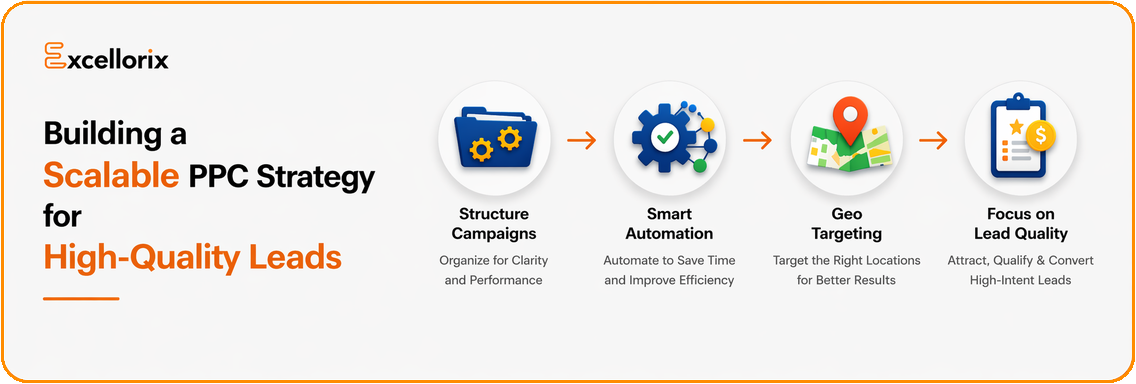
A strong structure is the foundation of every scalable campaign. Instead of grouping everything together, organize your campaigns based on user intent. Someone searching for immediate help should not be treated the same as someone who is still comparing options. This approach helps you create more relevant ads, control your budget more effectively, and improve overall performance.
A clear structure also makes it easier to scale your campaigns without confusion or wasted spend.
Step 2 Focus on Geo Targeted Campaigns
Once your structure is in place, the next step is refining who sees your ads. Broad targeting often leads to wasted clicks. Narrowing your campaigns to specific locations helps you reach users who are more likely to convert.
Using radius targeting, location based keywords, and localized messaging improves both relevance and results. When your ads feel specific to a location, they naturally attract more serious buyers.
Step 3 Use Automation with Clear Direction
As your campaigns grow, managing everything manually becomes difficult. Automation helps handle bidding, testing, and performance adjustments in real time. However, it works best when it is guided by clear goals.
Set rules based on performance, track meaningful conversions, and review results regularly. Strong PPC management combines automation with human decision making. At this stage, your campaigns are not just running. They are improving continuously
Step 4 Optimize for High Quality Leads
Efficiency is important, but lead quality is what drives real results. Not every lead has the same value, so it is important to define what a good lead looks like for your business. This could include budget, urgency, or service requirements. You can improve lead quality by adding qualifying questions, tracking offline conversions, and connecting your CRM with your campaigns.
These changes help you focus on leads that are more likely to turn into paying customers.
Step 5 Scale Gradually and Strategically
Once your campaigns are performing consistently, the next step is scaling. Scaling should be done carefully. Increasing budgets too quickly can disrupt performance and lead to higher costs. Instead, focus on gradual growth. Increase budgets step by step, monitor performance closely, and expand what is already working. This approach helps you maintain stability while continuing to grow your results.
Final Thoughts
Now that you understand how to structure, optimize, and scale your campaigns, the next step is applying this approach in a way that delivers consistent results. Scaling PPC is not about spending more money. It is about building a system that works reliably as your business grows. When your campaigns are structured around intent, optimized for high quality leads, and supported by the right PPC management strategy, growth becomes predictable instead of uncertain.
The difference between average results and consistent performance often comes down to how well your campaigns are managed over time. This is where a structured PPC management approach can make a real impact. Instead of guessing what works, you are making decisions based on data, performance, and clear direction. If your current campaigns are not delivering the results you expect, the issue is usually not the platform. It is the foundation behind it.
Schedule A Free PPC Management Strategy Call With Our Raleigh Team and get a clear breakdown of what is holding your campaigns back and how to turn them into a reliable source of leads.
FAQs
What is a scalable PPC strategy?
A scalable PPC strategy allows you to increase your ad spend while maintaining consistent performance. It focuses on stable costs, strong lead quality, and predictable growth over time.
How can I improve the quality of my PPC leads?
You can improve lead quality by refining your targeting, focusing on high intent keywords, and adding qualifying questions to your forms. Tracking which leads convert into customers also helps improve performance.
What is the best PPC account structure for scaling?
An intent based structure works best. Campaigns should be organized based on user behavior, with focused keyword groups and strong negative keywords to reduce wasted traffic.
Which automation tools are useful for PPC management?
Automation tools like smart bidding and performance optimization features help improve efficiency. Tools that connect with your CRM also provide better insights into actual conversions.