Skip to content



You’re reviewing a Google Ads dashboard that looks busy, active, and professionally managed. Clicks are coming in, campaigns are spending their budgets, and the platform reports conversions. Yet the finance team still can’t explain why profitable growth isn’t following the media investment. In many accounts, the problem isn’t a single bad keyword. It’s a combination of irrelevant traffic, incomplete tracking, weak landing-page alignment, and conversion values that don’t reflect the business’s true earnings.
A Google Ads audit service provides a structured way to find those gaps before they distort more decisions. It treats advertising as a business investment, not just a collection of campaigns, bids, and reports.
Introduction to Google Ads Audit Service
A midmarket ecommerce brand can see strong dashboard activity while profitable growth slips. Searches may generate interest but few profitable orders, and a tracking error may count actions that the CRM or store platform does not recognize as valuable customers. The account appears healthy because the platform is recording activity, while the business is absorbing costs without equivalent return.
An audit provides a safety net for budget and decision-making. It connects campaign performance with the company’s actual economics, much like checking a household budget against bank statements rather than trusting one spending app. The review should show which campaigns attract valuable demand, which consume spend without business value, and where measurement gaps block a reliable conclusion.
The practical test extends beyond platform metrics. Conversion values should reflect real revenue or contribution, not merely the fact that a form was submitted. Acquisition costs should fit the company’s acceptable CAC, while expected LTV should justify investment and support healthy margins as spending grows.
A campaign can report an attractive ROAS and still acquire customers who buy once, receive excessive discounts, or create service costs. A sound Google Ads audit service therefore examines whether tracking, conversion values, CAC, and LTV point toward profitable growth, not just more reported conversions.
Understanding Google Ads Audit Service
Think of a Google Ads audit as a financial health check for your marketing budget. An accountant doesn’t inspect one invoice and declare the business healthy. They review records, controls, categories, and reporting relationships. A professional audit applies the same discipline to campaign architecture, traffic quality, measurement, and business outcomes.
Google Ads began as AdWords on October 23, 2000, with about 350 advertisers. It later expanded through features such as Google Analytics integration, Product Listing Ads, remarketing, and the Google Ads rebrand. The history of Google Ads helps explain why modern audits must examine much more than bids and keywords.
What the review should cover
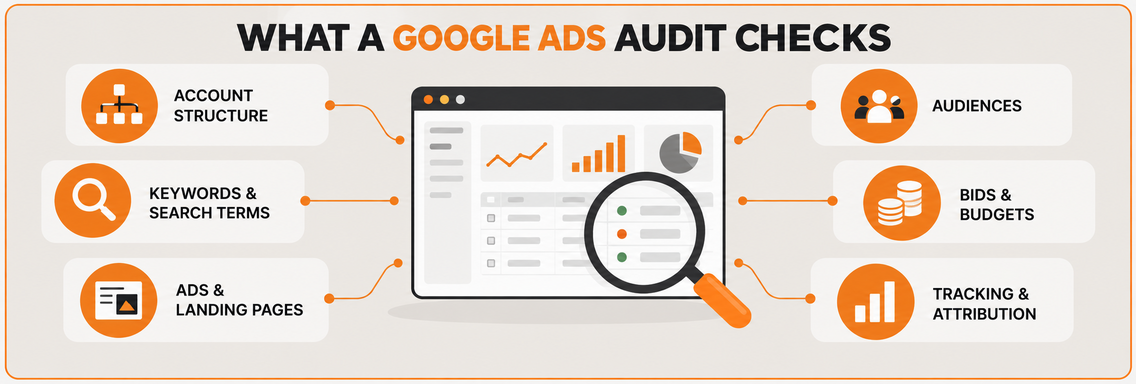
A thorough review usually examines:
- Account architecture: Campaign objectives, naming conventions, ad group organization, location settings, networks, and brand versus non-brand separation.
- Keyword strategy: Search intent, match types, negative keywords, search terms, and whether queries align with the products or services sold.
- Ads and landing pages: Message consistency, asset coverage, calls to action, page relevance, and conversion friction.
- Audiences and remarketing: Audience definitions, exclusions, list quality, overlap, and whether targeting supports the customer journey.
- Bids and budgets: Automated bidding inputs, budget distribution, learning constraints, target changes, and alignment with commercial priorities.
- Measurement and attribution: Conversion actions, primary versus secondary conversions, value mapping, GA4 or CRM reconciliation, enhanced conversions, and offline conversion imports.
The audit becomes useful when these parts are connected. For example, a keyword may appear efficient because Google Ads assigns it credit for a lead, but a CRM review may show that the lead never reaches a qualified sales stage. A landing page may convert well on paper, yet the conversion action may be firing on a form start rather than a completed inquiry.
For a practical comparison of scope and provider considerations, review this guide to what a PPC audit service is and how to choose one.
Benefits of a Google Ads Audit Service
A campaign can look healthy in Google Ads while producing weak business results. For example, a low CPC or attractive platform ROAS may hide repeat purchases, branded demand, low-margin products, or leads that never become sales. An audit connects account signals to the economics behind them, including conversion value, customer acquisition cost, and lifetime value.
The review can identify search terms that spend without meaningful outcomes, campaigns that compete for the same demand, and conversion actions that send automated bidding the wrong signals. It can also show whether reported conversions represent incremental growth or demand the business would have received anyway.
Independent audit findings indicate that 25-40% of monthly spend may be recoverable waste, while more than 70% of accounts contain conversion tracking errors, according to the PPC Land audit summary. These figures are not a savings forecast for every advertiser. They support a closer investigation of traffic quality, measurement, and business outcomes.
What the business gains
- Cleaner traffic: Negative keywords and match-type controls reduce exposure to searches that do not fit the offer.
- More reliable bidding: Automated strategies can respond to stronger signals when primary conversions reflect genuine business outcomes.
- Sharper allocation: Budgets can shift toward campaigns that support profitable demand, rather than generating inexpensive clicks.
- Better forecasting: Marketing and finance teams gain a clearer link between spend, qualified conversions, revenue, margin, and customer lifetime value.
- Earlier risk detection: Tracking gaps, feed issues, abrupt budget changes, and landing-page problems become visible before they distort a longer reporting period.
The audit also gives leaders a better way to judge performance. A cheaper click is useful only when the resulting customer has acceptable acquisition cost and value. Likewise, a higher platform ROAS matters only when reported revenue aligns with margin and the customers’ future value.
For a visual overview of why account reviews matter, watch the accompanying Google Ads audit video.
Audit Process Deliverables and KPIs
A credible audit follows a sequence. The order matters because recommendations made before the analyst understands the business model or validates measurement can create more confusion than improvement.
Discovery establishes the commercial context
The first phase collects account access, campaign history, conversion definitions, business goals, product or service margins, sales-cycle information, and CRM or ecommerce data. The provider should clarify whether the account is pursuing online purchases, qualified opportunities, phone calls, applications, or another outcome.
This phase should produce an initial brief that records the scope, data sources, known concerns, and success criteria. For a B2B advertiser, a qualified opportunity may matter more than a form completion. For a DTC brand, revenue and contribution margin may matter more than order volume alone.
Deep analysis tests the account mechanics
The analyst then reviews architecture, targeting, search terms, ads, landing pages, audiences, feeds, budgets, bidding, and measurement. A technically rigorous search review starts with a 90-day search terms export, segmented by campaign and match type. Sorting queries by cost and isolating terms with one click and zero conversions can expose what audit guidance calls “orphan-tail” spend.
A broad-match campaign consuming more than 40% of budget, or an account where more than 15% of search-term spend is irrelevant, may need a full match-type review. These thresholds and the export method are described in negative-keyword audit guidance from Clixtell.
Conversion measurement requires a separate reconciliation. Compare Google Ads conversion counts with GA4 and CRM records, then investigate material gaps. Practitioner guidance treats a difference above 15-20% as a likely tracking failure, while a gap above 40% strongly indicates broken attribution, missing UTMs, or misconfigured tags, as outlined in this conversion tracking audit guide.
Recommendations become useful when prioritized
The final report should rank findings by business impact, confidence, effort, and urgency. A long list of observations is less valuable than a decision-ready roadmap.
Typical deliverables include:
- Prioritized findings report: What is wrong, why it matters, and which evidence supports the finding.
- Search-term and negative-keyword file: Terms to exclude, terms to review, and the campaigns affected.
- Measurement audit output: Conversion-action inventory, tag findings, value mapping, attribution notes, and reconciliation results.
- Campaign architecture recommendations: Consolidation, separation, naming, audience exclusions, and budget changes.
- Landing-page observations: Message match, form friction, page relevance, and conversion-path concerns.
- Implementation roadmap: Tasks grouped by immediate correction, controlled testing, and ongoing monitoring.
KPIs should answer business questions
A useful KPI framework separates platform indicators from commercial outcomes:
| Audit area | Question to answer |
|---|---|
| Search-term relevance | Is spend reaching people with a realistic fit for the offer? |
| Conversion integrity | Do reported conversions match GA4, CRM, or ecommerce records? |
| Conversion quality | Do leads progress, and do purchases produce acceptable margin? |
| Budget allocation | Is funding concentrated where incremental value is strongest? |
| Bid inputs | Is automation receiving clean, timely, commercially meaningful signals? |
| Landing-page relevance | Does the post-click experience support the promise in the ad? |
A provider should also explain what will happen after implementation. Ongoing management matters because auction conditions, search behavior, product availability, and measurement signals change. Excellorix discusses this broader operating model in its guide to why high-performing Google Ads accounts require ongoing management.
Pricing Models and Provider Selection
Pricing should match the audit’s scope, complexity, and expected use of the findings. A small account with one business goal needs a different engagement structure from a global advertiser with multiple markets, feeds, CRM stages, and automated campaigns.
| Model | Best fit | Main strength | Main risk |
|---|---|---|---|
| Flat fee | A defined one-time review | Predictable budget and clear deliverables | Scope may be too narrow for complex accounts |
| Hourly consulting | Targeted questions or troubleshooting | Flexible access to specialist time | Total cost can be uncertain |
| Percentage of spend | Ongoing management after an audit | Creates a continuing operating relationship | It may not suit a one-off review |
| Performance-based | Clearly measurable savings or outcomes | Strong alignment with agreed goals | Attribution and measurement rules can become complicated |
The quote should identify the campaigns, markets, data sources, historical period, deliverables, presentation format, and implementation support. It should also state what the provider won’t review. A low price may reflect a restricted scope rather than superior efficiency.
Be cautious when a proposal promises a fixed savings amount before the provider has examined the account. A responsible auditor can describe likely opportunity areas, but actual findings depend on traffic quality, tracking reliability, commercial margins, and the account’s operating history.
Key Questions to Ask Your Audit Provider
Use the provider’s answers to test whether they can evaluate both platform mechanics and business economics.
-
How will you analyze search terms and match types? Look for a defined export period, campaign segmentation, cost-based prioritization, and a plan for negative-keyword governance.
-
How will you separate brand and non-brand performance? The answer should address how branded demand can affect reported efficiency and obscure incremental acquisition.
-
How do you evaluate Performance Max data leakage? Ask how the provider examines blended inventory, search-category insights, audience overlap, brand exposure, and areas where budget remains difficult to verify.
-
How will you reconcile Google Ads with GA4 and CRM data? A strong process compares counts, stages, values, timestamps, UTMs, and offline outcomes rather than accepting the platform interface as the final authority.
-
Which conversions will drive bidding? The provider should distinguish primary conversions from secondary actions and explain why each bidding signal belongs in the optimization set.
-
How will you map conversion values to economics? Ask whether recommendations account for revenue, gross margin, lead quality, sales probability, CAC, and LTV.
-
How do you assess attribution limitations? Privacy changes and incomplete customer journeys can affect what Google Ads can observe. The auditor should explain uncertainty instead of presenting every reported conversion as fully verified.
-
What will the final deliverables look like? Request a sample outline showing findings, evidence, priority, owner, and recommended action.
-
Who implements the changes? An audit can identify a problem, but your team may need technical, creative, feed, or landing-page support to resolve it.
-
How will signal quality be monitored afterward? Weekly checks of primary conversions, search terms, negatives, budget spikes, landing-page relevance, and conversion-path friction are increasingly important in automated accounts, according to this guidance on modern Google Ads audits.
Most audit content still emphasizes account hygiene. That leaves a major question unanswered: whether the platform is optimizing toward the outcomes the business values. A provider who can’t discuss CAC, LTV, margin, and incremental demand may produce a technically tidy account without improving the investment decision.
Case Studies and Example Findings
The examples in this section are illustrative audit scenarios, not verified client case studies. They show how an auditor might connect account evidence to business decisions without claiming a specific result.
Example one with a B2B services account
A professional services firm reports a steady flow of leads from Google Ads, but the sales team says many inquiries are outside its service area or asking for work the firm doesn’t provide. The audit begins with the search terms report and discovers irrelevant query themes, broad targeting, and weak exclusions.
The analyst then traces conversion data into the CRM. Google Ads is receiving form submissions, but it isn’t receiving reliable feedback about qualification or sales progression. The recommended fix includes tighter query controls, clearer service-specific landing pages, and offline conversion imports tied to meaningful sales stages.
The account may continue to show a similar number of form completions after the changes. That doesn’t mean the audit failed. The better evaluation is whether the firm can now distinguish a raw inquiry from a sales opportunity and calculate acquisition cost using a more credible definition of success.
Example two with an ecommerce account
An online retailer sees strong platform-reported ROAS in a Performance Max campaign, but finance reports uneven margin across product groups. The review checks product values, feed data, brand exposure, returning-customer behavior, and the conversion actions used for bidding.
The auditor finds that revenue is being treated as the central success signal without enough attention to margin differences. The action plan maps values more carefully, reviews product exclusions, improves negative-keyword controls where applicable, and creates a reporting view that compares platform results with contribution economics.
The important lesson is that an audit doesn’t promise that every metric will improve simultaneously. It improves the quality of the decisions behind budget allocation. A campaign that looks less impressive after measurement becomes more honest may be more useful to the company than one that reports attractive results no one can reconcile.
Next Steps to Engage Excellorix
Start with a short discovery conversation focused on the business question behind the audit. You may need to reduce wasted spend, verify lead quality, reconcile ecommerce revenue, separate brand from non-brand demand, or determine whether automated campaigns are optimizing toward profitable growth.
The next step is an individualized proposal that defines account scope, data access, historical review period, deliverables, presentation format, and implementation support. Prepare Google Ads access, GA4 or analytics access, CRM or ecommerce records, conversion definitions, margin information, and current CAC or LTV targets where available.
After kickoff, the audit should move from discovery to technical analysis, prioritized findings, and an action plan. Excellorix offers PPC services for Google Ads and Meta Ads within a broader revenue-focused marketing system, making it a potential option for organizations that need audit findings connected to landing pages, analytics, paid media, and conversion optimization.
The right audit won’t only tell you which campaign spent the most. It will show whether your advertising signals reflect the customers, revenue, margin, and long-term value your business needs.
Excellorix can review your Google Ads structure, tracking, targeting, landing pages, and conversion economics to identify waste and unreliable signals. Visit Excellorix to request a consultation and turn your account data into a clearer plan for profitable growth.