Skip to content



Your store might be getting traffic, but sales still feel stubbornly flat. The product pages look polished enough, the ads are doing their job, and yet visitors keep leaving before they buy. That gap usually isn’t a traffic problem, it’s a storefront problem, and ecommerce web design services are what turn a nice-looking site into a revenue system that builds trust, reduces friction, and supports purchase decisions at every step.
The market tells the same story. Independent research valued the global Ecommerce Website Design market at USD 10.42 billion in 2025 and projects it to reach USD 24.17 billion by 2034, with a 9.8% CAGR over the forecast period, which shows that brands are treating design as a core commercial investment rather than a cosmetic refresh Research and Markets. That matters because the site is where credibility is judged, products are compared, and checkout either happens or collapses.
Your Storefront Is More Than Just a Website
A brand can spend heavily on traffic and still feel like it’s pouring visitors into a leaky bucket. The usual pattern is familiar, product pages get clicks, carts get started, and then the numbers taper off because the site doesn’t help buyers feel confident enough to continue. That’s where ecommerce web design services stop being a visual upgrade and become a business function.
A high-performing storefront has to do several jobs at once. It has to look credible fast, organize products in a way shoppers understand, and remove hesitation at the moment someone is ready to buy. That’s why industry research showing 75% of people judge a business’s credibility based on its website design is so important, because first impressions aren’t abstract in ecommerce, they directly shape whether shoppers trust the brand enough to keep going Sixth City Marketing.
Design is a revenue system
A common mistake is treating design like a one-time visual project. A better approach is to think of the storefront as a living sales system where layout, copy, performance, navigation, and checkout all influence whether a visitor becomes a customer.
“Practical rule: if a page makes buyers think, pause, or backtrack, it’s usually hurting revenue more than it’s helping branding.
That’s why the category has grown into a measurable market. The global Ecommerce Website Design market’s USD 10.42 billion valuation in 2025 and USD 24.17 billion projection for 2034 signal that companies are paying for more than aesthetics, they’re buying a structure that supports growth Research and Markets. In practical terms, the question isn’t whether a store needs design work. It’s whether that work is built to support trust, conversion, and repeat buying in the same place.
Why traffic alone won’t save a weak store
A well-run ad account can bring people in, but it can’t fix a confusing product hierarchy, a slow mobile page, or a checkout that feels uncertain. Professional ecommerce design closes that gap by giving the buyer a clearer path from interest to purchase. If you’re mapping a storefront rebuild, a useful companion read is this guide on what growing online stores need beyond a basic Shopify setup.
A store that earns trust quickly tends to convert more efficiently because it answers the shopper’s unspoken questions before they reach the cart. The job of ecommerce web design services is to build a storefront that functions like a sales rep, merchandiser, and checkout assistant at the same time.
The Core Components of Ecommerce Web Design Services
A lot of agencies use the same phrase, ecommerce web design services, to describe very different work. Some mean visual mockups only. Others mean a full build that touches research, UX, development, and measurement. The difference matters because a storefront that converts is rarely the result of one discipline alone.
Strategy and discovery
Defining the business problem is foundational. A serious engagement starts by clarifying who the buyer is, what the store needs to sell, what the current funnel breaks, and which parts of the site matter most for revenue. Without that context, design decisions become guesses dressed up as taste.
Strong discovery work also shapes platform choice, content priorities, and the order of implementation. If product assortment is complex, the architecture needs to support that complexity. If the buyer needs reassurance before purchasing, then product detail pages and trust signals matter more than homepage theatrics.
UX and UI design
UX is about how the shopper moves. UI is about how the store looks and signals action. Together, they shape whether the visitor can find products fast, compare options without friction, and feel comfortable clicking “buy.”
The best UI work doesn’t try to impress with unnecessary decoration. It makes calls to action obvious, keeps product hierarchy clean, and makes the path to checkout feel natural. That’s especially important because 60% of ecommerce consumers say usability is an important factor in an online shop Sixth City Marketing.
Development and platform implementation
The design translates into a working store. On platforms such as Shopify, WooCommerce, or BigCommerce, development turns wireframes into templates, connects payment flows, and sets up the technical logic that keeps shopping smooth. The platform choice shouldn’t be based on habit, it should be based on the use case, the catalog structure, and the integration needs.
Ongoing optimization
Launch isn’t the finish line. After go-live, the site should be measured, tested, and refined. That includes checking analytics, reviewing behavior on product and checkout pages, and fixing the small issues that suppress conversion. If you want to see how experienced teams think about this broader setup, this resource on long-term website foundations is worth reviewing.
“The strongest ecommerce builds connect design decisions to measurable shopper behavior, not opinions in a meeting.
Together, these pillars create a store that’s easier to trust, easier to use, and easier to scale. That’s why ecommerce web design services are best understood as an operating system for growth, not a visual exercise.
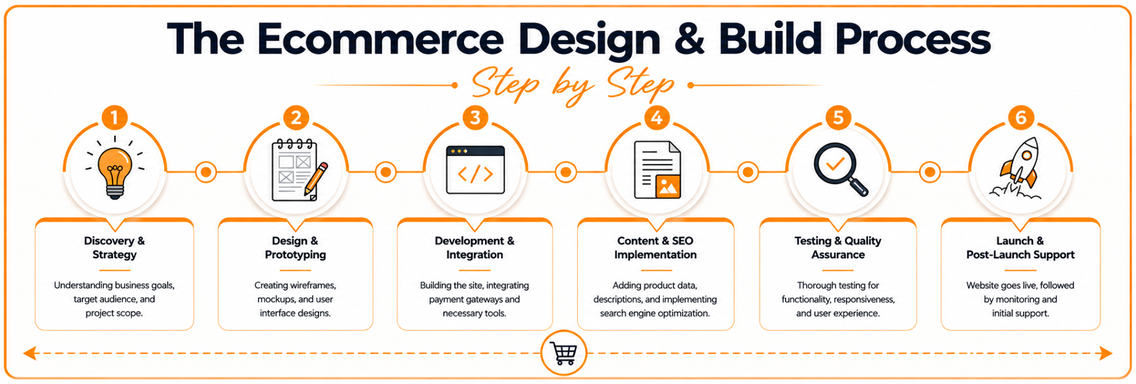
The Ecommerce Design and Build Process Step by Step
Most clients want the same thing at the start of a project, clarity. They want to know what happens first, what they’ll approve, and when the site becomes real. A good agency reduces uncertainty by turning the build into a sequence of decisions instead of a blur of tasks.
Discovery, design, and build
The first step is discovery, where the team aligns on business goals, audience behavior, technical constraints, and the pages that matter most. Then comes design and prototyping, where wireframes and mockups establish the structure before anyone touches production code. After that, development turns the approved design into a functioning storefront.
The best agencies use this phase to prevent expensive rework later. If a checkout flow feels too long in prototype form, it’s far cheaper to adjust there than after the build is already coded.
Content, testing, and launch
Content and SEO implementation come next, because products need clean copy, strong imagery, and a page structure search engines can understand. Then comes testing, which should include mobile responsiveness, form behavior, navigation logic, and edge cases in checkout. Only after those checks pass should the store go live.
Launch should not feel like the end of the conversation. It should feel like the start of measurement. The better partners keep watching how shoppers move through the store, because post-launch behavior almost always reveals one or two bottlenecks that weren’t obvious in the prototype.
What a realistic timeline feels like
Every build is different, but the sequence should still feel orderly. Discovery sets the direction. Design gives the business a visible plan. Development makes that plan real. Testing protects the launch. Optimization keeps the investment working.
If a provider can’t explain this flow cleanly, they probably don’t have a process they can repeat under pressure. That’s a risk for any ecommerce brand, because launch day isn’t where the work ends, it’s where the site starts proving whether the strategy was sound.
Key Deliverables and Technical Foundations
A proper ecommerce engagement should leave you with more than a finished homepage. It should give you a working system of deliverables that show how customers will move, what the interface will look like, and how the site will perform once real traffic arrives. If the agency can’t name those outputs clearly, the project is probably too vague to manage well.
| Project Phase | Key Deliverables |
|---|---|
| Discovery and planning | Customer journey notes, site goals, page priorities |
| UX and UI design | Wireframes, mockups, design system, mobile layouts |
| Development and build | Working templates, platform setup, payment integration |
| Launch and optimization | Analytics configuration, performance checks, post-launch fixes |
What the deliverables should actually do
Wireframes are useful because they force decisions about hierarchy before visuals distract from function. High-fidelity mockups matter because they let stakeholders judge the actual experience, not a rough sketch. A custom theme or template implementation matters because it turns the approved design into a usable storefront, not a static presentation file.
The technical foundation is where many stores win or lose. High-performing ecommerce services are engineered to meet Core Web Vitals targets such as Largest Contentful Paint under 2.5 seconds and Cumulative Layout Shift below 0.1, using techniques like code-splitting, CDN implementation, and image compression to protect mobile conversion rates Parallel HQ.
What to look for under the hood
This work should also include clean URL structures, schema markup, canonical handling, secure payment flows, and analytics setup. Those pieces don’t usually get talked about as much as color systems or homepage banners, but they’re the scaffolding that keeps the store discoverable and measurable.
“A storefront can look finished and still be structurally weak if it doesn’t support search, speed, and analytics from the start.
That’s why a detailed deliverables list matters. It helps you see whether the agency is delivering design assets or building a commerce engine. The distinction becomes obvious once you ask what happens after launch, because real ecommerce work always includes measurement and iteration, not just handoff.
If you’re comparing scopes, this breakdown of website foundations and marketing success can help you judge whether a proposal covers the full stack or just the visible layer.
How to Choose the Right Ecommerce Design Agency
The right agency partner doesn’t just make a store look better. It helps you make fewer expensive mistakes in platform choice, structure, and launch planning. That’s why the best selection process is less about browsing polished case studies and more about evaluating how the team thinks.
Look for architecture thinking, not decoration
A competent provider treats ecommerce as an architecture problem. That means SEO, structured data, secure payment flows, and analytics are considered from the beginning, not added after the design is done DesignRush. That mindset matters because the store needs to serve both shoppers and search engines without creating friction for either one.
The platform discussion should be just as practical. A good agency chooses the right setup for the use case, whether that’s Shopify, WooCommerce, BigCommerce, or a headless build. If a provider sounds loyal to one platform for every project, they’re probably selling comfort to themselves, not fit for your business.
Evaluate the team on outcome thinking
You want to hear how the agency defines success after launch. Do they talk about performance, conversion behavior, and technical stability, or do they only discuss visuals and deadlines? The stronger partner will connect design decisions to business outcomes and explain why one layout, template, or checkout structure is better for your model than another.
A useful test is to ask how they handle trade-offs. Good agencies can explain when custom development is worth it, when a platform native feature is enough, and when a more complex build would slow you down without adding value.
One practical way to separate partners
- Process depth: Ask how they move from discovery to launch, and whether that process changes for different catalog sizes or business models.
- Technical fluency: Check whether they can discuss performance, platform constraints, analytics, and structured data without drifting into vague language.
- Business alignment: Look for a partner that talks about revenue, conversion, and retention, not just “a better look.”
A growth partner will be comfortable talking about what the site needs to do, not just what it needs to resemble. That’s the difference between a design shop and a team that understands ecommerce as a revenue channel.
Critical Questions to Ask Before Signing a Contract
A contract can look polished and still leave too many unknowns. Before you sign, you want to pressure-test the agency’s communication style, technical depth, and post-launch commitment. The right questions reveal whether you’re buying a one-off project or a working partnership.
Questions that expose the real process
Ask how they measure success after launch, and listen for specifics about analytics, conversion behavior, and site performance. Ask what post-launch support includes, because some teams disappear once the site goes live while others stay engaged through monitoring and iteration.
You should also ask who your day-to-day contact will be. That answer tells you a lot about how the work is managed and whether you’ll be dealing with the people doing the actual building or passing through layers of account management.
Questions that reveal technical capability
Ask them to walk you through a time they handled a difficult ecommerce build issue. The answer doesn’t need to be dramatic, it just needs to show judgment. Strong teams can explain why a problem occurred, how they solved it, and what they changed to prevent it from returning.
You can also ask how they approach revisions during the project. A disciplined revision process keeps feedback focused and prevents the build from turning into an endless cycle of subjective tweaks.
If budget clarity is still fuzzy, this honest website cost breakdown can help you frame price against scope instead of guessing.
“Ask for examples of decision-making, not just finished screenshots. The way a team reasons through trade-offs tells you more than a portfolio grid ever will.
The goal here is simple. You want a partner who can explain what happens when something breaks, changes, or underperforms. That’s what separates professional ecommerce web design services from a surface-level design purchase.
Building Your Future-Proof Ecommerce Engine
A storefront that converts today still has to hold up next quarter, next season, and after the next campaign launch. That’s why ecommerce design should be treated as an ongoing growth system, not a one-time aesthetic event. The best builds connect brand credibility, technical performance, and measurement into one operating model.
The practical takeaway is straightforward. Choose partners who can design for trust, build for speed, and optimize against real business outcomes. If a provider can’t explain how their work supports revenue, retention, and the customer journey, they’re probably not building a future-proof store.
Excellorix builds ecommerce sites as part of a broader revenue-driven growth system, combining website design, ecommerce development, SEO, and conversion optimization under one team. If you want a storefront that’s built to convert and improve over time, visit Excellorix and talk with a team that works across design, performance, and measurable growth.