


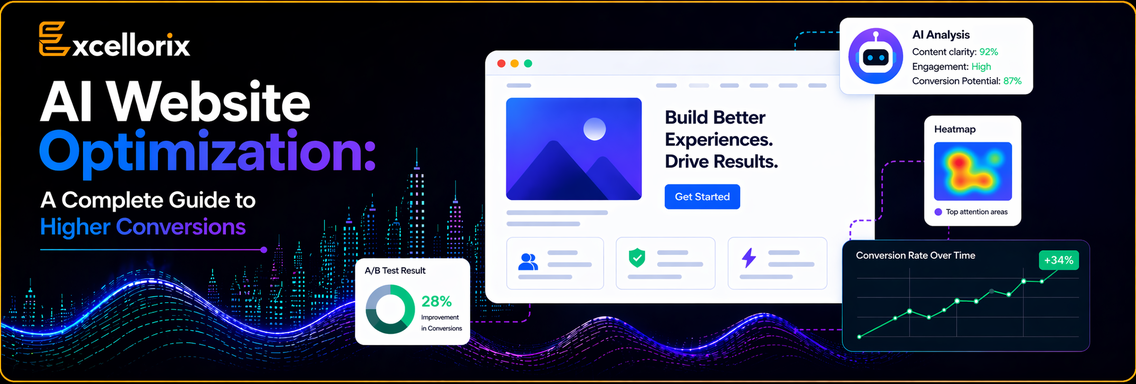
Many business websites look fine on the surface, but they fail where it matters most. They do not generate enough leads, build trust fast enough, or turn visitors into paying customers. That problem becomes expensive over time.
You may invest in ads, SEO Service, or social media to bring traffic in, only to send people to a website that is not built to convert. Visitors arrive interested, then leave because of slow speed, weak messaging, or poor user experience. This is why AI website optimization matters in 2026.
Today, successful websites do more than simply exist online. They learn from user behavior, improve performance faster, and help businesses turn attention into revenue.
At Excellorix, we help businesses turn underperforming websites into growth assets through SEO Service strategy, conversion optimization, and smarter user experiences. To understand how that works, it helps to begin with the foundation.
AI website optimization means using artificial intelligence, automation, and user behavior insights to improve how a website performs. This may include increasing conversions, improving user journeys, reducing bounce rates, personalizing experiences, speeding up pages, strengthening SEO visibility, and generating better leads. In simple terms, it helps your website make smarter decisions.
Traditional websites often treat every visitor the same way. Optimized websites learn from real behavior, identify what users need, and remove the friction that stops action. Instead of guessing what visitors want, businesses can respond based on evidence. That sounds valuable, but the real question is why it matters more now than ever before.
The online world has changed quickly. People now use Google AI Overviews, voice assistants, recommendation engines, and AI tools like OpenAI ChatGPT before ever visiting a business website. That means when someone lands on your site today, they are usually more informed and more selective. They are not casually browsing anymore. They are comparing options, checking trust signals, and deciding whether you are worth their time.
If your website feels slow, confusing, generic, or difficult to trust, they leave quickly. That is why modern growth now depends on two connected goals.
First, getting discovered.
Second, converting qualified traffic efficiently.
Many businesses focus only on visibility, but visibility without conversions is like filling a store with visitors who never reach the checkout. Once this shift is understood, the next step is building a website that performs intentionally.
1. Start With Clear Revenue Goals
Before changing layouts, colors, or headlines, define success clearly.
Examples include a homepage generating 10 calls per month, a service page converting 5 percent of visitors, a landing page reducing cost per lead by 20 percent, or a contact page increasing inquiries.
Without goals, even attractive websites can fail quietly. Too many redesigns are based on opinions rather than measurable outcomes. When that happens, teams stay busy but growth stays still.
Once goals are clear, structure becomes the next priority because visitors need a path to follow.
2. Build a Website Structure That Guides Visitors
A website should feel simple to navigate. Visitors should always know where to go next, while search engines should clearly understand how pages connect.
Strong examples include moving from homepage to services to contact, blog to relevant service to book call, or about page to reviews to inquiry form.
Weak websites often overload menus, hide important pages, or create dead ends where visitors stop progressing.
When users feel lost, they leave. When search engines feel confused, rankings often drop. A strong structure supports both user experience and SEO Service performance, which is why it becomes the base for everything else.
Once the path is clear, messaging becomes the next growth lever.
3. Create Hero Sections That Explain Value Fast
Your hero section is your first impression. Most visitors decide within seconds whether they should stay or leave, so unclear messaging can quietly destroy conversions.
Weak example:
We provide innovative solutions for growing businesses. It sounds polished, but says very little.
Better example:
Get More Qualified Leads With SEO Service and Conversion Focused Website Strategy. That works because visitors instantly understand the value.
Strong hero sections usually include who you help, what result you create, why trust you, and one clear call to action. Not five buttons, three slogans, and a smiling stock photo pretending to brainstorm.Strong messaging is a core part of AI website design because design should support action, not just appearance.
Once visitors understand your offer, they naturally move deeper into your site. That is where service pages must continue the momentum.
4. Turn Service Pages Into Sales Pages
Many service pages explain features but forget to sell outcomes. Visitors care less about internal processes and more about what changes for them after hiring you.
A strong service page should answer what the service is, who it is for, what problem it solves, why choose you, and what happens next. If you offer SEO Service, explain the impact clearly. Instead of saying you optimize keywords and metadata, explain that your SEO Service helps businesses increase qualified traffic, improve visibility, and turn search visitors into steady leads. Specific outcomes build trust faster than vague claims.
Once trust is created through messaging, user experience becomes the next factor that determines whether people act.
5. Improve User Experience With AI UX Optimization
People rarely read websites line by line. They scan quickly, which means clarity often matters more than creativity.
Simple UX wins include short paragraphs, clear headings, fast mobile layouts, easy forms, sticky call to action buttons, trust badges near decisions, and contact details that are easy to find. AI tools can also reveal where visitors stop scrolling, which buttons get ignored, where users abandon forms, and which sections hold attention longest. This helps remove friction.
If contacting your business feels like solving a puzzle, conversions will drop no matter how good the design looks. Good UX feels invisible. Bad UX becomes unforgettable for the wrong reasons.
Once usability improves, technical performance matters even more because speed shapes first impressions too.
6. Speed and Technical Health Still Matter
Even the best copy cannot save a painfully slow website. If pages load too slowly, many visitors leave before they ever read your message or see your offer.
Important technical priorities include fast page speed, Core Web Vitals improvements, mobile responsiveness, secure HTTPS setup, clean code, compressed images, reliable hosting, and schema markup.
A slow website is like inviting customers into a store and locking the front door halfway open. Technical health also supports SEO Service rankings and improves ad performance because better landing pages usually convert more efficiently.
Once the site runs smoothly, content gets a real chance to perform.
7. Build Content for Search Engines and Real Humans
Good content should answer real questions clearly. That includes helpful blog posts, FAQs, service pages, comparison pages, local landing pages, case studies, and industry guides.
AI search systems prefer structured answers. Humans do too.
Instead of publishing endless generic blogs, focus on topics your ideal customers actually care about and questions they are already asking. When content, speed, user experience, and messaging align, websites become much easier to grow.
That alignment is also what helps conversion rates improve over time.
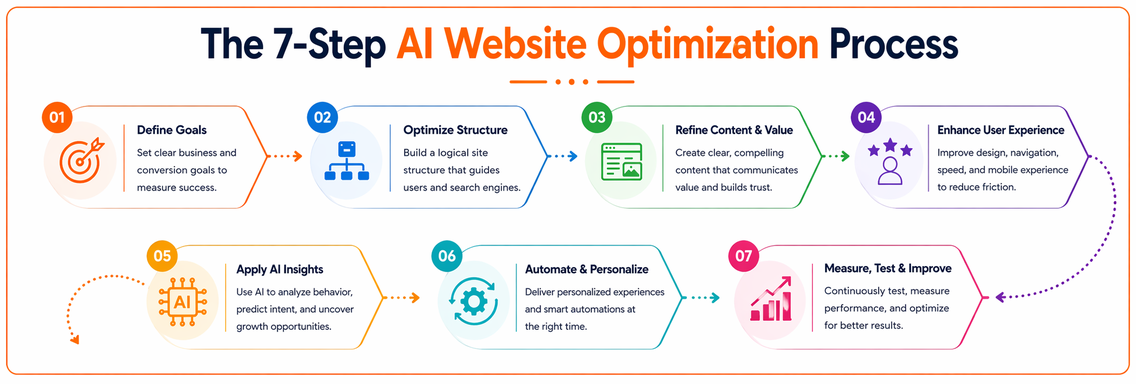
AI tools help businesses optimize faster than manual trial and error. They can identify which traffic sources convert best, which headlines outperform others, which users are likely to buy, where visitors leave the page, what time users engage most, and which layouts improve leads. This reduces wasted effort and poor assumptions. Guessing is expensive. Smart data decisions usually cost less and perform better. As these improvements stack together, common website mistakes become easier to spot and fix.
We focus on business outcomes, not vanity metrics. That means we care about leads, revenue opportunities, conversion rates, SEO Service improvements, paid campaign efficiency, user experience gains, and long term growth systems. Because traffic without results is just noise with analytics attached.
When strategy and execution work together, websites stop being expenses and start becoming assets.
AI website optimization is not about trends or buzzwords. It is about building a website that works like a real business system. When trust, speed, messaging, SEO Service strategy, and user experience support each other, growth becomes more predictable and scalable. A truly high converting website is built through strategy, testing, and continuous improvement.
The businesses winning in 2026 are not always the loudest. They are often the easiest to understand, the easiest to trust, and the easiest to buy from. If your website is not doing that today, the next step is clear.
Your website should do more than just exist online. It should attract qualified visitors, build trust, and turn traffic into real revenue. If that is not happening right now, there is usually a clear reason behind it.
Book a free strategy call with Excellorix and discover:
What is slowing down your current website performance
Where visitors are dropping off before converting
How better SEO Service strategy can increase qualified traffic
What conversion improvements can generate more leads
It is about building smarter systems that consistently produce results.
AI website optimization means using artificial intelligence, automation tools, and user behavior data to improve website performance. It helps increase conversions, improve user experience, speed up pages, and make smarter decisions based on real visitor actions.
Yes, absolutely. Small businesses can benefit without needing a huge budget. Even simple improvements like stronger calls to action, faster mobile pages, better forms, and smarter content can increase leads and sales significantly.
No, it works alongside SEO. SEO Service helps attract qualified visitors, while optimization helps convert those visitors into leads or customers. Together, they create stronger growth than either strategy alone.
Some changes such as speed fixes, cleaner layouts, or stronger headlines can improve performance within weeks. Larger gains like better rankings and consistent lead generation usually build over two to six months.
Yes, more than ever. Competition online is increasing, attention spans are shorter, and users expect better digital experiences. Businesses that optimize intelligently often waste less traffic and grow faster.
Tell us about your goals—we’ll show you how Excellorix can help you get there.