 Skip to content


You’re comparing agency decks that all look competent. One promises SEO, paid media, creative, automation, and “full-funnel growth.” Another presents polished dashboards and impressive logos. Your team needs qualified pipeline or profitable sales, but the decision is drifting toward whoever gives the smoothest presentation.
That’s the wrong decision process. The practical way to learn how to choose a digital marketing agency is to start with the business outcome, then judge agencies by their ability to move it, measure it, and explain what they’re doing. Outsourcing is already mainstream. The January 2026 CMO Survey reported that external agencies, partners, and service providers perform an average of 33.59% of companies’ digital marketing activities, with a median outsourcing level of 25% across 198 responses (Market.us digital marketing outsourcing data). Your job isn’t to find an agency that can do everything. It’s to find the partner that can do the right work for the outcome you’ve chosen.
Table of Contents
- Start With the Outcome, Not the Agency
- Evaluation Criteria That Actually Predict Fit
- Agency Pricing Models and Hidden Costs
- How to Read a Case Study Like a Skeptic
- RFP Questions and Sample Brief
- The AI-Visibility Question Most Buyers Skip
- Your 90-Day Agency Decision Plan
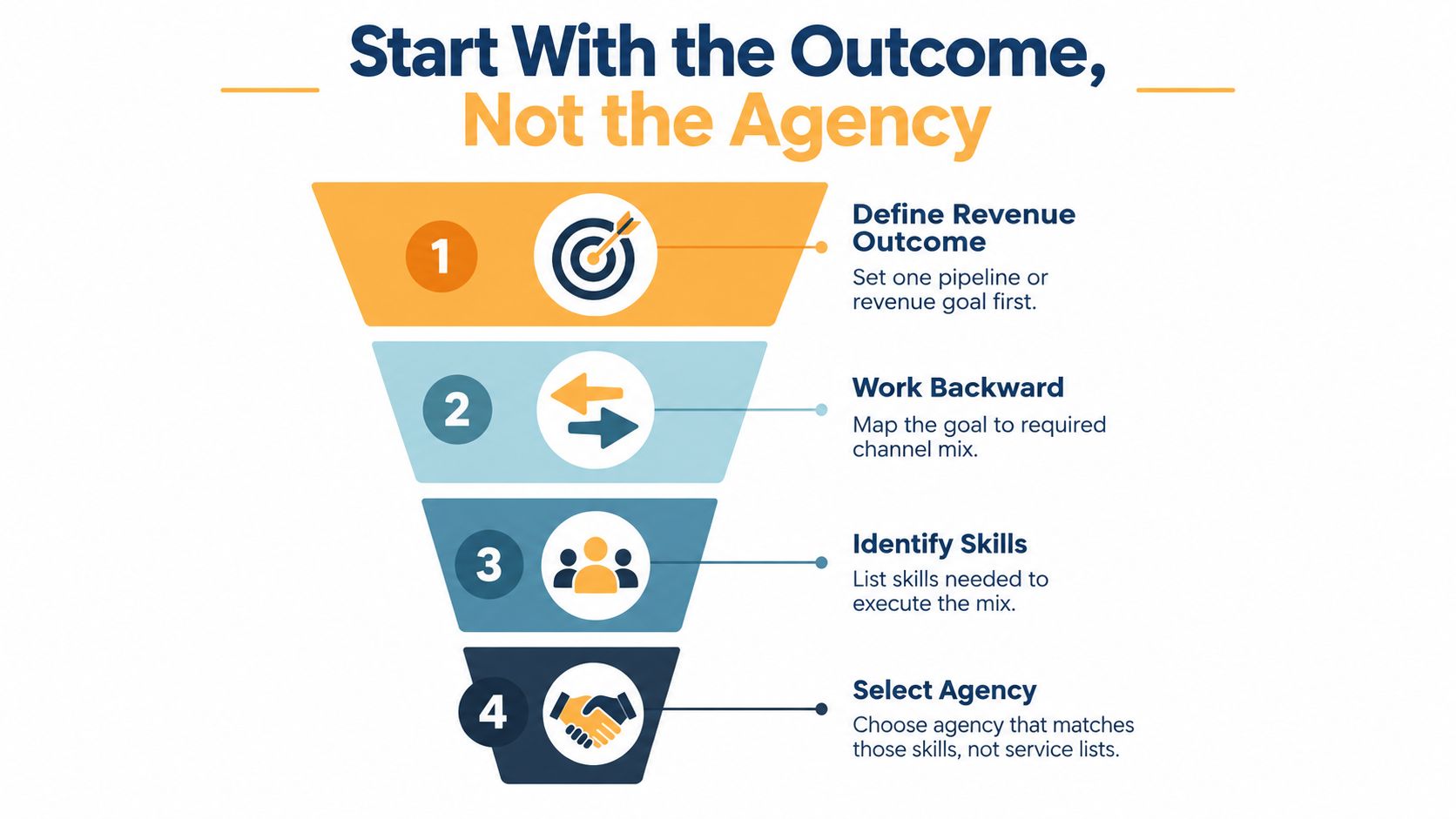
Start With the Outcome, Not the Agency
Your team needs qualified pipeline, but the agency pitch keeps pulling the conversation toward SEO, paid media, creative, and automation. By the end, the decision risks favoring the deck with the strongest presentation rather than the partner most likely to improve revenue.
Start with one question: Which business outcome are we hiring an agency to move?
A service list creates the wrong buying process. Agencies can bundle every requested channel into a retainer, even when those services do not address the commercial problem. Choose one primary outcome, such as qualified pipeline, ecommerce revenue, sales, or conversion efficiency. Supporting metrics can follow, but the selection process needs one clear decision anchor.
Use a specific starting statement:
We’re hiring a partner to increase qualified demo requests from our priority market, while improving the quality of opportunities entering sales.
Turn the outcome into an agency brief
Write a one-page brief that covers your commercial context, target audience, important conversion action, and internal constraints. Give agencies a defined problem. A request for “more visibility” invites a polished response without forcing anyone to connect activity to business results.
Add a 90-day leading indicator. It should sit close to the chosen outcome and become visible before the full sales or customer cycle ends. A B2B company might track qualified demo requests or sales-accepted opportunities. An ecommerce company might track a properly measured purchase funnel and improved conversion efficiency.
Discuss channels only after defining that indicator. The outcome determines whether you need technical SEO, landing-page experimentation, paid acquisition, lifecycle email, creative production, analytics implementation, or a narrower combination. It also sets the boundary between agency and internal work. If your team owns brand strategy and sales enablement, you may need execution and measurement instead of a full strategic retainer.
The January 2026 CMO Survey found that agencies received 15.48 out of 100 capability-development emphasis points, indicating that buyers may expect agencies to build internal capability while executing campaigns (Market.us digital marketing outsourcing data). Ask whether the agency will document decisions, train your team, and leave behind usable processes.
Use the outcome as a filter throughout selection. Every keyword plan, media recommendation, creative concept, and reporting dashboard should answer one question: how will this help move the selected business result? Case studies, pricing, and AI-readiness matter only after they pass that test.
Evaluation Criteria That Actually Predict Fit
A polished pitch is weak evidence. Score agencies against the business outcome you already chose, then test whether their proof, measurement, people, and terms support it. A broad service menu shows what an agency sells. It does not show whether the team understands your economics, can separate cause from correlation, or will assign experienced operators to the account.
Build a weighted scorecard before the pitches. Define the outcome, assign category weights, score three to five agencies independently, and multiply each score by its weight before comparing totals. Published buyer guidance on choosing a digital marketing agency recommends asking for relevant case studies with baselines, timeframes, work performed, and measurable outcomes. Use that standard instead of rewarding attractive logos or confident presentation.
Weight evidence, measurement, people, and terms
Give the most weight to four areas:
- Proof tied to your outcome: Traffic growth for a publisher does not prove an agency can generate qualified pipeline for a technical services company. Comparable commercial problems matter more than logo count.
- Measurement depth: Ask how the team handles conversion tracking, attribution, data ownership, CAC, ROAS, customer LTV, and the difference between correlation and incremental impact.
- Team seniority: The strategist in the pitch may not manage your account. Require named roles, expected involvement, and a clear escalation path.
- Contract clarity: Confirm intellectual property ownership, account and data access, reporting cadence, scope boundaries, renewal terms, and exit provisions.
A scorecard can use these starting weights:
| Criterion | E-commerce weight | SaaS weight | Lead-gen weight | Why it matters |
|---|---|---|---|---|
| Relevant proof of results | 30 | 30 | 30 | Shows the agency has solved a comparable commercial problem |
| Measurement and attribution | 25 | 30 | 25 | Connects activity to revenue, pipeline, and conversion quality |
| Team quality and seniority | 20 | 20 | 25 | Determines who actually makes decisions and executes the work |
| Strategic fit and channel rationale | 15 | 15 | 15 | Tests whether the proposed mix follows the outcome |
| Contract and scope clarity | 10 | 5 | 5 | Limits surprises around ownership, fees, and deliverables |
These weights are a starting point, not a rule. Increase the measurement category if your analytics are unreliable. Give compliance and senior review more weight when your business operates under regulatory constraints.
Set a no-go threshold before agency presentations influence you. A weak score on measurement, relevant proof, or account-team quality should disqualify an agency, even when the pitch is persuasive. A structured evaluation helps prevent presentation quality from replacing evidence. That is the central warning in this guide to evaluating a B2B SEO agency.
The 2025 Marketing Relationship Survey found that 91% of client respondents were actively involved in agency selection, while dissatisfaction with delivery and value each accounted for 61% of relationship endings (2025 Marketing Relationship Survey findings). The practical conclusion is direct: choose for fit and delivery discipline, not an impressive capabilities page.
Agency Pricing Models and Hidden Costs
Pricing changes the agency’s incentives. Don’t evaluate a proposal only by its monthly fee. Ask what the model rewards, who carries the risk, and which activities can expand without your approval.
A retainer buys reserved capacity. That can work well for compounding work such as SEO, content systems, conversion optimization, or ongoing strategy. The danger is unused capacity and vague scope. If the agency bills for access rather than defined outputs and decisions, the retainer can become difficult to challenge.
Percentage-of-ad-spend pricing is simpler for paid media, but it can reward budget expansion rather than efficiency. Put caps or tiered rates in writing, and separate media spend from agency fees. The agency should explain whether creative, landing pages, analytics, and experimentation are included or billed separately.
Project pricing provides a defined deliverable, such as a website, technical audit, or landing-page system. It limits open-ended commitment, but it can also create a handoff problem. An agency may deliver the asset while leaving your team responsible for measurement, iteration, and adoption.
Performance pricing sounds aligned, but it only works when attribution is clean and both parties control the relevant inputs. If sales follow-up, pricing, inventory, brand demand, or tracking quality sits outside the agency’s control, performance fees can create disputes rather than accountability.
| Pricing model | Buyer risk | Agency incentive | Common hidden costs | Best fit |
|---|---|---|---|---|
| Retainer | Paying for capacity that isn’t used | Retain the account and manage ongoing scope | Separate creative, strategy, or reporting charges | SEO, CRO, content, and ongoing strategic work |
| Percentage of ad spend | Fees rise as media budgets rise | Increase managed spend unless efficiency rules are defined | Media markup, creative fees, landing-page work | Paid media with capped or tiered rates |
| Project-based | Deliverable may not translate into ongoing performance | Finish the defined project efficiently | Change requests, maintenance, analytics setup | Website builds, audits, and defined launches |
| Performance-based | Attribution disputes and limited control over outcomes | Pursue the agreed conversion or revenue event | Setup fees, tracking work, minimum commitments | Cleanly measured programs with shared control |
Ask where the invoice can expand
Look for media markup layered over platform fees, separate creative retainers, onboarding charges presented as strategy workshops, and reporting software passed through at a markup. None of these costs is automatically unreasonable. The problem is discovering them after the contract is signed.
Request a sample invoice and a complete fee schedule. Ask whether you own the advertising accounts, analytics properties, creative files, landing pages, and reporting data. Also ask what happens when you pause spend, reduce scope, or terminate the relationship.
A practical rule is straightforward. Use retainers for work that compounds over time, percentage models for paid media with explicit caps, and performance pricing only when the measurement system can withstand scrutiny. Before signing, review the proposed agreement against these PPC agency red flags.
How to Read a Case Study Like a Skeptic
A polished graph does not prove agency performance. A case study becomes useful only when you can reconstruct the decisions, conditions, and contributions behind the result.
Start with the baseline. Ask what the account looked like before the agency began, which channels were active, what tracking existed, and what the client’s internal team already handled. Without that context, an impressive endpoint cannot show whether the agency created meaningful change or presented the strongest moment.
Examine the timeframe next. A short campaign window may show an early signal rather than durable performance. A long measurement period may include pricing changes, seasonality, product launches, sales hiring, or other factors that affected the outcome. Ask the agency to identify those influences and separate them from its own work.
Separate agency work from client work
The most revealing question is: who did what?
Ask who wrote the copy, built the landing pages, configured tracking, approved the offer, produced the creative, managed the website, and handled sales follow-up. A case study should show the client’s contribution when internal work materially affected the result. If the agency claims the entire outcome without explaining those dependencies, treat the evidence cautiously.
Tie the reported metric to commercial quality. Traffic, impressions, clicks, and rankings can help diagnose performance, but they should not replace qualified pipeline, revenue, ROAS, CAC, customer LTV, or conversion efficiency when those measures are available.
| Element | Credible case study | Red-flag case study |
|---|---|---|
| Baseline | Shows the starting condition and relevant context | Shows only an impressive final chart |
| Timeframe | States when work began and how long measurement lasted | Uses an unexplained date range |
| Scope | Names the agency’s work and the client’s contribution | Claims the entire outcome without attribution detail |
| Experiment design | Explains tests, comparison logic, or limitations | Presents correlation as causation |
| Commercial result | Connects activity to revenue, pipeline, or qualified conversions | Stops at impressions, clicks, or rankings |
| Verification | Offers dashboard access or a client reference | Relies on an anonymous logo or cropped screenshot |
Use direct questions during the pitch:
- What was the starting point?
- Which changes did your team make?
- Was this a controlled experiment?
- Who wrote the copy and built the landing pages?
- What did the client’s internal team contribute?
- Which results came from paid spend, and which came from organic demand?
- Can we see the raw dashboard rather than only the presentation?
- Can we speak with a comparable client?
A credible agency will explain uncertainty, dependencies, and the work it would repeat or change. It will not attribute every result to one tactic.
Request three references per finalist. Ask those clients about delivery quality, business value, communication, and whether the promised senior team stayed involved. Business understanding and strategic approach should receive direct scrutiny, because dissatisfaction in either area can end an agency relationship, as noted in the 2025 Marketing Relationship Survey findings.
RFP Questions and Sample Brief
Your RFP should test thinking before it negotiates price. If you ask only for channel recommendations and monthly fees, agencies can respond with interchangeable packages. A strong brief forces each finalist to explain the diagnosis, the operating model, the measurement plan, and the people responsible.
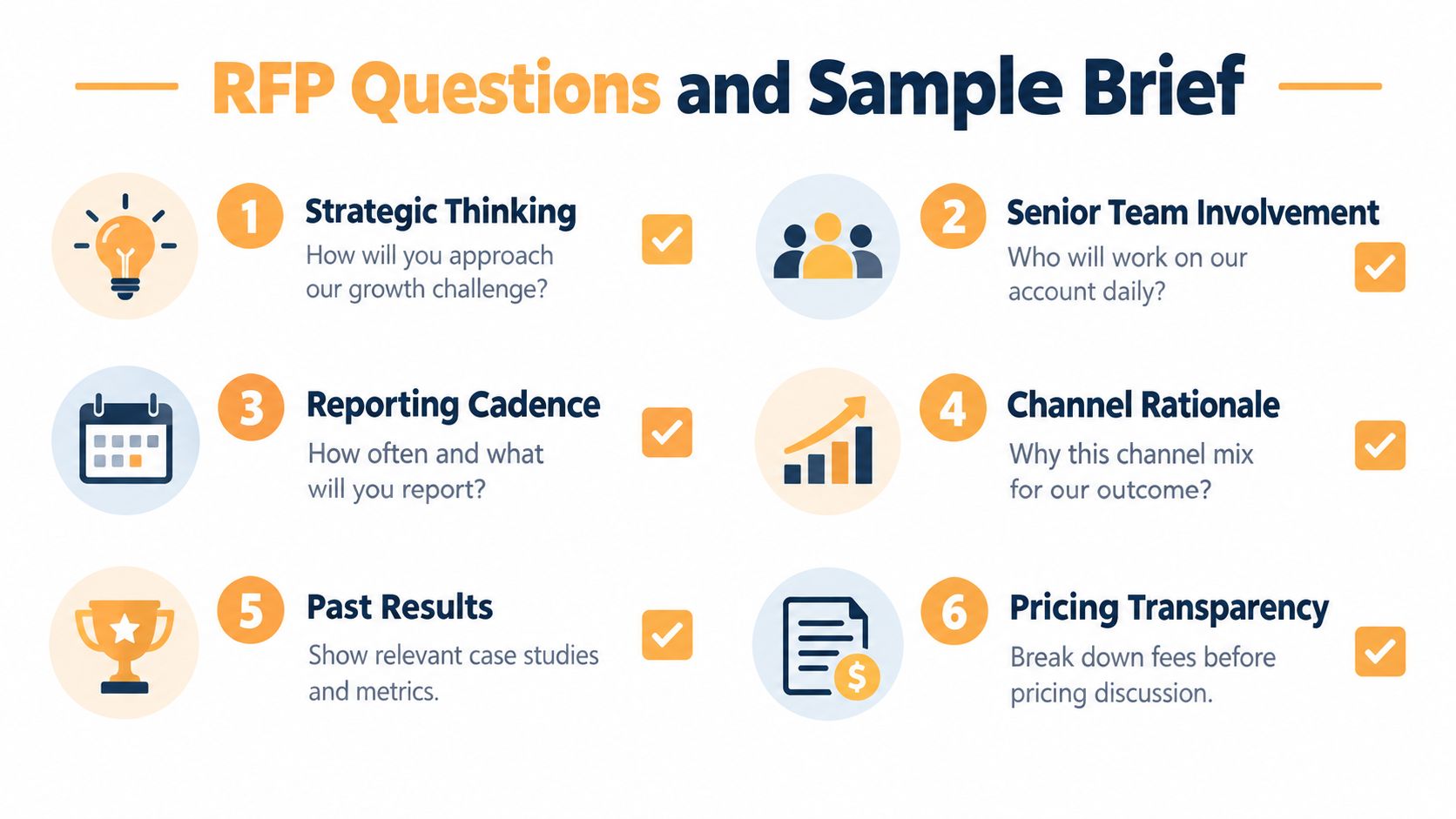
Use six blocks in the document
- Business context and outcome: Explain the commercial model, current growth constraint, primary audience, target action, and one business outcome.
- Audience and competition: Describe priority segments, buying triggers, sales-cycle realities, geographic focus, and known competitors.
- Scope and deliverables: State the work you expect the agency to own, the work your team will own, and the outputs required during the initial engagement.
- Team structure: Require named roles, seniority, responsibilities, availability, and escalation procedures.
- Measurement plan: Ask for tracking requirements, KPI definitions, attribution approach, dashboard access, reporting cadence, and decision rules.
- Commercial terms: Request fees, assumptions, pass-through costs, account ownership, intellectual property terms, renewal language, and termination provisions.
Give every agency the same brief and the same question set. That makes the comparison fair and prevents the strongest presenter from controlling the conversation.
Questions worth putting in writing
- Who is the day-to-day strategist?
- What is that person’s current client load?
- Who performs the hands-on work?
- Which senior people will attend strategy meetings?
- What will you need from our internal team?
- Why does your proposed channel mix fit our outcome?
- Which tactic would you avoid, and why?
- What must be fixed before campaign execution begins?
- How will you validate conversion tracking?
- How will you distinguish leads from qualified opportunities?
- How often will we see raw data versus a slide deck?
- Which tools will hold our data?
- Who owns the accounts and reporting configuration?
- What happens when a tactic underperforms for 30 days?
- How do you handle failed tests?
- What does the first 90 days include?
- Which deliverables are excluded?
- What fees sit outside the monthly proposal?
- What are your exit terms?
- Which client reference has a similar business model?
Here’s a compact brief you can hand to shortlisted agencies:
| Brief field | Buyer input |
|---|---|
| Primary outcome | One revenue, pipeline, sales, or conversion goal |
| Leading indicator | The early metric that signals progress |
| Audience | Priority segments and buying context |
| Current assets | Website, analytics, CRM, content, media accounts |
| Known constraints | Budget shape, approvals, staffing, compliance |
| Required scope | Work the agency must own |
| Internal scope | Work your team will provide |
| Reporting | Metrics, format, access, and meeting cadence |
| Pilot request | Deliverables, timeline, assumptions, success metric |
| Commercial response | Fees, exclusions, ownership, and termination terms |
Published selection guidance recommends a short RFI, a working-session pitch, and a 90-day paid pilot with one or two deliverables and a clear success metric (buyer guidance on choosing a digital marketing agency). Use that process to observe how the agency thinks and works, not to extract free strategy.
The AI-Visibility Question Most Buyers Skip
Traditional SEO deliverables still matter, but they shouldn’t be the only filter in your agency search. An agency can promise keyword rankings, backlinks, and traffic while ignoring how buyers increasingly encounter information through AI assistants, chat-based search, and answer interfaces.
The contrarian question is simple: can this agency make your brand understandable and cite-worthy to AI systems?
Answer Engine Optimization, structured content, entity clarity, and machine-readable brand information now belong in the shortlist conversation. The relevant issue isn’t whether an agency uses fashionable terminology. Ask whether it has a practical method for improving the chance that accurate brand information appears in AI-generated answers.
Turn AI visibility into a real evaluation criterion
Treat AI visibility as a tiebreaker between otherwise comparable finalists, not as a replacement for technical SEO, useful content, strong offers, or reliable analytics. Ask agencies to show how they inspect your brand’s current presence across relevant answer environments and how they record changes over time.
A serious discussion should cover:
- Answer presence: Where does the brand appear when prospects ask category and comparison questions?
- Citation quality: Which pages, entities, or third-party references support the answer?
- Structured-data hygiene: Can search systems interpret your organization, products, services, locations, and relationships?
- Content usefulness: Does the site answer specific buyer questions clearly enough to be retrieved and cited?
- Testing discipline: What experiments will the agency run, and how will it separate visibility from actual demand?
The agency should also explain limitations. AI answers can vary by query, user context, system, and source set. Anyone promising guaranteed inclusion is selling certainty they can’t control.
Read how AI and automation are reshaping digital marketing as a useful prompt for this part of the evaluation. Ask each finalist which clients it has moved on AI-visibility signals, what evidence it can share, and how those efforts connect back to qualified visits, assisted conversions, or sales conversations.
The best agency may not be the one promising the most keywords. It may be the one that can explain how search behavior is changing while still protecting the fundamentals that produce trust and conversion.
Your 90-Day Agency Decision Plan
Treat agency selection as a controlled decision, not a reaction to the best presentation. Start with one business outcome, score every candidate against it, and make the first engagement reversible. The process below keeps urgency, charisma, and procurement pressure from setting the terms.
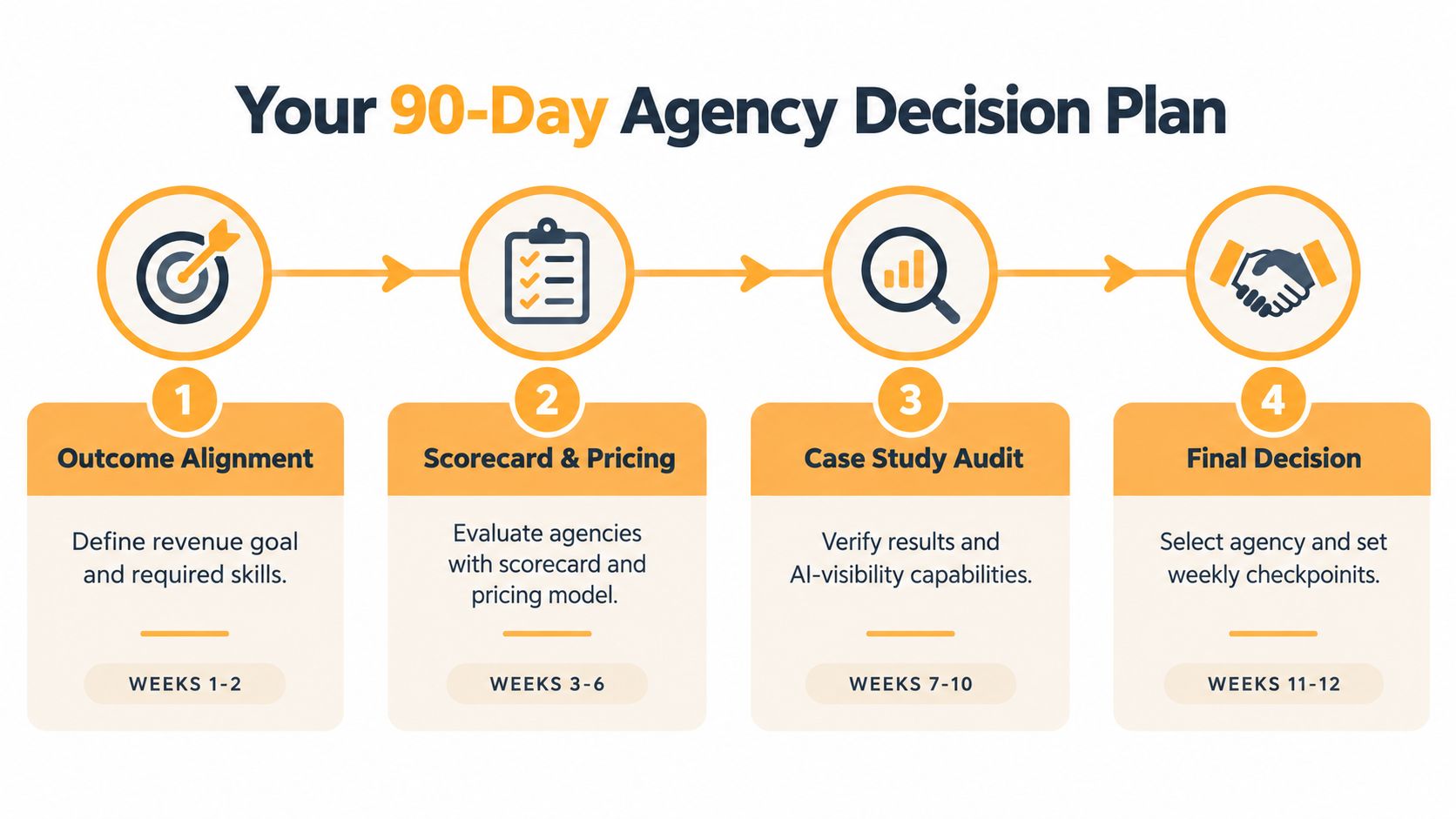
Weeks 1 to 2 define the outcome
Write a one-page outcome brief before inviting agencies into the process. Name the primary business result, the 90-day leading indicator, target audience, internal capabilities, and constraints. Your team must agree on this document first. It becomes the reference point for the scorecard, case-study review, pricing discussion, and AI-readiness questions.
Add the measurement questions now. Check whether your CRM, analytics, advertising accounts, and conversion events are reliable. If they are not, state that plainly. An agency may need to repair the measurement foundation before it can responsibly commit to channel performance.
Weeks 3 to 5 build and score the longlist
Create a longlist from relevant experience, not broad popularity. Prioritize agencies that can show work involving comparable business models, audiences, sales motions, or ecommerce mechanics.
Build a weighted scorecard with at least six criteria. Include outcome proof, measurement quality, team seniority, strategic fit, pricing clarity, and contract terms. Give each criterion a weight based on the outcome brief. Have decision-makers score candidates independently before discussing results. This exposes disagreements and shows whether a polished pitch is masking weak evidence.
Weeks 6 to 9 test the finalists
Send every finalist the same brief and questions. Require a working session instead of a generic presentation. Pay attention to how the agency challenges assumptions, prioritizes channels, explains trade-offs, and handles missing information. Strong candidates make their reasoning visible.
Negotiate a paid pilot with one or two deliverables and a clear success metric. Read the pilot statement of work for vague language, automatic expansion, uncapped revisions, unclear approval duties, and summary-only reporting. Confirm who owns the work and accounts if the relationship ends.
Weeks 10 to 13 sign with protection
Before signing, require a written RFP response, verified references, an agreed pilot scope, a complete fee schedule, and a master service agreement with clear termination terms. Set the reporting cadence in advance. Specify when your team receives raw data, strategic interpretation, and recommended next actions.
The decision continues after the contract. Establish weekly onboarding checkpoints, then review delivery against the scorecard. Continue the relationship only when the agency produces clear work, useful decisions, and accountable measurement.
The rule that protects the buyer: choose an agency as if the decision is revocable, because it is.
Complete these actions this week:
- Draft the one-page outcome brief.
- Request three references from every finalist.
- Review each pilot statement of work for scope-creep clauses.
- Confirm reporting cadence and data access before signing.
- Ask each agency what it will stop doing if the evidence shows a tactic is not working.
Digital marketing investment is rising, so agencies must connect spending to measurable business performance, not activity alone. The Market.us digital marketing outsourcing data provides additional context for that outsourcing trend. Reward the partner that connects strategy, execution, measurement, and learning to the outcome your company needs.
If you are evaluating agencies, Excellorix can help assess the full funnel, including landing pages, user flows, paid media, SEO, analytics, and conversion opportunities. Discuss a measurable growth plan, transparent reporting, and a scoped engagement built around the business result you need to move.


