

If you’ve ever looked at your business’s social media accounts and wondered, “We’re posting consistently, so why aren’t more customers reaching out?”, you’re asking a question that thousands of small business owners face every day. Social media takes time. Someone has to create graphics, write captions, respond to comments, record videos, and somehow keep up with every new trend that appears overnight. It’s easy to stay busy. What’s much harder is turning all that effort into phone calls, consultation requests, or online sales.
The truth is, posting regularly isn’t the problem. Posting without a clear direction usually is. Today’s social media marketing for small business is no longer about filling your content calendar or chasing viral moments. It’s about creating content that helps people trust your business and gives them a reason to take the next step. When every post has a purpose, social media stops feeling like another task on your to-do list and starts becoming a genuine growth channel. That shift has become even more important because social media itself has changed dramatically over the last few years.
Not long ago, businesses could grow simply by showing up consistently. Posting a few times each week was often enough to stay visible and keep your audience engaged. Today, that’s no longer the case. AI tools can generate captions, graphics, videos, and entire content calendars within minutes. While that’s made content creation easier, it has also filled every platform with more posts than people can realistically consume. Customers aren’t just scrolling through entertaining content anymore. They’re researching businesses before making decisions. They’ll visit your Instagram profile, read your LinkedIn posts, watch a few videos, check your reviews, and compare you with competitors before deciding whether you’re worth contacting.
Think about your own buying habits. Before hiring a service or purchasing something online, you’ve probably looked at the company’s social media pages to see if they seemed knowledgeable and trustworthy. Your customers do exactly the same thing. That’s why the question isn’t, “How often should we post?” The better question is, “Does our content help someone feel more confident about choosing our business?” Once you start looking at social media through that lens, another common problem becomes much easier to spot.
Many businesses confuse activity with progress. They post every day because they’ve heard consistency is important. They celebrate when a Reel reaches thousands of people or when follower numbers increase. Those moments feel like success, but after a few months, they notice something hasn’t changed. Sales. More likes don’t automatically mean more customers. More followers don’t guarantee more inquiries. A viral post doesn’t always attract people who are actually interested in buying. We’ve seen businesses invest months creating content without first deciding what they wanted that content to achieve. Every post existed on its own, disconnected from a larger business goal. As a result, they stayed active online without creating meaningful growth. Before creating your next piece of content, pause and ask yourself one simple question.
What do I want someone to do after seeing this post?
Maybe you want them to:
Once that destination is clear, every content decision becomes easier. Instead of posting because it’s Tuesday, you’re publishing content that supports a specific business objective. Now the challenge becomes building a strategy that consistently guides people toward those objectives.
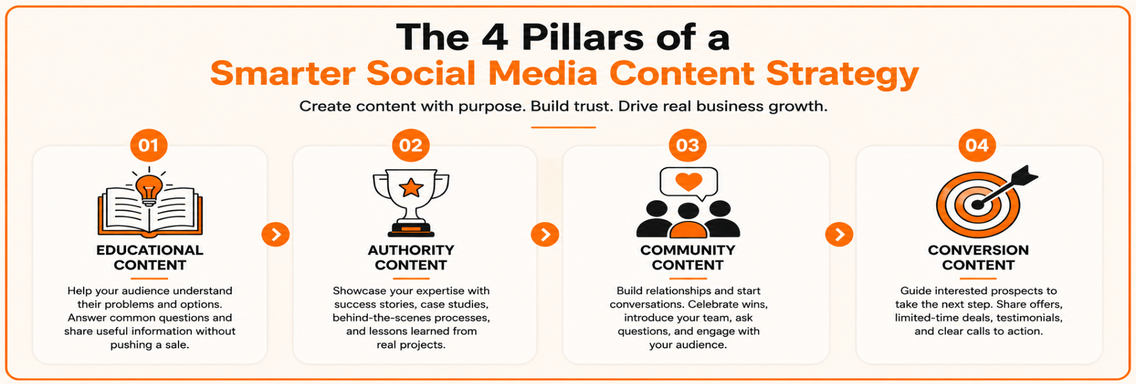
A strong social media content strategy doesn’t begin with choosing posting days or deciding how many Reels you’ll publish each week. It begins by understanding your customers. Think about the conversations you have before someone becomes a client. What questions do they ask? What concerns do they have? What information helps them feel confident enough to move forward? Those conversations should shape your content. When you answer real customer questions online, you’re helping future customers before they even contact you. That immediately makes your content more valuable than generic promotional posts. Most successful businesses create content around four simple categories.
Educational Content
Someone discovering your business for the first time usually isn’t ready to buy. They’re trying to understand their problem and learn what solutions exist. Educational content answers common questions, explains industry topics in simple language, and helps people make informed decisions. Instead of pushing a sale, you’re providing value first. That value creates trust. Once trust begins to grow, people naturally start looking for proof that your business can deliver on its promises.
Authority Content
This is where you demonstrate your expertise. Share client success stories, case studies, before-and-after results, behind-the-scenes processes, or lessons you’ve learned from real projects. People believe examples far more than marketing claims. Showing how you’ve solved problems for others helps potential customers picture similar results for themselves. Of course, credibility alone isn’t enough. People also want to feel connected to the businesses they choose.
Community Content
Social media was built for conversations, not constant advertising. That’s why community-focused content plays such an important role.
Celebrate customer milestones. Introduce your team. Ask questions. Share company updates. Respond to comments. Small interactions often create stronger relationships than perfectly designed promotional graphics. When people consistently engage with your business, trust grows naturally over time. And once that trust exists, inviting someone to take the next step becomes much easier.
Conversion Content
Eventually, every marketing strategy needs to encourage action. Conversion-focused content gives people a clear reason to move forward. This might include customer testimonials, service highlights, consultation invitations, downloadable resources, or limited-time offers. The goal isn’t to sell in every post. It’s to make taking the next step feel simple whenever someone is ready. When these four content types work together, your social media stops feeling random and starts supporting the entire customer journey. Naturally, the next question becomes:
How does that journey actually turn into new business?
One of the biggest misconceptions about social media lead generation is believing that one great post should instantly create a new customer. Every now and then, that happens. Most of the time, it doesn’t. People rarely make important buying decisions after a single interaction. They take their time, compare options, and look for signs that they’re making the right choice. Think about the last service you hired. Chances are you didn’t contact the first company you found. You probably looked at their website, checked reviews, visited their social media pages, and compared them with a few competitors before reaching out. Your customers follow a very similar path. A typical journey often looks like this:
Notice what happened. Social media started the conversation, but it wasn’t responsible for closing the sale on its own. That’s why successful businesses don’t treat social media as a standalone marketing channel. Instead, they connect it with their website, email marketing, search visibility, and customer follow-up process. When every marketing channel works together, customers experience a smoother journey from discovery to purchase. And once that system is in place, measuring your results becomes much more meaningful.
Many businesses judge social media success by looking at followers, likes, and views. While those numbers can indicate engagement, they don’t always tell you whether your marketing is helping your business grow. A post with 200 likes and no inquiries isn’t nearly as valuable as a post with 25 likes that generates three qualified leads. That’s why social media marketing strategy should always be measured against business outcomes instead of vanity metrics. Ask yourself questions like:
These are the numbers that help you make smarter marketing decisions. They also show you what your audience actually responds to. If educational posts consistently drive traffic, create more educational content. If customer success stories generate inquiries, make them a regular part of your strategy. If one platform performs better than another, invest more time where your audience is already engaging. Data removes guesswork and gives you confidence that your marketing efforts are moving in the right direction. Once you know what’s working, the next step isn’t creating more content. It’s improving the content you’re already producing.
One mistake businesses often make is thinking they need a completely new strategy whenever results slow down. In reality, small improvements usually create the biggest long-term gains. Start by simplifying your message. Every post should focus on one idea instead of trying to explain everything at once. Clear, focused content is easier to understand and much more likely to encourage action.Next, think about your writing style.
Many businesses unintentionally sound like marketing brochures on social media. Customers don’t connect with corporate language. They connect with conversations. Write the way you naturally speak during a consultation. Answer questions honestly. Share experiences. Offer practical advice. People appreciate content that feels genuine because it sounds like it’s coming from someone who understands their challenges rather than someone trying to make a sale. Finally, pay attention to the feedback your audience gives you.
Comments, messages, and frequently asked questions are valuable sources of content ideas. If several customers ask the same question, there’s a good chance many others are wondering the same thing. Instead of constantly searching for new topics, let your audience guide your content. These simple adjustments may not seem dramatic, but together they create a stronger marketing strategy over time. They also become much more effective when social media isn’t working alone.
Social media is an important marketing channel, but it shouldn’t carry the entire responsibility for generating leads. The strongest businesses connect social media with SEO, paid advertising, email marketing, and a website that’s built to convert visitors into customers. Imagine someone discovers your business through an Instagram post. A few hours later, they search for your company on Google. They find helpful blog articles that answer their questions. They read customer testimonials. They browse your services. Then they submit a contact form. That’s not luck. That’s a connected marketing strategy where every channel supports the next one.
Social media creates awareness. SEO helps customers find you when they’re actively searching. Your website builds credibility. Your follow-up process turns interest into conversations. When these pieces work together, attracting new customers becomes much more predictable. That’s ultimately what separates businesses that stay busy posting online from businesses that consistently grow because of their marketing.
Success on social media isn’t about posting every day or chasing every new trend. It’s about creating content that helps people solve problems, builds trust over time, and encourages meaningful action. Businesses that consistently generate results don’t necessarily publish the most content. They publish the most useful content. They understand their audience, measure meaningful outcomes, and continue improving based on real customer behavior instead of assumptions.
At Excellorix, we help businesses build marketing systems that produce measurable growth, not just more activity. Whether you need a results-driven social media marketing strategy for small business, ongoing social media management, or professional SEO services that improve your visibility across search engines, our team focuses on attracting qualified leads and turning them into long-term customers. Ready to move from posting for engagement to marketing for growth? Contact Excellorix today to discover how our social media marketing and SEO services can help your business generate more leads, improve conversions, and achieve measurable ROI.
The best strategy starts with understanding your customers and creating content that matches every stage of their buying journey. Educational content builds awareness, case studies establish credibility, community posts strengthen relationships, and conversion-focused content encourages people to take the next step.
Social media lead generation works by attracting potential customers with valuable content and guiding them toward actions such as visiting your website, requesting a quote, downloading a resource, or booking a consultation. Most people need multiple interactions before they become customers.
To measure social media marketing ROI, focus on metrics that connect directly to business growth. These include website traffic, qualified leads, consultation requests, customer acquisition cost, conversions, and revenue generated from social media campaigns.
Consistency is more important than posting every day. Publishing valuable, high-quality content on a schedule you can maintain is usually more effective than posting frequently without a clear purpose.
Yes. Organic social media continues to build trust, strengthen customer relationships, support SEO efforts, and improve brand visibility. When combined with a strong website and SEO strategy, it remains one of the most effective long-term marketing investments for small businesses.
Tell us about your goals—we’ll show you how Excellorix can help you get there.