

Launching an ecommerce store has never been easier. With Shopify, you can choose a theme, upload products, connect payment gateways, and start selling in a matter of days. For many businesses, that simplicity is exactly what makes Shopify so attractive. It removes technical barriers and allows entrepreneurs to focus on what matters most: getting products in front of customers. In the beginning, a standard Shopify theme feels like the perfect solution. The store looks professional. Customers can browse products. Orders start coming in. Everything works exactly as expected. Then growth happens. Sales increase. Product catalogs expand. Marketing campaigns become more sophisticated. Customer expectations rise. Suddenly, the same theme that once felt like an asset starts creating limitations. As a Shopify Development Agency Raleigh NC, we’ve seen this happen with growing ecommerce brands across multiple industries. What worked perfectly during the launch phase often struggles to support the next stage of growth. The challenge is that most business owners don’t recognize the problem right away. Instead, they assume they need more traffic, larger advertising budgets, or additional marketing channels. While those investments can certainly help, they often fail to address the real issue. The website itself has become the bottleneck.
There’s a reason Shopify themes are incredibly popular. They’re designed to help businesses launch quickly and affordably. Most themes already include the essential features needed to start selling online:
For a new ecommerce business, that’s more than enough. At this stage, the goal isn’t creating the perfect shopping experience. The goal is validation. You need to learn what products customers want, how they shop, and what influences their buying decisions. A standard Shopify theme allows businesses to gather those insights without investing heavily in development. And that’s exactly why themes are so valuable. The problem isn’t that Shopify themes stop working. The problem is that successful businesses eventually ask their websites to do more than those themes were originally designed to handle. That’s when the first warning signs begin appearing.
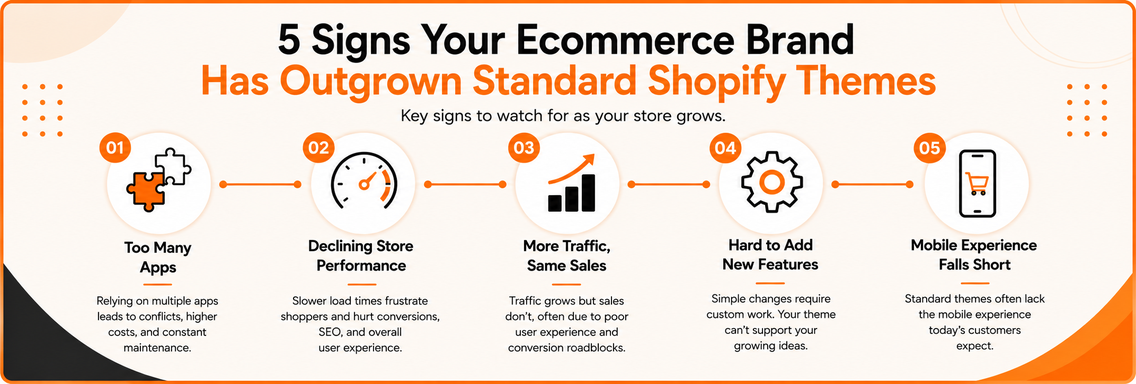
Shopify’s app marketplace is one of its biggest strengths. Need customer reviews? There’s an app for that. Need subscriptions? There’s an app for that too. Need upsells, loyalty programs, product bundles, quizzes, and personalized recommendations? You’ll find apps for all of those. At first, adding apps feels like a smart business decision. You identify a problem and solve it quickly. Then another challenge appears. Another app gets installed. A few months later, your store is running on a growing collection of third-party tools that all need to work together flawlessly. That’s where complications start appearing. Most store owners don’t notice the impact immediately. The first few apps feel harmless. Then a plugin update creates a conflict. A theme update breaks a feature. Pages become slower. Something stops working properly, and nobody is entirely sure which app is responsible. What started as a convenient solution slowly turns into a maintenance project. As complexity increases, performance is often the first thing affected.
Customers have very little patience online. If a website takes too long to load, most visitors won’t wait around. They’ll leave. That’s why Shopify website performance plays such a critical role in ecommerce success. Many businesses don’t realize they’re experiencing performance issues until they start seeing the effects. Pages load slower. Mobile experiences become frustrating. Bounce rates increase. Conversion rates begin declining. Nothing appears completely broken, but the store no longer feels as responsive as it once did. The impact goes beyond user experience. Strong Shopify website performance affects nearly every important business metric. Faster websites typically generate higher conversion rates. They improve advertising efficiency. They create better customer experiences. They support stronger search visibility. When performance suffers, revenue often follows. Unfortunately, performance issues usually create another challenge that growing brands know all too well.
This is one of the most frustrating situations ecommerce businesses face. Traffic increases. Marketing campaigns generate clicks. Social media engagement improves. Visitors are arriving at the store. Yet sales fail to grow at the same pace. The immediate assumption is usually that marketing needs improvement. More traffic seems like the logical solution. But more traffic doesn’t automatically create more sales. Visitors still need a positive experience after they arrive. They need to find products easily. They need confidence throughout the buying journey. They need a checkout process that feels effortless. When any of those elements create friction, conversion rates suffer. We’ve seen businesses spend thousands of dollars driving additional traffic to stores that weren’t fully optimized to convert visitors into customers. The result is often disappointing. More traffic enters the funnel, but the same conversion problems remain. And conversion challenges aren’t the only warning sign that a store has reached its limits. Many businesses discover the real issue when they try implementing new ideas.
Have you ever proposed a new feature and immediately heard: “The theme doesn’t support that.” Most growing ecommerce businesses eventually reach this stage. Maybe it’s a subscription program. Maybe it’s advanced product bundling. Maybe it’s personalized shopping experiences. Maybe it’s custom landing pages designed around specific campaigns. The ideas aren’t necessarily complicated. Implementing them becomes complicated because the existing theme wasn’t designed with that level of flexibility in mind. Simple updates start requiring workarounds. Development timelines get longer. Costs increase. Marketing opportunities get delayed. Over time, growth starts feeling slower than it should. Once businesses reach this point, they often begin exploring custom Shopify development as a way to remove limitations and create a stronger foundation for future growth.
Many people assume custom Shopify development is mainly about creating a unique design. While design is certainly part of the process, the biggest benefits happen behind the scenes. Custom development gives businesses greater control over how their store functions. Instead of forcing business goals to fit within theme limitations, the store can be designed around customer behavior and growth objectives. That flexibility creates opportunities to improve:
One of the biggest advantages of custom Shopify development is adaptability. As customer expectations change, businesses can evolve their stores without constantly running into technical limitations. That flexibility becomes increasingly valuable as brands grow.
Customers don’t compare your website to competitors. They compare it to every great online experience they’ve ever had. Amazon. Apple. Nike.Target. Every positive ecommerce experience raises customer expectations. People want websites that are easy to navigate. They want pages that load quickly. They want checkout processes that feel simple and intuitive. When a store creates friction, customers leave. When a store feels effortless, customers buy. That’s why successful ecommerce brands invest heavily in improving the customer experience. Small improvements often create surprisingly large business results. Of course, customer experience depends on more than design alone. Performance plays a major role as well.
This is where ecommerce SEO services become incredibly important. Many businesses focus on keywords and content while overlooking technical performance. Search engines increasingly reward websites that provide excellent user experiences. Site speed matters. Mobile usability matters. Website structure matters. Technical performance matters. Strong Shopify website performance doesn’t just improve customer experience. It also supports organic visibility. When paired with effective ecommerce SEO services, businesses create stronger opportunities for long-term growth. The challenge is that many stores eventually reach the limits of what their existing theme can support. That’s where Shopify theme customization often enters the conversation.
For many businesses, Shopify theme customization is the right next step. Small modifications can improve branding, functionality, and usability without requiring a complete rebuild. In many situations, Shopify theme customization provides excellent value. However, there comes a point where customization starts becoming a series of workarounds instead of long-term solutions. If developers are constantly modifying code, rebuilding sections, and creating temporary fixes just to support basic business requirements, the store may have reached its practical limit. At some point, continuing to patch an existing theme becomes less efficient than investing in custom Shopify development. The goal isn’t endless customization. The goal is building a store that can support growth without creating new obstacles every few months.
Ecommerce continues evolving rapidly. Customer expectations continue rising. Personalization is becoming standard. AI-powered shopping experiences are becoming more common. Consumers expect faster, smoother, and more intuitive buying experiences than ever before. Businesses that rely solely on template limitations may struggle to adapt. That doesn’t mean every ecommerce brand needs enterprise-level development. It simply means growing businesses should regularly evaluate whether their technology is helping growth or quietly limiting it. The most successful brands view their website as a growth asset rather than a simple online catalog. They invest in systems that support future growth instead of creating future limitations.
Most ecommerce brands don’t suddenly decide they need custom Shopify development. The realization usually happens gradually. A new feature takes longer to launch. Another app gets installed. Page speed starts slipping. Conversion rates stop improving. Marketing campaigns become harder to execute. Individually, these issues seem manageable. Together, they often signal that the business has outgrown the foundation it started with. Growth should feel exciting. It shouldn’t feel like you’re constantly fighting your website. If your store feels harder to manage, slower to improve, or less effective at converting visitors into customers, it may be time to look beyond a standard theme.
At Excellorix, we help ecommerce brands improve Shopify website performance, implement strategic Shopify theme customization, and build scalable solutions through custom Shopify development. Whether you’re struggling with slow page speeds, conversion challenges, or theme limitations, our team can help identify opportunities for growth and create a roadmap for long-term success. Schedule a free strategy call today and discover what’s helping your store grow and what’s quietly holding it back.
Most businesses start considering custom Shopify development when they experience performance issues, app overload, conversion plateaus, or limitations that prevent future growth.
In many cases, Shopify theme customization is an excellent first step. However, businesses with advanced requirements often need more flexibility than a standard theme can provide.
Strong Shopify website performance improves user experience, reduces bounce rates, and helps visitors move through the buying journey more smoothly, which often leads to higher conversion rates.
Yes. Custom Shopify development allows businesses to create tailored customer journeys, improve navigation, optimize checkout flows, and remove friction throughout the shopping experience.
Absolutely. Ecommerce SEO services help improve search visibility, attract qualified traffic, and support long-term growth when combined with strong website performance and user experience.
Shopify theme customization modifies an existing theme, while custom Shopify development creates tailored functionality, features, and experiences designed specifically around a business’s goals and customer needs.
Tell us about your goals—we’ll show you how Excellorix can help you get there.