

Your website is often the first impression people have of your business. Before a prospect calls, submits a form, or schedules a meeting, they have already started evaluating whether they trust your company. In many cases, that decision happens within seconds. Think about your own online behavior. When you visit a website that loads slowly, looks outdated, or makes information difficult to find, you probably leave and continue your search elsewhere. Your customers do the same thing. That is why a website redesign is no longer just about updating visuals. A strategic business website redesign can improve marketing performance, support sales growth, and create a better website user experience that helps turn visitors into customers. In 2026, businesses are competing on experience just as much as products and services. And for most companies, that experience starts with their website.
A few years ago, many business websites acted like digital brochures. A homepage, a services page, and a contact form were often enough. Today, customer expectations are much higher. Before visiting your website, people may have already read reviews, compared competitors, watched videos, and even asked AI tools for recommendations. By the time they land on your site, they are looking for proof that your business is credible and capable of helping them. If your website feels outdated or difficult to navigate, many visitors will leave without taking action. That is why modern website design is about much more than appearance. It is about helping visitors find answers quickly, build trust, and move confidently toward a decision.
Many business owners assume a website redesign is mainly a visual project. New colors. New images. A different layout. While those changes may be part of the process, a successful redesign goes much deeper. It evaluates:
The goal is not simply to make a website look better. The goal is to make it perform better. The most successful business website redesign projects focus on improving usability and business outcomes, not just aesthetics.
When growth slows, many businesses focus on generating more traffic. More ads. More content. More marketing. The problem is that traffic alone does not guarantee results. We have seen businesses spend thousands of dollars driving visitors to websites that create confusion and frustration. Traffic arrives, but conversions never follow. Often, the real issue is not marketing. It is the website user experience. Common warning signs include:
Imagine inviting customers into a store where nothing is clearly labeled and finding help is nearly impossible. Most people would leave. The same thing happens online every day.
Every marketing effort eventually leads visitors back to your website.
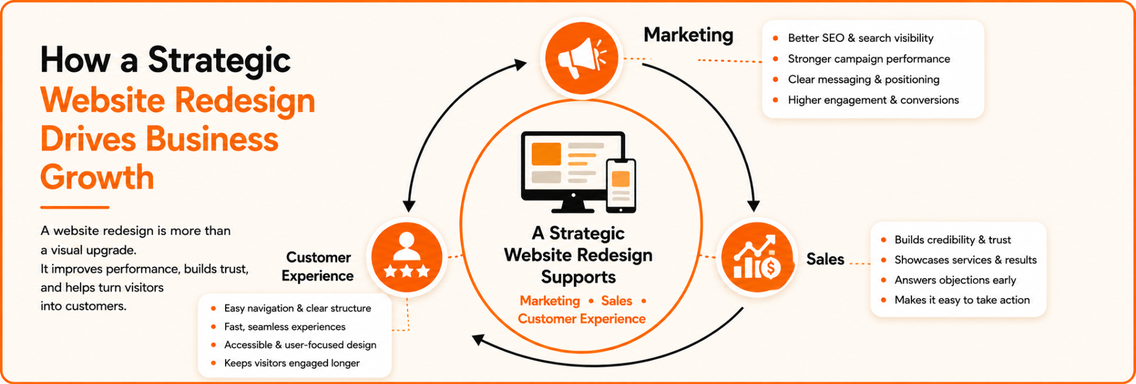
Whether traffic comes from SEO, Google Ads, email campaigns, or social media, your website becomes the place where visitors decide what happens next. A strategic business website redesign helps maximize the value of your marketing investment.
Better Search Visibility
Search engines prioritize websites that provide strong user experiences. A redesign often improves:
These improvements support both SEO performance and user engagement.
Stronger Campaign Results
Many businesses focus on generating clicks, but clicks alone do not generate revenue. Conversions do. When marketing messages align with landing page experiences, visitors are more likely to stay engaged and take action.
Better Insights
Modern websites provide stronger tracking and analytics. This helps businesses understand what is working, where visitors drop off, and which content influences conversions.
Sales conversations often begin before a prospect contacts your business.
People research online. They compare options, read reviews, and look for proof. Your website plays a major role in that process.
Building Trust
Modern websites build credibility through:
When visitors see proof that your business delivers results, they feel more comfortable moving forward.
Reducing Friction
Small frustrations can quickly drive visitors away. A redesign helps visitors understand:
The easier the journey, the higher the likelihood of conversion.
Many businesses assume they need more traffic when they actually need a better website. If your website struggles to convert visitors into leads, increasing traffic may simply magnify existing problems. That is why many companies benefit from a professional review before increasing marketing spend. Teams that provide SEO services and website performance analysis often uncover technical issues, content gaps, and conversion barriers that limit growth. Of course, lead generation is only part of the equation. Customer experience matters too.
Customer expectations continue to rise. People expect websites to be fast, simple, and easy to use. A poor website user experience can undermine even the strongest marketing efforts.
Better Navigation
Visitors should be able to find important information quickly without searching through multiple pages.
Stronger Mobile Experiences
Mobile traffic now accounts for a large percentage of website visits. Modern redesigns prioritize mobile usability from the beginning.
Improved Accessibility
Accessibility improvements help all users navigate your website more effectively while creating a smoother overall experience. When speed, usability, and accessibility work together, visitors are more likely to stay engaged and take action.
Today’s websites must support marketing, sales, and customer experience simultaneously. Some key elements include:
The most successful businesses view modern website design as an investment in growth rather than a one-time project.
A successful website redesign is not about following trends. It is about creating a better experience for visitors while supporting your business goals. A thoughtful business website redesign can improve marketing performance, support sales growth, strengthen the website user experience, and create a stronger foundation for long-term success. If your website is not generating the leads or inquiries you expected, it may be time to look beyond marketing tactics and evaluate the website itself. At Excellorix, we provide website redesign and SEO services that help businesses attract, engage, and convert the right customers. Schedule a call with our team today and discover how a strategic website redesign can help turn your website into a powerful growth asset.
Most businesses should evaluate their website every few years and consider a redesign every 3 to 5 years based on performance, technology updates, and customer expectations.
A refresh focuses mainly on visual updates, while a redesign improves structure, functionality, performance, and user experience.
Yes. Better site structure, faster page speeds, improved mobile usability, and stronger content organization can all support better SEO performance.
Absolutely. A positive website user experience helps visitors find information quickly, build trust, and take action more confidently.
Modern website design helps businesses improve credibility, increase engagement, generate leads, and create better customer experiences.
Tell us about your goals—we’ll show you how Excellorix can help you get there.