Skip to content


Have you ever had a month where your ads performed incredibly well, only to see results slow down a few weeks later? Most business owners have experienced that frustration. One month leads are coming in consistently. The next month, costs increase, conversions decline, and suddenly your marketing feels unpredictable.
When this happens, many businesses assume the problem is the advertising platform. In reality, the issue is often much bigger than Google Ads, Facebook Ads, or Instagram campaigns. The real problem is the absence of a clear paid media strategy for business growth. Many businesses launch campaigns without a full funnel paid media strategy, making it difficult to generate consistent results month after month. The companies achieving steady growth are not relying on luck. They are building systems that guide potential customers from discovery to purchase. That system is what creates predictable revenue. Let’s explore how smart businesses approach paid media differently and why their results tend to be more consistent over time.
Why Revenue Often Feels Unpredictable
Many companies launch advertising campaigns with good intentions. They create ads, choose audiences, set budgets, and expect results to follow. Sometimes they do. Sometimes they don’t. The challenge is that advertising does not operate in isolation. A campaign can drive traffic, but if the audience is not qualified, the messaging is unclear, or the customer journey has gaps, revenue becomes difficult to predict. Think of it like filling a bucket with a hole in the bottom. You can keep adding more water, but the bucket will never stay full until the leak is fixed. Many businesses respond to declining performance by increasing their advertising budget. Unfortunately, spending more money on a weak strategy rarely solves the problem. The businesses that generate predictable growth focus less on individual campaigns and more on building a complete customer acquisition system. That shift changes everything.
Why Understanding Customer Behavior Matters More Than Platform Selection
One of the biggest mistakes businesses make is becoming obsessed with platforms. Should we invest in Google Ads?Should we focus on Facebook? Should we try Instagram? These questions matter, but they should not be the starting point. Today’s buyers rarely make decisions after seeing a single advertisement. A prospect may discover your business through social media, visit your website later, search for your company on Google, read reviews, compare alternatives, and only then decide whether to contact you. The buying process is no longer a straight line. It is a collection of interactions that build trust over time. That is why predictable revenue starts with understanding customer behavior rather than choosing advertising channels. Businesses that understand how people move through the buying process are better equipped to create campaigns that support every stage of the customer journey. Once you understand how customers make decisions, choosing the right advertising platforms becomes much easier.
Stop Chasing Immediate Sales
Many advertising campaigns fail because they expect too much, too quickly. Every ad is expected to generate a lead. Every visitor is expected to convert. Every click is expected to create revenue. Real life rarely works that way. Think about the last major purchase you made. You probably did not buy from the first company you discovered. You likely researched options, compared providers, checked reviews, and returned multiple times before making a decision. Your customers behave the same way. Most people need multiple interactions before they feel comfortable making a purchase. They need exposure to your brand, confidence that you can solve their problem, and reminders that keep you top of mind while they make a decision. Businesses that understand this stop chasing immediate sales and start building momentum instead. This is where a full funnel paid media strategy becomes incredibly valuable. Instead of focusing only on conversions, it helps businesses build awareness, nurture prospects, and create a more predictable path to growth.
How a Full Funnel Paid Media Strategy Creates Consistent Growth
A successful advertising strategy supports customers throughout their entire buying journey. Rather than treating every prospect the same, it delivers the right message at the right time.
Building Initial Awareness
Before someone becomes a customer, they need to know your business exists. At this stage, the goal is not to generate an immediate sale. The goal is to introduce your business to the right audience. Educational content, video campaigns, social advertising, and helpful resources can all contribute to awareness. The objective is simple. Become familiar. People are far more likely to trust a brand they have seen multiple times than one they have never encountered before.
Strengthening Trust
Awareness alone does not create customers. People need confidence before they make a decision. After discovering your business, prospects often spend time researching, comparing options, and evaluating whether your solution is right for them. This is where trust-building campaigns become important. Customer success stories, testimonials, case studies, educational content, and retargeting campaigns help keep your business visible while prospects continue their research. The goal is not to pressure people into buying. The goal is to help them feel confident in their decision.
Converting High-Intent Prospects
Eventually, prospects reach a point where they are ready to take action. They understand the problem. They know their options. Now they are looking for the right provider. This is where conversion-focused advertising becomes most effective. Search advertising often performs exceptionally well because it allows businesses to appear when prospects are actively searching for solutions. When awareness, trust-building, and conversion campaigns work together, revenue becomes much easier to predict. The next question becomes how to deliver those campaigns effectively.
Why Google and Meta Ads Work Better Together
Business owners often ask whether Google Ads or Meta Ads is the better investment. The truth is that they serve different purposes. In reality, the strongest results often come from a Google and Meta ads full funnel approach. Rather than treating the platforms as competitors, successful businesses use them together to support different stages of the customer journey. Google Ads is often strongest when someone already knows they need a solution and is actively searching for it. A person searching for a service, product, or provider is usually much closer to making a decision. Meta works differently. People are not scrolling Facebook or Instagram looking for products. They are consuming content, watching videos, and interacting with brands. This makes Meta highly effective for introducing businesses to new audiences before they actively begin searching. Because these platforms support different stages of the customer journey, businesses that use both strategically often achieve stronger results. A well-planned Google and Meta ads full funnel strategy helps businesses stay visible from the first interaction all the way through the final purchase decision. Understanding how these platforms complement one another helps businesses create a stronger growth strategy.
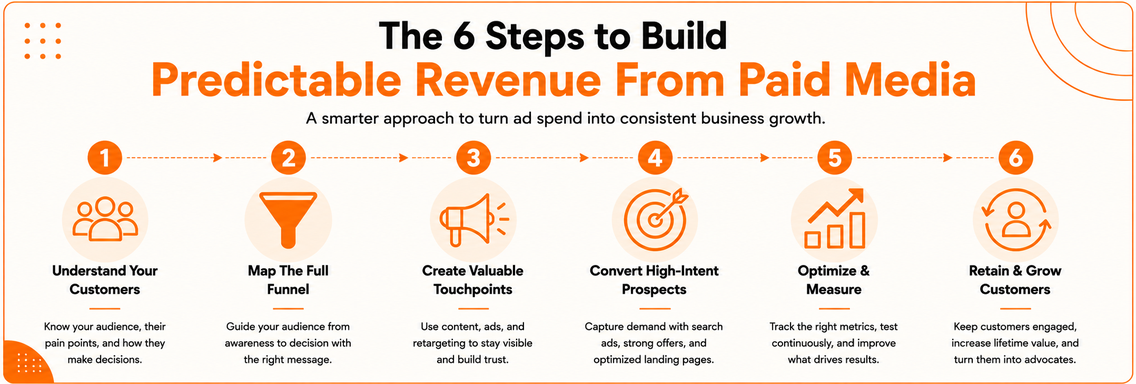
How to Create a Paid Media Strategy for Business Growth
Once you understand how customers buy and how platforms support that process, the next step is creating a structured plan. A strong paid media strategy for business growth starts with clarity.
Start With Business Goals
Advertising should support business objectives. Not the other way around. Before discussing platforms, audiences, or budgets, define what success looks like. Do you want more qualified leads? More consultations? More online sales? The clearer your goals, the easier it becomes to make smarter advertising decisions.
Align Your Messaging
One of the most overlooked aspects of paid media is consistency. A prospect who sees your social media ad should experience similar messaging when they visit your website or landing page. Consistent messaging builds trust.
Trust improves conversion rates.
Focus on Meaningful Metrics
Not every number deserves your attention.
Website traffic can be useful. Impressions can be useful. But neither guarantees business growth. Smart businesses focus on metrics that directly impact revenue, including:
- Cost per acquisition
- Lead quality
- Return on ad spend
- Revenue generated
- Customer lifetime value
These metrics provide a much clearer understanding of performance and help guide better decisions. Once businesses understand what success looks like, the next conversation almost always revolves around budget.
How Much Should You Spend on Google Ads?
One of the most common questions advertisers ask is about the right Google Ads budget for small business. Unfortunately, there is no universal answer. The right budget depends on factors such as:
- Industry competition
- Customer value
- Geographic targeting
- Revenue goals
- Sales cycle length
A local service company may achieve excellent results with a smaller budget, while a national ecommerce brand may require a larger investment to remain competitive. The goal is not to spend the most money. The goal is to invest enough to gather meaningful data. Advertising improves through learning. The more accurate the data, the easier it becomes to optimize campaigns and improve results over time. A properly planned Google Ads budget for small business should support both testing and optimization rather than simply generating clicks. And once businesses start collecting meaningful data, many discover that advertising becomes even more effective when supported by other marketing channels.