


A website is supposed to help your business grow. It should attract visitors, build trust, generate leads, and make it easier for potential customers to choose you over competitors. But as businesses evolve, their websites do not always keep pace. What once felt modern and effective can gradually become a limitation. The challenge is that most business owners do not notice it immediately. The website is still online. Forms still work. Pages still load. Everything appears fine on the surface. Meanwhile, your services have expanded, your goals have changed, and your marketing strategy has become more sophisticated. That is why understanding when to redesign your website is so important. A strategic website redesign is not simply about appearance. It is about making sure your website can continue supporting your business as it grows.
Most business owners are focused on serving customers, managing employees, and growing revenue. The website often becomes something that only gets attention when there is an obvious problem. The assumption is simple. If the website is still functioning, it must still be working. Unfortunately, growth can create challenges that are less obvious. Your business may have evolved significantly over the past few years, while your website continues presenting an outdated version of your company. The result is a growing gap between who you are today and what visitors see online. That gap can make it harder to attract the right customers, communicate your value, and support future growth.
An older website is not automatically a problem. Many websites continue performing well because they are regularly updated, optimized, and aligned with business goals. An outdated website is different. It no longer supports where the business is today or where it wants to go tomorrow. Some common outdated website signs include:
While some of these issues may seem minor individually, they often become much larger obstacles as a company grows.
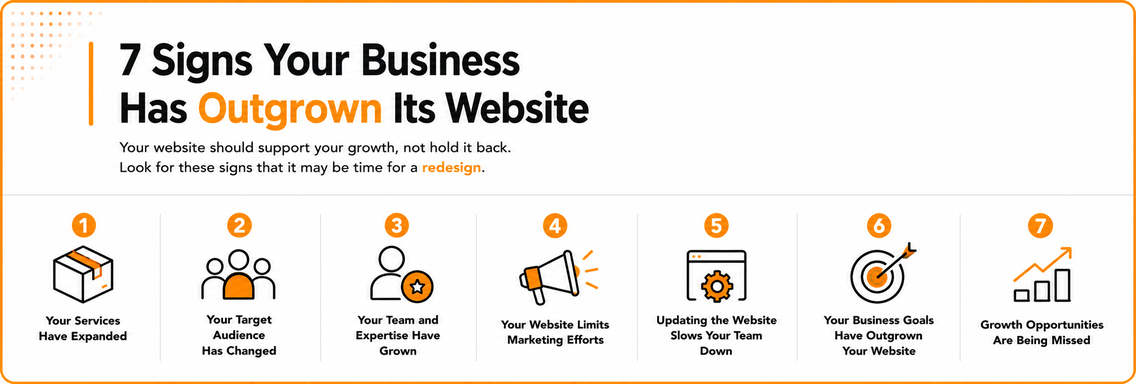
Your Service Offerings Have Expanded
Think about where your business was when the website was first built. You may have offered only a handful of services. Today, your company may provide a much broader range of solutions. The problem is that many websites never evolve alongside those changes. Important services become buried in navigation menus, hidden within generic pages, or missing entirely. Visitors should not have to work hard to understand what you offer. If your website no longer showcases your full capabilities, it may be time to consider a business website redesign that better reflects the scope of your services.
Your Target Audience Has Changed
Business growth often changes the type of customers you want to attract. Maybe you originally served small local clients and now target larger organizations. Perhaps you expanded into new industries or geographic markets. However, if your website messaging still speaks to your old audience, it can create confusion. The language, examples, and positioning that worked years ago may no longer resonate with the customers you want today. A strategic website redesign allows you to realign your messaging with your current business goals and ideal audience.
Your Team and Expertise Have Grown
As companies grow, they develop stronger expertise. New team members join. Certifications are earned. Processes improve. Case studies accumulate. Results become more impressive. Yet many websites continue presenting a company that looks much smaller than it actually is. Potential customers want to know who they are working with. They want to see experience, credibility, and proof that your team can solve their problems.
If your website no longer reflects the depth of expertise your company has developed, it may be underselling your business.
Your Website Cannot Support New Marketing Initiatives
Marketing has changed dramatically over the past few years. Businesses are investing in SEO, content marketing, email automation, lead magnets, webinars, CRM integrations, and customer nurturing systems. Older websites often struggle to support these initiatives. You may find yourself constantly working around platform limitations or delaying marketing opportunities because your website lacks the necessary functionality. At that point, the website is no longer supporting growth. It is restricting it.
One of the clearest signs of when to redesign your website is when your marketing strategy becomes more advanced than your website can handle.
Updating the Website Slows Your Team Down
A website should make it easier to keep information accurate and current. Unfortunately, many older websites become difficult to manage. Simple updates require technical assistance. Publishing content takes longer than it should. Team members avoid making changes because the process feels complicated. Over time, this creates a cycle where content becomes outdated and important information gets neglected. Modern websites are designed to be flexible and easy to manage. If updating your website feels like a project every time, it may be time for a more scalable solution.
Your Business Goals Have Outgrown Your Website
Perhaps the biggest indicator is that your business goals have changed. The website that helped you reach your first milestone may not be capable of helping you reach the next one. A company focused on steady local growth has different needs than a company expanding regionally or nationally.
Larger goals often require:
If your website was built for a different stage of business growth, it may no longer support where you are headed.
The consequences rarely appear overnight. Instead, growth opportunities become harder to capture. Launching new services becomes more difficult. Marketing campaigns generate lower returns. Visitors fail to understand the full value of your business. Over time, your website gradually shifts from being a growth tool to becoming a growth limitation. Many companies respond by increasing marketing budgets when the real issue is that the website itself is no longer aligned with the business. That is why recognizing outdated website signs early can save both time and money.
Not every website requires a complete rebuild.
Sometimes a refresh is enough. A refresh focuses on updating visuals, improving content, and making small usability improvements. A redesign goes much deeper. It rethinks site structure, user experience, conversion paths, and overall business goals. One of the biggest questions business owners ask is when to redesign your website rather than simply refresh it. If your challenges are primarily cosmetic, a refresh may solve the problem. If your website struggles with conversions, performance, mobile usability, or growth limitations, a full website redesign is often the better investment.
Sometimes the signs are obvious. Other times they develop so gradually that they are easy to miss. If several of these outdated website signs sound familiar, it may be time to evaluate how your website is supporting your business goals. A professional website review can uncover usability issues, conversion barriers, and growth opportunities that often go unnoticed. In many cases, improving the website delivers better results than simply increasing marketing spend.
A lot of businesses assume they need more traffic when growth slows down. Sometimes that is true. But often the bigger issue is what happens after visitors arrive. If you have noticed multiple outdated website signs, declining conversions, or a growing gap between your business and your online presence, it may be time to consider a business website redesign. A modern website should do more than simply exist online. It should support your marketing efforts, build trust, answer questions, and help convert visitors into customers. If you have been wondering when to redesign your website, schedule a call with Excellorix. We can review your current website, identify opportunities for improvement, and help you determine whether a refresh or a complete website redesign is the right next step. The sooner you address the warning signs, the sooner your website can become a growth tool instead of a growth barrier.
Most businesses should review website performance every two to three years and consider a redesign every three to five years depending on growth, technology changes, and customer expectations.
Common outdated website signs include slow loading speeds, poor mobile usability, declining conversions, outdated design, difficult navigation, and messaging that no longer reflects your business.
If your website is no longer generating leads, supporting marketing efforts, or meeting customer expectations, it may be time to evaluate when to redesign your website and whether a refresh or redesign is needed.
Yes. A strategic website redesign can improve page speed, user experience, site structure, and content organization, all of which can positively impact SEO performance.
SEO services can drive more visitors to your website. However, if visitors arrive on an outdated website, conversions may still suffer. Combining SEO services with a modern website often delivers stronger long-term results.
For many businesses, yes. A business website redesign can improve lead generation, customer experience, conversion rates, and overall marketing effectiveness, making it a valuable long-term investment.
Tell us about your goals—we’ll show you how Excellorix can help you get there.