


If you are trying to understand how long SEO takes to show results, the honest answer is usually slower than most marketing promises suggest. And that is not a bad thing. SEO is not something that delivers overnight results. It grows step by step through consistency, structure, trust, and content that actually helps users. Google does not reward websites just because they publish content or add keywords everywhere. It rewards websites that prove they deserve visibility. That is exactly why SEO timeline expectations matter so much in 2026.
Most businesses start SEO expecting quick leads within weeks. When that does not happen, they assume something is wrong. In reality, the website is still building its foundation, fixing technical gaps, and earning trust in a competitive search environment. This is also where most businesses start asking the same question.
When does SEO start working?
There is no fixed date. SEO starts working in stages, not all at once. The good part is this. Once SEO starts working, it compounds over time instead of resetting every month. Unlike paid ads that stop when spending stops, SEO continues to bring traffic and leads long after the work is done.
There is no single timeline that applies to every business. A local service business may grow faster than a national brand competing in a crowded industry. A website with existing authority will also usually perform better than a brand new domain. Still, most SEO campaigns follow a predictable growth pattern.
In the early phase, work focuses on technical fixes, keyword research, and building a strong foundation. This is the stage where structure is corrected and search engines begin understanding the website properly. After that, early signals start appearing. These are usually small improvements like better impressions, indexing, and keyword movement. As optimization continues, traffic begins to grow more consistently. Pages start ranking for more search terms and visibility becomes more stable.
Over time, SEO becomes more predictable. Leads become more consistent and rankings stop fluctuating as much. Eventually, SEO turns into a long term growth system where results compound instead of restarting. This is what realistic SEO timeline expectations look like in most industries today. It also helps explain the real SEO results timeframe businesses experience in practice.
Google’s entire system is designed to show users the most reliable answers. If rankings were instant, search results would quickly be filled with spam, thin content, and pages created only to manipulate algorithms. In 2026, search engines evaluate far more than keywords. They look at content quality, user experience, website trust, topical authority, engagement signals, internal linking, and whether the page actually satisfies search intent.
SEO today is not about keyword placement. It is about proving value over time. Helpful content performs better because users engage with it. Weak content usually drops because it does not create real value. And trust cannot be rushed. That is why SEO always starts with building a strong foundation.
The first month focuses on fixing the foundation of the website. This stage is not very visible, but it is critical for long term growth. Many websites struggle because of hidden technical issues like slow speed, weak structure, broken pages, duplicate content, missing metadata, and poor mobile performance. Before scaling content, these issues need to be resolved.
This stage usually includes keyword research, competitor analysis, technical SEO improvements, analytics setup, search console configuration, schema implementation, and internal linking improvements. At this stage, the goal is not rankings. The goal is stability. Many businesses think they have a content problem when the real issue is structural.
Once the foundation is fixed, SEO starts becoming more visible. Pages are optimized based on search intent, service pages are improved, and internal linking becomes more structured. This is also where content strategy becomes important. Many businesses make a mistake here by focusing on quantity instead of quality. Publishing large amounts of weak AI generated content rarely works because search engines can detect content that lacks depth or originality.
Today, content must clearly answer questions, show real understanding, and match what users are searching for. Helpful content builds trust faster while generic content struggles to rank. This is usually the stage where businesses begin to notice early SEO signals and start understanding their real SEO results timeframe instead of expecting instant growth. Once Google processes these improvements, small changes start appearing in search visibility.
This is the stage where many business owners ask: when does SEO start working At this point, SEO is already working, just in small ways. You may notice increased impressions, more indexed pages, keyword movement, and small traffic growth from long tail searches. This phase often feels unstable. Some keywords rise. Some drop. Some stay unchanged. That is completely normal.
Search engines test performance before deciding stable rankings. One mistake businesses make here is changing strategy too early. SEO requires consistency. Constant changes slow progress instead of improving it. Think of it like fitness. You do not see major change in a few weeks, but progress is still happening in the background.
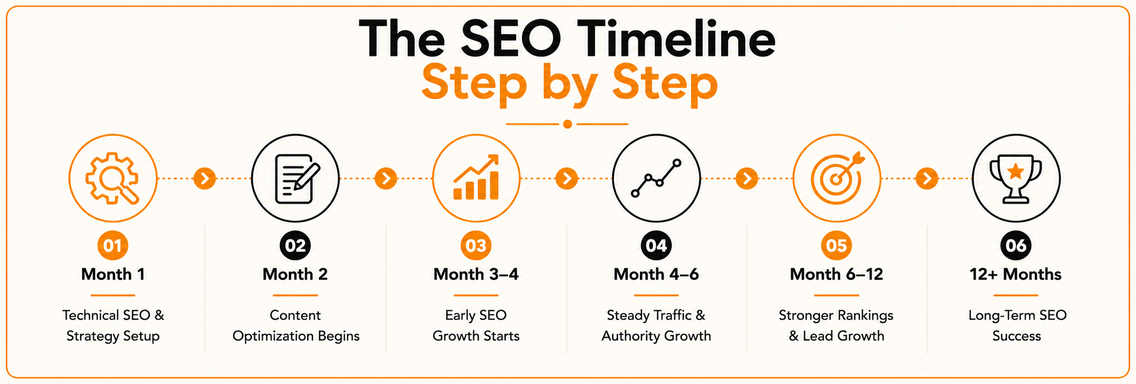
By this stage, SEO becomes more noticeable in real business results. More pages are indexed. Keyword visibility improves. Authority builds across the website. Traffic becomes more stable and predictable. Businesses may start seeing more leads, better local rankings, improved click through rates, and stronger organic conversions. This is also where AI search becomes more important.
In 2026, SEO is no longer limited to traditional search results. Visibility now includes AI Overviews, voice search, conversational answers, and featured snippets. Websites with strong structure and useful content perform better across all formats.
This is where SEO starts compounding. Growth becomes steady instead of unpredictable. Rankings stabilize. Traffic increases consistently. Leads become more reliable. At this stage, SEO becomes one of the most cost effective marketing channels because it continues working without ongoing ad spend. A single strong page can bring leads for years. A well written blog can generate traffic every month without extra effort. This is where businesses truly understand long term SEO growth.
Not every website grows at the same speed. Several factors affect SEO results timeframe including competition, website age, content quality, backlink strength, technical health, and industry difficulty. A local business usually grows faster than a national brand in a competitive market. An older website with authority also has a natural advantage over a new domain. That is why SEO timelines should always be based on real conditions instead of generic promises.
SEO has changed significantly in recent years. Search engines now focus on topical depth, clarity, user satisfaction, and entity understanding instead of simple keyword matching. AI generated content has increased competition, but it has also made high quality human content more valuable. Websites that provide real experience, clarity, and structure are now performing better than mass produced content.
Modern SEO now overlaps with AI search optimization and answer engine optimization. The goal is no longer just ranking. It is becoming the most trusted answer across platforms.
Many businesses unintentionally slow their SEO progress. Common mistakes include low quality content, weak technical SEO, inconsistent publishing, poor internal linking, and targeting overly competitive keywords too early. Another major issue is focusing only on traffic instead of conversions.
Traffic alone does not grow a business. Relevant traffic does.
So how long does SEO take to show results. Most businesses see early improvements within 3 to 6 months. Stronger and more meaningful growth usually takes 6 to 12 months depending on competition and strategy. But the real question is not just timing. It is about long term value. Would you rather have temporary traffic or a system that keeps building visibility over time. SEO takes patience because it is building something stable and long lasting.
In 2026, businesses that invest in strong content, technical SEO, and AI ready optimization are the ones building real digital assets. And those who stay consistent usually win. If you are serious about growing your visibility through SEO, you can schedule a quick call with Excellorix to understand where your website currently stands and what kind of SEO strategy will actually work for your business.
Most businesses start seeing early SEO improvements within 3 to 6 months. Stronger growth and consistent lead generation usually take 6 to 12 months depending on competition, website quality, and strategy consistency. This is the most realistic SEO timeline expectations model for most industries.
SEO starts working gradually rather than all at once. Early signs include indexing, impression growth, and keyword movement. Real results become more visible over time as authority builds. So when does SEO start working depends on your website strength and competition level.
SEO takes time because Google evaluates trust, authority, content quality, and user experience before ranking websites. This directly affects SEO results timeframe, especially in competitive industries where multiple websites are competing for the same keywords.
Several factors influence SEO speed including competition level, website age, content quality, backlink strength, technical SEO health, and search intent alignment. These factors directly impact SEO timeline expectations for any business.
Yes, local SEO often shows faster results because competition is smaller and more location focused. A strong Google Business Profile, local content, and proper technical SEO can significantly improve speed.
Yes, SEO is still one of the highest ROI marketing channels. It builds long term visibility, sustainable traffic, and strong brand authority across Google and AI driven search systems.
Tell us about your goals—we’ll show you how Excellorix can help you get there.