Choosing between Google Ads and Meta Ads is not really about picking a winner anymore. In 2026, the smarter question is which platform actually matches the way your customers buy. A lot of businesses still approach paid advertising like it is a gamble. They launch campaigns, spend money for a few weeks, and expect instant results. When leads slow down or costs increase, they assume the platform stopped working. Most of the time, that is not the real problem. The reality is that both Google Ads and Meta Ads have become far more advanced. Automation is smarter, competition is tougher, and customer attention spans are shorter than ever. Businesses that still rely on weak creatives, poor landing pages, or random targeting usually struggle no matter how much budget they spend.
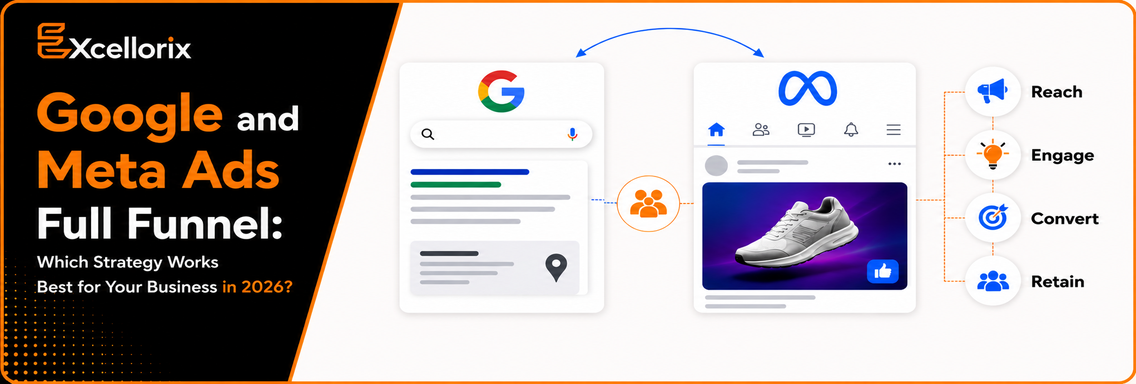
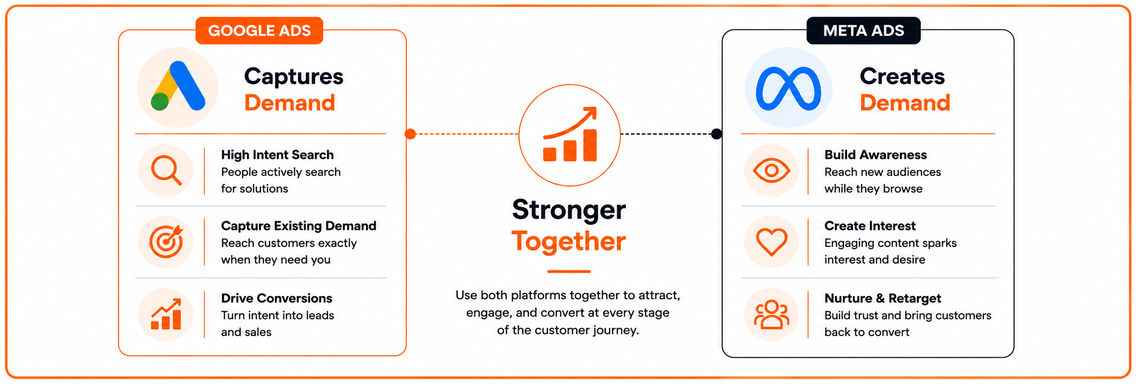
The companies seeing consistent growth today are usually the ones that understand customer intent, creative quality, tracking, and overall funnel strategy. For most brands, the conversation is no longer simply about Google Ads vs Facebook Ads. The real focus in 2026 is building a Google and Meta ads full funnel strategy that supports the entire customer journey from awareness to conversion. Google usually captures demand. Meta usually creates it. That difference sounds simple, but it changes everything from campaign strategy to customer behavior.
Google and Meta Ads Full Funnel Strategy in 2026
The easiest way to understand the difference between both platforms is this. Google Ads reaches people who are already searching for something. Meta Ads reaches people who may become interested after seeing the right message or offer. If someone searches for “best dentist near me,” the intent already exists. They actively need a service and are looking for options. Google Ads works well because it places businesses directly in front of customers during that decision-making moment.
Meta Ads works differently. Someone scrolling Instagram may not be searching for your business at all, but a strong creative, relatable video, or useful offer can still grab attention and create interest naturally.
That is why more businesses are investing in a Google and Meta ads full funnel approach instead of treating both platforms like direct competitors. Understanding this difference helps businesses avoid one of the biggest advertising mistakes in 2026, expecting one platform to do everything perfectly on its own.
How Google Ads Works for High Intent Customers
Google Ads performs best when customer intent already exists. Most people using Google are actively searching for a solution. They may be comparing providers, checking reviews, researching prices, or trying to solve a problem quickly. That is why Google Ads often feels more direct than social media advertising. You are not interrupting someone’s day. You are responding to a need they already expressed themselves.
Google Ads is especially effective for:
- local services
- lead generation
- B2B companies
- healthcare
- businesses
- legal services
- industries where timing matters
For example, if someone suddenly needs an emergency plumber or a personal injury lawyer, they are unlikely to browse Instagram for answers. They usually go straight to search. That is where Google becomes extremely valuable. But not every customer journey starts with a search. In many industries, customers discover brands long before they actively search for them, which is where Meta Ads becomes powerful.
How Meta Ads Create Awareness and Demand
Meta Ads focuses more on awareness, discovery, and audience building. People on Facebook and Instagram are usually browsing casually. They are watching videos, checking updates, or scrolling through content without actively searching for a service. That behavior creates opportunity.
A strong Meta campaign can introduce your brand naturally before someone even realizes they may eventually need your product or service. This is why Meta Ads often perform well for:
- ecommerce brands
- lifestyle products
- fitness companies
- beauty brands
- visually engaging businesses
In 2026, creative quality matters more than ever on Meta. Generic graphics and overly polished corporate ads tend to get ignored quickly. Audiences respond far better to content that feels relatable, authentic, and natural.
Sometimes a simple customer video performs better than an expensive ad campaign because it feels more real. Of course, engagement alone does not matter if campaigns are not profitable. That is where the Meta ads vs Google Ads ROI conversation becomes important for businesses trying to scale efficiently.
Meta Ads vs Google Ads ROI: What Actually Matters?
A lot of businesses still compare advertising platforms based only on CPC or traffic costs. That approach usually creates the wrong conclusions. A cheaper click does not automatically mean better results. A higher CPC is not necessarily bad if the lead quality is stronger.
The real ROI conversation should focus on:
- qualified leads
- conversion rates
- customer value
- long term profitability
- conversion optimization
- customer lifetime value
Google Ads often performs well when intent is already high because customers are actively searching for solutions. Meta Ads often performs strongly when the offer is compelling and customers need time before making a purchase decision.
For example, a local home service business may generate faster leads from Google. A fashion or skincare brand may see better long term returns from Meta because storytelling and retargeting play a bigger role in the buying journey.
The businesses getting the best results are usually the ones focusing less on vanity metrics and more on actual business growth.
Because traffic means very little if it never converts into revenue. Once businesses understand how Meta ads vs Google Ads ROI actually works, the next question usually becomes which platform makes more sense for smaller budgets.
Best Paid Ads Platform for Small Business in 2026
The best paid ads platform for small business depends mostly on customer behavior. If people already search for your service directly, Google Ads is often the stronger starting point. If customers need education, visual persuasion, or repeated exposure before buying, Meta Ads may work better initially.
In many cases, businesses eventually benefit from using both together instead of depending completely on one traffic source. A plumbing company may perform better with Google Ads because customers search during urgent situations. A skincare brand may perform better with Meta Ads because visual storytelling creates demand more naturally. That is why there is no universal answer to the best paid ads platform for small business question. The better platform usually depends on how customers move through the buying journey in your industry.
The strongest long term growth usually happens when businesses combine advertising with proper SEO services, conversion optimization, and better website strategy instead of treating ads like a shortcut.
Why a Google and Meta Ads Full Funnel Strategy Works Better in 2026
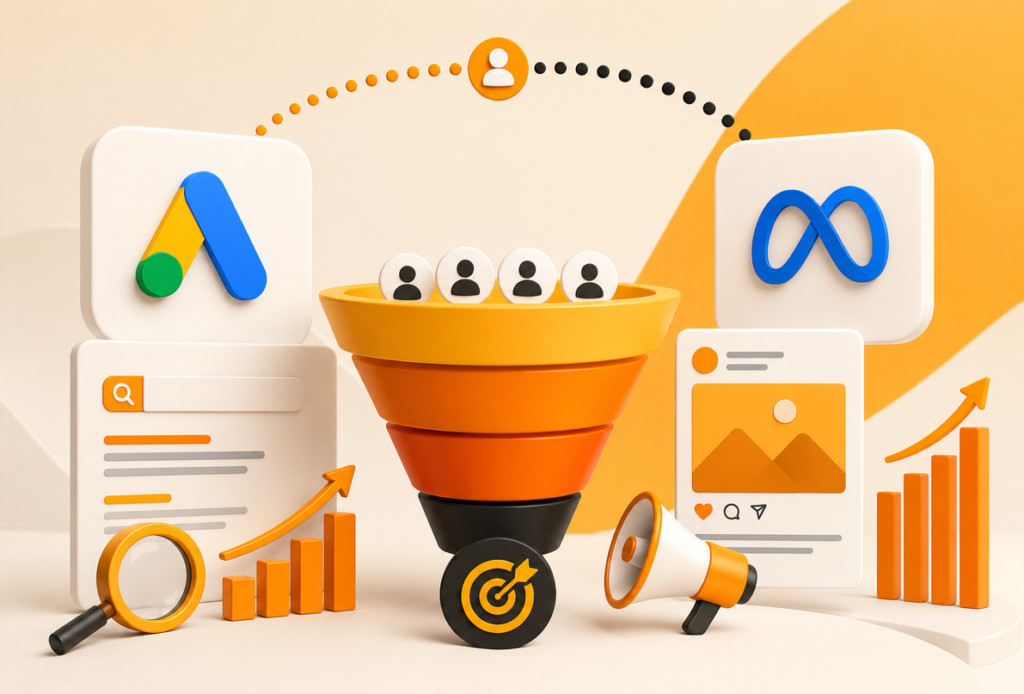
One of the biggest mistakes businesses still make is expecting a single platform to manage the entire customer journey. That is rarely how people buy anymore. Someone may discover your brand on Instagram, search for reviews later on Google, visit your website multiple times, leave without converting, and then finally return after seeing a retargeting ad. That is why a Google and Meta ads full funnel strategy works so well in 2026.
Meta often starts the conversation. Google often finishes it. Retargeting helps keep your business visible during the middle of the decision-making process. When all of those pieces work together properly, campaigns usually become far more efficient. And this approach has become even more important because of how quickly both platforms evolved over the last few years.
What Changed in Google Ads and Meta Ads in 2026?
Both Google Ads and Meta Ads now rely heavily on automation and machine learning.
The platforms have become smarter at:
- audience targeting
- bid optimization
- ad delivery
- conversion prediction
- creative testing
But automation only works well when businesses provide strong inputs.
That means success now depends more heavily on:
- good creatives
- accurate tracking
- strong landing pages
- clear messaging
- proper funnel
- structure
- stronger SEO services
This is also why many businesses still struggle with paid advertising even while using advanced campaign settings. The issue is often not the advertising platform itself. The real problem usually sits inside the customer journey. If the website experience is confusing, conversions drop. If messaging feels weak, ad performance suffers. If landing pages load slowly, campaigns become more expensive.
Businesses that usually see the strongest long term results are not relying only on paid ads. They are improving the entire customer journey around those campaigns. That includes stronger SEO services, faster landing pages, better conversion tracking, clearer messaging, and a strategy that connects every stage of the funnel properly. This is where Excellorix supports businesses more effectively, because successful growth in 2026 is rarely about running ads alone. It is about building a marketing system where Google Ads, Meta Ads, SEO services, and conversion optimization all work together to generate better quality leads and more sustainable growth over time.
How Excellorix Builds a Stronger Paid Marketing Funnel
Many businesses struggle with paid advertising because they focus only on ad spend while ignoring the rest of the customer journey. A campaign can generate clicks and still fail if the landing page experience is weak, the messaging feels unclear, or the funnel is not properly optimized for conversions. That is why businesses looking for stable long term growth usually need more than isolated ad campaigns. They need a connected strategy that combines paid ads, SEO services, conversion optimization, audience targeting, and funnel improvements together.
Excellorix focuses on building that complete growth system instead of treating Google Ads and Meta Ads like standalone channels. The goal is not just generating traffic. The goal is generating qualified leads, improving conversion quality, and helping businesses build a marketing structure that performs consistently over time.
Final Thoughts
If you want the short answer, here it is. Google Ads is usually better at capturing existing demand, while Meta Ads is usually better at creating demand. The businesses growing consistently in 2026 are not relying entirely on one platform anymore. They are building a connected marketing system where every channel supports the customer journey from awareness to conversion. That approach may not sound flashy, but it is usually the strategy that creates stronger lead generation, better conversion rates, and more stable long term growth. And if your paid campaigns are underperforming, the issue is not always the ad platform itself. Sometimes the real problem sits inside the landing page experience, messaging, website structure, or overall SEO services strategy supporting the campaigns.
Whether you are trying to generate more leads, improve ecommerce sales, or build a stronger Google and Meta ads full funnel strategy, the right mix of Google Ads, Meta Ads, SEO services, and conversion optimization can make a significant difference over time. If you are unsure which platform fits your business goals best, scheduling a strategy call with Excellorix can help you understand where your funnel, targeting, or overall digital strategy may be underperforming before more budget gets wasted.
FAQ
Which is better in 2026, Google Ads or Meta Ads?
Both platforms are effective, but they solve different problems. Google Ads works better when customers are already searching for a service or product, while Meta Ads performs better for awareness, discovery, and audience building. Many businesses see the strongest results when both platforms are used together inside a Google and Meta ads full funnel strategy.
Is Google Ads better than Facebook Ads for small businesses?
It depends on how customers buy in your industry. If people already search directly for your service, Google Ads often performs better. If your business depends more on visual marketing, storytelling, or brand discovery, Meta Ads may deliver stronger results initially.
Which gives better ROI, Meta Ads or Google Ads?
ROI depends on customer intent, creative quality, landing pages, and overall strategy. Google Ads often performs strongly for high intent searches, while Meta Ads can produce excellent returns through awareness campaigns, retargeting, and audience nurturing.
Can Google Ads and Meta Ads work together?
Yes. In many cases, they work best together. Meta Ads can introduce your brand to new audiences, while Google Ads captures people who later search for your business with stronger buying intent.