


Most ad accounts don’t fail because they don’t get traffic. They fail because the system behind that traffic doesn’t actually work together. You see clicks coming in. Reports look active. Platforms show everything is in a learning phase. On paper, things look fine. But when you look at revenue, nothing really moves. That’s usually the moment when the real issue becomes clear. It’s not the ads themselves. It’s the structure underneath them.
At Excellorix, this is often the first thing we fix when working as a Full Funnel Paid Media Agency for brands that are stuck in “steady spend, no growth” situations.
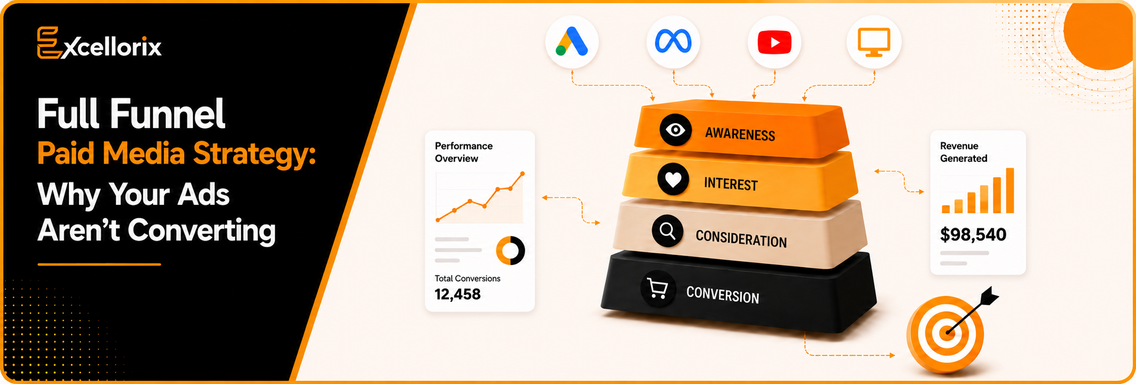
A Full Funnel Paid Media Strategy is no longer just about running ads across platforms. It is about guiding users through a decision process that actually reflects how people buy. Someone becomes aware of your brand, then they get interested, then they evaluate you, and finally they convert. That sounds simple, but most ad accounts fail because they don’t actually connect these stages properly. They either focus too much on attention at the top or try to force conversions too early without building trust in the middle.
So even though the funnel exists in theory, in practice it behaves more like disconnected campaigns than a real system. That’s exactly why a strong Paid Media Strategy for Business Growth is not about isolated ads anymore. It’s about how each stage supports the next one so the system can actually compound results over time.
Even with automation and AI improvements, most ad accounts still don’t perform the way they should. And the reason is rarely the platform. It’s almost always the input going into it. When you look at underperforming accounts, the same issues show up repeatedly.
Tracking does not reflect real user behavior, which means optimization is based on incomplete data
When this happens, platforms like Google and Meta don’t really optimize in a meaningful way. They guess based on limited signals. And that guesswork becomes even more obvious in Google and Meta Ads Full Funnel setups, where every stage depends on clean signal flow between awareness, consideration, and conversion.
When that connection breaks, performance becomes unpredictable no matter how much you spend.
The biggest shift in paid media didn’t come from new strategies. It came from AI taking over optimization decisions. Today, platforms don’t rely heavily on manual targeting anymore. Instead, they analyze behavioral signals like scroll depth, watch time, engagement speed, and repeat interactions. This is why two campaigns targeting the same audience can perform completely differently.
Targeting is no longer the strongest lever. Creative quality and behavioral response now matter more. A weak creative can reduce performance across the entire funnel, even if everything else is set up correctly. Because the system is no longer just asking who you are targeting. It is asking how people respond when they see your message. And once attention is captured, the real challenge becomes whether that attention can be turned into consistent revenue.
When a Google and Meta Ads Full Funnel system is properly structured, the difference becomes very noticeable.
This is what a properly built full funnel actually delivers. Not sudden spikes, but stable and predictable scaling.
However, this only happens when the system is built in the correct order. And most accounts don’t follow that order at all.
Most performance issues don’t come from strategy. They come from sequencing. Brands try to scale too early or build everything at once, and the system never stabilizes.
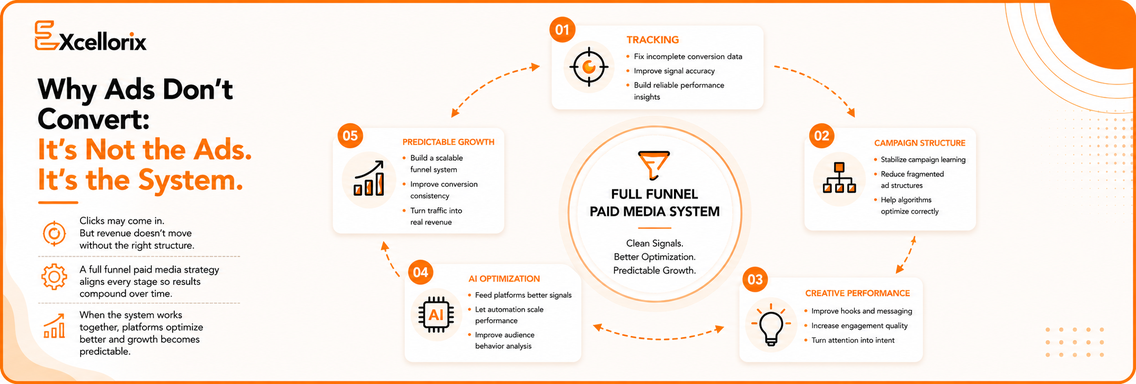
A proper Full Funnel Paid Media Strategy only works when it is built step by step.
It starts with tracking because without clean and reliable data, everything else becomes misleading.
Once tracking is stable, campaign structure needs consistency so the system can actually learn instead of resetting constantly.
After that, creative testing becomes the main growth driver because it controls attention and engagement.
Only then does automation and AI optimization start scaling what is already working.
When this order is ignored, the system keeps restarting before it ever becomes stable. And once stability is achieved, one factor starts influencing performance more than anything else.
At this stage, most brands realize something important. Media buying is no longer the main lever. Creative is. Not just design, but messaging, hooks, positioning, and how clearly the offer is communicated in the first few seconds.
In an AI-driven system, creative is the first filter. If it fails to hold attention, nothing else in the funnel matters. Even perfect targeting cannot fix weak messaging. That is why creative testing speed now directly impacts how fast a business can grow using paid media. But attention alone is not enough. What happens after attention matters just as much.
Creative brings users in. Tracking tells you what actually happens after. Without proper tracking, performance becomes misleading. Strong campaigns can look weak, and weak campaigns can look strong. That is why server-side tracking has become essential in modern systems. It reduces data loss and gives a more accurate view of conversions across platforms.
When tracking is fixed, accounts don’t suddenly improve. They simply become visible. And once visibility is clear, you can finally build a real system instead of guessing your way through performance.
Most people overcomplicate paid media when the reality is much simpler.
The best systems are usually the most structured ones.
This is the exact approach used by a Full Funnel Paid Media Agency like Excellorix. Not just to run ads, but to build systems that actually sustain long-term growth.
A Full Funnel Paid Media Strategy is no longer just a marketing tactic. It is system design. When the structure is weak, increasing spend does not fix performance. But when the system is aligned, growth becomes predictable instead of random.
Most businesses don’t actually need more traffic. They need a funnel that understands the traffic they already have and moves it correctly through each stage. When that alignment is missing, the symptom is always the same. Clicks without conversions. At that point, fixing the system matters far more than adding more budget.
If you are stuck there, working with a Full Funnel Paid Media Agency is often the fastest way to rebuild the foundation because the focus shifts from running ads to fixing the system behind them. You can also combine our SEO service with paid media to build a unified Paid Media Strategy for Business Growth, where both channels support each other instead of operating in isolation.
Schedule a Free Strategy Call with Excellorix We will break down where your funnel is leaking and rebuild a structured Google and Meta Ads Full Funnel system designed for real conversions, not just traffic.
A Full Funnel Paid Media Strategy is an approach to advertising where campaigns are structured around the full customer journey instead of just running isolated ads. It guides users from awareness to consideration and finally to conversion. In modern paid media, especially with AI-driven platforms like Google and Meta, success depends on how well each stage of the funnel connects and shares accurate signals.
This usually happens when there is a breakdown somewhere after the click. You may be getting attention at the top of the funnel, but users are not being guided properly toward conversion. Common reasons include weak landing pages, unclear messaging, poor retargeting structure, or missing conversion tracking. Without fixing these gaps, traffic rarely turns into revenue even with strong ad performance on the surface.
A Google and Meta Ads Full Funnel setup divides campaigns based on user intent. Top-of-funnel focuses on awareness, middle funnel builds trust and engagement, and bottom funnel drives conversions. When structured correctly, both platforms use AI to learn from each stage and automatically optimize delivery toward users most likely to convert, improving efficiency over time.
The most effective Paid Media Strategy for Business Growth combines strong creative testing, clean conversion tracking, and structured funnel design. Instead of focusing only on targeting, it focuses on feeding platforms high-quality behavioral signals and continuously improving creative performance. This allows businesses to scale more predictably rather than relying on inconsistent spikes in results.
You don’t always need an agency, but it becomes valuable when your campaigns stop scaling or become too complex to manage effectively. A Full Funnel Paid Media Agency helps identify leaks in your funnel, fix tracking issues, improve creative performance, and structure campaigns so AI systems can optimize properly. This is especially useful when ad spend is increasing but results are not improving.
In 2026, Full Funnel Paid Media is heavily driven by AI and automation. Manual targeting has become less important, while creative quality, tracking accuracy, and funnel structure now determine performance. Platforms like Google and Meta rely more on behavioral data than audience settings, making system design more important than manual optimization.
Tell us about your goals—we’ll show you how Excellorix can help you get there.