Skip to content



You’ve been publishing regularly, approving drafts between meetings, and watching organic traffic go nowhere. Your sales team can’t name an article that helped close a deal, yet the next agency proposal promises more posts, more keywords, and another dashboard. You’re not looking for a bigger publishing calendar. You’re trying to decide whether outside help will produce customers or just another expense.
Table of Contents
- What SEO Content Marketing Services Actually Deliver
- The Four Pillars of a Modern Service
- How an Agency Workflow Actually Runs
- Editorial Quality as a System, Not a Vibe
- Measuring Success When AI Answers Steal the Clicks
- Engagement Models and How to Compare Agencies
- Technical Foundations That Multiply Every Other Effort
- Realistic Outcomes and Your First 90 Days
What SEO Content Marketing Services Actually Deliver
SEO content marketing services should connect search demand to business outcomes. That means coordinating research, website improvements, editorial work, and commercial measurement. Writing is part of the service, not the entire purchase.
The distinction matters when you evaluate proposals. An agency can deliver every contracted article while targeting people who’ll never buy, ignoring broken inquiry forms, or sending qualified readers toward an irrelevant offer. You need an agreement that makes those problems someone’s responsibility.
Buy a growth mechanism, not a production quota
Start with the business constraint. A consultancy might need more inquiries from companies that fit its expertise. A DTC brand might need shoppers to understand which product suits their needs before they reach a collection page.
Those goals require different page types, editorial inputs, and conversion paths. Neither automatically requires more blog posts.
Ask a prospective partner to connect its recommendations through this chain:
- Customer need: What problem brings the buyer to search?
- Commercial relevance: Which product or service addresses that problem?
- Content decision: Should you create something new, improve an existing page, or consolidate competing material?
- Buyer action: What useful next step should a qualified visitor take?
- Business evidence: How will you determine whether the work contributed to sales?
A strategy makes choices. A service executes and tests them. If a proposal lists production tasks without explaining the choices behind them, you’re buying capacity rather than direction.
Before approving a content deliverable, ask what business decision its performance will help you make.
Separate accountability from guarantees
Don’t confuse outcome accountability with guaranteed revenue. You still control pricing, product quality, sales follow-up, and other variables outside an agency’s remit.
Instead, require the agency to state its assumptions, identify dependencies, and explain what it will change if results disappoint. If qualified visitors arrive but don’t inquire, the response shouldn’t automatically be another article. It might be a clearer offer, stronger evidence, or a better landing page.
That’s the working definition worth taking into a sales call: a coordinated service that attracts relevant demand, helps buyers act, and tests its contribution to revenue.
The Four Pillars of a Modern Service
Organic search deserves serious planning, but historical benchmarks aren’t forecasts for your website. In its 2019 analysis, BrightEdge reported that organic search generated approximately 53% of trackable website traffic, based on thousands of domains and tens of billions of sessions, a useful acquisition benchmark rather than a universal site-level target (BrightEdge organic search research).
Build your evaluation around the operating capabilities below, not around whether an agency offers a fashionable service label.
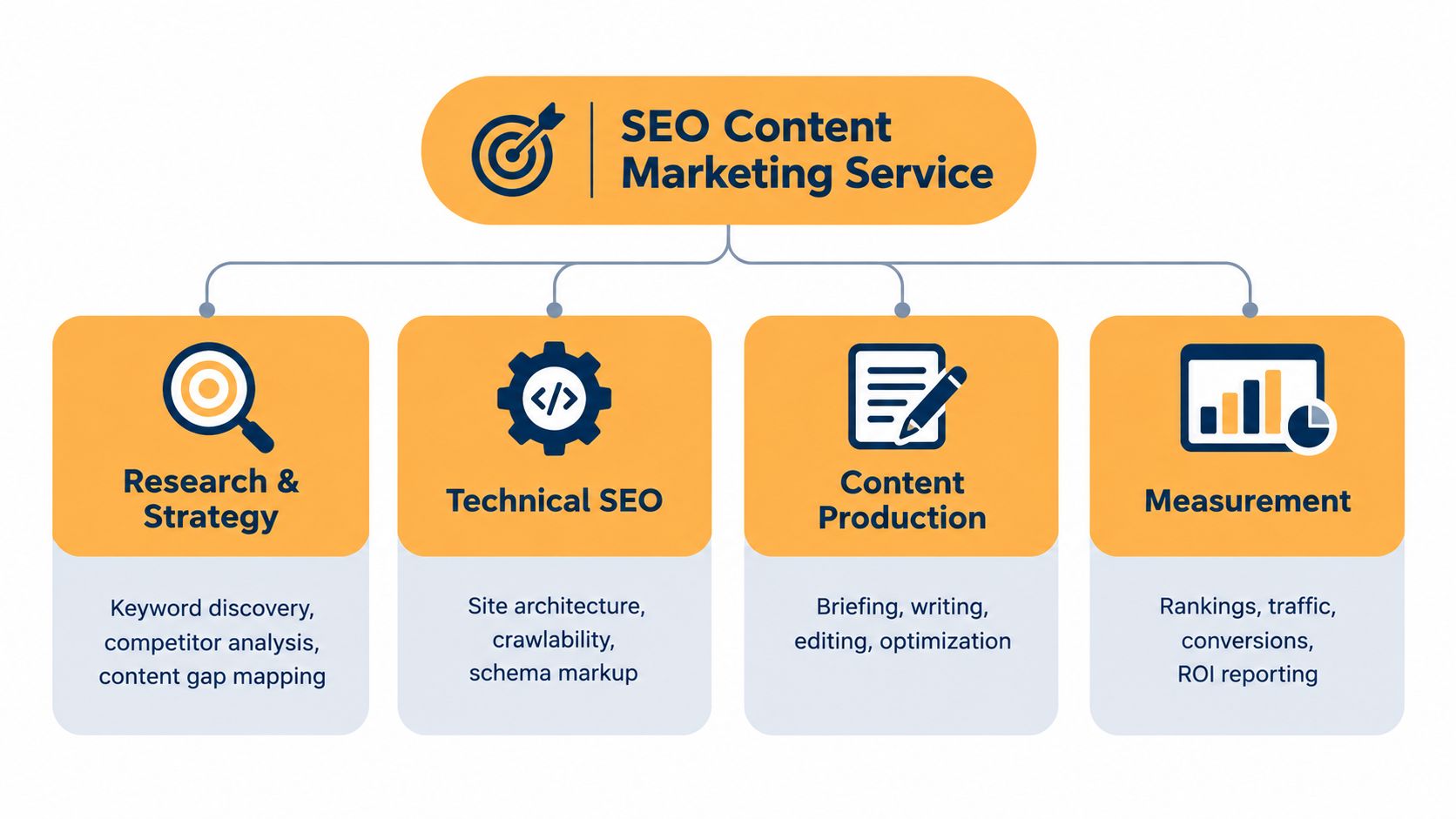
Research and strategy determine what deserves investment
Research should combine search intent with customer knowledge and commercial priorities. Ask the strategist to examine sales objections, product capabilities, existing landing pages, and the language customers use.
For a DTC skincare brand, I’d evaluate product-selection questions before commissioning broad lifestyle content. For an industrial supplier, I’d investigate applications, materials, and specification requirements. A healthcare provider’s plan should distinguish general education from appointment-related needs and define the appropriate clinical review.
Search volume alone isn’t a business case. Prioritize topics where you can provide a useful answer and offer a credible next step.
Technical SEO makes the plan executable
Your technical specialist should identify obstacles that affect the selected pages, not export a tool’s warning list. Require priorities that distinguish urgent access problems from lower-impact cleanup.
The practical question is whether your developers can implement the recommendations. An audit without tickets, owners, and acceptance criteria is unfinished work.
Content production requires more than writing capacity
A content engine needs access to expertise, editorial review, design support where necessary, and someone who can publish correctly. A calendar only records deadlines.
For a healthcare organization, include a clinical reviewer. For a manufacturer, involve an engineer who can verify tolerances and application limits. For ecommerce, give the writer accurate product information and access to whoever handles customer questions.
- Define responsibilities: Name who briefs, writes, checks, approves, and publishes.
- Match capacity: Don’t commission more drafts than your reviewers can responsibly approve.
- Support the page: Budget for comparison tables, diagrams, or supporting documentation when readers need them.
Measurement directs the next investment
Agree on commercial definitions before reporting starts. A professional services firm should distinguish an inquiry from an accepted opportunity; an ecommerce team should distinguish a purchase from a commercially worthwhile acquisition.
Use those definitions to decide where to expand, revise, or stop spending. That’s the difference between reporting activity and managing a channel.
How an Agency Workflow Actually Runs
Ask an agency to show you a completed brief, an implementation ticket, and a performance review. Those artifacts reveal more about delivery discipline than a polished process slide.
The workflow below is useful only if each handoff has an owner and a clear acceptance condition.
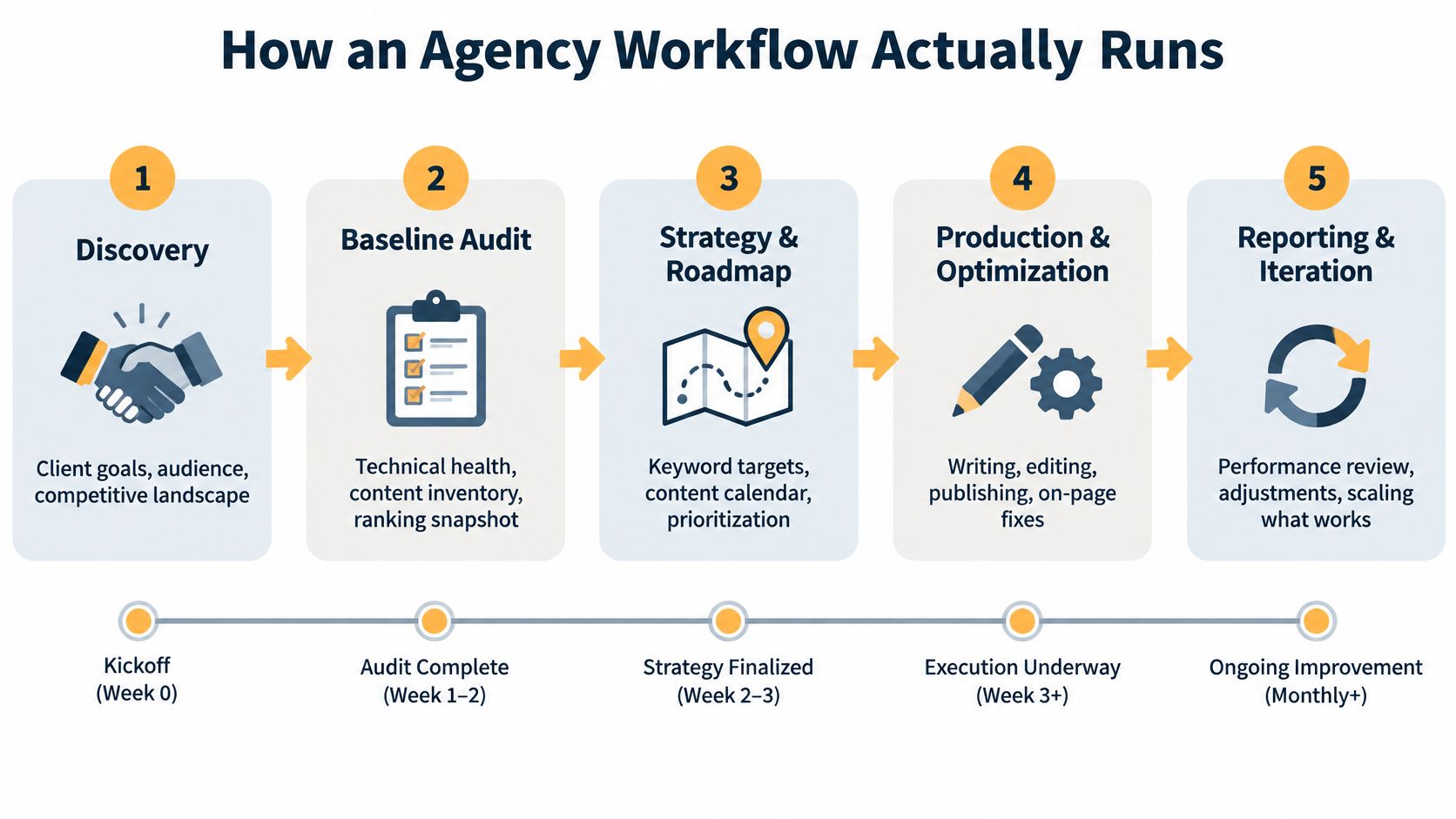
Discovery and the baseline audit
Discovery should produce a decision brief. Give the agency access to the people responsible for sales, product, customer service, and website delivery. Ask it to document priority audiences, profitable offers, disqualifying customer characteristics, and approval constraints.
The baseline audit should then test the website against those priorities. Its output should combine a content inventory, technical findings, conversion observations, and an agreed starting measurement period.
Don’t accept a ranking export as a complete diagnosis. Ask which existing pages deserve improvement, which serve no clear purpose, and which missing pages prevent a buyer from evaluating your offer.
Strategy and production handoffs
The roadmap should turn findings into an ordered backlog. Every proposed task needs a rationale, an owner, dependencies, and a completion standard.
| Handoff | Required output | Reason to send it back |
|---|---|---|
| Strategy to editorial | Approved intent, audience, evidence needs, and page purpose | The writer must guess what the page is for |
| Editorial to reviewer | Draft with traceable claims and flagged uncertainties | Unsupported assertions appear as established facts |
| Review to publishing | Approved copy, page assets, and implementation instructions | Nobody owns the final page experience |
| Publishing to measurement | Live-page checks and recorded launch details | The team can’t distinguish launch errors from performance issues |
Set the publishing cadence around review and implementation capacity. Shipping drafts faster than the client can verify them creates a queue, not progress.
Publication needs its own quality gate. Check the rendered page, mobile layout, relevant links, title, and intended action rather than assuming the approved document survived the CMS unchanged.
Reporting and iteration
A useful review connects observations to decisions. If a page attracts the wrong queries, revisit its positioning; if relevant visitors arrive but abandon the next step, investigate that transition.
Require the agency to record what changed and why. Without a change log, your team can end up crediting a rewrite for improvements that followed a form fix or a revised offer.
Operational test: If nobody can name the owner of the next handoff, the workflow isn’t ready to scale.
Editorial Quality as a System, Not a Vibe
A draft lands in the approval thread. The prose is clean, the formatting is tidy, and two stakeholders sign off before lunch. Six months later the page ranks for queries your buyers never search, because nobody defined what it had to prove or who it had to convince. Standards set as taste produce exactly this outcome, and they surface later as organic traffic that never touches pipeline.
Google recommends helpful, reliable, people-first content that is unique, organized, readable, and kept current. That guidance gives buyers a firmer editorial standard than keyword repetition or a vague promise of premium writing (Google’s SEO Starter Guide). Your job is to turn it into acceptance criteria a reviewer can apply without consulting the writer.
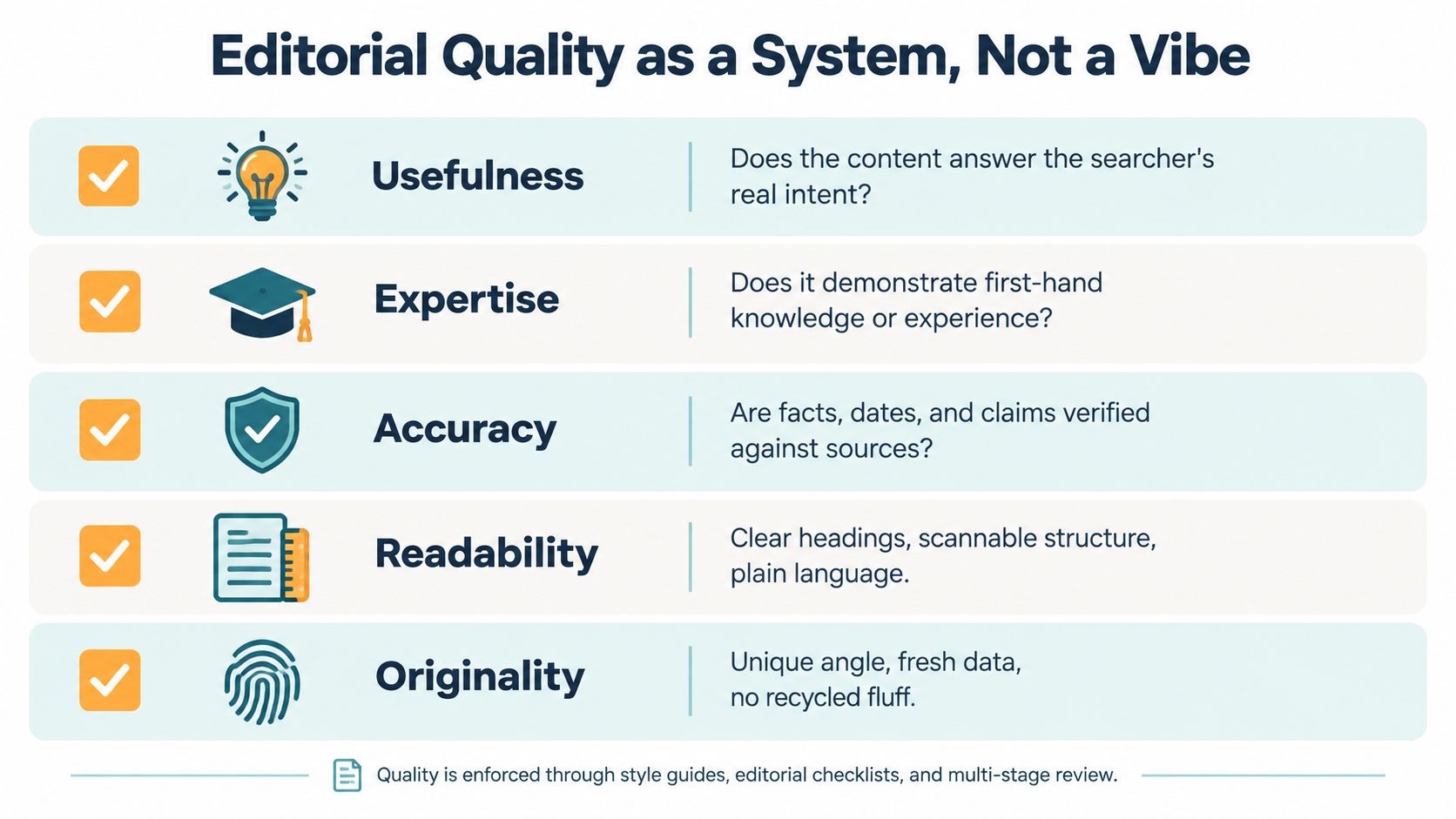
Define acceptance as questions a reviewer can answer cold. What problem does the page resolve, and does the answer arrive without making readers hunt? Which claims trace to a source or documented internal expertise? Does the draft explain real choices, limitations, and implementation detail? What does it add that competing pages lack? Who owns corrections when the underlying facts change? Where medical, technical, or financial topics require qualified judgment, the brief should also state what the writer must not imply.
Order the reviews around what each one fixes. The subject-matter reviewer checks accuracy and completeness first; the editor refines prose only after the substance holds. Teams that reverse this order polish explanations they later rebuild. Treat unverifiable claims as publication blockers: if a product capability cannot be confirmed, cut it or get confirmation. Softening an unsupported promise until it sounds plausible produces copy your sales team will spend calls walking back.
Useful differentiation rarely requires a new subject. A documented implementation example, an expert explanation of trade-offs, or a comparison built around real purchasing criteria all count. For a practical framework your editorial team can apply, work through this guide to creating unique SEO content together.
Maintenance gets an owner and a trigger, such as a product change, a revised regulation, or a superseded specification. Changing a date without rechecking the substance leaves the page stale where it matters.
Write the standard down, attach it to an owner, and reject drafts that fail it. Polished pages that say nothing still consume the budget that could fund pages buyers trust.
Measuring Success When AI Answers Steal the Clicks
A buyer can read an AI summary quoting your page, never visit your site, and still book a demo six weeks later. A traffic report records none of that. A citation counter records the reference but not the decision. Swapping a weak traffic dashboard for a weak AI-visibility dashboard solves nothing.
Pew Research Center found that users clicked a traditional search result in 8% of visits where an AI-generated summary appeared, compared with 15% of visits without one, while links inside the summaries earned clicks in 1% of visits (Pew’s analysis of browsing behavior and AI summaries).
Use the following visual as an illustration of the pattern, not as evidence of a measured trend or validated performance benchmarks.
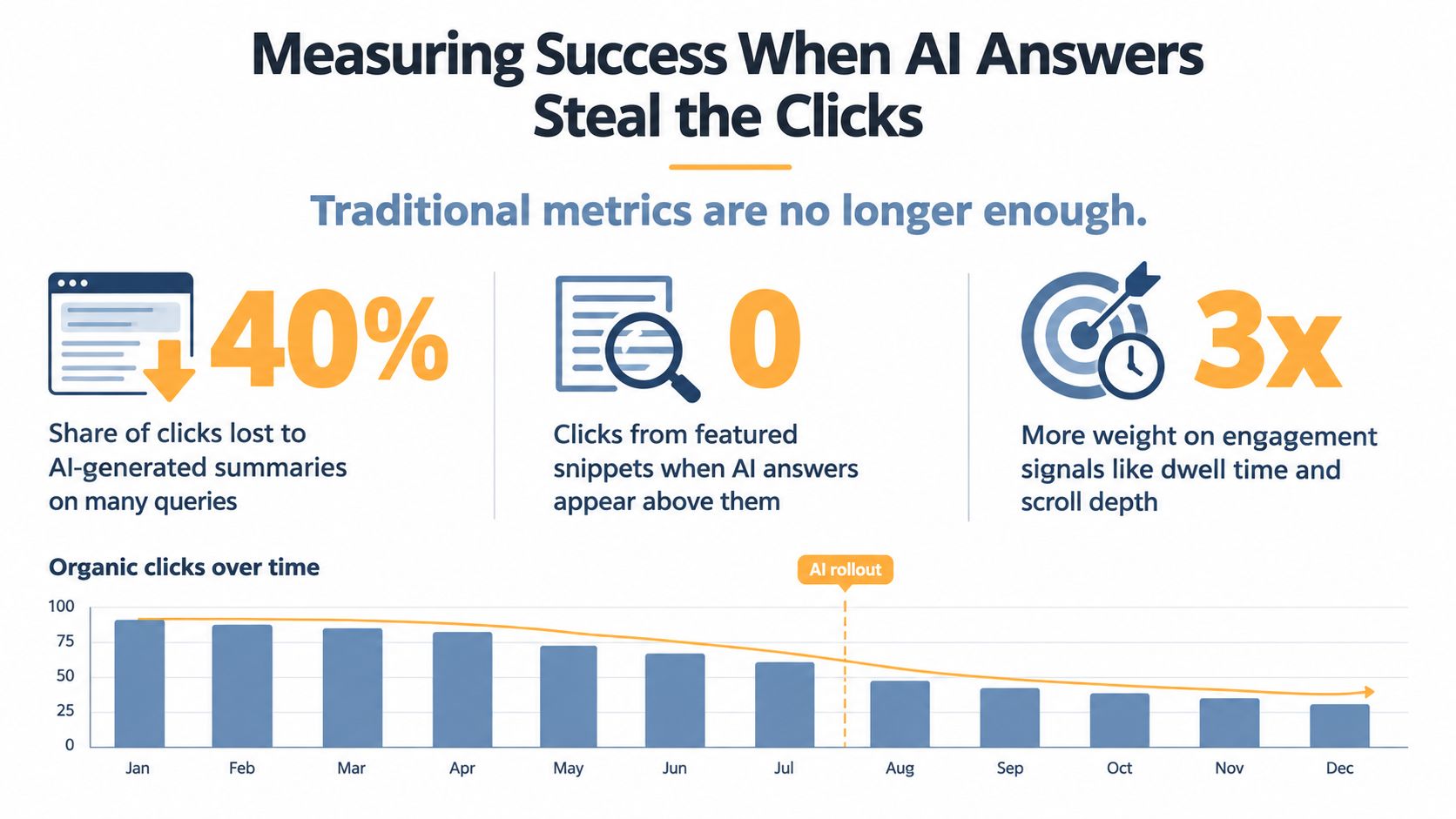
Google tells a different story at platform level: relatively stable overall organic click volume and improved click quality (Google’s perspective on AI search and click quality). Neither account forecasts your business. What matters is what you can observe on your own queries and connect to revenue.
The measurement split worth demanding
Observation and attribution are different claims, and your reporting should keep them apart:
- Answer presence. Sample your target queries on a fixed schedule. Record cited pages, brand descriptions, and collection dates. This is visibility evidence.
- Branded demand. Track branded search and direct visits, and log concurrent campaigns that could explain any lift.
- Assisted pipeline. Match known content touches against CRM opportunities. Refuse reports that assign an invisible AI exposure to every closed deal.
- Commercial quality. Measure accepted leads, sales progression, purchase value, and acquisition economics.
- Comparison design. Compare similar page groups and document website or campaign changes alongside the numbers.
Ask the agency to state its measurement limits before it shows you a projected return. A vendor that cannot say what it cannot measure will sell you confidence it has not earned.
Give buyers a reason the summary cannot satisfy. Publish concise, evidence-backed answers, then attach what a two-line citation cannot carry: an application selector, full specifications, a working calculator, or honest comparison criteria.
For a second angle on the search debate, the video below is a separate viewing resource.
A citation proves a system referenced your page. It does not prove a buyer chose you.
Falling clicks deserve investigation, and so does flat pipeline that gets blamed on AI. Influence you cannot measure is a hypothesis, not a result. Treat it that way in the contract.
Engagement Models and How to Compare Agencies
Choose the engagement around the work you need and the responsibilities your team can retain. Don’t let an agency’s preferred billing structure determine your operating model.
A focused project makes sense when you need a bounded diagnosis or implementation. Ongoing support is more appropriate when the agency must keep researching, publishing, maintaining, and evaluating the program.
Comparing common engagement models
| Model | Best for | How you pay | What to watch |
|---|---|---|---|
| Retainer | Continuing strategy, execution, and optimization | Recurring fee for agreed responsibilities and capacity | Recurring invoices without explicit priorities or review decisions |
| Project | A defined audit, roadmap, migration review, or content rebuild | Fixed scope with milestones and acceptance criteria | A finished document that nobody implements |
| Performance-based | Work with reliable tracking and clearly agreed commercial events | Compensation tied to specified outcomes, sometimes with a base fee | Disputes over attribution, qualification, refunds, and responsibilities |
My default recommendation is a scoped diagnostic before a substantial ongoing commitment. Use it to test the agency’s judgment and your own team’s ability to supply access, expertise, and approvals.
A performance-based contract deserves particular scrutiny. Define whether payment depends on an inquiry, a qualified opportunity, or collected revenue. Exclude outcomes the agency didn’t meaningfully influence and agree how disputed records will be reviewed.
Read the statement of work like an operator
The statement of work should make delivery and evaluation inspectable. Look beyond the headline package:
- Named ownership: Who handles strategy, editorial review, technical implementation, and analytics?
- Scope boundaries: Are development, design, expert interviews, and revisions included?
- Client dependencies: What must your team provide, and what happens when access or approval is delayed?
- Reporting decisions: What will the review cover, who attends, and how will priorities change?
- Exit provisions: Who keeps the content, accounts, research, and working documents?
Use this framework for choosing a digital marketing agency to structure follow-up questions rather than comparing presentation quality.
Finally, ask competing agencies to explain the same sample opportunity. Their reasoning will tell you more than differently packaged deliverable lists. Favor the partner that can explain trade-offs and implementation dependencies without pretending it controls every result.
Technical Foundations That Multiply Every Other Effort
Technical work earns budget when it removes a constraint buyers or crawlers already feel. Everything else is decoration.
Before approving tickets, make the agency name the page group, the failure, and the commercial consequence. “Improve the audit score” is a weak reason to spend developer capacity; “product comparison pages are crawled daily but excluded by a template canonical” is a reason.
Start where revenue leaks
Use a technical SEO audit checklist to order the diagnosis, then force each finding into a business frame:
| Foundation | Operator question | Revenue risk when ignored |
|---|---|---|
| Crawlability | Can search engines reach the important content and follow its relevant links? | Strong pages stay invisible while weaker competitors collect the demand. |
| Indexation | Are intended pages eligible for indexing, with accidental exclusions investigated? | The program reports effort while money pages never enter the auction. |
| Architecture | Can buyers move from broad needs to products, services, and proof? | Traffic lands on the wrong page and comparison intent stalls. |
| Internal linking | Do useful pages connect through descriptive, crawlable links? | Authority pools on blog posts instead of reaching pages that close. |
| Page experience | Can visitors read, compare, and act without avoidable friction? | Rankings may hold while conversion quietly underperforms. |
Your developer needs a reproducible issue, affected templates, an implementation recommendation, and a validation method. If an agency cannot supply that, it is selling activity.
Use structured data to sharpen measurement
Google says explicit structured-data clues can help it understand a page and may support enhanced search presentations, and its guidance treats markup as an advanced enhancement for eligible pages (Google’s developer guidance on SEO foundations). Choose types that describe visible content: Product, Article, Organization, and BreadcrumbList where they fit. Require checks for identifiers, canonical consistency, required properties, and errors after CMS changes.
AI answers raise the value of this discipline. If richer results and citation surfaces send fewer clicks, you need clean attribution on the visits that still arrive; a valid schema badge by itself proves nothing. Judge eligible templates by search appearance, qualified visits, assisted conversions, and completed actions.
A clean technical report is an implementation milestone. Growth shows up when discoverable pages turn qualified visits into pipeline or orders.
Realistic Outcomes and Your First 90 Days
Treat the first 90 days as an operating plan, not a promised revenue deadline. The checkpoints below are recommended commitments you can put into a proposal, not claims about how quickly every website will grow.
Set checkpoints your team can verify
By day 30, require agreed goals, validated tracking, a prioritized diagnosis, and named implementation owners. Resolve access and approval bottlenecks before expanding production.
By day 60, expect the priority work to be underway, with approved pages or improvements moving through the publishing process. Review whether the agency’s recommendations survived actual editorial and development constraints.
By day 90, ask for an evidence-led assessment of what shipped, what buyers did, what remains uncertain, and what should change. Early indicators can guide decisions without being presented as proof of future revenue.
For months four through twelve, plan repeated evaluation and selective expansion. Increase investment where evidence supports the business case, not only because the contract allows more production.
Bring a buyer checklist to the next call
Before signing, get clear answers to these questions:
- Diagnosis: Why is our current program underperforming?
- Priority: What would you deliberately postpone or stop?
- Ownership: Who implements recommendations and verifies completion?
- Measurement: How will you distinguish visibility from commercial contribution?
- Adaptation: What evidence would make you change the plan?
Watch for guaranteed rankings, guaranteed AI citations, and proposals that specify output before investigating the business. This week, choose a priority offer, gather its existing content and conversion data, and use that evidence to brief either your internal team or an agency.
Excellorix offers SEO strategy, technical remediation, content programs, conversion optimization, and analytics as part of its revenue-focused marketing services. Visit Excellorix to discuss your current search performance and scope a plan around qualified demand, implementation ownership, and measurable business outcomes.