


Getting more traffic to your website is exciting. But traffic alone doesn’t generate revenue. Many businesses invest heavily in SEO, paid advertising, and content marketing, only to discover that website visitors aren’t turning into leads at the rate they expected. That’s exactly the challenge a Raleigh-based business faced when they approached our team. Their website was attracting a steady flow of visitors. Search visibility was improving, advertising campaigns were generating clicks, and overall traffic continued to trend upward. Yet lead generation remained inconsistent. Instead of immediately recommending more marketing spend, we decided to look at what was happening after people landed on the website.
Over a 90-day period, we analyzed visitor behavior, identified conversion barriers, and implemented targeted improvements. The result was a 63% increase in conversions without a significant increase in traffic. This Website conversion rate optimization case study serves as a real-world CRO case study, showing how strategic website improvements can unlock growth opportunities that already exist within your current traffic.
At first glance, the company’s marketing performance looked healthy. Website traffic was increasing month after month. Search engine visibility was improving. Advertising campaigns were delivering qualified visitors. However, inquiries and consultation requests were not growing at the same pace. This is a common challenge for businesses that focus heavily on traffic acquisition while overlooking conversion performance. More visitors don’t automatically mean more customers.
If a website creates confusion, friction, or uncertainty, many potential leads will leave before taking action. Before recommending larger advertising budgets, we wanted to understand why visitors weren’t converting.
To identify the root cause of the problem, we conducted a detailed conversion audit. Our review included:
Rather than looking for one major issue, we focused on understanding the complete customer journey. What we discovered was something we see quite often. The website wasn’t suffering from a single critical problem. Instead, several smaller issues were working together to reduce conversions. Each issue created a little friction. Together, they created a noticeable barrier between visitor interest and customer action.
After reviewing user behavior data, several patterns became clear.
Messaging Wasn’t Clear Enough
The website explained the company’s services effectively, but it didn’t immediately communicate why a visitor should choose them over competitors. Most customers aren’t looking for a detailed list of features. They’re looking for solutions to their problems. Visitors had to spend too much time figuring out the value of the offer, creating unnecessary hesitation during the decision-making process.
Calls to Action Needed Improvement
Another issue involved calls to action throughout the site. Some pages offered too many choices, while others made key actions difficult to find. Visitors weren’t always sure what step to take next. Even small moments of uncertainty can significantly impact conversion rates.
Mobile Experience Created Friction
More than 70 percent of website traffic came from mobile devices. That immediately made mobile usability a priority. Important information often appeared too far down the page. Navigation required more effort than necessary, and some action buttons lacked visibility. While these issues weren’t severe individually, they collectively created a less convenient experience for mobile visitors.
Trust Signals Were Hidden
The business had positive customer reviews, years of industry experience, and a strong reputation. The problem wasn’t credibility. The problem was visibility. Many trust-building elements were buried deep within pages where visitors were unlikely to see them early in their journey.
Once we understood where visitors were encountering friction, we focused on improvements with the highest potential impact. Rather than redesigning the entire website, we made strategic changes designed to simplify the customer journey and remove unnecessary barriers.
Simplifying the User Journey
We streamlined navigation and improved access to important pages. Visitors should never have to search for key information or wonder how to contact a business. By reducing complexity, we created a smoother and more intuitive experience.
Improving Website Messaging
Next, we rewrote critical sections of website copy. Instead of focusing primarily on services and features, we emphasized outcomes and benefits. This helped visitors understand the value of the business more quickly and with greater clarity. Clear messaging is one of the most important elements of website conversion rate optimization and often produces immediate improvements.
Strengthening Calls to Action
We improved the placement and visibility of calls to action throughout the website. Each page was designed with a clear objective and a logical next step. The goal wasn’t to pressure visitors. It was to remove uncertainty and make engagement easier.
Building Trust Earlier
Testimonials, reviews, and credibility indicators were moved into more visible locations. Instead of appearing near the bottom of pages, trust signals became part of the overall customer journey. This helped visitors feel more confident about contacting the business.
Optimizing for Mobile Users
Finally, we enhanced the mobile experience by improving readability, simplifying layouts, and making important actions easier to access. These improvements played a significant role in helping improve website conversions across mobile devices.
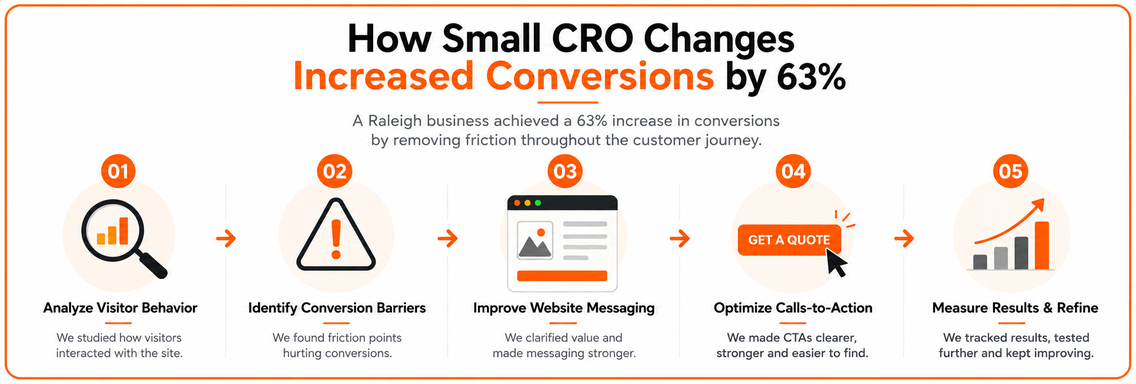
Within a few weeks, we began noticing positive changes in user behavior. Visitors spent more time engaging with important pages. Contact form interactions increased. Navigation patterns became more efficient. As optimization efforts continued, the results became even more apparent. After 90 days, the company achieved a 63% increase in overall conversion rate. Additional website optimisation results included:
These conversion rate improvement results demonstrated that the company didn’t need dramatically more traffic to generate growth. It simply needed a website that made it easier for visitors to take action. This section of our Website conversion rate optimization case study highlights the value of optimizing existing traffic before increasing acquisition costs.
Many businesses assume growth requires larger advertising budgets. Sometimes that’s true. However, many organizations already have enough traffic to generate more leads. The challenge is converting that traffic efficiently. Visitors rarely leave because of one major issue. More often, they leave because several smaller obstacles create hesitation.
An unclear message.
A weak call to action.
A difficult mobile experience.
A lack of trust.
By removing those obstacles, businesses can often generate significant gains without dramatically increasing traffic. Looking back at this CRO case study, the biggest lesson is that small improvements across multiple areas can create substantial results when combined.
One of the biggest takeaways from this project is that growth opportunities are often closer than they appear. Many businesses focus exclusively on attracting more traffic while overlooking opportunities to improve conversion performance. Before increasing your marketing budget, ask yourself:
The answers often reveal opportunities for improvement. A strong lead generation strategy doesn’t stop at attracting visitors. It focuses equally on converting those visitors into customers.
This Website conversion rate optimization case study demonstrates an important lesson. More traffic isn’t always the answer. Sometimes the fastest path to growth is improving what happens after visitors arrive. For this Raleigh business, a series of targeted improvements led to a 63% increase in conversions, stronger lead quality, and improved marketing performance. These conversion rate improvement results show how strategic optimization can unlock growth opportunities that already exist within your website.
At Excellorix, we help businesses generate more leads through data-driven SEO services, website performance optimization, and conversion optimization services designed to deliver measurable results. If your website is attracting visitors but not producing enough leads, schedule a consultation with our team. We’ll identify the opportunities limiting performance and build a strategy that helps convert more traffic into qualified customers.
A Website conversion rate optimization case study shows how website improvements increased conversions, leads, or sales while documenting the strategy and measurable outcomes.
A CRO case study provides a real-world example of how businesses identify conversion barriers and improve website performance to generate more leads.
Website optimisation results include measurable improvements such as higher conversion rates, improved engagement, lower bounce rates, and increased lead generation.
Many businesses begin seeing measurable improvements within 30 to 90 days, depending on website traffic levels and the scope of changes implemented.
Tell us about your goals—we’ll show you how Excellorix can help you get there.