


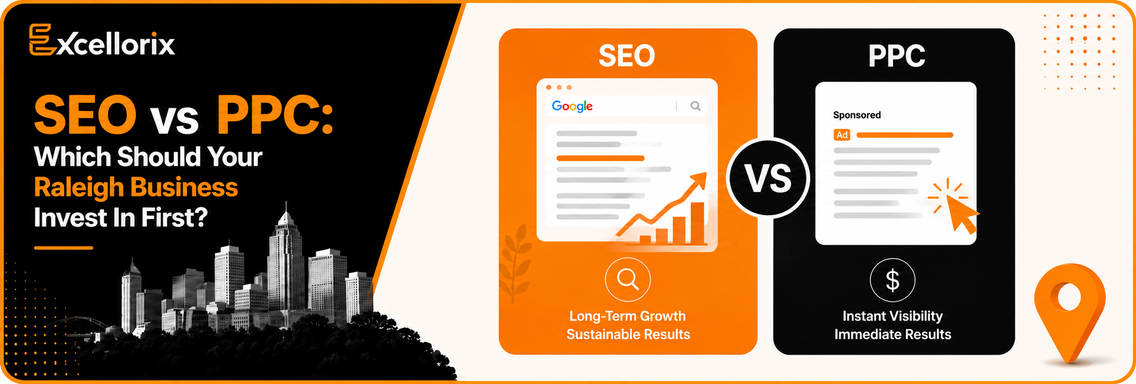
If you own a local business in Raleigh, chances are you have asked yourself this question before: Should you invest in SEO first or spend your budget on paid ads? And honestly, it is one of the most important marketing decisions businesses face in 2026. Every agency seems to have a different answer.
SEO agencies say paid ads are expensive and unsustainable. PPC agencies claim SEO takes too long to generate results. Meanwhile, business owners are stuck somewhere in the middle trying to figure out what actually drives leads without wasting time or budget. The truth is simpler than most marketers make it sound. Both SEO and PPC work. But they solve different problems.
SEO services help businesses build long term visibility through organic search. PPC helps businesses generate traffic and leads quickly through paid campaigns. The better choice depends on your goals, competition, timeline, and budget. That is why understanding SEO vs PPC for small business growth matters more now than ever before.
Search behavior has changed dramatically. Google AI Overviews, conversational AI search, and rising advertising costs are reshaping how businesses appear online. Companies still relying on outdated marketing strategies are finding it harder to compete, especially in local markets. According to Search Engine Journal, businesses combining SEO and paid advertising often create more sustainable long term growth compared to relying entirely on one channel. Source: Search Engine Journal
So which strategy should your Raleigh business invest in first? Let’s break it down properly.
SEO, or Search Engine Optimization, is the process of improving your website so it appears naturally in search results without paying for every click. When someone searches for:
SEO helps your business appear in those search results organically. But SEO in 2026 is no longer just about rankings. Modern SEO is closely tied to:
Search engines now prioritize businesses that provide genuinely useful information instead of content written only for keywords. That shift has completely changed how businesses should approach online marketing. This is also why the discussion around organic vs paid search has become more important in recent years.
Organic traffic does more than generate clicks. It builds trust. When people consistently see your business ranking naturally in search results, they often view your brand as more credible before even contacting you. That trust becomes incredibly valuable in competitive industries. Of course, SEO takes time to build momentum. Businesses needing faster visibility often turn toward PPC first.
PPC, or Pay Per Click advertising, allows businesses to appear instantly through paid placements on platforms like Google Ads and Meta Ads. You bid on keywords, create campaigns, and pay whenever someone clicks your advertisement. PPC works well for businesses needing:
For example, if a local HVAC company suddenly needs emergency summer repair leads, waiting months for SEO rankings to improve is probably not realistic. PPC helps generate traffic quickly. But successful PPC campaigns require more than simply running ads. Businesses also need:
Without those elements, PPC can become expensive very quickly. This is where many businesses misunderstand SEO vs paid ads. Traffic alone does not generate revenue. If visitors land on a slow or confusing website, both SEO and PPC campaigns will struggle to produce meaningful results. Paid advertising simply exposes those problems faster. That is why businesses comparing SEO and PPC should always evaluate website performance alongside traffic generation.
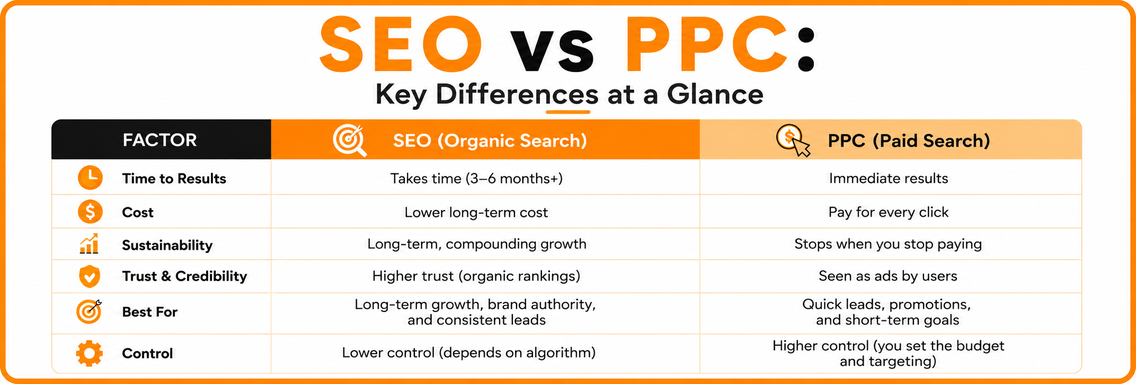
The biggest difference between SEO and PPC comes down to speed versus sustainability. SEO builds visibility gradually over time. PPC generates visibility almost immediately. SEO behaves more like building a long term business asset. Strong content, optimized service pages, and trusted authority can continue generating leads for years. PPC behaves more like renting visibility. Once the ad budget stops, traffic usually disappears as well. Neither strategy is wrong.
The smarter question is:
What does your business need most right now?
Businesses evaluating PPC vs SEO ROI often notice that PPC delivers faster short term results while SEO creates stronger long term value. That shift is becoming even more important as competition increases across local markets.
SEO is usually the better choice for businesses focused on:
If your business plans to grow steadily over the next several years, investing in professional SEO services can become one of your most valuable marketing assets.
A strong blog post or optimized service page can continue attracting traffic and leads long after publication. That compounding value is one reason businesses often prioritize SEO when comparing long term marketing investments. SEO also performs especially well for:
Especially in industries where trust heavily influences buying decisions. Businesses investing consistently into SEO often reduce their dependence on paid advertising later. But SEO is not always the best first move for every situation. Some businesses simply need faster lead flow.
New businesses especially benefit from PPC while SEO gains momentum in the background.
For example, a newly launched local service company may not want to wait several months before generating inquiries. PPC helps bridge that gap. That is why many successful businesses stop viewing SEO vs PPC for small business as an either or debate. The strongest strategies usually combine both.
Businesses comparing organic vs paid search should also understand that PPC provides valuable customer data quickly, while SEO builds long term authority and trust. Together, they often create a stronger growth system than relying entirely on one channel alone.
Here is the uncomfortable truth. Most marketing problems are not actually traffic problems. They are conversion problems.
Businesses frequently spend thousands on SEO or paid ads while ignoring:
That creates expensive disappointment. Whether traffic comes from organic vs paid search, your website still needs to convert visitors into customers. Otherwise you are simply increasing the number of people leaving your website without taking action.
Customers today expect fast, clear, and easy online experiences. If your website feels outdated or difficult to navigate, both SEO and PPC performance suffer quickly. That is why conversion optimization matters just as much as traffic generation itself.
AI driven search is rapidly changing SEO. Google AI Overviews and conversational AI search platforms are now surfacing answers directly from trusted websites. That means SEO today is no longer only about rankings. It is about becoming a trusted source of information. Businesses producing helpful, experience driven, human sounding content are often outperforming websites still relying on outdated SEO tactics. That makes long term SEO even more valuable moving forward.
In many cases, yes. The strongest marketing systems combine SEO and PPC instead of treating them as competing strategies. SEO builds long term authority and sustainable visibility. PPC supports immediate traffic, lead generation, and remarketing. Together, they create a more balanced and scalable marketing strategy.
For example:
SEO content attracts organic traffic
PPC retargets visitors later
brand familiarity increases
conversion rates improve over time
This combination often creates stronger PPC vs SEO ROI compared to relying on one traffic source alone. Especially in competitive local markets.
The answer depends on your business goals. If you need immediate leads and faster visibility, PPC may make more sense first. If you want sustainable growth, stronger authority, and lower long term acquisition costs, SEO is usually the smarter investment.
For many businesses, the best solution is combining both strategies together. SEO builds trust and long term visibility. PPC helps generate immediate traffic and leads. Together, they create a stronger growth foundation. If your business wants better visibility, stronger lead generation, and long term growth, investing in professional SEO services alongside a strategic PPC campaign can create a far more reliable marketing system. And if you are unsure where to start, schedule a strategy call with Excellorix to build a roadmap tailored to your business goals, competition, and growth opportunities.
Sometimes the difference between inconsistent marketing and sustainable growth is simply having the right strategy from the beginning.
SEO is generally better for long term growth because it helps businesses build organic visibility and trust over time. PPC works better for businesses needing immediate traffic and faster lead generation. The right strategy depends on your goals, competition, and timeline.
Most businesses begin seeing noticeable SEO improvements within 3 to 6 months depending on competition, website quality, and content consistency. Highly competitive industries may take longer to generate strong rankings and traffic.
Yes. PPC campaigns can generate traffic almost immediately after launch, which makes them useful for short term promotions, local campaigns, and businesses needing faster lead generation.
SEO is usually more cost effective long term because organic traffic can continue without paying for every click. PPC requires ongoing ad spending to maintain visibility and traffic.
Absolutely. Many successful businesses combine SEO and PPC to balance short term lead generation with sustainable long term growth. Together, they often create stronger overall marketing performance.
Tell us about your goals—we’ll show you how Excellorix can help you get there.