

Most businesses focus on getting more traffic. More website visitors. More ad clicks. More impressions.
While traffic is important, it is only part of the equation. A website can attract hundreds or even thousands of visitors each month and still struggle to generate leads or sales. This is why conversion rate optimization services have become such a valuable investment for businesses looking to improve marketing performance. The reality is simple. People rarely discover a business and immediately become customers. They research, compare options, read reviews, and revisit websites before making a decision. Understanding how buyers move through this process can help businesses identify missed opportunities and increase website conversions without constantly increasing advertising budgets.
Today’s buyers are more informed than ever. Before contacting a business, they may search Google, read online reviews, visit social media profiles, compare competitors, and even ask AI tools for recommendations. This means your website is rarely the first interaction someone has with your brand. Instead, it becomes part of a larger decision-making process. The problem is that many businesses still focus entirely on generating traffic while ignoring what happens after visitors arrive. As a result, they find themselves dealing with a common problem: website visitors not converting into leads or customers. The businesses that consistently grow understand that success comes from improving the entire customer experience, not just attracting more visitors.
Marketing funnels often make the buying process look simple. A person sees an ad, visits a website, fills out a form, and becomes a customer. Real life rarely works that way. A potential customer might discover your business through Google, leave your website, read reviews a few days later, revisit your site from social media, and then finally contact you weeks later. Another person may visit your website several times before ever speaking to your team. People move back and forth between research and decision-making before they feel comfortable taking action. That is why understanding the customer journey is so important. When businesses know how buyers think and behave, they can remove obstacles that prevent conversions.
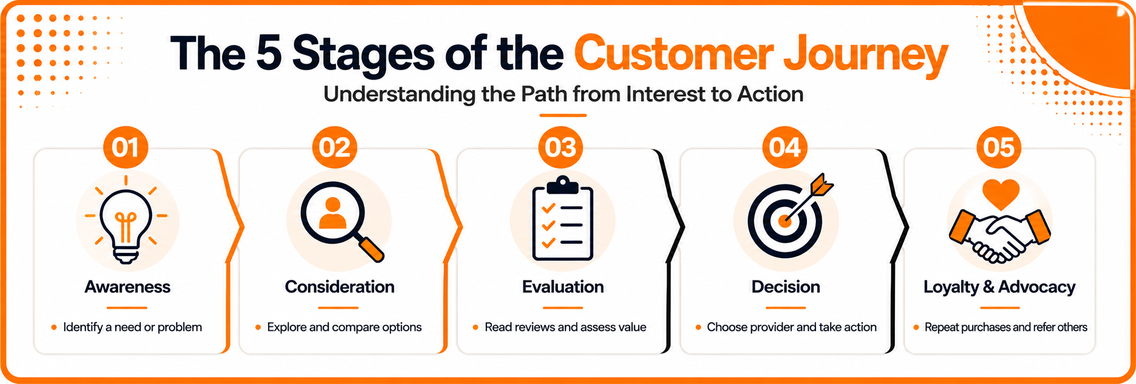
Awareness
This is the stage where buyers first recognize a problem or opportunity. For example, a business owner may notice website traffic increasing while leads remain flat. Something is clearly not working. So they begin searching for answers. At this stage, educational content is often the most effective. Blog articles, guides, and videos help people understand the problem while building trust in your business. Once buyers understand the challenge, they begin looking for solutions.
Consideration
Now buyers start exploring different options. They compare providers, services, tools, and strategies. This is where trust becomes critical. Businesses that educate and guide prospects often perform better than those that immediately focus on selling. People want to feel understood before they feel persuaded. Once they find businesses that seem trustworthy, they begin narrowing down their choices.
Evaluation
This stage is where buyers take a closer look. They read testimonials, review case studies, compare pricing, and evaluate service offerings. Many businesses lose potential customers here. Confusing messaging, unclear value propositions, and a lack of trust signals can quickly create doubt. If visitors cannot clearly understand why they should choose your business, they often leave and continue searching elsewhere.
Decision
At this stage, buyers are ready to act. They may request a quote, schedule a consultation, submit a contact form, or make a purchase. Ironically, many businesses lose customers at this point because of small problems. Slow-loading pages, long forms, weak calls to action, or confusing checkout processes can stop a motivated buyer from moving forward. Even minor friction can have a major impact on conversions.
Loyalty and Advocacy
The customer journey does not end after the sale. Happy customers often become repeat buyers, referral sources, and brand advocates. Yet many businesses spend most of their resources chasing new customers while overlooking the people who already trust them. Building long-term relationships is often one of the most effective ways to grow sustainably.
One of the biggest misconceptions in digital marketing is that low conversions always mean poor traffic. In reality, many conversion problems are caused by issues within the customer journey itself.
Common reasons for website visitors not converting include:
Each of these creates friction. The more friction visitors experience, the less likely they are to take action. This is why businesses should focus on improving the user experience rather than simply increasing traffic numbers.
Once businesses identify where visitors are dropping off, the next step is fixing those issues. This is where conversion rate optimization services provide value. Instead of relying on assumptions, CRO focuses on understanding how real users interact with a website.
Common CRO activities include:
The goal is straightforward. Make it easier for visitors to become customers. In many cases, small changes can create meaningful improvements. A clearer headline, a stronger testimonial, or a simpler form can significantly improve performance.
Businesses that consistently improve results often focus on proven conversion optimisation strategies that remove friction and improve the customer experience. Some of the most effective strategies include:
Prioritize User Intent
Visitors arrive with specific goals. Your content should help them find answers quickly and easily.
Improve Mobile Experiences
A large percentage of website traffic comes from mobile devices. A poor mobile experience can reduce conversions dramatically.
Strengthen Trust Signals
Reviews, testimonials, guarantees, and case studies help reduce uncertainty and build confidence.
Simplify the Conversion Process
The fewer steps required to take action, the better. Simplifying forms and calls to action can help increase website conversions significantly.
Create Helpful Content
Content that answers questions and solves problems helps move visitors through the customer journey while building trust. For many businesses, combining SEO services with strong conversion optimisation strategies creates a powerful growth system.
Most businesses spend their time trying to attract more visitors. The smarter approach is often making better use of the visitors already arriving. When you understand how buyers move from awareness to action, you begin to see your website differently. Every page, testimonial, form, and call to action becomes part of a larger customer experience. If your business is struggling with website visitors not converting, now is the time to evaluate your customer journey and identify opportunities for improvement. The right conversion rate optimization services can help remove friction, improve user experiences, and increase website conversions without requiring more traffic.
At Excellorix, we combine conversion rate optimization services, SEO services, and customer journey analysis to help businesses generate more leads from the traffic they already have. Schedule a Free Growth Strategy Call today and discover where your website may be losing potential customers.
The customer journey is the process buyers go through before becoming customers. It typically includes awareness, consideration, evaluation, decision, and loyalty stages.
Common reasons include unclear messaging, weak trust signals, poor navigation, slow page speed, and ineffective calls to action.
Conversion rate optimization services analyze visitor behavior and identify opportunities to improve website performance and increase conversions.
Improving user experience, simplifying forms, strengthening trust signals, and optimizing calls to action are some of the most effective ways to increase website conversions.
Conversion optimisation strategies are methods used to improve the percentage of website visitors who complete a desired action, such as filling out a form or making a purchase.
Many businesses begin seeing improvements within a few weeks, while long-term gains come from ongoing testing and optimization.
Tell us about your goals—we’ll show you how Excellorix can help you get there.