

Most business owners remember the moment their first ad campaign finally worked. The leads started coming in. Sales increased. The cost per lead looked reasonable. For the first time, advertising felt predictable instead of risky. Naturally, the next step seemed obvious. Increase the budget and get more results. Unfortunately, that is where many businesses run into problems. A campaign that performs well at a smaller budget does not always perform well when spending increases. What worked in the beginning can quickly become less efficient as businesses try to grow. This is why having a strong paid media strategy for business growth is so important. Scaling is not simply about spending more money. It is about creating a system that can consistently attract, convert, and retain customers as your marketing investment grows.
One reason early campaigns perform so well is that they usually target the easiest opportunities first. Many of your initial customers are already looking for a solution. They may have visited your website before, searched for your services, or heard about your business through referrals. These people already understand their problem. They are simply deciding who they want to work with. That makes conversions easier. The challenge is that this stage does not last forever. Eventually, you reach most of the people who were already interested in what you offer. To keep growing, you need to reach new audiences who know less about your business and may not be ready to buy immediately. That is where scaling becomes much more complicated.
Many business owners assume advertising works like a vending machine. Put more money in. Get more customers out. If only it were that simple. As budgets increase, several challenges start appearing that were hidden during the early stages of a campaign.
Audience Saturation
There are only so many people within a target audience. As your campaigns grow, the same people begin seeing your ads repeatedly. At first, results remain steady.
Then engagement starts falling. Eventually, conversions begin slowing down. This is one of the biggest challenges businesses face when scaling Meta Ads. Without refreshing your creative or testing new audiences, ad performance can decline quickly. People are not necessarily rejecting your offer. They simply stop paying attention to it.
Rising Costs
Another common issue appears when scaling Google Ads. Many businesses assume they can increase budgets while maintaining the same cost per lead. In reality, growth often requires targeting broader keywords and entering more competitive auctions. As a result, customer acquisition costs rise. You may generate more leads, but each lead becomes more expensive. That can make growth far less profitable than expected.
Creative Fatigue
Even the best ad eventually stops performing. Many businesses find a winning ad and keep running it for months. Then performance suddenly drops. The first reaction is often to blame Google or Meta. In reality, the audience has simply seen the same message too many times. Successful advertisers continuously test new headlines, offers, visuals, and messaging. Growth requires constant adaptation.
One of the biggest misconceptions in digital marketing is that more traffic automatically creates more sales. Need more revenue? Get more traffic. Need more leads?Get more traffic. Need more growth? Get even more traffic. The problem is that traffic alone does not fix weaknesses in your business. Think about a bucket with holes in the bottom. Pouring in more water does not solve the problem. It simply makes you lose water faster. Advertising works the same way. If your website is slow, your landing pages are confusing, or your follow-up process is weak, increasing traffic only magnifies those issues. This is one reason businesses investing in conversion optimization, website improvements, and SEO services often scale more successfully than companies relying entirely on advertising. The click is only the beginning of the customer journey. What happens after the click matters just as much.
This is where many businesses get stuck. They focus heavily on advertising metrics. More clicks. More impressions. More leads. Everything looks positive. But business growth depends on much more than advertising performance.
Questions like these matter:
A campaign can produce impressive numbers while creating challenges elsewhere in the business. That is why sustainable growth requires looking beyond the ad platform dashboard.
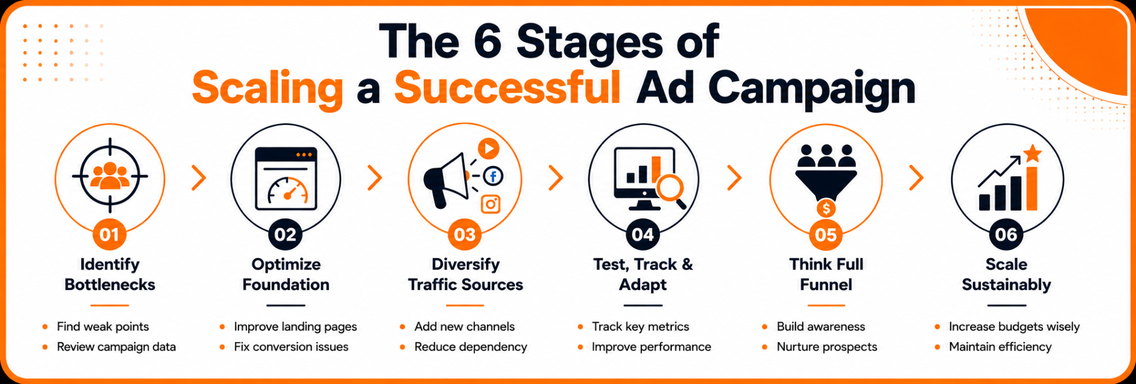
Once businesses identify their growth bottlenecks, the focus shifts from fixing problems to building systems. The companies that scale successfully rarely depend on one campaign. Instead, they create a framework that supports long-term growth.
Multiple Traffic Sources
Businesses that rely on a single platform often struggle when costs rise or algorithms change. That is why successful companies combine Google Ads, Meta Ads, SEO, email marketing, and content marketing.
Diversification creates stability.
Continuous Testing
The best marketers never assume today’s winning campaign will keep working forever. They test new audiences, new messaging, new offers, and new landing pages. Small improvements often produce significant gains over time.
Better Tracking
Good decisions require accurate data. Without proper tracking, businesses often scale the wrong campaigns while overlooking the channels generating the best results. Reliable tracking helps eliminate guesswork.
One reason businesses struggle to scale is that they focus only on people ready to buy today. That works for a while. Then growth slows. There are only so many people actively searching for your services at any given time. Eventually, you need to create future demand as well. This is where a strong growth marketing strategy becomes important. Instead of focusing only on immediate conversions, a growth marketing strategy looks at the entire customer journey. It helps businesses build awareness, generate interest, create trust, and increase retention. The result is a healthier pipeline of future customers.
You may have reached a scaling limit if:
These signs usually indicate that the issue is not budget. The issue is the system behind the advertising.
Many businesses assume scaling means increasing budgets. In reality, scaling means strengthening the foundation underneath your marketing.
Those are the questions that matter. At Excellorix, we often see businesses focus on increasing ad spend before fixing the systems that support long-term growth. The companies that scale successfully take the opposite approach. They improve their websites. They strengthen their SEO services strategy. They optimize their conversion process. They build a stronger paid media strategy for business growth. Then they scale.
If your campaigns generated early success but growth has started slowing down, it may not be an advertising problem. It may be a scaling problem.
Book a free strategy call with Excellorix to discover:
The goal is not simply to spend more. The goal is to build a marketing system that continues working as your business grows.
Scaling Google Ads often requires targeting broader keywords and entering more competitive auctions. This usually increases costs and can reduce efficiency if campaigns are not properly optimized.
When scaling Meta Ads, audience fatigue and ad saturation become common challenges. The same users repeatedly see your ads, causing engagement and conversions to decline.
A paid media strategy for business growth focuses on creating a sustainable customer acquisition system through advertising, conversion optimization, audience expansion, tracking, and retention.
A growth marketing strategy focuses on the entire customer journey, from awareness and consideration to conversion and retention, helping businesses achieve sustainable long-term growth.
SEO services help increase visibility, attract qualified traffic, and build long-term demand. This often improves advertising performance while reducing dependence on paid traffic alone.
Tell us about your goals—we’ll show you how Excellorix can help you get there.