

If you are trying to figure out how much you should spend on Google Ads, you are definitely not alone. It is one of the most common questions businesses ask before starting paid campaigns. And in 2026, it has become even more complex because costs, competition, and AI driven automation have changed how Google Ads actually performs.
Some businesses start with very small budgets expecting instant results. Others spend heavily without proper tracking or landing page optimization and then assume Google Ads does not work. Both usually end the same way. Wasted budget, inconsistent leads, and frustration. But the real issue is not Google Ads itself. Google Ads still works extremely well in 2026. The difference is that success now depends on structure, tracking quality, and knowing how to set realistic expectations from the beginning.
At Excellorix, we’ve seen businesses improve performance simply by fixing campaign structure, improving landing pages, and aligning spend with real revenue goals instead of guessing budgets.
Google Ads has become more competitive across almost every industry. More businesses are investing in paid search because organic visibility is harder to maintain. At the same time, AI driven search results and automated bidding systems are changing how users interact with ads. This has increased competition and pushed costs higher in many industries.
Google’s system now relies heavily on automation using signals like:
This works well only when there is enough data. If your budget is too small, Google does not get enough signals to optimize properly. That is where many businesses misunderstand performance. So instead of asking what the cheapest budget is, the better question is what budget gives your campaign enough data to improve consistently.
There is no universal number that works for every business. A proper PPC budget guide for 2026 depends on a few key factors that directly influence cost and performance.
Industry Competition
Some industries are naturally more expensive. Legal services, HVAC, dental clinics, financial services, and SaaS companies often have high cost per click because one customer can generate high revenue. A law firm may pay over 100 dollars per click, while a local café may pay only a few dollars. This is why copying someone else’s budget rarely works. Every industry has different economics behind acquisition.
Customer Lifetime Value
Your Google Ads budget for small business should always be based on customer value. If a customer only buys once, your budget needs to stay controlled. But if a customer:
then higher acquisition costs can still be profitable.
For example, med spa clients return regularly, HVAC customers need ongoing service, and B2B clients often stay for years.
Higher customer value usually allows higher ad spend.
Geographic Targeting
Location plays a major role in cost. Large cities usually have:
Smaller or focused areas are often more efficient. That is why smart campaigns focus on:
A strong Google Ads budget for small business is not about scale. It is about precision.
Website and Conversion Rate
Your ads only bring traffic. Your website decides results. If your landing page:
your conversion rate drops immediately.
When conversion drops, cost per lead increases. That is why every PPC budget guide must include landing page optimization and conversion tracking. Traffic without conversion systems is wasted spend.
A realistic Google Ads budget for small business in 2026 depends on industry and goals.
Local service businesses typically start between 1000 and 3000 dollars per month.
Small ecommerce stores usually spend between 1500 and 5000 dollars per month.
Competitive home service industries often require 3000 to 10000 dollars per month.
Law firms frequently spend above 5000 dollars due to high competition.
B2B SaaS companies may invest between 4000 and 15000 dollars per month depending on growth stage.
These are not instant success budgets. They are testing budgets designed to collect data and optimize performance over time.
Small budgets are not bad, but they are limited. Google Ads needs enough data like clicks, conversions, and engagement signals to optimize properly. When data is limited, performance becomes unstable. This is often called budget starvation. For example, if CPC is high, a small budget may only generate a few clicks per day. That is not enough for optimization. This is why understanding how to set Google Ads budget in 2026 is more important than guessing a number.
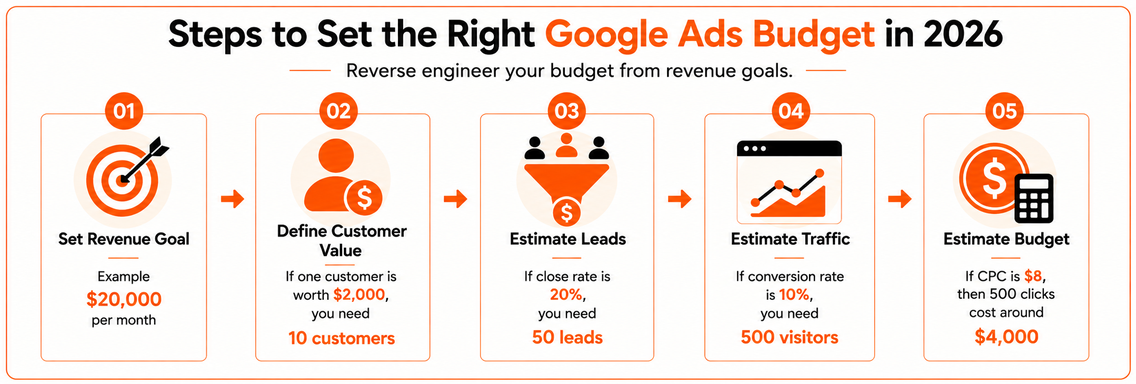
The smartest approach is to reverse engineer your budget from revenue goals. This is the foundation of a strong PPC budget guide.
Step 1: Set revenue goal
Example 20000 dollars per month
Step 2: Define customer value
If one customer is worth 2000 dollars, you need 10 customers
Step 3: Estimate leads
If close rate is 20 percent, you need 50 leads
Step 4: Estimate traffic
If conversion rate is 10 percent, you need 500 visitors
Step 5: Estimate budget
If CPC is 8 dollars, then 500 clicks cost around 4000 dollars
This is the correct way to understand how to set Google Ads budget instead of guessing.
AI now plays a major role in campaign performance. It affects:
Google uses behavioral signals, intent data, and conversion probability to decide when ads appear. This improves efficiency, but only when tracking is accurate. Without clean data, automation cannot perform well. That is why businesses need:
Automation is powerful, but only when guided by strong inputs.
Most wasted spend comes from simple issues:
Sometimes the issue is not ads, but the business process itself. Slow follow up, unclear offers, and weak sales systems can also reduce ROI. That is why SEO services and PPC work best together as a complete system.
You do not need to choose one.
Google Ads gives immediate leads and visibility.
SEO builds long term organic traffic and authority.
Together, they create a balanced growth system.
Paid ads give speed.
SEO gives stability.
Most businesses benefit from both.
The right Google Ads budget is not about spending more. It is about spending with clarity. A strong budget depends on:
Most businesses do not fail because Google Ads does not work. They fail because campaigns are not structured properly. In 2026, success is less about budget size and more about execution quality.
At Excellorix, we help businesses understand where their Google Ads budget is going and what is holding back performance.
On a free strategy call, we review:
The goal is simple. Not to spend more. But to make sure every dollar drives real business growth.
Most beginners should start with 1000 to 3000 dollars per month. This gives enough data for Google Ads to optimize while keeping risk manageable.
A good Google Ads budget for small business is usually between 1000 and 5000 dollars per month depending on competition, industry, and goals.
The best way is to reverse engineer from revenue goals, customer value, and conversion rates instead of guessing spend.
Most issues come from poor targeting, weak landing pages, or missing tracking rather than the budget itself.
Yes, costs are higher in many industries, but proper optimization still makes campaigns profitable.
Yes. SEO builds long term traffic while Google Ads drives immediate leads, making both essential for stable growth.
Tell us about your goals—we’ll show you how Excellorix can help you get there.